
Apartment rents in Abu Dhabi rose 12.5% year on year in 2025, a pace that matched the prior year’s strength rather than fading after one strong cycle, according to Cavendish Maxwell’s Abu Dhabi residential market performance 2025 report. That single figure changes how global investors should read the market. This isn’t just a Gulf lifestyle story. It’s a rental income story backed by unusually firm apartment demand.
For investors assessing house rent in Abu Dhabi, the main question isn’t whether the city is attractive. It’s whether the income profile justifies the capital risk better than established alternatives such as the UK. In 2026, that comparison matters more than ever. Western gateway markets still offer legal familiarity and deep financing ecosystems, but yields are often compressed. Abu Dhabi offers a different mix: stronger rental momentum in apartments, selective premium districts, and a tenant base shaped by professionals, families, and internationally mobile residents.
That makes Abu Dhabi less comparable to a pure emerging market and more comparable to a specialist income market. Investors who already understand how to invest in Dubai real estate will recognise the broad regional logic, but Abu Dhabi’s rental profile is distinct. It is calmer, more segmented, and currently more revealing in the gap between apartment and villa performance.
Abu Dhabi's Property Market for Global Investors
Abu Dhabi sits in an unusual position within global real estate. It offers the policy stability and institutional credibility that many international buyers look for, but its rental economics still resemble a market that hasn’t fully compressed to Western levels.
The most important distinction is this. Apartments are doing the heavy lifting. The emirate’s strongest rental momentum is concentrated in flats rather than villas, which tells investors where demand is deepest and where pricing power is currently strongest.
Why the market matters to portfolio investors
A global investor doesn’t buy Abu Dhabi solely to mirror London, Manchester, or Dubai. They buy it to diversify across different demand drivers. In Abu Dhabi, affordability pressures, lifestyle migration, and investor appetite for rental income are all supporting apartment leasing activity.
That matters because a market with broad tenant demand is easier to underwrite than one dependent on a narrow luxury segment. The current pattern suggests investors should think in terms of income durability first, and prestige second.
Abu Dhabi’s strongest rental story isn’t the trophy asset. It’s the well-positioned apartment in a district with repeat tenant demand.
What investors should focus on
Three practical filters matter when reviewing house rent in Abu Dhabi:
- Asset type: Apartments have outperformed villas, so stock selection matters more than city-level averages.
- District quality: Prime areas can protect downside, but not every premium address produces the best income return.
- Global benchmark: A yield only becomes meaningful when compared with alternative markets competing for the same capital.
For international buyers, Abu Dhabi works best when treated as a disciplined income allocation rather than a speculative regional play.
Abu Dhabi Rental Market 2026 Snapshot
Apartment rents in Abu Dhabi increased 12.5% in 2025, then slowed to 6% to 9% growth in early 2026, based on figures cited earlier from Cavendish Maxwell. For investors used to UK residential markets, that pattern matters. A market can produce attractive income without relying on another year of exceptional rental inflation.

The key point is not speed alone. It is the combination of still-positive rental growth, high tenant demand in the apartment segment, and pricing that remains competitive against other regional hubs. For global buyers benchmarking Abu Dhabi against the UK, the comparison is straightforward. In many established UK markets, rental growth has become harder to convert into strong net yield because entry pricing is already high. Abu Dhabi offers a different profile. Rent levels have risen, but the city still gives investors room to target income returns that are difficult to match in London and often stronger than many southern UK markets.
Growth has cooled, but income conditions remain supportive
Early 2026 looks more orderly than overheated. Apartment rent growth has slowed from the previous year’s double-digit pace, while villas have expanded at a lower rate. That moderation reduces the risk of underwriting on unsustainably aggressive assumptions.
It also improves market readability.
Investors can now separate cyclical momentum from durable demand. Apartments remain the stronger part of the leasing market, while villa performance is more mixed. That distinction has direct financial implications. If an investor is targeting dependable occupancy and fewer void periods, the apartment segment still offers the cleaner case.
As noted earlier, affordable apartments recorded some of the strongest rental increases, mid-market stock also advanced, and prime apartments achieved the sharpest gains in selected districts. The spread between those outcomes is useful. Abu Dhabi is not a market where a citywide average is enough for underwriting. Returns depend on matching the right unit to the right tenant budget.
A tenant affordability comparison with Dubai also matters at the margin. Many relocators assess the two cities side by side before committing, which is why Dubai living cost comparisons for regional housing context remain relevant to demand forecasting in Abu Dhabi.
Villas require tighter underwriting
Villa rents also increased, but the performance profile is less consistent. Earlier data referenced in the article showed citywide villa growth lagging apartments, with weakness in parts of the luxury villa segment. For investors, that is a warning against treating all low-density family housing as a uniform income product.
A villa purchase can still work. The margin for error is narrower.
The asset has to justify itself through district strength, tenant profile, specification, and renewal probability. In practical terms, apartments currently offer a broader renter base and a more reliable income thesis. Villas can outperform in the right micro-market, but they need more selective underwriting and usually a more patient hold strategy.
Investor takeaway: Abu Dhabi’s 2026 rental market is still attractive for income buyers, but the strongest case sits in apartments with repeat tenant demand rather than in higher-ticket stock that relies on a smaller audience.
Current rent benchmarks reinforce that split. Earlier figures in this article placed average apartment rents at roughly AED 1,150 per square metre per year, with lower pricing in outer suburbs and meaningfully higher levels in prime districts such as Saadiyat and Al Maryah. For international investors, that pricing ladder matters because it creates several ways to position capital. Prime assets may offer stronger tenant quality and better long-term resale appeal. Mid-market units often present the clearer yield trade.
The following video gives a useful visual sense of the market environment and city profile:
What this means in portfolio terms
Three conclusions stand out:
- Rental growth is moderating, not reversing. That is healthier for disciplined underwriting than another year of extreme increases.
- Apartments remain the strongest income segment. They benefit from deeper tenant demand and a wider affordability range.
- Abu Dhabi deserves to be judged against global alternatives. For investors comparing gross yield potential with the UK, the city remains compelling because purchase prices and rental income still combine more favourably than in many mature Western markets.
For a global landlord, the 2026 snapshot supports a clear strategy. Use Abu Dhabi as an income-focused allocation, prioritise apartments in proven leasing corridors, and compare expected returns against UK assets on a net basis rather than on headline rent growth alone.
Prime vs Emerging Neighbourhoods for Rental Investment
For a global investor, the neighbourhood decision shapes returns almost as much as the asset itself. In Abu Dhabi, the key split is not prime versus cheaper stock. It is whether the local tenant base can sustain occupancy, support rent collection, and protect resale liquidity if the cycle softens.
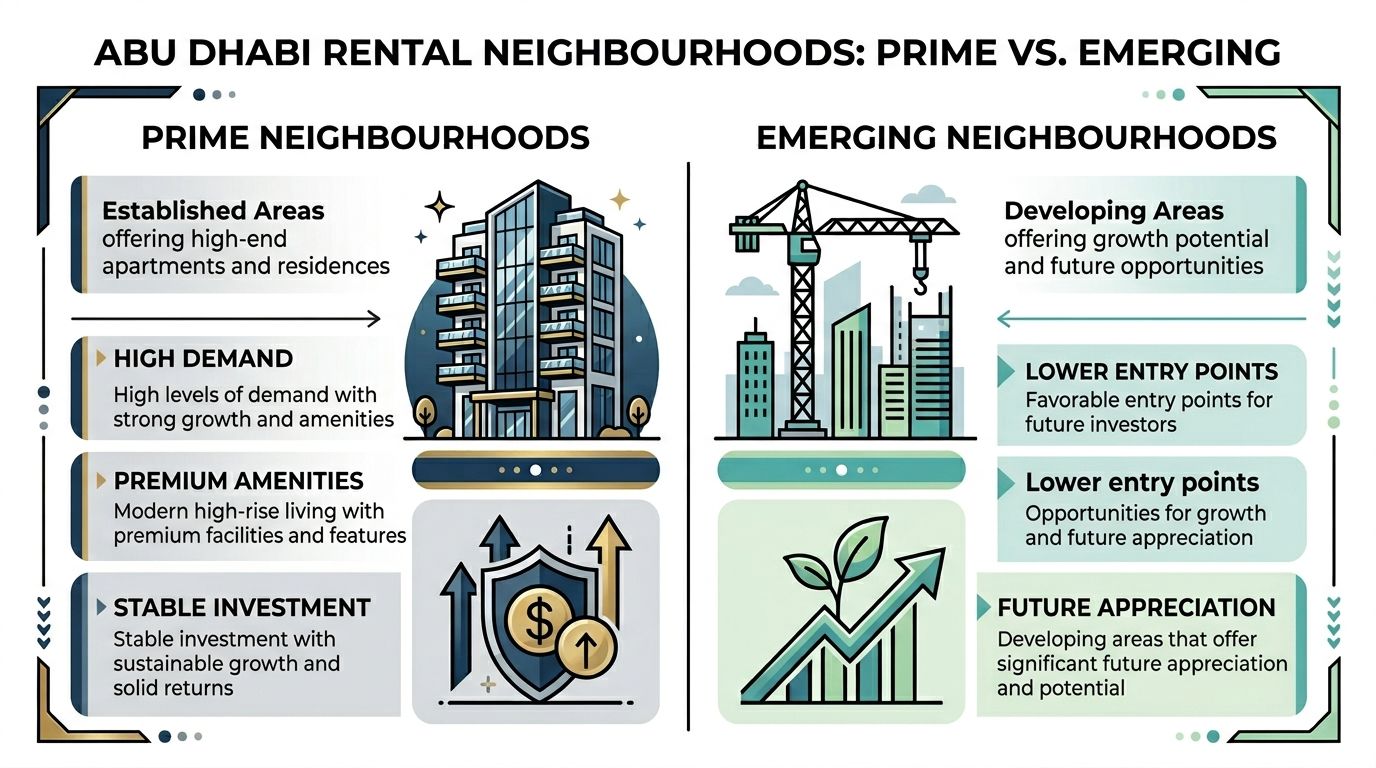
As noted earlier, market research identifies Khalifa City as a strong affordable apartment location, Al Reem Island as a leading mid-tier market, and Al Raha Beach as a recognised luxury rental area. That matters because these districts serve different tenant budgets and produce different return profiles. For UK-based buyers used to mature, lower-yield markets, the distinction is practical. Abu Dhabi gives investors a clearer choice between income-led buying and status-led buying.
Prime districts and what they offer
Prime districts in Abu Dhabi usually combine waterfront positioning, newer buildings, branded amenities, and a higher-income tenant mix. Saadiyat Island and Al Maryah fit that profile. Al Raha Beach often does too, particularly for higher-specification apartments.
These locations tend to appeal to investors who care about asset defensiveness, international tenant appeal, and stronger long-term exit prospects. The financial compromise is straightforward. Entry pricing is higher, so the margin for yield compression is smaller. If purchase prices rise faster than achievable rents, gross returns narrow quickly.
That is the same pattern many investors already know from prime London. Prestige can preserve value, but it rarely produces the strongest income return on capital.
Emerging districts and why they matter
Khalifa City presents a different investment case. It attracts value-conscious households and benefits from broader affordability, which usually supports a deeper tenant pool. For landlords, that often means fewer void risks than a narrower luxury segment.
Al Reem Island sits between prime and purely budget-led stock. It is better viewed as a scaled apartment market with wide appeal among professionals, couples, and smaller families. That mix can strengthen leasing resilience and improve resale flexibility because demand does not depend on one narrow tenant group.
For investors screening multiple deals, a rental yield calculator for Abu Dhabi buy-to-let analysis is useful only after the neighbourhood has been classified correctly. A high rent figure in a prestige district does not automatically beat a lower-priced unit in a district with faster leasing velocity.
Abu Dhabi Neighbourhood Investment Snapshot
| Neighbourhood | Property Type Focus | Avg. Gross Yield (Est.) | Target Tenant Profile |
|---|---|---|---|
| Khalifa City | Affordable apartments | Qualitatively strong income potential | Families and value-focused renters |
| Al Reem Island | Mid-tier apartments | Within Abu Dhabi apartment market’s competitive yield range | Professionals and mid-market expats |
| Al Raha Beach | Luxury apartments | Competitive for premium stock if bought well | Executives and affluent expats |
| Saadiyat Island | Prime apartments | More capital-preservation oriented than yield-led | High-income lifestyle tenants |
How to choose between prime and emerging
A better framework is to match district type to portfolio objective.
- Income-first buyers: Khalifa City and selected mid-market apartment zones usually merit closer attention.
- Balanced investors: Al Reem Island offers a credible middle ground between tenant depth, pricing, and resale appeal.
- Capital-preservation buyers: Al Raha Beach and Saadiyat Island make more sense where asset quality and long-term positioning matter as much as annual rent.
The non-obvious point is that Abu Dhabi’s strongest rental proposition for many overseas investors may sit outside the most prestigious addresses. In yield terms, emerging and mid-market districts often compare more favourably with UK buy-to-let benchmarks because acquisition costs stay more tightly aligned with tenant affordability. That creates a more repeatable rental model, which matters more than postcode prestige if the objective is consistent cash flow.
Calculating Rental Yields and Investor Returns
Most investors discuss rent first and yield second. That’s backwards. Rent is only useful once it’s converted into return on capital.
The standard gross yield formula is simple: annual rent divided by purchase price, multiplied by 100. The challenge in Abu Dhabi isn’t the maths. It’s avoiding false confidence. A strong headline rent can still produce an average investment if the entry price is too high.

What the benchmark says
For international context, Bayut’s Abu Dhabi rental market analysis states that average gross rental yields for UK buy-to-let properties stood at 5.8% in Q1 2026, with London at 4.2% and Manchester at 7.1%. The same source notes that Abu Dhabi apartment gross yields can range from 6% to over 8% in certain areas.
That comparison is the heart of the investment case. Abu Dhabi is not merely “high yielding for the region”. It is competitive against a mature Western benchmark that many global investors already understand.
How to read gross yield properly
A gross yield is a screening tool, not a final decision tool. It tells you whether a deal deserves further analysis. It doesn’t tell you what you’ll keep.
For a more useful underwriting process:
- Start with annual rent. Use realistic achieved rent, not an optimistic listing figure.
- Divide by total acquisition cost. Include the true purchase cost rather than the headline sale price alone.
- Pressure-test the result. Ask what happens if the property needs incentives, upgrades, or a longer reletting period.
If you want to test scenarios quickly, a dedicated rental yield calculator helps standardise assumptions across markets.
A property with the highest headline rent isn’t automatically the best investment. The better asset is the one that keeps more of that rent after realistic ownership costs.
Abu Dhabi versus the UK
The direct comparison with the UK reveals a useful asymmetry.
- London: Lower gross yield, but stronger legal familiarity and global liquidity.
- Manchester: Better income than London, but still within a regulated and tax-heavy mature market.
- Abu Dhabi apartments: Competitive or stronger gross yields in selected areas, with a different risk profile driven more by tenant mobility and market segmentation.
This doesn’t make Abu Dhabi “better” in every case. It makes it more efficient for investors prioritising income over familiarity. For a landlord comfortable with cross-border management and local compliance, that can be a rational trade.
What returns really depend on
Investor returns in Abu Dhabi will still vary sharply by execution. In practice, the biggest levers are:
- Buying discipline: Overpaying destroys yield faster than modest rent growth can repair it.
- Asset format: Apartments currently have the more compelling rental logic.
- Tenant fit: A unit aligned with local demand will usually outperform a more luxurious but less liquid alternative.
The broad lesson is simple. Abu Dhabi’s appeal lies in the spread between achievable rent and still-competitive entry economics. That spread is narrower in many established Western cities.
Navigating the Legal Process for Landlords
A strong rental market only works for investors who can convert occupancy into enforceable income. In Abu Dhabi, legal discipline matters as much as location choice.
The first principle is straightforward. A landlord should treat documentation, registration, and contract quality as part of the investment return. Weak paperwork doesn’t just create legal risk. It creates income risk.
Start with proper tenancy registration
The mandatory operational step is to ensure the tenancy agreement is properly registered through the local system used for formal rental documentation. Investors should never rely on an informal arrangement, even with a seemingly low-risk tenant.
Registration gives the tenancy a recognised legal footing. That matters if payment terms are disputed, if notice periods become an issue, or if a future sale requires clear documentation of occupancy status.
Review the contract like an investor
A tenancy agreement isn’t routine admin. It is the operating manual for the asset during the lease term.
Investors should pay close attention to:
- Payment structure: Rent schedules should be clear and enforceable.
- Maintenance responsibilities: Minor and major obligations shouldn’t be left vague.
- Renewal and notice terms: These clauses directly affect occupancy stability.
- Use restrictions: The contract should reflect whether the property is intended for standard residential use only.
A surprising number of landlord disputes come from ambiguity rather than outright bad faith.
The safest rental income is documented rental income. If a clause matters to your cash flow, it should be written clearly enough to enforce.
Think about residency and ownership planning together
For some international buyers, property ownership is connected to a wider relocation or residence strategy. In those cases, it helps to assess the rental structure alongside the broader investor visa landscape rather than treating the property as an isolated purchase.
That doesn’t change the tenancy mechanics, but it does affect how some buyers structure holding periods, occupancy plans, and succession arrangements.
A practical landlord checklist
Before leasing a property, an investor should confirm that:
- Ownership records are in order
- The tenancy contract reflects the actual commercial terms
- Registration has been completed through the appropriate local process
- Repair obligations are allocated clearly
- Any property manager is operating under written authority
Why this matters financially
Legal compliance is often framed as a defensive task. It’s more than that. It supports valuation, rent collection, tenant management, and exit flexibility.
An overseas investor can tolerate many market uncertainties. They should not tolerate preventable legal ambiguity. In Abu Dhabi, the landlords who operate cleanly are the ones most likely to preserve both income and resale options.
Strategies to Maximise Rental Income and Occupancy
Maximising rent in Abu Dhabi isn’t about pushing for the highest asking figure. It’s about matching product, pricing, and tenant expectation so the property lets quickly and renews reliably.
That requires active asset management. A passive landlord may still collect rent in a strong market, but an intentional landlord usually protects occupancy better when conditions normalise.

Furnished or unfurnished
In Abu Dhabi, the right choice depends on tenant type rather than landlord preference. A furnished apartment can appeal to newly arrived professionals and shorter-stay occupiers. An unfurnished property often suits families and longer-term tenants who want stability and control over the home environment.
The decision should follow the district. A mid-tier apartment near major employment nodes may benefit from a ready-to-move format. A family-oriented unit is often better kept practical and neutral.
Price for occupancy, not ego
Many landlords lose income by overpricing and then chasing the market down. The better approach is disciplined positioning from day one. Good operators compare nearby competing stock, note the specification gap, and set rent where enquiry quality is strongest.
For investors refining their leasing approach, this guide to rental property pricing strategies is useful because it focuses on market-led pricing rather than guesswork.
Use management as a return tool
Overseas owners often think of property management as a cost line. In practice, it can be a return tool if it improves responsiveness, inspection quality, contractor control, and renewal handling.
A landlord receiving overseas rental income needs a management process that protects continuity. That usually means documented inspections, fast maintenance decisions, and consistent tenant communication.
Well-managed properties don’t just look better. They are easier to renew, easier to market, and less likely to suffer avoidable vacancy.
Tactics that usually work
- Target the right furnishing level: Don’t overfit a property with expensive finishes that your tenant segment won’t pay for.
- Keep the specification clean: Neutral décor, working appliances, and visible maintenance standards help more than decorative upgrades.
- Respond quickly to issues: Tenants remember service quality at renewal time.
- Review competing listings regularly: Market drift can turn an acceptable asking rent into an overpriced one.
The landlords who outperform usually do ordinary things consistently well. In a market like Abu Dhabi, that discipline often matters more than trying to engineer a premium through cosmetic upgrades alone.
Your Final Verdict on Abu Dhabi's Rental Market
Abu Dhabi deserves serious attention from income-focused property investors. The core reason is not hype or regional momentum alone. It is the combination of strong apartment rental performance, competitive gross yield potential, and a market structure that still compares well against mature Western alternatives.
The most persuasive part of the story is the contrast inside the city itself. Apartments have shown much stronger rental traction than villas, which gives investors a clear signal about where demand is most dependable. That kind of segmentation is useful because it reduces guesswork. It points capital towards the parts of the market where pricing power is more credible.
The global comparison also matters. When Abu Dhabi apartments can sit in a yield range that compares favourably with UK buy-to-let benchmarks, the emirate moves from niche interest to legitimate portfolio candidate. For international investors, that creates a real allocation question rather than a speculative one.
There are still risks. Tenant mobility can affect reletting patterns. Premium stock can underperform if bought at the wrong price. Cross-border ownership always requires better legal and operational discipline than domestic investing.
Still, the broad conclusion is clear. If your priority is house rent in Abu Dhabi as a source of rental income, the most compelling opportunities are likely to be well-selected apartments in districts with broad tenant appeal, not merely the most expensive address available.
World Property Investor helps global buyers compare rental yields, ownership rules, taxes, and market fundamentals across major cities and emerging destinations. Explore more data-led guides at World Property Investor if you’re building an international property strategy grounded in evidence rather than sales language.