
A property listing can look irresistible from a distance. The agent highlights a strong rental yield, the photographs suggest effortless demand, and the local market report points to future growth. Then the buyer converts funds, discovers that the exchange rate moved against them, finds that local taxes apply at a different threshold, and realises that a headline yield says little about the cash left after financing, management, maintenance and empty periods.
That's why learning how to evaluate investment opportunities requires more than comparing asking prices or gross rental yields. Whether you're considering a UK buy-to-let, a holiday villa in Spain, or an apartment in an emerging market, you need a framework that combines objectives, neighbourhood evidence, net cash flow, legal friction, timing and exit liquidity.
Table of Contents
- Defining Your Property Investment Objectives
- Conducting Hyper-Local Market and Neighbourhood Research
- Mastering Financial Analysis and Yield Metrics
- Navigating Tax, Legal and Operational Friction Costs
- Assessing Risk and Timing the Market Entry
- Planning Exit Strategies and Portfolio Recycling
Defining Your Property Investment Objectives
Before reviewing listings, write down what the investment must achieve. An investor looking for dependable income needs a different property from someone prioritising long-term capital growth. A holiday home may be allowed to produce inconsistent income if personal use is important, while a buy-to-let acquisition usually needs reliable occupancy and manageable operations.
Start with three decisions:
- Return priority: Decide whether rental income, capital appreciation or a balance between both matters most.
- Liquidity requirement: Establish how quickly you may need to sell or refinance without accepting a distressed price.
- Risk tolerance: Consider how much exposure you can accept to vacancies, currency movements, interest-rate changes, regulatory intervention and local market weakness.
A mature buy-to-let market generally calls for disciplined income analysis. A development project in an emerging economy demands a different lens, including planning risk, construction delivery, infrastructure quality, resale depth and the reliability of local contractors. Treating both opportunities as if they were standard rental properties produces misleading comparisons.
Set a hurdle rate before you see the property
Your required return should be decided before an attractive listing starts influencing your judgement. The UK's long-term evidence supports the importance of matching expected return with time horizon. Cambridge Associates' UK investment data shows that UK equities produced an 8.6% nominal average annual compound return over 1900 to 2022, while the previous ten-year period produced a 6.5% nominal annual compound return. The same research recorded UK equity returns exceeding bond returns in 72% of five-year periods, 76% of ten-year periods and 94% of 25-year periods.
Those figures aren't a promise of property performance. They're a useful reminder that an investment's holding period changes the outcome. Short-term property returns can be distorted by purchase costs, financing conditions and resale timing, even when the underlying location remains sound.
UK corporate decision-making offers another practical reference point. A 2025 study of UK firms found that 58.8% selected a payback period of three years or less, with mean and median payback periods of 3.71 and 3.43 years. It also reported mean and median costs of funds of 24.246% and 25.931%. These figures shouldn't be copied blindly into a personal property model, but they demonstrate that real decision-makers assess both recovery time and the required return on capital.
Practical rule: If you can't state your minimum acceptable net return, maximum cash commitment and intended holding period, you aren't ready to compare properties.
Build a short investment mandate covering the purchase budget, financing approach, target tenant or guest, acceptable management burden, currency exposure and exit route. Any property that fails the mandate should be rejected, even if the marketing material looks compelling.
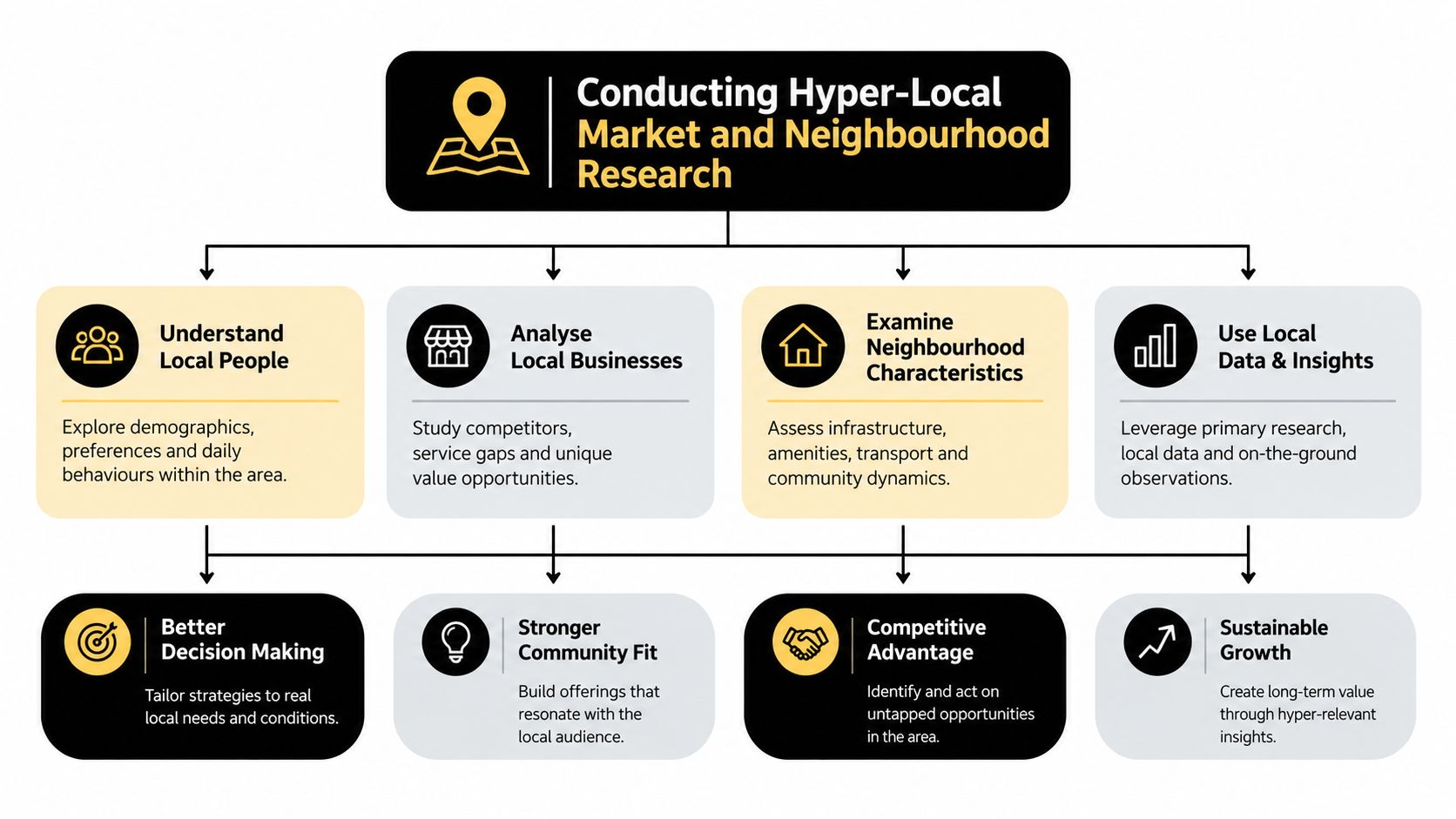
Conducting Hyper-Local Market and Neighbourhood Research
National market headlines rarely describe the specific property you are buying. A country can show modest house-price movement while one neighbourhood benefits from a new employment hub, another suffers from oversupply, and a third attracts tenants only during a short seasonal window.
The research process should move from broad context to the smallest reliable local unit. In the UK, the Office for National Statistics guidance on housing market data confirms that housing bulletins provide rent and price information at regional and local-area levels, with breakdowns by property type and bedroom category. That makes postcode-level analysis more useful than a national average when you're estimating actual rent, tenant demand and resale appeal.
Start with the tenant rather than the listing
Identify who will rent the property and why. A location near a hospital, university, logistics centre or major employer may attract a different tenant profile from a coastal district dependent on holiday demand. Then test whether the property's layout, furnishing standard, transport access and local services fit that audience.
Look for evidence of structural demand:
- Employment hubs: Establish whether local jobs support year-round tenants or only temporary workers.
- Transport and infrastructure: Check completed improvements separately from proposals. A promised project shouldn't receive the same weight as an operating transport link.
- Demographic movement: Compare the likely tenant pool with the property type. A family-oriented area may not support a large supply of small holiday apartments.
- Competing stock: Review comparable listings, not just completed transactions. The number, condition and marketing duration of competing homes reveal how hard it may be to secure tenants.
- Supply constraints: Determine whether planning restrictions, land availability or construction economics limit future competing supply.
A 2026 UK rental-yield dataset using HM Land Registry sale prices and VOA rent data reported an average gross rental yield of 3.6% across 1,964 postcode districts. The postcode-level rental yield report illustrates why yield screening needs local detail. An average can help you form an initial benchmark, but it doesn't tell you whether a particular street has stronger tenant demand, higher maintenance costs or weaker resale liquidity.
Separate rent growth from asset growth
Recent UK data show why investors should avoid assuming that rising rents automatically mean rising property values. Average private rent reached £1,400 in August 2026, up 3.8% year on year, while average UK house-price growth was 1.4% in July 2026, according to the ONS private rent and house prices bulletin. London rents rose 3.5% to £2,332, while the North East recorded 5.8% rent inflation and lower entry prices, according to the same source.
The implication is practical. Two properties can show a similar gross yield while exposing you to very different tenant risks, maintenance requirements and capital-growth prospects. Analyse achievable rent, not the highest advertised rent, and inspect the local evidence for both demand and future supply before treating a yield as investable.
Use market research tools for property investors to organise comparable rents, local prices and neighbourhood signals, but validate the result with agents, letting managers and an in-person inspection where possible.
Mastering Financial Analysis and Yield Metrics
Gross yield is a screening measure, not an investment conclusion. It divides annual rent by the purchase price, but it ignores acquisition costs, financing, insurance, management, repairs, utilities, tax, voids and the cost of moving money across borders.
A better model begins with the full acquisition cost. Add the purchase price to taxes, legal work, survey costs, financing fees, furnishing, currency conversion and any immediate refurbishment. Then calculate operating income from realistic rent, subtract recurring expenses and model debt separately. This gives you a clearer view of both the property's operating performance and the cash required from you.
The difference between gross and net yield is often decisive. A gross yield versus net yield guide can help structure the calculation, but the model still depends on your own verified assumptions.
Build the cash-flow waterfall
Work through the property in this order:
- Effective gross income: Begin with achievable rent or booking revenue, then deduct realistic empty periods, discounts and bad debt.
- Operating expenses: Include management, cleaning, insurance, repairs, service charges, utilities paid by the owner and compliance costs.
- Net operating income: This is the property's income before financing and personal taxation.
- Debt service: Model interest, principal repayment and refinancing risk separately. A property can have a respectable operating yield but weak cash flow after debt.
- Investor cash flow: Subtract tax, reserve contributions and cross-border transfer costs from the cash available to you.
For multi-unit or serviced properties, submetering can help allocate utility costs and protect operating income where the owner otherwise absorbs consumption. The practical mechanics are set out in this resource on how submetering helps NOI from Axis Meter Solutions.
| Cost Factor | Typical Impact on Yield | Mitigation Strategy |
|---|---|---|
| Financing costs | Reduces cash flow after debt service and can turn a positive operating return negative | Model several interest-rate and refinancing scenarios |
| Empty periods | Lowers effective income below the advertised annual rent | Use achievable occupancy assumptions and maintain a cash reserve |
| Management and guest services | Compresses net income, particularly for remote owners and holiday lets | Compare local operators, service scope and fee structures |
| Repairs and replacement | Creates irregular cash demands that a simple annual budget may miss | Separate routine maintenance from major replacement reserves |
| Tax and transaction charges | Reduces the capital available for investment and the amount retained on exit | Obtain local advice and include every charge in the acquisition model |
| Currency conversion | Changes the value of both purchase capital and repatriated income | Compare transfer providers and model adverse exchange-rate movement |
Add IRR, cap rate and sensitivity analysis
The capitalisation rate, or cap rate, measures net operating income against the property value or purchase price. It helps compare properties without debt, but it won't capture your financing structure, purchase costs or resale timing.
Cash-on-cash return focuses on the cash you personally invest and the annual cash flow you receive after financing. It's useful for comparing different borrowing strategies, although borrowing can magnify losses as well as gains.
Internal Rate of Return, or IRR, incorporates the timing of cash flows, including the initial purchase, operating income, refinancing, sale proceeds and selling costs. It can be more informative than a single-year yield, but it remains highly sensitive to assumptions about future rent, valuation and the eventual exit.
A discounted cash flow model adds another layer by converting future cash flows into present values using a required rate of return. The model is only as credible as its assumptions, so don't hide uncertainty inside a single optimistic forecast.
A strong deal model shows you where the investment breaks, not just where it performs.
Run sensitivity cases for lower rent, longer vacancies, higher financing costs, unexpected repairs, weaker resale value and adverse currency movement. You don't need false precision. You need to know which variable causes the greatest damage and whether you have the liquidity to absorb it.
The most useful output is often a decision range. If the property works only with full occupancy, uninterrupted rent growth and favourable currency movement, it is not resilient. If it remains serviceable after several adverse assumptions, you can then decide whether the return compensates you for the remaining risk.
An embedded financial explainer can support the technical analysis:
Navigating Tax, Legal and Operational Friction Costs
Cross-border property returns often deteriorate through small charges that never appear in the listing brochure. The acquisition price is only the starting point. You may also face transaction taxes, legal fees, notary charges, surveys, bank costs, currency spreads, registration expenses, furnishing, compliance work and local management.
Build a cost schedule before making an offer. Separate one-off acquisition costs from recurring ownership costs and disposal costs. This prevents an apparently attractive yield from being calculated against the property price while ignoring the larger amount of capital really required.
Check thresholds and chargeable consideration
Tax rules frequently depend on thresholds, property use, ownership status and the definition of the taxable transaction value. In England and Northern Ireland, residential SDLT starts at £125,000, while the first-time buyer threshold rises to £300,000 for qualifying purchases at or below £500,000, according to the HMRC SDLT manual. HMRC also states that SDLT is charged on the total chargeable consideration, not just on the headline price.
That distinction matters in financial modelling. Never assume that a threshold applies to only the portion above it, or that a first-time buyer treatment applies to an investment purchase. Ask a qualified adviser to confirm the rules for the buyer, property and intended use. Other jurisdictions may apply different transfer taxes, registration charges or ownership restrictions, so a UK assumption cannot be carried into an overseas model.
Review the legal position before committing funds:
- Ownership: Confirm whether you're buying personally, through a company, partnership or another structure, and understand the tax and reporting consequences.
- Title and planning: Verify title, boundaries, planning permissions, building compliance and any restrictions on letting.
- Rental permissions: Check whether long-term, short-term or holiday letting is permitted and whether local registration applies.
- Finance: Confirm the lender's requirements, currency, repayment terms and security arrangements.
- Repatriation: Establish how rental income and sale proceeds can be transferred, what documentation the bank requires and which taxes may apply.

Price remote management honestly
Self-management looks inexpensive until the owner has to handle a burst pipe, late-night guest issue, tenant dispute or local inspection from another country. A local manager may charge for placement, collection, maintenance coordination, guest communication or emergency attendance. The right comparison isn't “manager versus no manager”. It's the cost of professional oversight versus your time, travel and operational exposure.
Ask for a written fee schedule and clarify whether contractors' charges include mark-ups. For a holiday home, test how the operator handles seasonality, cleaning standards, guest damage and owner use. For a long-term rental, review tenant screening, arrears procedures, inspections and renewal practices.
A contract review tool such as AI-powered contract drafting by LegesGPT may help organise an initial agreement or checklist, but it shouldn't replace advice from a qualified solicitor in the relevant jurisdiction. Your model should include legal review as a real cost, not treat it as an optional administrative detail.
Use a detailed property conveyancing costs guide when building the acquisition schedule, then obtain local quotes before exchange. Currency conversion deserves its own line. A small spread on a substantial purchase or repeated income transfers can materially change the return you receive in your home currency.
Assessing Risk and Timing the Market Entry
“Buy now” is rarely a complete investment thesis. Timing should be tested against funding costs, achievable income, supply, buyer demand and the investor's ability to hold through an unfavourable period.
The UK evidence illustrates why financing conditions deserve close attention. In September 2026, the ten-year gilt moved to about 5.3%, while one market report placed the all-property equivalent yield at 6.86%, leaving only 157 basis points between them, according to Cushman & Wakefield's UK investment market analysis. That spread doesn't determine whether a property is attractive, but it shows how a higher bond yield can reduce the cushion available to a buyer relying on borrowed funds.
Read supply as a risk signal
A constrained rental market can support occupancy and rents, but constrained supply doesn't eliminate operating risk. The same Cushman & Wakefield report described rental supply as 20% to 30% below pre-pandemic levels across regions and noted that national rental listings fell below the previous year's level in the second quarter of 2026 for the first time since 2022.
That combination can support landlords, yet it also demands interpretation. If supply is low because new construction is weak, the market may have structural support. If available homes are scarce because landlords are selling, regulations are changing or tenants can't afford the asking rent, the apparent strength may be less durable.
Landlord activity offers another clue. Purchases remained muted, while a growing share of landlord acquisitions involved homes that had previously been let. That points towards a recycling market, where existing rental stock changes hands, rather than a broad wave of new supply. For a buyer, the distinction matters because recycling can preserve scarcity without necessarily improving the quality or capacity of the rental stock.
Stress-test the funding environment
A property that works at today's financing cost may not work after a refinancing event. Model the debt with a higher interest assumption, delayed rent collection and a repair reserve. Then ask whether you could hold the property without selling at the first sign of weakness.
Your timing assessment should include:
- Bond and mortgage conditions: Compare the property's net operating return with the cost and availability of debt.
- Supply pipeline: Separate completed homes from planning announcements and proposed developments.
- Exit liquidity: Identify the likely buyer when you sell. An owner-occupier market may behave differently from an investor-led market.
- Income resilience: Test whether tenants or guests can continue paying if local employment or tourism weakens.
- Currency exposure: Decide whether debt and income are held in the same currency as your capital.
Predictive tools can support scenario analysis, but they shouldn't turn uncertain forecasts into apparent facts. A practical overview of predictive modelling for property investment can help investors think about variables and scenarios without surrendering judgement to a dashboard.
The right entry point is the one where the property remains viable under realistic adversity. A lower purchase price doesn't compensate for weak demand, and strong demand doesn't rescue a deal whose funding structure leaves no margin.
Planning Exit Strategies and Portfolio Recycling
A property purchase has two critical dates, completion and disposal. Investors who focus only on entry often discover too late that the asset appeals to a narrow buyer group, carries expensive selling friction or sits inside an ownership structure that complicates refinancing and inheritance.
Consider two otherwise similar villas. One is near established services, has straightforward title and can appeal to local residents, international buyers and holiday-home purchasers. The other depends on seasonal tourism, has restrictive letting rules and requires specialist marketing. The second may offer an appealing income story, but its exit pool is narrower.
Design the exit before completing
Start by identifying the most likely exit routes:
- Open-market sale: Estimate the buyer groups, presentation requirements and time needed to sell.
- Refinance: Check whether future lenders will accept the property type, income history and ownership structure.
- Partial disposal: Consider whether the asset can be divided, sold as units or transferred without creating legal complications.
- Portfolio sale: Determine whether the property strengthens or weakens the overall portfolio if sold alongside other assets.
Ownership structure deserves advice from both property and tax professionals. Personal ownership, a company or another legal arrangement can affect administration, financing, inheritance planning and taxation. The cheapest structure at acquisition may not be the most flexible when family circumstances or portfolio goals change.
Selling costs also need a place in the original model. Include agency fees, legal work, outstanding finance, repairs required for sale, tax and currency conversion. For investors selling a rental property in a jurisdiction that applies depreciation recapture, this guide to depreciation recapture on a rental sale provides useful background, but local professional advice remains essential because treatment varies by country and ownership structure.
Build a portfolio that can move
Portfolio recycling means releasing capital from a mature or strategically weaker asset and redeploying it into an opportunity with better risk-adjusted prospects. That decision shouldn't be based solely on whether the property has risen in value. Compare its current net income, remaining risks, likely sale costs and future capital needs with the alternatives available.
A practical review should ask:
- Does the property still meet the original investment mandate?
- Has the tenant, financing or regulatory profile changed?
- Could the capital produce a better risk-adjusted outcome elsewhere?
- Can you exit without depending on a single buyer type or a perfect market?
- Will the ownership structure support your family and portfolio plans?
Use a structured resource such as how to build a portfolio of properties to keep acquisitions connected to a wider strategy rather than treating each listing as an isolated purchase. The strongest portfolio is not necessarily the one with the most properties. It's the one whose income, geography, financing and exit options remain flexible when conditions change.
Before you make an offer, use World Property Investor to compare international markets, rental yields, taxes, ownership rules and local investment fundamentals. Apply the research to your own acquisition model, verify every legal and tax assumption with qualified advisers, and proceed only when the net return, risk tolerance and exit plan align.