
For years, the Portugal Golden Visa was the benchmark for residency-by-investment programmes, offering a clear path for global investors to live, work, and study in Europe. Its most significant advantage was the freedom to travel visa-free across the 26 countries in the Schengen Area.
However, the landscape has shifted. Following a major policy change in late 2023, the Portuguese government removed direct real estate purchases as a qualifying route, a direct response to pressures on the domestic housing market. For investors who viewed the Golden Visa and property acquisition as synonymous, it is time for a strategic reassessment. The programme has not been discontinued; rather, its focus has been recalibrated to channel investment into other vital sectors of the Portuguese economy.
Understanding the Core Value Proposition
Even without the direct property option, the Golden Visa retains its fundamental appeal. It remains a powerful instrument for diversifying not just a portfolio, but an entire lifestyle strategy. It should be viewed less as a simple transaction and more as the strategic acquisition of European access. The primary benefits are firmly in place and remain highly attractive for non-EU nationals.
Here is what makes it so compelling:
- European Mobility: The right to travel freely throughout the Schengen Zone for up to 90 days in any 180-day period.
- Minimal Residency Obligation: A requirement to spend an average of only seven days per year in Portugal to maintain residency status, making it one of the most flexible programmes globally.
- Family Inclusion: The visa can be extended to immediate family, including a spouse, dependent children, and dependent parents.
- Pathway to Citizenship: After holding the Golden Visa for five years, applicants become eligible for permanent residency and, ultimately, Portuguese citizenship, which unlocks an EU passport.
The real value of the Golden Visa now lies in securing a European foothold through investments that support Portugal's economic priorities, such as innovation and capital markets. This marks a move away from a property-centric model towards a more dynamic, fund-based investment strategy.
This new framework presents different opportunities—and different risks—compared to owning a tangible asset like a villa or an apartment. While it is always prudent to explore various international investment destinations via our global country guides, the revamped Portuguese programme offers a unique blend of a low physical presence requirement and a clear route to one of the world's most powerful passports.
The following sections will break down the current investment routes, helping you navigate these new Portugal Golden Visa requirements with confidence.
A Detailed Breakdown of the Current Investment Routes
With direct real estate no longer an option, Portugal's Golden Visa programme has shifted its focus towards boosting other key economic areas. For investors, this means the rules of engagement have changed. The new routes are designed to funnel capital into venture capital, scientific research, and cultural preservation, moving away from tangible assets like property towards more dynamic, albeit different, investment classes.
Understanding these new Portugal Golden Visa requirements is the first step. Each option carries its own risk profile and minimum investment threshold, and is suited to a different type of investor. Making the right choice depends on your financial goals, risk appetite, and long-term objectives for securing European residency.
This flowchart maps out the typical journey for an investor, from making the initial investment right through to the ultimate prize: the opportunity to apply for EU citizenship.
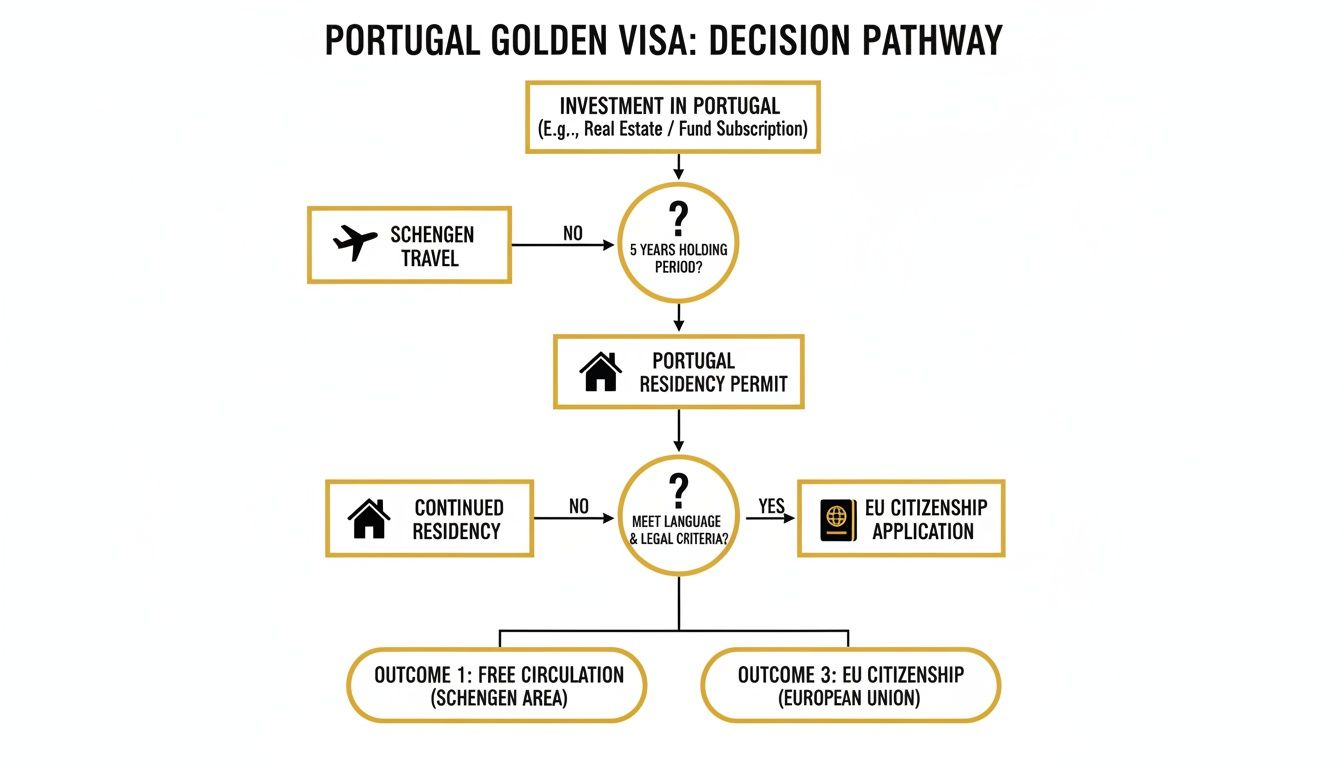
As illustrated, each stage builds upon the last. It is a clear pathway showing how maintaining the qualifying investment leads directly to residency and, after five years, the option to become a full citizen.
To help you compare the options, this table breaks down the main routes, their costs, and their ideal investor profiles.
Comparison of Portugal Golden Visa Investment Options
| Investment Route | Minimum Investment | Key Conditions | Ideal Investor Profile |
|---|---|---|---|
| Investment Funds | €500,000 | Must be a Portuguese-regulated fund (e.g., VC/PE). 60% of capital invested in Portuguese-based companies. No direct real estate link. | Investors seeking a hands-off, professionally managed asset with potential for capital growth and diversification. |
| Capital Transfer | €1.5 million | Funds transferred to and held in a Portuguese bank account for the duration of residency. | High-net-worth individuals who prioritise simplicity, security, and capital preservation over generating returns. |
| Job Creation | N/A | Create and maintain 10 full-time jobs in a Portuguese company (or 8 jobs in a low-density area). | Entrepreneurs seeking to build a genuine business presence in Europe and who are prepared for hands-on operational involvement. |
| Cultural Donation | €250,000 | A non-refundable donation to support artistic production or national cultural heritage projects. | Philanthropically minded individuals for whom the residency benefit is the primary goal, rather than financial return. |
| Scientific Research | €500,000 | Capital transfer to public or private scientific research institutions integrated into the national scientific system. | Investors passionate about supporting innovation and science, where the contribution itself is as important as the visa. |
Each pathway offers a unique way to qualify for the Golden Visa, catering to different financial strategies and personal interests. Let us examine the details of each.
The Investment Fund Route: The Predominant Choice
The most popular route currently is the investment fund option. This requires a minimum contribution of €500,000 into a qualifying Portuguese-regulated investment fund. These are typically venture capital (VC) or private equity (PE) funds and must be registered with the Portuguese Securities Market Commission (CMVM).
There are several important conditions to note:
- At least 60% of the fund's capital must be invested in companies with a registered head office in Portugal.
- The fund cannot be directly or indirectly linked to real estate investments.
- The investment must be held for a minimum of five years.
This route is ideal for investors seeking a hands-off, professionally managed investment that also offers the potential for capital appreciation. It diversifies a portfolio away from traditional assets and is generally more liquid than property. Of course, it also carries market risk—the value of your investment can fall as well as rise—so conducting due diligence on the fund manager’s track record is vital.
Capital Transfer: The Direct Approach
For investors with a low risk tolerance and substantial capital, the direct capital transfer route is the most straightforward option. It involves transferring €1.5 million or more into a Portuguese bank account, where the funds must remain for the entire residency period.
The main attraction is simplicity and security. This route avoids the market volatility associated with funds, offering a clear, predictable path. The obvious drawback is the opportunity cost, as a significant amount of capital is tied up without generating returns. It is best suited for high-net-worth individuals who value capital preservation and simplicity above all else.
Creating Economic Value: The Job Creation Route
Another qualifying route involves establishing a business. An investor can obtain the Golden Visa by setting up a company in Portugal that creates and maintains at least 10 full-time jobs. This is a hands-on option that requires direct involvement in the local economy.
The appeal lies in building a tangible business asset in Europe, making it a good fit for entrepreneurs who wish to establish a genuine operational presence. The primary challenge, however, is the significant administrative and operational work involved in running a business and adhering to strict employment laws. If the business is located in a designated low-density area, the requirement drops to eight jobs.
For a deeper understanding of managing large-scale investments, our guide on financing investment property offers valuable insights.
Supporting Culture and Science: The Philanthropic Routes
Finally, donation-based routes are available to support Portugal’s cultural heritage and scientific innovation. These involve non-refundable contributions, representing a philanthropic approach to gaining residency.
There are two main options:
- A donation of at least €250,000 to support artistic production or the maintenance of national cultural heritage.
- A capital transfer of at least €500,000 for research activities carried out by public or private scientific research institutions.
These routes are for individuals who are passionate about supporting the arts or sciences and for whom an investment return is secondary to the residency benefit.
The programme's evolution has attracted a diverse applicant pool. Post-Brexit, UK citizens have fuelled a residency boom, with Portuguese government data showing 27,080 permits issued to British nationals by early 2023. Since its launch in 2012, the programme has channelled over €7.5 billion into the economy, with fund investments now the clear preference for high-net-worth individuals seeking alternatives to real estate.
Navigating The Application Process Step By Step
Understanding the Portugal Golden Visa requirements is the first hurdle; navigating the application is the next. What may appear to be a bureaucratic challenge is a logical sequence of steps. By approaching it as a project with clear milestones, the entire process becomes far more manageable.
This roadmap breaks the Golden Visa journey down into distinct stages, from initial preparation to having the residence permit in hand. While official processing times can vary, this step-by-step guide provides a clear plan of action.

Stage 1: The Preparatory Phase
Before any capital is invested, the legal and financial foundations must be correctly established. This initial stage is arguably the most critical, as errors here can cause significant delays.
The first action is to secure two essential Portuguese credentials:
- A NIF (Número de Identificação Fiscal): This is a unique Portuguese tax number, essential for opening a bank account, making an investment, or conducting almost any financial transaction in Portugal.
- A Portuguese Bank Account: The entire Golden Visa investment must originate from a Portuguese bank account. This provides the authorities with a clear, traceable record, proving the legitimacy of the funds.
Both can typically be handled remotely by a qualified lawyer, taking approximately one to three weeks. This is also the point at which you will finalise your investment choice, whether a venture capital fund or a cultural donation.
Stage 2: Executing Your Investment
With your NIF and bank account in place, it is time to make the investment. You will transfer the required capital—for instance, the €500,000 for an investment fund—from your home bank account to your new Portuguese one.
From there, you will complete the official transaction. For the fund route, this means signing the subscription agreement and wiring the money to the fund manager. In return, you will receive a formal declaration from the fund's management company confirming your investment. This document is a critical piece of evidence for your application.
It is crucial to obtain and retain all paperwork related to this transaction. This includes bank transfer receipts and official investment certificates. These documents constitute the non-negotiable proof that you have met one of the core Portugal Golden Visa requirements.
Stage 3: Application Submission and Biometrics
Once your investment is made and documented, your legal team will compile all necessary information and submit your application online. This is done through the official government portal, now managed by AIMA (Agency for Integration, Migrations and Asylum). The submission includes all personal documents, proof of investment, and completed application forms.
After the online submission, you will be scheduled for a biometrics appointment in Portugal. Here, you will provide your fingerprints and a photograph, and submit the original copies of your documents. Be prepared for a potential wait; securing an appointment can sometimes be the longest part of the process, occasionally taking several months.
Stage 4: Final Approval and Permit Issuance
Following a successful biometrics appointment, your application moves into the final review stage, where AIMA will conduct its last due diligence checks. Once they grant approval, you will be asked to pay the final government fees for the permit itself.
The final step is the issuance of your residence card. This card is your official permit, granting you the right to live in Portugal and travel visa-free across the Schengen Area. Realistically, the entire journey from obtaining your NIF to holding your card can take anywhere from 12 to 18 months, though this is always dependent on AIMA's processing capacity. Professional legal support is vital to ensure each step is completed correctly, minimising delays and smoothing your path to European residency.
Your Essential Documentation Checklist
A successful application for the Portugal Golden Visa hinges on meticulous preparation. Submitting a complete and correctly formatted application is essential for avoiding lengthy delays or rejection. Consider your paperwork the foundation of your case; any cracks will compromise the entire structure.
This checklist outlines the critical documents you and any dependants will need to gather. The Portuguese authorities are forensic in their review, and accuracy is paramount.

Core Personal Documents
These items are required for you and every accompanying family member. They form the basis of your personal identification and background check.
- Valid Passport or Travel Document: Ensure it has at least six months of validity remaining. A certified copy will be required.
- Criminal Record Certificate: This must be obtained from your country of origin and any other country where you have resided for over a year. The document is valid for only 90 days from its issue date, so timing is critical.
- Proof of Health Insurance: You must provide evidence of a valid health insurance policy that covers you in Portugal.
Portuguese Legal and Financial Documents
These documents prove you are correctly established within Portugal. They must be sorted before you can make your qualifying investment.
- Portuguese Tax Number (NIF): Your NIF (Número de Identificação Fiscal) is non-negotiable for any financial activity in Portugal.
- Portuguese Bank Account: You must provide proof of an open and active bank account in your name with a Portuguese institution. All investment funds must pass through this account. To better understand financial responsibilities in a new country, it helps to understand property taxes and other fiscal duties.
- Declaration of No Debt: A sworn statement confirming you have no outstanding debts with the Portuguese Tax and Customs Authority or its Social Security system.
Investment-Specific Proof
This is where you provide evidence that you have fulfilled the primary financial part of the Golden Visa requirements. The exact documents needed will depend on your chosen investment route.
A common pitfall is the failure to have documents correctly apostilled or officially translated. Any document from a foreign authority must be legalised—usually with an Apostille stamp—and then translated into Portuguese by a certified translator.
For Investment Fund Subscribers (€500,000):
- Fund Subscription Declaration: A formal certificate from the fund’s management company confirming your subscription, the amount invested, and that the fund complies with Golden Visa regulations.
- Bank Statement: A statement from your Portuguese bank showing the successful transfer of the €500,000 into the fund.
For Cultural Donation Applicants (€250,000):
- Official Receipt of Donation: A formal declaration from the recognised cultural institution, confirming receipt of your contribution.
- Government Approval: You must provide proof that the project or institution is officially recognised and approved by the relevant Portuguese cultural authorities (GEPAC).
Compiling this documentation is a detailed process that demands careful project management. It is highly recommended that you work with legal counsel to ensure every item is prepared, certified, and submitted exactly to AIMA’s exacting standards.
Residency Renewals and Your Path to Citizenship
Obtaining your initial Golden Visa is a significant milestone, but understanding the long-term journey transforms it from a simple permit into a strategic family asset. The programme was designed for investors needing flexibility, not a full-time relocation. Its enduring value is the clear, structured path it offers towards permanent residency and, ultimately, European citizenship.
One of the most attractive features of the Portugal Golden Visa is the minimal time required on the ground. To maintain your status, you only need to be in the country for an average of seven days per year. This can be completed in a single trip or spread out, providing a level of freedom rarely found in other European residency schemes, which often demand six months or more of physical presence.
This minimal stay requirement means you can enjoy the benefits of EU residency and Schengen Area access without disrupting your life or business commitments elsewhere. It is a major reason the programme remains popular with global investors managing international portfolios and lifestyles.
The Renewal Process Explained
Your first residence permit is valid for two years. To remain on the pathway, you will need to renew it twice. The process is straightforward, provided you have met the core conditions.
- First Renewal: At the end of year two.
- Second Renewal: At the end of year four.
For each renewal, you must prove two key things to the Portuguese authorities (AIMA): that you have maintained your qualifying investment, and that you have met the minimum stay requirements. This typically involves providing updated paperwork from your fund manager or the recipient organisation, along with proof of your time in Portugal.
Renewals should be viewed as a verification check, not a full re-application. As long as your investment remains compliant and you have spent at least 14 days in Portugal over the previous two-year period, the process is typically a formality.
From Temporary Resident to EU Citizen
After holding your Golden Visa for five years, you unlock the programme's ultimate prize: the option to apply for both permanent residency and Portuguese citizenship. This five-year countdown begins from the date your first residency card is issued.
Permanent Residency: This grants you the right to live and work in Portugal indefinitely, and you no longer need to maintain your original investment.
Portuguese Citizenship: This is the final step, leading to a Portuguese passport. With it comes the right to live, work, and study anywhere in the European Union, plus visa-free travel to a vast number of countries worldwide. To qualify for citizenship after five years, you must demonstrate:
- A clean criminal record.
- No outstanding tax debts in Portugal.
- A basic grasp of the Portuguese language, proven by passing an A2-level examination (known as CIPLE).
The appeal of this pathway is clear, especially for investors seeking a secure footing in Europe. By the end of February 2023, Portuguese authorities had issued permits to 27,080 UK citizens, making them one of Portugal's largest foreign resident groups, according to official government statistics. This demonstrates how many investors are using the programme to regain EU mobility and long-term security. To see how Portugal compares to other markets, you can read our guide on the best countries to invest in property.
Common Pitfalls And How To Avoid Them
Navigating the Portugal Golden Visa is a rewarding journey, but several common mistakes can lead to frustrating delays or even rejection. Based on our experience, understanding these pitfalls from the outset is key to a smooth and successful application. Forewarned is forearmed.
The single greatest mistake is underestimating the bureaucracy. Government processing timelines, especially at the new Agency for Integration, Migrations and Asylum (AIMA), can be unpredictable. Investors who expect a swift turnaround are often the most frustrated by delays that can extend for many months. The solution is to approach the process with realistic expectations and patience.
Another frequent issue is the incorrect certification of documents. The Portuguese authorities are meticulous about paperwork. Any foreign document, such as a criminal record check or birth certificate, must be properly legalised with an Apostille stamp and then officially translated into Portuguese by a government-certified translator. A minor oversight here can bring an entire application to a halt.
Choosing Your Partners Wisely
Attempting this process without experienced local legal assistance is a significant risk. The legal landscape in Portugal is highly specific, and a reputable Portuguese law firm is not a luxury—it is an absolute necessity. They will ensure every document is compliant, manage all submissions, and act as your representative with AIMA, saving you considerable time and stress.
When selecting a law firm, look for one with a proven track record specifically with Golden Visa applications. Do not be afraid to ask for testimonials and be wary of any firm that promises unrealistic timelines.
The most important due diligence you will conduct is not on your investment, but on the legal and financial advisors you choose. Their expertise is the bedrock of a successful application.
Likewise, selecting a non-compliant investment fund is a disastrous and entirely avoidable mistake. Not all funds in Portugal are eligible for the Golden Visa. You must ensure your chosen fund is regulated by the Portuguese Securities Market Commission (CMVM) and explicitly meets the programme's criteria, such as investing at least 60% of its capital in Portuguese-based companies.
To avoid this, your legal team must conduct thorough due diligence on any fund you consider. Request the fund's official documentation and have its compliance status verified before committing any capital. This proactive step ensures your investment fulfils the core Portugal Golden Visa requirements.
Finally, some investors are caught out by complex financial structures, particularly those with indirect links to property. While direct real estate investment is prohibited, some funds might have indirect exposure that falls into a legal grey area. For more perspective on evaluating property-related investments and assessing risk, our guide on the pros and cons of buying off-plan properties offers valuable insights. It is always safer to stick with straightforward, transparent investment vehicles to ensure compliance.
Frequently Asked Questions
We will conclude with clear answers to the questions we hear most often from investors considering the Portugal Golden Visa. Use this as a quick reference to resolve any final uncertainties.
Can I Include My Family in the Application?
Yes, and this is one of the programme’s most significant advantages. The main applicant can extend the Golden Visa to immediate family members, making it an excellent way to secure European residency for an entire household under a single investment.
Dependants typically include:
- Your spouse or legal partner.
- Children under the age of 18.
- Dependent children over 18, provided they are unmarried and enrolled in full-time education.
- Dependent parents of either the main applicant or their spouse.
While each family member requires their own personal documents (such as a passport and a clean criminal record), they are all covered by the one qualifying investment.
What Are the Tax Implications of Holding a Golden Visa?
Holding a Golden Visa does not automatically make you a tax resident in Portugal. Your tax status is determined by the amount of time you physically spend in the country. If you adhere to the minimum stay of just seven days per year, you will almost certainly not become a tax resident and will only be taxed on income generated within Portugal.
However, if you decide to live in Portugal for more than 183 days in a year, you will be considered a tax resident. In this case, you may be eligible for the Non-Habitual Resident (NHR) tax regime, which offers significant benefits for new residents for their first ten years, including exemptions on most foreign-sourced income.
Can I Still Gain Exposure to Property Through an Investment Fund?
This is a common question now that the direct real estate route has closed. While some investment funds may hold assets in the property sector, the law is clear: a qualifying fund cannot be directly or indirectly linked to real estate investments.
This is a critical point to understand. To meet the Portugal Golden Visa requirements, you should focus on funds clearly designated as Venture Capital or Private Equity that invest in Portuguese-based operating companies. Attempting to find a workaround with property-linked funds is a high-risk strategy that will likely lead to the rejection of your application.
What Is the Realistic Timeline to Receive My Residency Card?
From initiating the legal paperwork to having your first residency card in hand, the entire process typically takes between 12 to 18 months. This timeline can vary depending on the processing capacity of the Agency for Integration, Migrations and Asylum (AIMA) at any given time.
The longest delay usually occurs between submitting the application online and securing a date for the biometrics appointment in Portugal. This is where working with an experienced legal team proves invaluable—they ensure your application is submitted correctly the first time, helping to avoid any preventable delays.
At World Property Investor, we provide the data and analysis you need to make informed decisions in global markets. Explore our in-depth investment guides to find your next opportunity.