
For global property investors evaluating the state of Portugal’s housing market, the data is unequivocal: the market has been on a powerful and sustained upward trajectory for several years. This is not a speculative bubble. The growth is underpinned by a potent mix of high international demand, a robust tourism sector, and a persistent structural shortage of housing.
Consequently, property in strategic locations has become a highly sought-after asset class for investors seeking both capital appreciation and rental income.
Decoding the Portuguese Property Market
Before committing capital, the first step is to grasp the dynamics driving Portugal housing prices. The market’s current climate is the result of compounding factors that have transformed the country from a quiet European outlier into a prime destination for property investment.
Portugal’s appeal is broad, attracting a diverse cohort from digital nomads and retirees to high-net-worth individuals. This steady inflow of foreign capital continues to exert upward pressure on prices, particularly in established hotspots.
Key Investment Hubs and Market Fundamentals
Three primary regions dominate the investment landscape, each with a distinct character and price point:
- Lisbon: The vibrant capital remains the most expensive market, serving as the nation’s economic and cultural engine. Its appeal to technology professionals and international firms fuels strong demand for city-centre apartments.
- Porto: As Portugal's second city, Porto offers a compelling blend of historic charm and modern industry. Its property market is more accessible than Lisbon's but is on a clear upward trend.
- The Algarve: This world-renowned coastline is the epicentre for tourism and lifestyle-driven investment. Demand for villas and holiday-let apartments consistently supports property values in this region.
The market has experienced a dramatic surge. Recent data from Portugal's National Statistics Institute (INE) shows the median bank valuation for apartments has reached an all-time high of €2,345 per square metre. This represents a remarkable year-on-year increase of 17.7%, highlighting the market's robust momentum. You can read more on this record-breaking trend from Euronews.
This sustained growth is not merely speculative. It is built on tangible demand from both international buyers and a thriving local economy, creating a supply-demand imbalance that fundamentally supports current valuations.
Understanding these core principles is essential before committing capital. For those new to purchasing property abroad, reviewing a comprehensive guide for property investors can provide crucial context. This initial overview sets the stage for a deeper analysis of specific regions, rental yields, and the strategic thinking required for a successful investment.
A Regional Deep Dive on Property Prices
While the national average provides a useful benchmark, any seasoned investor understands that real estate is fundamentally local. The real story is not in the national figures but in the significant variations between Portugal's distinct regions. Portugal housing prices are not a monolith; they are a collection of diverse micro-markets, each with its own drivers and trajectory.
Grasping these local nuances is the key to aligning an investment with your objectives. The price disparity between Lisbon and a secondary city can be enormous, and understanding the reasons for this is crucial. The recent price surge has pushed values to new heights, but this momentum is not evenly distributed.
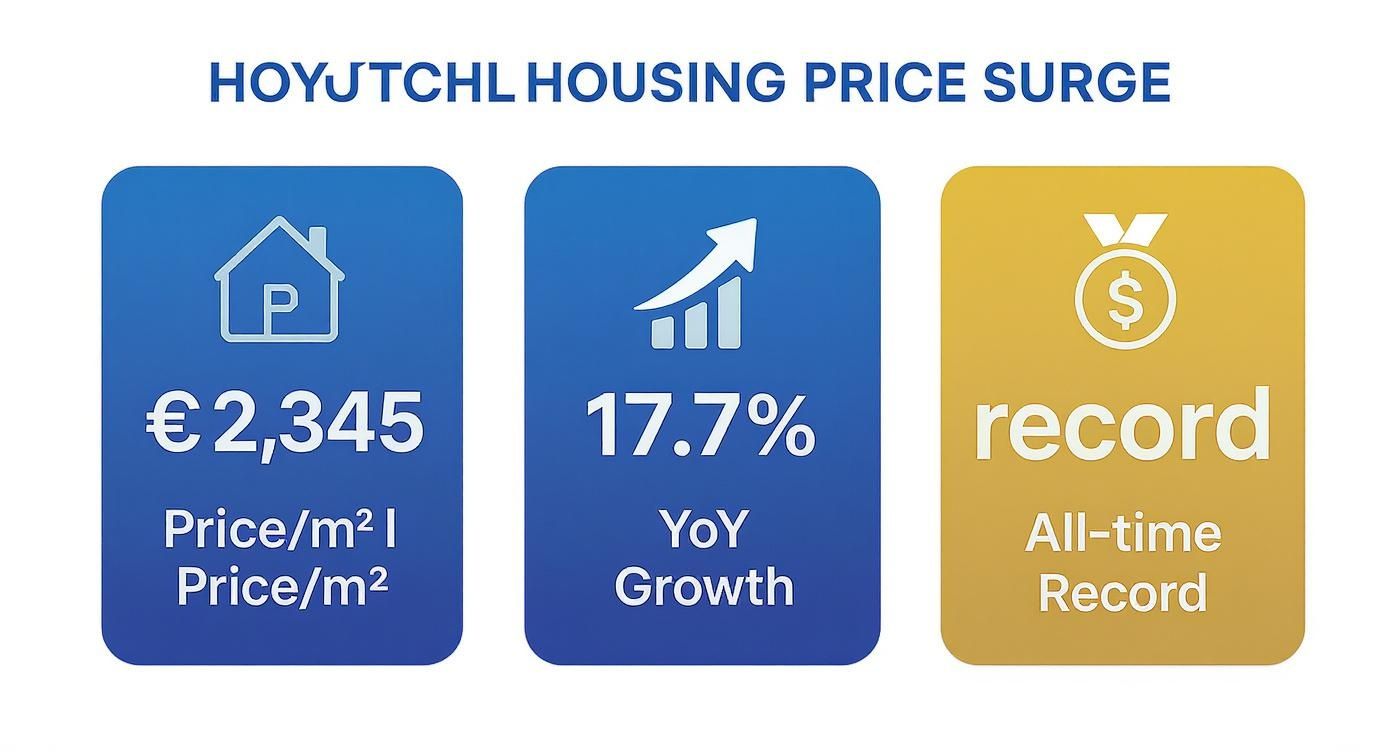
The headline numbers are impressive: a 17.7% year-on-year jump and a new record average of €2,345 per square metre. However, these figures are heavily skewed by the prime markets. A closer examination reveals a more complex picture.
The Established Prime Markets
Portugal’s property landscape is anchored by its "big three": Lisbon, Porto, and the Algarve. These regions attract the majority of international capital and consistently command the highest prices.
-
Lisbon: As the capital and a rapidly growing tech hub, Lisbon is comfortably the most expensive market. In sought-after central districts like Chiado or Príncipe Real, apartment prices average €6,000 to over €8,000 per square metre. This premium is fuelled by relentless demand from corporate relocations, digital nomads, and wealthy individuals, which helps maintain respectable rental yields despite the high entry cost.
-
Porto: Portugal's second city presents a compelling alternative. While very much a prime market, prices are more grounded than in Lisbon. Central properties typically average between €3,500 and €5,000 per square metre. Porto benefits from a diversified economy—a strong industrial base, a world-class university, and a booming tourism scene—creating balanced demand for both long and short-term rentals.
-
The Algarve: This sun-drenched southern coast is the heartland of tourism and lifestyle investment. Here, prices are dictated by proximity to the beach, golf courses, and marinas. A villa in a prime location like Vilamoura or Lagos can easily exceed €800,000, with average prices in popular coastal towns hovering around €3,400 per square metre. The market is highly seasonal but delivers some of the best short-term rental yields in the country.
Comparative Analysis of Regional Housing Prices
This table provides a breakdown of average prices and recent growth across Portugal's major investment regions. It highlights the significant price differences between prime coastal hubs and more affordable inland or emerging areas.
| Region | Average Price per m² (Apartment) | Average Price per m² (House) | Year-on-Year Growth (%) |
|---|---|---|---|
| Lisbon (Metropolitan Area) | €4,250 | €3,800 | 12.5% |
| Porto (Metropolitan Area) | €3,100 | €2,750 | 14.8% |
| Algarve | €3,400 | €3,750 | 16.2% |
| Silver Coast (Costa de Prata) | €2,400 | €2,200 | 11.5% |
| Central Portugal (e.g., Coimbra) | €1,850 | €1,600 | 9.8% |
| Northern Portugal (e.g., Braga) | €1,950 | €1,700 | 13.1% |
While prime markets offer prestige, emerging regions often demonstrate compelling growth from a lower base, signalling strong future potential.
High-Potential Emerging Markets
For investors seeking higher growth potential and a more attractive entry point, looking beyond the "big three" is essential. Several secondary cities and regions are experiencing robust growth, driven by local economic development, and are well-positioned for strong capital appreciation. These markets offer a different risk-reward profile, often with superior rental yields due to lower acquisition costs.
The key to identifying value is to spot regions with solid economic fundamentals before they appear on the mainstream investment radar. University-driven rental demand, new infrastructure projects, and growing local industries are all strong indicators of future growth.
Cities like Braga and Coimbra are excellent examples. Braga, with its burgeoning tech scene and young, educated population, is seeing steady growth in property values. Coimbra, home to one of Europe's oldest universities, has a perennially strong student rental market. In these cities, property can often be acquired for €1,500 to €2,500 per square metre, representing a significant value proposition.
Another area gaining traction is the Silver Coast (Costa de Prata). This stretch of coastline north of Lisbon, including towns like Nazaré and Peniche, offers a more authentic and affordable alternative to the Algarve. With prices typically between €2,000 and €2,800 per square metre, it is attracting both international buyers and Lisbon residents seeking weekend homes, creating a robust and growing market.
To place this in a wider context, it is useful to see how Portugal compares to other global hotspots. You can explore our overview of leading property investment countries around the world. This comparative analysis is vital for making an informed decision that diversifies your portfolio.
The Fundamental Drivers Shaping Market Values
To invest with confidence, one must look beyond headlines and understand the underlying reasons for market movements. The trends in Portugal housing prices are not arbitrary; they are the result of powerful, interconnected forces. A firm grasp of these fundamentals provides a solid framework for assessing market sustainability and future direction.

At its core, the Portuguese property market is driven by a classic economic principle: a structural imbalance between supply and demand. For years, the construction of new homes has lagged significantly behind soaring demand from both domestic and international buyers. This persistent shortfall creates a foundational pressure that supports property values, even during periods of economic uncertainty.
The Influence of International Demand
Consistent foreign investment has been the primary engine of growth for Portugal’s property market over the past decade. This demand originates from a diverse group, including British and EU retirees, American expatriates, and global investors seeking portfolio diversification. They have injected substantial capital into the market, particularly in prime coastal and city locations.
While initiatives such as the Golden Visa have been scaled back, their legacy endures. These programmes placed Portugal firmly on the global map for high-net-worth individuals, creating a self-sustaining reputation for stability and lifestyle appeal that continues to attract investment. This enduring international interest provides a crucial layer of support for property values.
Tourism's Direct Impact on Property Values
Portugal’s booming tourism industry is another critical driver. The country’s popularity as a top travel destination creates relentless demand for short-term rental properties, especially in Lisbon, Porto, and the Algarve. This has a direct impact on how investors calculate potential returns.
Properties holding a valid Alojamento Local (AL) licence for holiday lets can command premium prices because they offer the potential for significantly higher rental yields compared to long-term leases. This dynamic has a ripple effect, increasing the baseline value of all residential property in high-demand tourist zones and fuelling both capital growth and rental income potential.
A key takeaway for investors is that properties in areas with strong, year-round tourism often demonstrate greater resilience. The consistent demand from holidaymakers provides a reliable income stream that can help insulate an investment from fluctuations in the domestic long-term rental market.
Economic Factors and Buyer Behaviour
Broader economic conditions also play a significant role. Fluctuating interest rates, for example, directly affect the cost of borrowing for domestic buyers and investors using leverage. While recent rate rises have moderated activity in some market segments, the underlying demand from cash-rich international buyers has helped offset this, preventing a major price correction.
Furthermore, Portugal’s growing reputation as a hub for digital nomads and technology start-ups is introducing a new demographic of well-paid professionals into the rental market. This trend supports rental price growth in major cities, which in turn makes buy-to-let investments more attractive and further supports property valuations. It is always wise to understand property taxes in Portugal before committing, as they can significantly affect net returns.
How to Calculate Your Potential Return on Investment
Understanding market drivers and regional price differences is essential, but the true test of an investment is its financial performance. For any investor analysing Portugal housing prices, calculating potential return on investment (ROI) and rental yield is what separates speculation from a strategic acquisition. This process reveals how an asset truly performs beyond its purchase price.

A disciplined approach is required, looking past headline figures to account for all associated costs. A clear-eyed projection of your net returns is the only way to avoid common financial errors and ensure an investment aligns with your long-term objectives.
Gross Yield vs Net Yield: A Crucial Distinction
First, it is vital to understand the difference between gross and net rental yield. Gross yield is a simple, top-level metric, but it can be dangerously misleading because it ignores the real-world costs of property ownership.
- Gross Rental Yield: This is your total annual rent divided by the property's purchase price, expressed as a percentage. It is useful for a quick comparison but does not tell the full story.
- Net Rental Yield: This is the figure that truly matters. It takes your annual rental income, subtracts all yearly running costs, and then divides it by your total investment. This is the true measure of your property’s profitability.
To achieve an accurate forecast, you must be meticulous in accounting for all ongoing expenses. These include property taxes (IMI), condominium fees, insurance, property management fees, maintenance, and potential void periods.
A common error among new investors is underestimating these running costs. A property that appears profitable based on its gross yield can quickly become a financial liability once taxes, fees, and repairs are factored in. Always calculate the net yield for a true financial picture.
The Two Rental Models: Long-Term vs Short-Term Lets
Your potential yield will be heavily influenced by your chosen rental strategy. In Portugal, the market is split between traditional long-term leases and short-term holiday lets, known locally as Alojamento Local (AL). Each comes with distinct financial and operational considerations.
Long-term lets offer stability and a predictable income stream, typically attracting tenants such as local families, students, or professionals. Yields are generally lower but far more consistent, and day-to-day management is less intensive. Based on recent market data, gross yields for long-term rentals in major cities like Lisbon and Porto average between 5% and 6%.
Conversely, short-term lets with an AL licence can generate much higher yields, especially in prime tourist hotspots. The trade-off is greater operational complexity, higher management fees, and exposure to tourism trends and regulatory changes.
A Practical Case Study: Porto Apartment vs Algarve Villa
To illustrate this, let’s compare two hypothetical investments.
Scenario 1: A Modern Porto Apartment (Long-Term Let)
Consider a one-bedroom apartment purchased for €250,000. It is let on a long-term contract at €1,200 per month, generating a gross annual income of €14,400.
- Gross Yield Calculation: (€14,400 / €250,000) x 100 = 5.76%
- Annual Costs: Deduct likely annual costs: IMI tax (€400), condominium fees (€720), insurance (€150), and a small maintenance fund (€500). Total costs: €1,770.
- Net Income: €14,400 – €1,770 = €12,630
- Net Yield Calculation: (€12,630 / €250,000) x 100 = 5.05%
Scenario 2: An Algarve Villa (Short-Term Let)
Now, consider a two-bedroom villa in a coastal town, purchased for €450,000. Rented short-term, it might achieve 80% occupancy during the high season (6 months) at €200/night and 40% occupancy in the low season at €100/night. This generates approximately €43,200 in gross income.
- Gross Yield Calculation: (€43,200 / €450,000) x 100 = 9.6%
- Annual Costs: Costs are much higher: AL management fees (20% of income = €8,640), larger utility bills (€2,000), IMI tax (€900), cleaning (€3,000), and insurance (€400). Total costs: a substantial €14,940.
- Net Income: €43,200 – €14,940 = €28,260
- Net Yield Calculation: (€28,260 / €450,000) x 100 = 6.28%
This comparison clearly shows how an impressive gross yield can diminish once the higher running costs of a short-term let are accounted for. For a more detailed breakdown, explore our guide on how to calculate return on investment for real estate.
Portugal Versus Other European Property Markets
To accurately assess Portugal housing prices, it is essential to adopt a pan-European perspective. For any global investor, comparing Portugal against other popular destinations is a critical part of due diligence. This comparison reveals Portugal’s genuine value proposition, demonstrating how capital can work more effectively here than in more mature, and often saturated, markets.
The most immediate difference is the entry cost. Acquiring property in Portugal remains significantly more affordable than in many of its Western European neighbours. For a city-centre apartment, the average price is around €3,400 per square metre. This contrasts sharply with over €6,000 in France and the €14,000 required for a similar property in central London. You can explore more on the cost of living differences on Movingto.com.
This value gap is a powerful driver for investors seeking both long-term capital growth and immediate rental income.
Benchmarking Price and Yield
When comparing markets, price is only half the equation; rental yield is equally crucial. Here again, Portugal often outperforms its more expensive counterparts, delivering stronger gross rental yields. In Lisbon and Porto, it is not uncommon to see yields for long-term lets in the 5% to 6% range. Achieving similar returns in Paris or Munich is challenging due to prohibitively high property prices.
This attractive yield-to-price ratio means an investment begins generating a meaningful income stream much more quickly. For investors focused on cash flow, Portugal is a clear standout.
Portugal's competitive edge lies in a rare balance of affordability, solid rental yields, and an exceptional quality of life. This combination is difficult to find elsewhere in Europe and underpins the market's long-term investment appeal.
The Quality of Life Factor
Beyond the financial metrics, Portugal’s high quality of life provides a fundamental support for property values. Factors such as its excellent climate, high safety ratings (it frequently ranks among the world's safest countries in the Global Peace Index), and modern infrastructure make it a highly desirable place to live.
This lifestyle appeal is not a "soft" metric; it translates directly into sustained demand from tenants and future buyers—from retirees and digital nomads to young families. This consistent demand helps to de-risk an investment by ensuring a deep and diverse pool of potential renters and buyers. When deciding where to allocate capital, a detailed look at the best countries to invest in property can offer valuable perspective on how different markets balance risk and reward.
Navigating the Purchase Process for Foreign Buyers
Analysing Portugal housing prices is one component; understanding the mechanics of acquisition is just as critical. For foreign investors, the process is transparent and well-regulated. However, it demands a methodical, step-by-step approach to ensure a smooth transaction and avoid costly errors.
The process begins with two non-negotiable prerequisites. First, you must obtain a Portuguese fiscal number, known as a NIF (Número de Identificação Fiscal). This is essential for any significant financial activity in the country. Second, you must open a Portuguese bank account, as all funds for the purchase and associated taxes must pass through it.
Understanding Transaction Taxes
With your NIF and bank account established, the next step is to budget for acquisition taxes. These are one-off costs paid at the time of the transaction, and failing to account for them can disrupt your financial planning.
As a sound rule of thumb, set aside an additional 8-10% of the property's purchase price to cover all transactional fees and taxes.
The two primary taxes are:
- IMT (Property Transfer Tax): Officially Imposto Municipal sobre as Transmissões Onerosas de Imóveis, this is the most significant tax. Its rate is calculated on a sliding scale based on the property’s value, type, and intended use (e.g., primary residence vs. second home). Rates vary from 0% up to 7.5%.
- Stamp Duty (Imposto do Selo): This is a fixed tax charged on a wide range of official documents, including property deeds. For a property purchase, it is a flat rate of 0.8% of the declared value.
A critical point for investors is that both IMT and Stamp Duty must be paid before signing the final deed. The notary will require proof of payment to finalise the sale, making this an essential and time-sensitive step.
Your Ongoing Financial Responsibilities
Financial obligations do not end upon completion. Property ownership in Portugal entails an annual tax known as IMI (Imposto Municipal sobre Imóveis). This is a municipal property tax, analogous to council tax in the UK, set by the local council where the property is located.
The IMI rate varies by municipality but generally falls between 0.3% and 0.45% of the property’s tax-assessed value (which is often lower than its market price).
For properties valued over €600,000, an additional wealth tax called AIMI may also apply. Understanding these ongoing costs from the outset is fundamental to accurately calculating your net rental yield and the long-term cost of holding the asset.
Frequently Asked Questions on Portugal Housing Prices
Entering the Portuguese property market can raise many questions. This section addresses some of the most common queries from investors, offering clear, data-driven answers to help you build a confident investment strategy.
Consider this a practical checklist for your final due diligence, addressing key concerns from market stability to often-overlooked costs.
Are Portuguese Property Prices in a Bubble?
While prices have risen sharply, the consensus among analysts is that this is not a speculative bubble. The growth is supported by solid market fundamentals—namely, strong international and domestic demand meeting a chronic shortage of housing stock. This supply-demand imbalance provides a firm floor for valuations.
The primary debate in Portugal concerns local affordability, not a market bubble. For investors, the takeaway is to focus on properties with proven rental demand and genuine long-term value, rather than pursuing short-term speculative gains.
What Are the Hidden Costs of Buying Property in Portugal?
The listed price is just the starting point. You must budget for several additional costs. The two main taxes are the IMT (Property Transfer Tax), which is tiered based on the property’s value, and Stamp Duty (Imposto do Selo), a flat-rate tax.
In addition, you will have notary, registration, and legal fees. Once you own the property, an annual municipal property tax known as IMI is due each year.
As a reliable rule of thumb, it is prudent to set aside an additional 8% to 10% of the purchase price. This buffer should comfortably cover all transactional taxes and professional fees.
Which Regions in Portugal Offer the Best Growth Potential?
While Lisbon, Porto, and the Algarve are the established prime markets, they are not the only options. Several emerging areas show significant potential for capital growth, often with lower entry prices and superior rental yields.
- Braga and Coimbra: These dynamic university cities benefit from growing technology sectors and a consistent student population, which underpins strong rental demand.
- The Silver Coast: Stretching north of Lisbon, this coastline is becoming a popular and more affordable alternative to the Algarve, attracting both foreign buyers and Lisbon residents seeking better value.
These emerging regions offer an excellent opportunity for investors looking to position themselves ahead of the next wave of growth in Portugal’s dynamic property market.
At World Property Investor, we provide the in-depth analysis and data-driven guides you need to make informed decisions in global real estate. Explore our resources to compare markets and invest with confidence. https://www.worldpropertyinvestor.com