
Viewing property as an investment means acquiring a real estate asset not for personal residence, but to generate a financial return. At its core, it is a strategy for wealth creation through two primary mechanisms: consistent rental income and long-term capital appreciation.
This guide provides a practical framework for global investors, focusing on the fundamentals that underpin successful, data-driven decisions in the UK property market.
Why Property Remains a Cornerstone Investment
For global investors, 'bricks and mortar' remains a foundational component of a diversified portfolio. Unlike financial instruments such as stocks or bonds, property is a tangible asset. This physical nature provides a sense of security and control, acting as a real-world buffer against market volatility.
The primary appeal lies in its dual-return potential. The asset can generate regular dividends through rent, while the underlying value of the building and land can grow over time. This combination of immediate cash flow and long-term growth is a potent wealth-building engine.
The Dual Engines of Return
A successful property investment strategy does not force a choice between monthly income and future growth; it balances both.
- Rental Income: This is the regular cash flow generated from tenants. It is the revenue used to cover mortgage payments, insurance, maintenance, and any management fees. A well-chosen property should produce a positive net cash flow, providing a steady, predictable income stream.
- Capital Growth: This refers to the increase in a property's market value over time. According to data from the Office for National Statistics, UK house prices have shown a consistent upward trend over decades, weathering various economic cycles. This growth represents the profit realised upon the eventual sale of the asset.
A robust investment property is structured to deliver both monthly income and long-term appreciation. This creates a resilient asset that performs effectively across different economic conditions.
Stability in an Unpredictable World
Property also serves as an effective hedge against inflation. As the cost of living rises, rents and property values typically follow suit, enabling investment returns to keep pace. This intrinsic link helps to protect the real-world value of capital over the long term.
Furthermore, the use of a mortgage allows an investor to control a high-value asset with a relatively small initial capital outlay. This leverage can significantly magnify returns. For instance, a 5% increase in the value of a £200,000 property results in a £10,000 gain. If acquired with a £50,000 deposit, the return on the actual cash invested is 20%, before costs.
Understanding UK Property Market Cycles
A core principle of successful property investment is that the market moves in cycles. Property values do not follow a linear path; they ebb and flow in response to wider economic forces. Understanding this cyclical rhythm is what distinguishes a strategic long-term investor from a reactive speculator.
These cycles are driven by a confluence of factors. Interest rates, set by the Bank of England, directly impact mortgage affordability. Government policies, such as adjustments to Stamp Duty Land Tax or incentives for first-time buyers, can influence market sentiment. Broader economic conditions and employment levels also play a critical role in consumer confidence.
For a global investor, analysing the UK market through this cyclical lens is essential. It provides the necessary context to time an entry, manage risk, and maintain a long-term perspective unshaken by short-term market headlines. Historical data demonstrates that periods of rapid growth are often followed by corrections, which in turn pave the way for recovery and stabilisation.
Lessons from Past UK Market Cycles
Analysis of previous cycles offers a masterclass in risk management and market resilience. The period leading up to the 2008 global financial crisis serves as an instructive case study.
In the early 2000s, the UK property market experienced a significant boom, peaking in Q3 2007. When the crisis hit, prices fell by over 20% nationally by 2009. More recently, after a correction in 2022, the market has stabilised, with easing lending conditions supporting a year-on-year rise in house prices in Q4, according to Gov.uk data. Economic forecasts from major bodies project renewed growth as interest rates moderate, reminding investors of the long-term viability of UK property. You can explore detailed price history research from the Global Property Guide.
This historical context teaches a vital lesson: stress-test investments against potential interest rate rises and maintain sufficient cash reserves to navigate slower periods or temporary price declines.
Established vs Emerging Markets: A Comparison
Understanding market cycles is critical when comparing different investment locations, as each has a distinct rhythm and risk profile.
- Established Markets (e.g., London, South East England): These locations are akin to 'blue-chip' stocks. They typically offer lower rental yields but are perceived as lower risk due to deep-rooted demand and a long history of strong capital growth. Their cycles tend to be less volatile, but the entry cost is significantly higher.
- Emerging Markets (e.g., Manchester, Birmingham, Leeds): Often found in regeneration hotspots, these cities can provide much higher rental yields and greater potential for rapid capital growth. The trade-off is increased sensitivity to economic shocks, which can lead to more pronounced boom-and-bust cycles.
Your investment strategy should reflect this dynamic. A portfolio containing a mix of assets in both established and emerging locations can help to manage risk while capturing growth opportunities.
The Investor Takeaway
Proper due diligence is non-negotiable. It requires a focus on long-term fundamentals—such as transport links, local employment, and population growth—rather than chasing short-term market hype.
By understanding the cyclical nature of the UK property market, you can make more informed decisions, sidestep common pitfalls, and build a resilient portfolio designed for sustained, long-term success.
Choosing Your Property Investment Strategy
Selecting the right strategy is the most critical decision in your property investment journey. There is no single "best" approach; the optimal path aligns with your financial goals, risk tolerance, time commitment, and available capital.
Your choice will dictate everything from the type of property you seek to your level of day-to-day involvement. A hands-off investor prioritising steady, long-term growth will pursue a different route from one chasing maximum monthly cash flow, even if it entails greater management responsibilities.
Let us examine the most common strategies in the UK market to help you align your objectives with a clear, actionable plan.
The Classic Buy-to-Let
This is the foundational strategy for property investment. It involves purchasing a residential property and letting it to a single tenant or family on a long-term contract, typically for 12 months or more.
The appeal of a standard buy-to-let lies in its simplicity and dual return. You receive a steady rental income to cover the mortgage and other expenses, while also benefiting from potential capital appreciation over time. It constitutes the largest segment of the UK's private rented sector, ensuring generally consistent tenant demand.
- Best for: Investors seeking a balance of monthly income and long-term capital growth with moderate management demands.
- Risk Profile: Generally lower risk, provided the property is in a location with strong, stable tenant demand.
Houses in Multiple Occupation (HMOs)
For investors prioritising maximum monthly cash flow, an HMO can be highly profitable. An HMO is a property rented out by at least three people from different 'households' who share facilities like a kitchen and bathroom. This model is common for student housing or shared homes for young professionals.
By letting the property on a room-by-room basis, the total rental income can significantly exceed that of a single-family let. However, HMOs are far more management-intensive, involving multiple tenancies, higher tenant turnover, and stricter legal regulations concerning safety and local authority licensing.
Key Takeaway: While HMOs can generate excellent rental yields, often exceeding 8% in strong locations, they function as a business. They require more upfront capital for conversion, strict compliance with council regulations, and a hands-on management approach.
Short-Term and Holiday Lets
Powered by platforms like Airbnb, the short-term let market offers the potential for the highest rental returns of any residential strategy. A fully furnished property is let to tourists or business travellers on a nightly or weekly basis. In a popular tourist destination, the income can far surpass that of a traditional buy-to-let.
This is, however, the most hands-on strategy. It demands constant management of bookings, cleaning, guest communication, and marketing. Income can also be highly seasonal, and an increasing number of local authorities are introducing tighter regulations and licensing schemes.
Real Estate Investment Trusts (REITs)
For those seeking exposure to the property market without direct ownership, a Real Estate Investment Trust (REIT) is an excellent, hands-off option. REITs are companies that own and operate portfolios of income-producing properties, such as office buildings, shopping centres, or large apartment blocks.
Shares in a REIT can be purchased on the stock exchange, making it a liquid and accessible way to invest in property with minimal capital. Returns are delivered as dividends, but this strategy does not offer the leverage or direct control over capital growth associated with owning a physical asset. It is an ideal tool for diversifying a wider investment portfolio.
The diagram below illustrates the typical Boom, Correction, and Recovery cycle that all property investments, regardless of strategy, tend to follow.
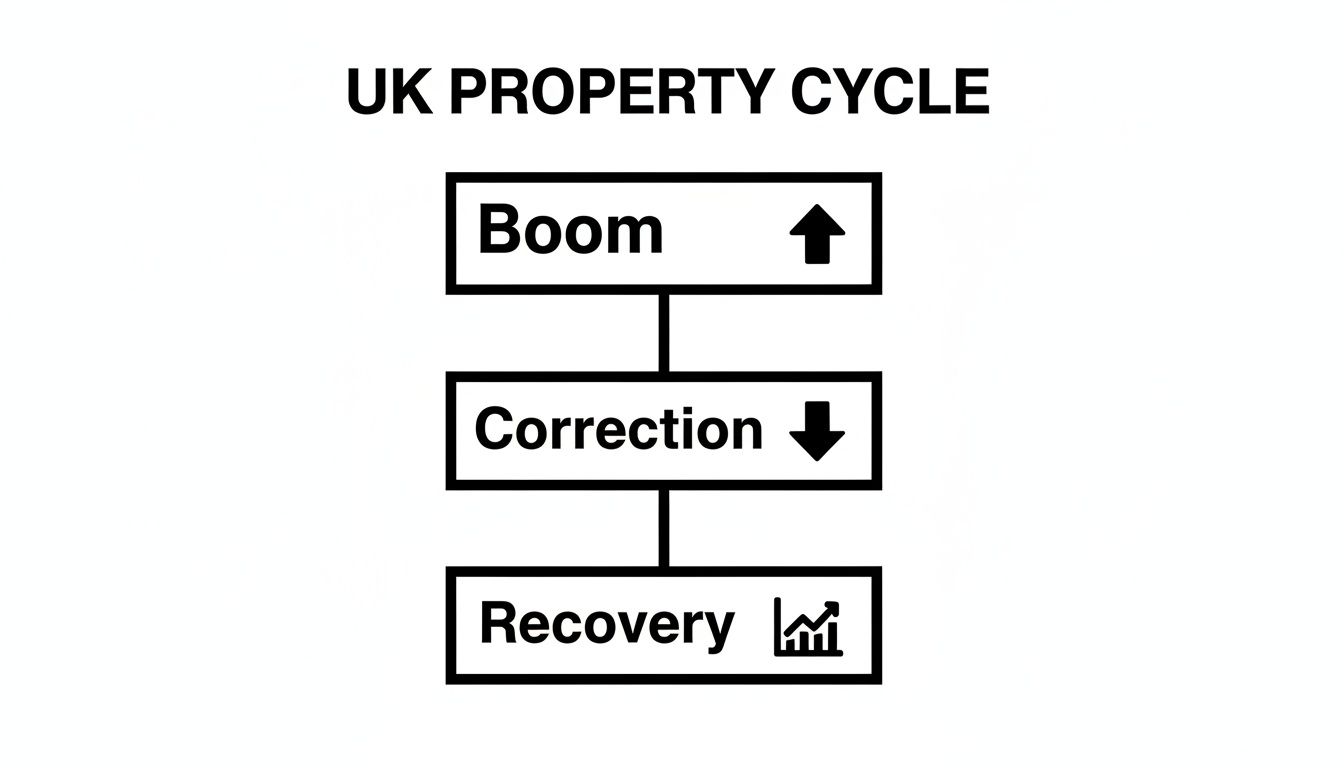
Understanding these phases reinforces the importance of a long-term view, as even the best strategy will encounter market fluctuations. For those considering another approach, our guide explains the pros and cons of buying off-plan properties.
Comparing UK Property Investment Strategies
The table below provides a snapshot comparison of these strategies, based on potential returns, management intensity, and capital requirements.
| Strategy | Typical Gross Yield | Management Level | Capital Requirement | Best For |
|---|---|---|---|---|
| Buy-to-Let | 4-6% | Low-Medium | Medium | Balanced income & long-term growth |
| HMO | 8-12%+ | High | High | Maximising monthly cash flow |
| Holiday Let | 10%+ (seasonal) | Very High | Medium-High | High returns in tourist locations |
| REIT | 3-5% (dividends) | Very Low | Very Low | Hands-off diversification & liquidity |
These figures are indicative. A well-chosen buy-to-let in a high-demand city can outperform a poorly managed HMO. The key is to select a strategy that aligns with your personal finances, lifestyle, and long-term ambitions.
How to Calculate Your Investment Returns
Successful property investment is based on accurate financial analysis. To determine if a property is performing effectively, it is essential to move beyond aesthetics and become proficient with key calculations.
Mastering these metrics demystifies the investment, transforming a hopeful venture into a predictable financial asset. It provides the confidence to assess whether a deal is genuinely strong or merely appears so on the surface.
Returns from property are generated by two distinct engines: rental yield (income) and capital growth (appreciation). A sound investment balances both, and understanding each separately is the first step toward building a resilient portfolio.
Calculating Your Rental Yield
Rental yield is a percentage that expresses the annual return from rent relative to the property's value. It is the most immediate measure of an investment’s cash flow performance.
It is crucial to distinguish between two types of yield.
Gross Rental Yield is a preliminary calculation that measures total annual rent against the property’s purchase price. While useful for an initial assessment, it ignores operational costs and can present an overly optimistic picture.
- Formula: (Annual Rental Income / Property Purchase Price) x 100 = Gross Yield %
Net Rental Yield is the true measure of profitability. It provides a clear view of the actual cash an investment generates after all expenses are paid.
To determine your real profit, you must calculate the net yield. This involves subtracting all operational costs—such as mortgage interest, insurance, letting agent fees, maintenance, and service charges—from your gross rental income before applying the formula.
A Practical Example in Manchester
Consider a real-world example of a two-bedroom flat purchased in a growing area of Manchester.
- Purchase Price: £250,000
- Monthly Rent: £1,200
- Annual Rent: £1,200 x 12 = £14,400
First, calculate the gross yield:
(£14,400 / £250,000) x 100 = 5.76% Gross Yield
Now, factor in annual costs to determine the net yield:
- Mortgage Interest: £5,000
- Insurance: £300
- Letting Agent Fees (10%): £1,440
- Maintenance & Repairs: £1,000
- Total Annual Costs: £7,740
Your Net Annual Rental Income is: £14,400 – £7,740 = £6,660
Now, we can calculate the net yield:
(£6,660 / £250,000) x 100 = 2.66% Net Yield
The net yield provides a much more sober and realistic assessment of the return. For a more granular analysis, our guide on how to calculate the return on investment (ROI) for real estate incorporates your initial cash deposit and acquisition costs.
Understanding Capital Growth
While rental yield measures income, capital growth—or appreciation—is the profit realised from an increase in the property's value over time. This is not cash-in-hand until the property is sold or remortgaged, making it a critical long-term component of your strategy.
The UK property market has a long, proven history of capital appreciation. Long-term data from major economic bodies shows a clear upward trend, delivering significant gains for patient investors who benefit from a powerful combination of capital growth and income stability. A successful property investment strategy always involves finding the right balance between yield and growth that aligns with your financial goals.
Finance and Tax Essentials for Global Investors
Investing in the UK property market from abroad requires a clear understanding of its specific financial and regulatory landscape. Mastering these rules is fundamental to budgeting accurately and forecasting returns effectively. For global investors, a firm grasp of non-resident finance and taxation is the bedrock of a successful long-term investment.
Securing the right financing is the first step. Non-resident investors typically face stricter lending criteria than UK residents, as lenders perceive them as carrying a higher risk profile.
This usually translates into a requirement for a larger deposit. While a UK resident might obtain a mortgage with a 15-20% deposit, an international buyer should be prepared to provide between 25% and 40% of the property's value. Engaging a specialist mortgage broker with experience in non-resident applications is invaluable, as they have access to lenders and products designed for your circumstances.
Navigating UK Property Taxes
Once financing is arranged, the next focus is the UK tax system. Three key taxes will impact your investment at different stages: upon purchase, during ownership, and upon sale.
-
Stamp Duty Land Tax (SDLT)
This tax is paid on the purchase of property in England and Northern Ireland. As an overseas buyer, you will almost certainly pay a higher rate. A 2% surcharge applies to non-UK residents on top of standard rates, which also include a 3% surcharge for anyone buying an additional property. This can add a significant sum to your initial acquisition costs. -
Income Tax on Rental Profits
Profit generated from renting out your UK property is subject to UK Income Tax. Under the government's Non-Resident Landlord Scheme, tax must be handled correctly. You can apply to receive rent gross and manage the tax yourself via an annual Self Assessment tax return. -
Capital Gains Tax (CGT)
Upon selling your UK property, you will be liable for Capital Gains Tax on any profit made from the increase in its value. The rate for residential property is higher than for other assets. It is crucial to keep meticulous records of all costs associated with buying, improving, and selling the property, as these can be deducted to reduce your final taxable gain.
Navigating these obligations is complex, and regulations can change. Professional advice is essential for structuring your investment in the most tax-efficient manner and ensuring full compliance with UK law.
For a more detailed breakdown, our guide on how to understand property taxes in the UK provides further clarity. Factoring these costs into your calculations from the outset is vital to avoid unwelcome surprises and ensure your investment delivers the expected returns.
How To Identify High-Growth Investment Locations

The adage that property is about "location, location, location" is the fundamental truth underpinning every successful real estate investment. An asset's performance is intrinsically linked to the economic and social health of its immediate environment.
Identifying a high-growth area before it reaches its peak is how astute investors unlock significant capital appreciation and secure robust rental demand. This requires looking beyond prime London postcodes.
While established markets offer stability, many of today's most compelling opportunities are in regional economic hubs like Manchester and Birmingham, or in towns benefiting from targeted regeneration. The key is to develop a data-driven methodology for identifying these locations, based on fundamentals, not market hype. Our guide on the role of location in real estate investment success explores this principle in greater depth.
The Four Pillars Of A High-Growth Location
A robust investment location is supported by four key pillars. Analysing these factors helps compare a high-capital, low-yield property in a prime central spot against a lower-entry, higher-yield opportunity in a growing northern city.
-
Economic Growth and Employment: A thriving local economy drives property demand. Look for areas with diverse employment sectors, major corporate investment, and job creation rates that exceed the national average. The arrival of major businesses attracts skilled professionals, creating a strong tenant pool.
-
Transport and Infrastructure: Connectivity is crucial. Major infrastructure projects, such as new rail lines like HS2 or Crossrail, act as powerful catalysts for property price growth. Always scrutinise an area’s transport links to major employment hubs and its future development pipeline.
-
Population Trends and Demographics: Growing populations create housing demand. Use data from sources like the ONS to identify areas with positive net migration, particularly those attracting young professionals and families. A rising population directly fuels both the rental and sales markets.
-
Regeneration and Government Investment: Areas undergoing significant regeneration often provide the greatest potential for capital uplift. Look for government-backed projects focused on improving public spaces, local amenities, and housing stock. These long-term commitments signal confidence in an area’s future.
Comparing Established And Emerging Markets
Applying this framework clarifies the risk-reward balance between different markets. An established market like central London offers perceived safety and deep-rooted demand, but its growth potential may be more modest and rental yields are often compressed, typically around 2-3%.
In contrast, an emerging city like Birmingham might offer rental yields of 5-6% or higher, coupled with stronger potential for capital growth as regeneration projects materialise. The perceived risk may be slightly higher, but the long-term fundamentals—a young population, major corporate relocations, and infrastructure upgrades—all point towards sustained growth.
The core of a successful property investment strategy is identifying locations where economic fundamentals are set to drive long-term demand. It is about investing where jobs, people, and infrastructure are heading, not just where they are today.
Historical data validates this strategic approach. Your task as an investor is to apply these foundational principles to identify the next generation of high-performing locations.
Common Questions from Global Property Investors
Entering a new market naturally raises practical questions. Below, we address some of the most common queries from global investors considering UK property, providing clear, actionable answers.
Is Property a Better Investment Than Stocks?
This question frames the choice as mutually exclusive, which is rarely how sophisticated investors operate. Property and stocks fulfil different roles within a well-balanced portfolio.
Property is a tangible asset that generates consistent rental income and has historically served as a strong hedge against inflation. Stocks, in contrast, offer greater liquidity and the potential for faster growth, albeit with higher volatility.
A sound wealth-building strategy rarely relies on a single asset class. It balances the stability and income of property as an investment with the growth potential of equities. The optimal allocation depends on your personal risk tolerance and financial objectives.
How Much Deposit Do I Need as an Overseas Investor?
You should anticipate needing a larger deposit than a UK resident. From a lender's perspective, overseas buyers may present a higher risk due to the complexities of verifying international income and credit histories.
As a general rule, be prepared to provide a deposit in the 25% to 40% range. This higher equity stake reduces the lender’s risk and demonstrates your financial commitment. It is advisable to work with a specialist mortgage broker experienced in non-resident applications.
For a deeper analysis, you can explore our complete guide on investing in overseas property.
What Are the Biggest Risks in UK Property Investment?
All investments carry risks, and property is no exception. The main risks to plan for include:
- Market Downturns: Property values can fall as well as rise, which could impact your capital growth.
- Void Periods: Gaps between tenancies result in a loss of rental income while costs such as mortgage payments continue.
- Unexpected Costs: Unforeseen maintenance, such as boiler failures or roof repairs, can arise.
- Rising Interest Rates: A variable-rate mortgage exposes you to increased monthly payments if interest rates rise.
A successful long-term strategy always includes a contingency fund to cover at least three to six months of expenses. This financial buffer, combined with a long-term outlook, is your best defence against these challenges.
At World Property Investor, we provide the data and analysis you need to navigate international markets with confidence. Explore our in-depth guides at https://www.worldpropertyinvestor.com to find your next investment opportunity.