
After several years of volatility, the global property market in 2025 is entering a phase of stabilisation and strategic re-evaluation. For most established markets, forecasts indicate modest, single-digit price growth. This marks a definitive shift from the post-pandemic frenzy, primarily because higher borrowing costs are constraining rapid price escalation.
Your 2025 Global Property Investment Outlook

This guide provides an authoritative briefing on the international real estate landscape for the year ahead. Market turbulence is subsiding, giving way to a new phase governed by solid fundamentals. The era of cheap credit and explosive capital growth is behind us; the focus is now on rental yields, sustainable cash flow, and long-term value.
This transition requires investors to be more discerning. The days of acquiring any property and expecting double-digit returns are over. Success in 2025 will be contingent on a clear understanding of regional economic disparities, demographic shifts, and local supply-and-demand dynamics. For a deeper analysis of core strategies, our guides on property investment offer essential background information.
Key Themes Shaping The Year Ahead
Three overarching themes will define the property market in 2025. A firm grasp of these will enable you to identify genuine opportunities and mitigate potential risks.
- Interest Rate Normalisation: Central banks globally are maintaining higher interest rates to control inflation. This directly impacts mortgage affordability, cooling buyer demand in many developed nations and placing a ceiling on price growth.
- The Primacy of Rental Yield: With capital growth slowing, strong and reliable rental income is paramount. Markets with robust rental demand—driven by factors such as population growth, urbanisation, or tourism—will be the most attractive for investment.
- Divergence Between Markets: The global property market is not monolithic. While established markets like the UK and parts of North America are stabilising, some emerging markets in Asia and the Middle East continue to exhibit strong growth potential. This creates a clear divergence in the risk-reward profile across different geographies.
A High-Level Snapshot
To ground your strategy, it is crucial to understand the broader context. The following table provides an at-a-glance comparison of expectations across different market types, helping to align your investment objectives with the appropriate global region.
2025 Global Property Market Snapshot
| Region/Market Type | Projected Price Trend (2025) | Key Driver | Investor Focus |
|---|---|---|---|
| Established (e.g., UK, USA) | Flat to Low Growth (+0% to +3%) | Economic Stability & Affordability | Strong Rental Yields & Long-Term Hold |
| Eurozone (e.g., Spain, Portugal) | Moderate Growth (+2% to +5%) | Tourism & Lifestyle Demand | Holiday Lets & Residency Schemes |
| High Growth (e.g., Dubai) | Strong Growth (+5% to +10%) | Safe-Haven Status & Pro-Investor Policy | Capital Appreciation & Premium Rentals |
| Emerging (e.g., SE Asia) | Variable Growth (+4% to +8%) | Urbanisation & Middle-Class Growth | Long-Term Growth Potential & Diversification |
This snapshot underscores the strategic shift for 2025: it is less about chasing short-term gains and more about selecting the right market for a specific strategy, whether that is stable income, steady growth, or a combination of both.
The Economic Forces Steering Global Real Estate
To accurately forecast the property market in 2025, one must first examine the underlying global economy. Macroeconomic forces are the powerful currents that steer real estate markets, dictating everything from buyer demand to investment returns. For any serious investor, understanding these forces is non-negotiable.
Foremost among these are the interest rate policies of central banks. Institutions such as the Bank of England and the U.S. Federal Reserve have spent recent years raising rates to bring inflation under control. The direct effect is an increase in borrowing costs, making mortgages more expensive and naturally cooling buyer demand. This is the primary reason rapid price growth has stalled in many established markets.
Looking to 2025, the key question is not if rates will decrease, but when and at what pace. A slow, measured reduction would improve affordability and gently stimulate market activity. However, if inflation proves persistent, rates could remain elevated for longer, continuing to act as a brake on price growth.
Inflation: The Unseen Architect of Value
Inflation's impact on property is twofold. On one hand, it erodes the real value of cash, often making tangible assets like real estate a more attractive safe haven. On the other, it is the primary target of the higher interest rates set by central banks. Monitoring inflation figures is therefore crucial.
When inflation remains high, so do borrowing costs, squeezing household budgets and reducing the pool of potential buyers. As inflation cools towards the central bank target (typically around 2%), it provides the necessary conditions for rate cuts, creating a healthier environment for property investment. The consensus for 2025 is a slow decline in inflation across most developed economies, suggesting that pressure will gradually ease.
Investor Takeaway: The relationship between inflation and interest rates is a balancing act. High inflation forces central banks to raise rates, slowing the property market. As inflation cools, rates can drop, providing the fuel for future growth.
Divergent Paths: North America vs. Europe and Asia
A defining feature of the 2025 landscape is economic divergence. The United States, for instance, has demonstrated surprising economic resilience, which may lead its Federal Reserve to adopt a more cautious approach to rate cuts compared to the European Central Bank, which is contending with more sluggish growth.
This divergence creates distinct opportunities and risks.
- North America: Markets in the US and Canada are closely tied to their central banks' decisions. A stronger economy could mean rates stay elevated for longer, a scenario favouring cash buyers and investors focused on rental yields over immediate capital growth.
- Europe: Facing weaker economic forecasts, the Eurozone may see earlier or deeper rate cuts. This could boost affordability and potentially reignite property price growth sooner, particularly in popular markets like Spain and Portugal.
- Asia: This region is a mix of economies. Established markets like Australia are tackling domestic inflation, while many emerging economies are powered by powerful internal trends like urbanisation and a rising middle class.
This varied economic climate means a one-size-fits-all approach is ineffective. A strategy that works in Florida could be entirely inappropriate for Lisbon. Investors must analyse the specific economic conditions of their target market, from local job growth to national GDP forecasts. Understanding these differences is also vital when structuring finance. Our detailed guide on financing an investment property offers deeper insights into navigating these different economic settings.
Forecasting Major Markets: The UK, USA, And Australia

While the global picture provides a broad framework, real returns are generated by understanding specific country dynamics. For 2025, established markets like the UK, United States, and Australia each present a unique narrative. Nuanced opportunities exist for investors who look beyond headline figures.
These mature markets are known for their stability and transparency, which often translates to slower growth compared to emerging counterparts. Success in 2025 will require a granular approach, focusing on regional differences and specific property types.
The United Kingdom: A Market Of Two Halves
The UK property market is increasingly fragmented. For investors in 2025, the most significant trend is the growing divide between London and the nation's northern cities. While the capital is constrained by an affordability ceiling, cities like Manchester, Leeds, and Liverpool demonstrate surprising strength, driven by regeneration, employment growth, and more attractive entry prices.
This regional divergence presents a clear strategic choice. London offers long-term stability but likely lower rental yields and flatter capital growth in the near term. Conversely, northern cities offer the potential for higher yields and stronger price appreciation, albeit with their own local economic risks. For any investor focused on income, exploring the best buy-to-let locations outside the capital is essential due diligence for 2025.
Another key trend is the performance gap between new-build and existing homes. Data from Gov.uk shows that while the UK housing market saw modest annual price growth, new-build properties significantly outperformed existing stock. This indicates a clear market preference for modern, energy-efficient homes and presents a distinct investment opportunity. For example, some official data has shown new-builds achieving double-digit annual price increases while existing resold properties grew by low single digits.
The United States: A Story Of State-Level Divergence
In the USA, federal interest rate policy sets the national tone, but the real action occurs at the state level. The 2025 property forecast reveals starkly different conditions from coast to coast. States like Florida and Texas continue to benefit from domestic migration, fuelled by lower taxes and business-friendly policies that sustain strong housing demand.
In contrast, high-cost states like California and New York are experiencing a slowdown. Here, affordability challenges are more acute, leading to flatter price growth and a market that is far more sensitive to interest rate fluctuations. This has created a landscape where investment strategy must be intensely localised.
Investor Takeaway: For US investors in 2025, looking beyond national averages is critical. The performance of a rental property in Austin, Texas, will be driven by a completely different set of economic forces than a similar property in Los Angeles, California.
Australia: The Supply and Demand Conundrum
Australia’s major property markets, particularly Sydney and Melbourne, continue to be defined by a fundamental mismatch between housing supply and population growth. Consistently high levels of immigration support demand for both rentals and sales, providing a solid floor for prices even as borrowing costs have risen.
This dynamic makes Australia a compelling market for long-term investors. The demand is demographic, not speculative, suggesting a stable outlook for both rental income and capital growth. The primary challenge is the high cost of entry, making this a market better suited to well-capitalised investors.
- Sydney: Remains Australia's most expensive market, where a chronic undersupply will almost certainly support property values.
- Melbourne: Is experiencing similar demand pressures, with its diverse economy and lifestyle appeal drawing a steady flow of new residents.
- Brisbane & Perth: Offer more affordable alternatives with strong growth prospects, benefiting from interstate migration and major infrastructure investment.
For 2025, the Australian property forecast suggests that while the pace of price growth may moderate, the core fundamentals remain incredibly strong. Investors able to overcome the high barrier to entry will find a market supported by some of the most robust demographic trends in the developed world.
Finding Europe’s Property Hotspots
Mainland Europe has long attracted global property investors with its blend of lifestyle appeal and solid financial returns. As we look towards 2025, the market is shaped by the post-pandemic travel boom, evolving residency schemes, and significant demographic trends. While established favourites offer stability, a few high-risk, high-reward outliers are creating different opportunities.
To identify where true value lies, one must look past the picturesque scenery and analyse the economic fundamentals driving each market.
Established Favourites: Spain and Portugal
Spain and Portugal remain at the top of most international buyers' lists. Both countries offer a high quality of life, relatively affordable property, and robust rental markets. Demand is supercharged by tourism and a steady influx of remote workers seeking a sunnier climate.
The post-pandemic travel rebound has been a significant boon, especially for holiday lets in coastal hotspots and major cities.
Furthermore, the rise of the digital nomad has transformed cities like Lisbon, Porto, and Malaga into year-round hubs for location-independent professionals. This has created a reliable, long-term rental market that did not exist a decade ago. Astute investors are targeting well-located apartments that appeal to this demographic, often achieving rental yields that surpass those in their home markets.
Investor Takeaway: While the 'golden visa' programmes in Spain and Portugal have recently been modified, their legacy has cemented these countries on the global investment map. The influx of foreign capital has significantly supported property values over the past decade. Investors must now watch for regulatory risks, as local councils introduce new rules to control the short-term rental market, which can impact potential returns.
High-Risk, High-Reward: The Case of Turkey
For investors with a greater appetite for risk, Turkey presents a fascinating, if volatile, option. The country's economic challenges, including high inflation and currency devaluation, have created a uniquely complex investment environment. While property prices in Turkish Lira have soared, this does not reflect the full picture for a foreign investor.
The real opportunity emerges when prices are converted to a stable currency like the US Dollar or the Euro. The Lira's devaluation means foreign buyers can acquire property at a significant discount compared to a few years ago. This opens up the potential for substantial capital gains if the currency stabilises or appreciates.
This currency play is the essence of the high-risk, high-reward strategy in Turkey.
- The Reward: Buying with a hard currency (e.g., Euros, Dollars) when the Lira is weak could result in a dramatic increase in the asset's value in your home currency if the Lira strengthens, independent of local property price movements.
- The Risk: Conversely, if the Lira continues to fall, it will erode the value of your investment and any rental income collected in the local currency.
Economic instability also creates unusual local market dynamics. While it can suppress domestic demand, it makes Turkish property highly attractive to international buyers, especially from the Middle East and Russia, who are seeking a safe haven for their capital. Investing in a market like Turkey requires a different mindset to buying in Spain; it is less about steady rental income and more a speculative play on a macroeconomic turnaround. Our guide on the best countries to invest in property provides a wider comparison to help weigh these complex decisions.
Spotlight On High Growth And Emerging Markets
Beyond the predictable stability of established property markets lie the frontiers of investment. These are dynamic, fast-evolving regions where the potential for significant returns is matched by a unique set of challenges. For investors seeking to enhance their portfolio in 2025, a strategic allocation to these high-growth markets could be a powerful way to diversify and capture raw, demographically-driven growth.
These markets are not for the risk-averse, but for those who conduct thorough due diligence, the rewards can be substantial. Here, we examine two distinct high-growth environments: the established safe-haven of Dubai and the demographically supercharged economies of Southeast Asia.
Dubai: A Unique Safe Haven
Dubai has firmly established its status as a global property hotspot, and its momentum shows no signs of abating. It operates differently from most other major cities, acting as a magnet for international capital seeking security, a low-tax environment, and a luxury lifestyle. This sustained global demand continues to fuel growth across its luxury and mid-market segments.
The emirate's appeal is built on several key fundamentals:
- Pro-Investor Policies: The government actively encourages foreign investment with minimal property taxes, attractive investor visa programmes, and transparent ownership laws.
- Economic Stability: While much of the world grapples with uncertainty, Dubai's economy remains robust, attracting wealth from regions experiencing political or economic turmoil.
- Sustained Demand: A constant influx of expatriates, high-net-worth individuals, and tourists keeps both the rental and sales markets buoyant, supporting strong rental yields and capital appreciation.
Investor Takeaway: For investors in 2025, Dubai represents a compelling blend of high-growth potential and relative security. It is less about speculating on emerging trends and more about investing in a proven, globally recognised hub that continues to attract wealth and talent.
The Demographic Powerhouses Of Southeast Asia
Shifting focus to the East, markets in Southeast Asia present an opportunity driven by powerful, long-term internal forces. Countries like Vietnam, Thailand, and the Philippines are at the epicentre of two major demographic shifts: rapid urbanisation and the rise of a vast middle class.
This creates a potent formula for property market growth. As millions move from rural areas to cities for better employment, demand for housing escalates. Concurrently, as household incomes rise, a newly affluent middle class seeks to buy their first homes, upgrade their living standards, and invest in property themselves.
Vietnam serves as an excellent case study. Its fast-growing economy and young, ambitious population are generating enormous demand for urban housing in cities like Ho Chi Minh City and Hanoi. While foreign ownership laws can be complex, the underlying growth story is one of the most compelling in the world. Investors who can successfully navigate these markets are positioning themselves to benefit from decades of demographic tailwinds. To learn more, explore our breakdown of the top emerging property investment markets for a wider perspective.
The following decision tree helps illustrate the risk-reward spectrum when considering different types of overseas property investments.
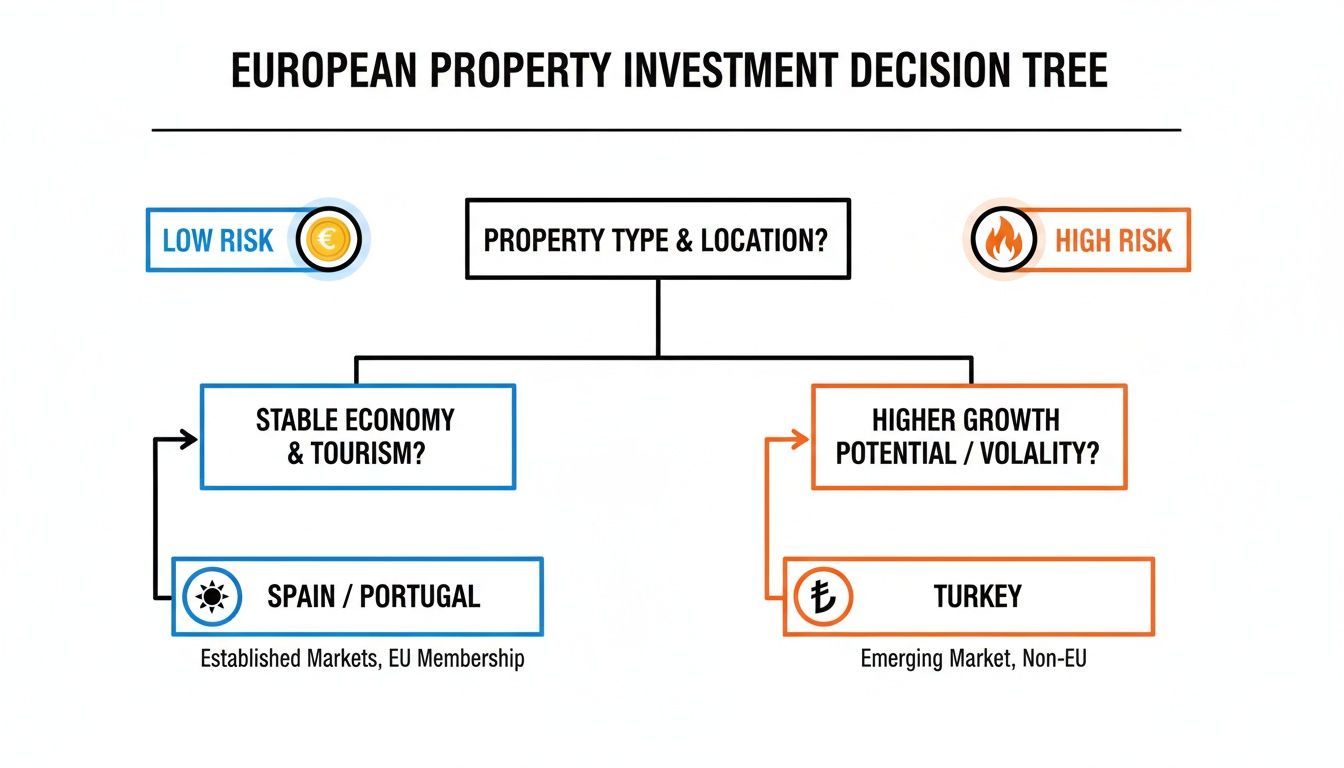
This visual guide contrasts lower-risk European sun-belt locations like Spain with higher-risk, higher-reward markets like Turkey, helping you align your strategy with your own appetite for risk.
Due Diligence Is Non-Negotiable
Investing in these promising but complex environments demands a level of due diligence far exceeding that required in your home country. The potential for high returns is always accompanied by higher risks.
Before committing capital, your checklist must include a thorough investigation of:
- Foreign Ownership Laws: Can you legally own freehold property, or is it a leasehold? Are there restrictions on the type or location of property you can buy?
- Political and Economic Stability: Assess the country's political climate and economic outlook. Currency volatility, in particular, can significantly impact returns when repatriated.
- Legal Framework and Taxation: Understand the local property acquisition process, associated taxes (e.g., stamp duty, capital gains tax), and the legal protections in place for foreign investors.
High-growth and emerging markets offer a compelling narrative for 2025 and beyond. By focusing on fundamentals and conducting rigorous due diligence, you can position yourself to capitalise on some of the most powerful economic and demographic trends globally.
Your Strategic Investment Playbook for 2025
Translating global trends into a personal action plan is what separates successful investors from the rest. The 2025 market is not a place for broad, sweeping bets; it demands a targeted approach built around your own financial goals, risk tolerance, and investment horizon.
The central question for many will be how to balance the pursuit of rental income (yield) against the potential for long-term capital growth. In established, slower-moving markets like the UK or parts of the US, a focus on high-demand rental areas can deliver steady, reliable cash flow. By contrast, some emerging markets might offer lower initial yields but hold far greater promise for price appreciation over the next decade.
Tailoring Your Investment Approach
Different objectives require different strategies. The first step is to define what kind of investor you are, as this will shape where you look and what you purchase.
- The Yield-Focused Investor: This investor prioritises immediate, consistent income. The best targets are properties in university cities or urban centres with strong, diverse economies. The goal is durable tenant demand that minimises void periods, not short-term price jumps.
- The Growth-Oriented Investor: This individual is comfortable with higher risk in pursuit of significant capital gains. They should research markets poised to benefit from major infrastructure projects or powerful demographic shifts, such as select cities in Southeast Asia or specific districts in Dubai.
- The Balanced Investor: Seeking a blend of income and growth, this investor might consider established European lifestyle destinations like Spain’s Costa del Sol. Here, a robust tourism market provides solid rental returns, while the area's long-term desirability underpins steady value appreciation.
A Longer-Term Perspective Beyond 2025
While this forecast focuses on the year ahead, prudent investors always maintain a long-term perspective. Following a relatively subdued 2025, many analysts predict a return to more robust growth.
Projections from credible sources like Savills, for example, have previously forecast significant cumulative UK price growth over a five-year period. This is typically driven by improving economic conditions and wage growth eventually outpacing property price rises. This long-term view reinforces the idea that 2025 could represent a strategic entry point before the next growth cycle begins in earnest.
You can discover more about what to expect from the housing market on Strutt & Parker's knowledge hub.
Your Questions Answered
Navigating the global property market naturally raises questions. Here are clear, practical answers to some of the most common queries for 2025.
Is 2025 A Good Year To Buy Investment Property?
For the strategic investor, yes. The market has moved beyond the frantic price hikes of recent years into a more measured, sustainable phase.
This environment is ideal for investors who prioritise long-term fundamentals, such as solid rental yields and genuine demographic demand. With borrowing costs stabilising and fewer speculative buyers, diligent research can uncover true value. The focus should be less on timing the market perfectly and more on acquiring a quality asset in a location with proven fundamentals.
Which Markets Offer The Best Rental Yields in 2025?
The best rental yields are typically found where there is a disparity between property prices and strong local rental demand. For 2025, several areas stand out:
- UK Northern Cities: Cities like Manchester and Leeds continue to offer attractive yields. They are magnets for young professionals and students, ensuring high tenant demand, while property prices remain more accessible than in London.
- European Lifestyle Hubs: Locations in Portugal and Spain popular with digital nomads, tourists, and expatriates can generate strong income from both short and long-term lets.
- Dubai: Despite significant price growth, Dubai’s rental market remains a powerhouse. The constant influx of expatriates sustains incredibly strong demand, delivering some of the most competitive yields of any major global city.
Investor Takeaway: Remember that the headline yield is not the whole story. You must always deduct local taxes, management fees, and potential void periods. Your net yield is the only figure that provides a true measure of profitability.
What Are The Biggest Risks Facing Property Investors in 2025?
The primary risk remains persistently high interest rates in major economies. If central banks are forced to keep rates higher for longer than anticipated, it will continue to dampen buyer demand and cap price growth.
Regulatory change is another key risk, particularly for short-term lets. Cities across Europe are implementing stricter licensing and new taxes, which can directly impact the profitability of a holiday rental. Finally, for those investing in emerging markets, currency volatility is a constant factor that can erode returns when repatriating funds. A well-diversified portfolio across different markets is a proven method for mitigating these local risks.
At World Property Investor, we provide the in-depth analysis and on-the-ground insights you need to navigate these challenges and opportunities. Explore our comprehensive guides to make your next international investment with confidence. https://www.worldpropertyinvestor.com