
A tenant in England spent 36.3% of household income on an average-priced private rental home in 2024, above the 30% affordability benchmark used by the Office for National Statistics (ONS private rent affordability data). That figure changes the question behind a rental income required calculator. The required rent is not just the amount a household can afford, nor is it automatically the rent that makes a property financeable.
For an investor, there are at least three separate answers: the rent a tenant can reasonably support, the rent a mortgage lender requires under stress testing, and the income left after operating costs, vacancies and tax-sensitive assumptions. Overseas buyers face another layer, because currency movements, remote management and local rules can make a property appear stronger in sterling or euros than it is in the investor's own financial position.
A useful calculator must expose those differences instead of hiding them inside one headline yield.
Table of Contents
- Modern Rental Yields: Gross Figures Versus Spendable Cash Flow
- Core Components of the Rental Income Formula
- Navigating Mortgage Affordability and Stress Tests
- Designing Your Investment Profitability Model
- International Considerations and Hidden Risks
- Practical Scenarios and Common Pitfalls
Modern Rental Yields: Gross Figures Versus Spendable Cash Flow
UK rents remain high, although growth has slowed. ONS-linked reporting placed average UK private rent at £1,368 a month in December 2025, up 4.0% year on year, the lowest annual growth rate reported since May 2022 (rental market reporting). Figures for July 2025 showed an average of £1,343, with England at £1,398, Wales at £807, Scotland at £999 and London at £2,250.
Provisional ONS figures for the 12 months to June 2026 put average UK private rent at £1,388 a month, an annual increase of 3.3%. Regional differences remained substantial: England stood at £1,446, Wales at £843 and Scotland at £1,012 (ONS private rent and house prices).

Gross rent is not spendable income
A respectable gross yield can still produce weak cash flow. Gross annual rent is the starting revenue figure, before letting or management charges, repairs, insurance, service charges, compliance work, void periods and refinancing costs reduce the amount available to the owner.
HM Revenue & Customs' property rental income statistics cover unincorporated landlords and declared property income across five tax years, from 2020–21 through 2024–25. The latest results recorded 2.88 million unincorporated landlords declaring rental income in 2024–25, while 88% claimed some form of expense (HMRC property rental income statistics). London-based landlords represented 17% of landlords but 28% of property income, illustrating how location can distort national assumptions.
Practical rule: Treat gross rent as turnover. Treat net cash flow as the amount available after the property's full operating and financing costs.
An overseas investor comparing London with a regional city should enter a local rent assumption rather than apply a UK average to every property. PropLab on rental yield math explains the distinction between gross and net calculations, while this rental yield explanation places both measures in a property-investment context.
Tenant affordability and lender affordability can point to different rents. A household may support the local asking rent, while a lender may require more income coverage after applying interest-rate stress tests. Overseas investors may face stricter assessments because currency movements and additional regulatory risks affect the lender's view of repayment capacity.
Slower rent growth adds another risk. A deal that depends on rapid increases becomes less resilient when tenant costs are already high and future growth is uncertain. The useful question is whether the property still produces acceptable cash flow after realistic leakage and weaker growth, not just what rent it can achieve.
Core Components of the Rental Income Formula
A practical rental income required calculator should separate income, operating costs and finance rather than blend them into a single yield. A useful baseline is:
Required gross rent = operating costs + required mortgage coverage + target cash reserve + expected income leakage
That formula isn't a tax calculation or a lender approval. It's a decision model that helps an investor identify the rent the property needs before optimistic assumptions are allowed to influence the result.
Start with the property cost stack
Enter the recurring costs that arise even when the property is occupied:
- Mortgage interest: For an interest-only loan, this is the main finance cost used in the cash-flow calculation. A repayment mortgage also requires capital repayment, which affects monthly cash flow even when a lender's interest coverage test focuses primarily on interest.
- Insurance: Include buildings or landlord cover where the owner pays it, plus specialist cover for holiday lets or unusual property risks.
- Management and letting: A remote owner may need tenant-find, renewal, inspection or full management services. For a holiday home, use the relevant booking and operational charges rather than assuming a long-term tenancy model.
- Repairs and maintenance: Allow for routine repairs, appliances, decorating and property wear. A low-maintenance year shouldn't become the permanent assumption.
- Service charges: Flats and managed developments may carry service charges, reserve contributions or other building costs that don't appear in the advertised rent.
- Compliance: Safety checks, licensing, certificates and required remedial work belong in the model when they apply to the property or tenancy.
- Council tax and utilities: Clarify which costs the tenant pays and which remain with the landlord. Holiday lets and furnished properties often have a different cost profile from a standard tenancy.
- Void and collection loss: Model periods without rent, late payment and reletting costs instead of assuming twelve identical receipts.
The distinction between gross yield and net yield is explained in more detail by this guide to gross yield versus net yield. It matters because the same rent can produce very different outcomes depending on the property's service charges, management arrangement and financing.
Convert annual costs into a rent requirement
Add the annual operating costs, then add the lender's assessed finance requirement. If the result is a minimum net figure, gross it up for costs charged as a percentage of rent and for expected voids. A management charge based on rent, for example, rises as the rent assumption rises, so it shouldn't be treated as a fixed amount.
Short-term and holiday-let owners need a different income structure. Separate peak-season bookings, shoulder-season demand, cleaning, platform charges and owner use. Resources discussing fair rates for family getaways are useful for pricing context, but a pricing strategy isn't a substitute for a full cost model.
The calculator should show at least four lines: gross annual rent, operating costs, mortgage cost and net cash flow. It should also show whether the rent is a market estimate, a signed lease figure or an investor's forecast. Those inputs carry different levels of certainty.
Navigating Mortgage Affordability and Stress Tests
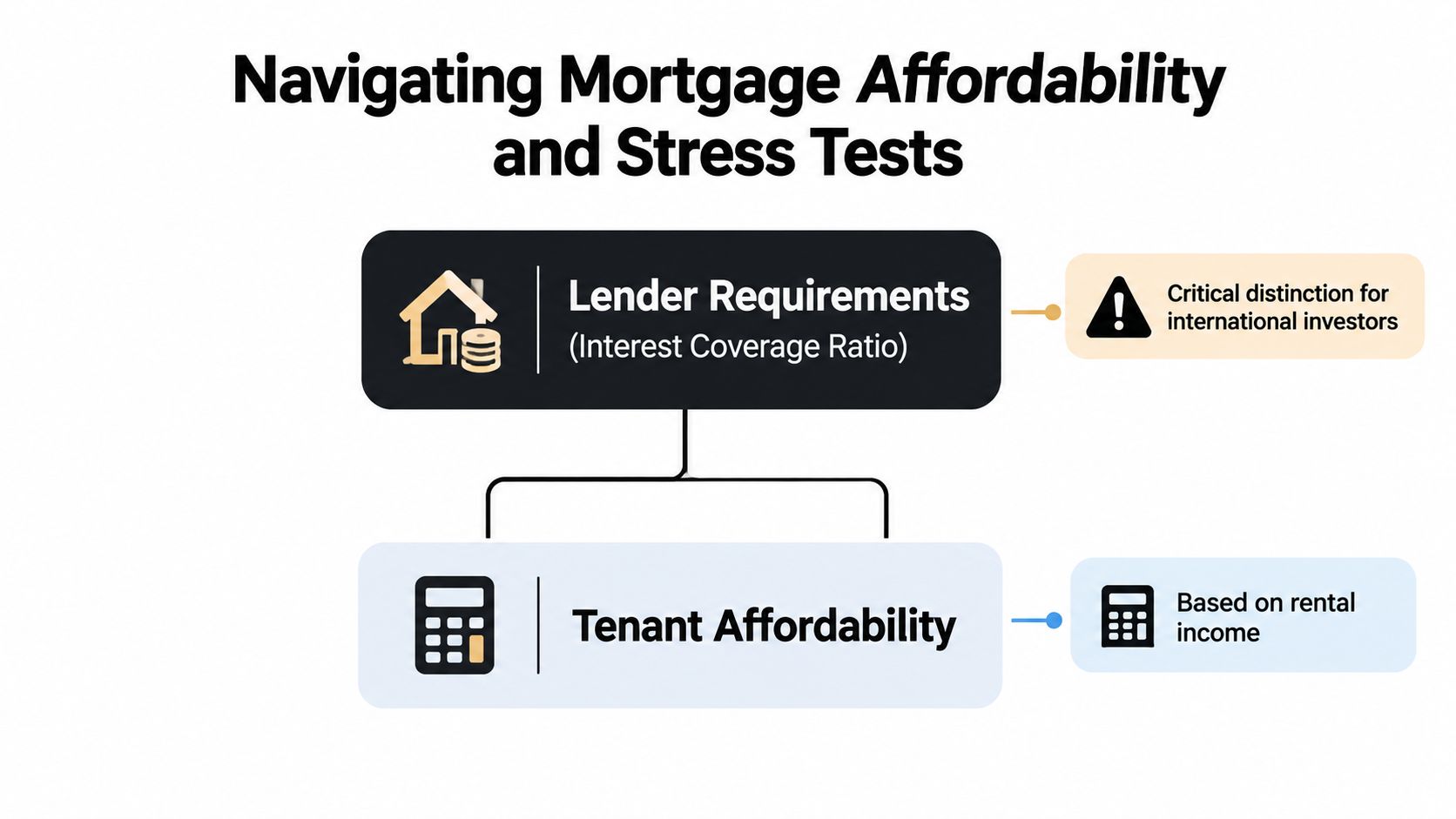
A property can support a tenant's rent budget and still fail a lender's affordability test. Tenant affordability measures how much rent a household can sustain from its income. Lender affordability measures whether projected rent covers mortgage interest calculated at a stressed rate and the required coverage threshold. The first test focuses on household finances. The second focuses on the loan's ability to withstand higher financing costs.
The PRA defines the Interest Coverage Ratio, or ICR, as expected monthly rental income divided by monthly mortgage interest. Lenders must account for possible future interest-rate increases when assessing affordability. The Bank of England reported that lenders commonly test buy-to-let applications against a minimum ICR of 125%, using stressed interest rates and basic-rate income tax assumptions (PRA supervisory statement).
How ICR changes the required rent
Assume the lender assesses monthly interest at £1,000. A 125% ICR requires £1,250 of monthly rent. If the lender uses a 167% threshold, the required rent rises to £1,670. The higher figure is an approximate breakeven level identified for higher- and additional-rate taxpayers.
The formula is:
Required rent = assessed monthly interest × ICR
Assessed interest may differ from the mortgage payment shown in a product illustration because underwriting can use a stressed interest rate. Tax assumptions can also affect the threshold applied to the application. A calculator should therefore display both the 125% and 167% results rather than imply that one rent figure applies to every borrower.
Loan structure changes the cash-flow interpretation. For interest-only borrowing, the coverage calculation focuses on interest. For repayment borrowing, the PRA framework allows lenders to consider whether personal income and rental income can support both interest and capital payments where relevant. A property can pass an interest-only coverage test while producing tighter monthly cash flow once capital repayment is included.
Why overseas investors need a wider margin
Overseas investors may receive rent in sterling while earning income, servicing debt or measuring wealth in another currency. Exchange-rate movements can reduce the value of remitted rental income without changing the UK rent or mortgage payment. Lenders may also apply different requirements to documentation, source of funds and the borrower's wider income position, depending on the product and applicant profile.
These factors make a single rent estimate unreliable. Run the property using the lender's quoted stressed rate and both ICR thresholds, then compare those outputs with the rent local tenant incomes can support. A Mortgage Calculator from Bluevectis can help model borrowing mechanics, while this guide to calculating debt-to-income helps distinguish a personal affordability measure from a property coverage measure.
Two failure points follow. The property may pass the tenant test but fail the lender's ICR because the stressed interest calculation demands more rent. It may also pass lender coverage only because the assumed rent exceeds what the local household market can sustain. Overseas buyers face an added margin of uncertainty from currency movements and lender-specific regulatory checks. A viable investment must satisfy both affordability tests using assumptions that remain credible under stress.
Designing Your Investment Profitability Model
A useful profitability model separates assumptions from decisions. Start with visible inputs for purchase price, deposit, mortgage balance, interest rate, mortgage type, local rent, management arrangement, service charges, insurance, maintenance, voids and any target reserve. Each figure should be easy to challenge or replace without rebuilding the spreadsheet.

Build the calculator around decisions
The model should produce separate outputs rather than compressing everything into one score:
- Tenant maximum rent: Estimate the rent households can support using income and local affordability assumptions. England's 36.3% median renter burden in 2024 sits above the ONS's 30% benchmark, while Wales recorded 25.9% and Northern Ireland 25.3%, according to the ONS affordability comparison.
- Lender minimum rent: Calculate the rent required under the selected ICR and stressed interest assumption.
- Owner break-even rent: Find the amount needed after operating costs, voids and mortgage payments to avoid negative cash flow.
- Local affordability warning: Flag cases where the required rent is materially above what local incomes appear to support.
The comparison exposes a problem that gross yield can hide. A property may produce an acceptable headline return yet require rent beyond the tenant market. In that case, the purchase price or loan structure may be the constraint, rather than the letting strategy.
Show repayment borrowing on its own cash-flow line. Interest-only borrowing can reduce monthly outflow while leaving the capital balance largely unchanged. Repayment borrowing directs part of each payment toward debt reduction. Compare monthly cash flow, total debt reduction and refinancing exposure before choosing between them.
Use scenarios rather than a single forecast
Create base, downside and severe-downside cases. Test lower achievable rent, a longer void, a material repair, higher service charges, a stressed refinancing rate and an adverse currency conversion. Change assumptions individually first, then combine weaker conditions to see whether the investment remains serviceable.
A sound model doesn't predict the future. It shows which assumption can break the deal.
Overseas owners should maintain a home-currency view beside the sterling view. Record UK property income, mortgage payments and operating costs in sterling before converting the resulting cash flow using a conservative planning assumption. This separates property performance from the effect of exchange-rate movements and makes the remittance risk visible.
A cash-on-cash return guide can help compare the return on deposited capital across opportunities. That measure should sit beside, rather than replace, the required-rent calculation because it does not show whether tenant affordability, lender coverage and owner break-even requirements align.
Update the model when the mortgage offer changes, a tenancy is renewed, costs rise, a service-charge budget is revised or market rent is re-evaluated. Overseas borrowers should also revisit assumptions when lender documentation or regulatory requirements change, since a property can pass the tenant affordability test while failing lender stress testing.
The video below offers another way to consider how a property calculator can present changing assumptions and outcomes.
International Considerations and Hidden Risks
Cross-border property analysis fails when it treats the UK property as an isolated asset. Overseas investors often measure returns in a home currency, fund deposits from overseas income and rely on local agents to manage tenants, repairs and compliance. Each step introduces uncertainty that a domestic rent-only calculator may omit.
Currency risk is the most obvious example. Rent can remain unchanged in pounds while its value falls after conversion into the investor's home currency. Mortgage payments can create a partial offset if the debt and income are both sterling-based, but an investor who funds costs from abroad may still face an exchange-rate shortfall.
A risk-adjusted model should show both property cash flow in sterling and remitted cash flow in the investor's home currency. The latter should be tested under weaker exchange-rate assumptions, with transfer fees and timing considered qualitatively where exact costs aren't known. A guide to hedging currency risk can help frame that decision, but hedging doesn't remove the underlying exposure or guarantee a better outcome.
Legal and operational friction
Foreign ownership rules, non-resident tax obligations and local licensing requirements vary by jurisdiction and property type. Even within the UK, the relevant costs can differ between a standard long-term tenancy, a furnished holiday let and a property in a managed development. The investor should confirm the applicable position with a solicitor, tax adviser and lender rather than assume that a calculator can determine it.
Remote ownership also changes the cost of failure. A small leak, missed inspection or delayed compliance action may require a local contractor and urgent travel or management intervention. These risks don't always appear as a regular line item, so the model should include a contingency reserve or a clearly stated allowance for irregular costs.
The required rent should include resilience
The minimum rent that passes an ICR isn't necessarily the rent that makes the investment safe. The lender's test may ignore some operating costs, while the tenant affordability test may expose a ceiling on achievable rent. The investor's sustainable requirement sits where those constraints meet, after expenses, voids and currency exposure.
A high-rent London property can produce a larger income number but also face a higher entry cost and stronger affordability pressure. A lower-rent property in Wales or Scotland may appear weaker on gross income but be more compatible with local incomes. Location changes both sides of the equation, so the calculator should allow users to select a UK nation or local market rather than default to the national average.
Practical Scenarios and Common Pitfalls
An overseas investor assessing a UK flat can produce a misleading surplus by multiplying advertised monthly rent by twelve and subtracting the broker's quoted mortgage payment. That calculation excludes management, repairs, insurance, service charges, voids and the lender's stressed interest coverage ratio.
A better model separates gross annual rent, operating costs, assessed mortgage interest and net cash flow. It then compares the tenant's local affordability ceiling with the lender's 125% and 167% coverage requirements, using the PRA and Bank of England ICR framework covered in the mortgage affordability section. For an overseas owner, the lender may also apply closer scrutiny to currency movements and regulatory obligations, even when the proposed rent appears affordable to a tenant.
The comparison produces four distinct outcomes:
- Tenant-supported and lender-supported: The rent appears achievable locally and satisfies the selected coverage test.
- Tenant-supported but lender-rejected: The deal may require a different loan structure, a larger deposit or a lower purchase price.
- Lender-supported but tenant-stretched: Underwriting passes, but the forecast depends on rent that local households may struggle to sustain.
- Neither supported: The investment needs a fundamental change rather than a more optimistic forecast.
Common errors include using national rent averages for a specific neighbourhood, treating gross rent as profit, overlooking service charges, assuming continuous occupancy, ignoring repayment capital and converting the result into a home currency only after approval. Holiday-home buyers can also mistake peak-season income for evenly distributed annual revenue.
Update the model when mortgage terms, rent, insurance, management agreements or building costs change. Test the result under weaker exchange rates and realistic occupancy assumptions. If the deal works only with full occupancy, rapid rent growth or favourable currency movements, classify it as exposed rather than secure.
The strongest calculator output isn't “approved”. It's a clear explanation of which assumption the investment depends on.
World Property Investor publishes market guides, rental yield breakdowns and buying advice for international investors comparing property locations. Use its research alongside lender figures and professional advice, then visit World Property Investor to compare local market conditions, rental assumptions and ownership considerations before committing capital.