
A Saint Lucia passport is more than a travel document; it is a strategic asset secured through the country's Citizenship by Investment (CBI) programme. For a minimum investment starting from $100,000, it unlocks visa-free travel and a favourable tax environment. However, its value has been tested by recent geopolitical shifts, a reality every serious investor must understand from the outset.
What a Saint Lucia Passport Really Means for an Investor
For any global property investor, a second passport is not merely about convenience. It is a powerful tool for mobility, wealth preservation, and lifestyle security. The Saint Lucia passport, obtained via its established Citizenship by Investment (CBI) programme, has long been a key player in this arena. Before examining the specifics, it is essential to understand the core concept behind second citizenship by investment.
At its heart, the programme grants full, irrevocable citizenship in return for a significant, government-approved investment into the nation's economy. This is not a temporary visa or residence permit; it is permanent citizenship that can be passed down through generations. For property investors, this creates a unique dual opportunity: acquiring an asset for personal freedom while also investing in tangible, potentially income-generating real estate. Our guides to other investment-friendly countries offer useful comparisons.
Core Benefits and Strategic Value
The primary appeal of the Saint Lucia passport lies in the tangible benefits it adds to an investor’s portfolio and lifestyle. These advantages are the bedrock of its value proposition.
- Global Mobility: The passport grants visa-free or visa-on-arrival access to numerous countries, making international business and leisure travel significantly more seamless.
- Wealth Preservation: Saint Lucia does not levy capital gains, inheritance, or wealth tax on the worldwide income of non-residents, creating a favourable environment for financial planning.
- Family Inclusion: The programme is family-friendly, allowing the inclusion of a spouse, children, parents, and even siblings within a single application.
- Asset Diversification: The real estate option allows an investor to acquire a physical asset in a stable Caribbean market, diversifying holdings away from traditional financial instruments.
A Realistic View on Geopolitical Shifts
However, any prudent investor must weigh risks alongside rewards. The power of any passport is subject to international relations and policy updates. The Saint Lucian passport’s mobility was recently affected when the UK Government chose to impose visa requirements, a direct result of a significant surge in CBI applications across the Caribbean.
While this was a setback, the passport still provides access to 147 visa-free destinations. The loss of UK access is a notable downgrade from its peak, but it also serves as a critical reminder of the geopolitical risks inherent in any CBI programme.
This development underscores the importance of viewing the Saint Lucia passport not just for its current travel benefits, but as one component of a wider, long-term investment strategy grounded in sound fundamentals.
Choosing Your Investment Path to Citizenship
When seeking Saint Lucian citizenship, there are two distinct paths. The first is a non-refundable donation to the island's National Economic Fund (NEF). The second is an investment in government-approved real estate.
Making the right choice is not just about the upfront cost; it is a strategic decision that hinges on your long-term financial objectives. One is a straightforward transaction; the other is an asset on your balance sheet.
The Donation Route: The Direct Path to a Passport
The NEF donation is the simplest and fastest method to secure citizenship. It is a direct contribution to the country's development, starting at $100,000 for a single applicant. It can be viewed as a fixed fee for the passport itself.
For investors whose sole objective is to gain global mobility with minimal complexity, this is the most efficient option. There is no property to manage and no holding period to consider—just a clear, one-time cost.
The Real Estate Route: Turning Citizenship into an Asset
For the global property investor, the real estate option is far more compelling. It transforms the cost of citizenship into a tangible and potentially profitable capital investment. This route requires a minimum investment of $200,000 in an approved tourism-related property.
The key condition is that the property must be held for a minimum of five years before it can be sold.
This simple flowchart can help you visualise which path aligns best with your investment philosophy.
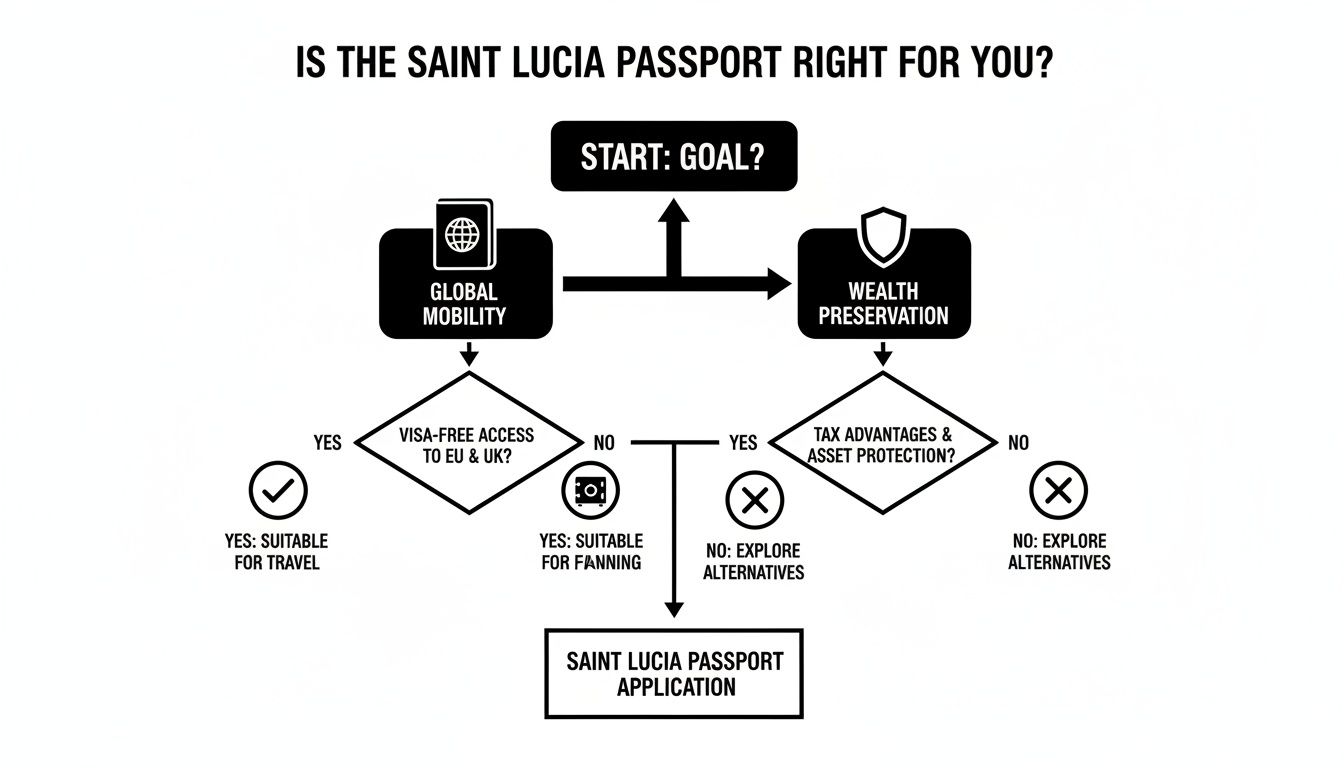
The decision ultimately boils down to whether you prioritise the passport as a standalone tool for mobility or see it as part of a wider wealth and asset-building strategy.
Comparing Donation vs Real Estate Investment
The choice between a sunk cost and a recoverable asset is the most critical one an applicant will make. The NEF donation is an irrecoverable expense. A property, on the other hand, is an asset you own. While the initial cash outlay for real estate is higher, the potential to generate rental income and recover capital after five years changes the entire financial equation.
For the serious investor, the real estate option is not merely about acquiring a holiday home. It is about acquiring an income-producing asset in a stable, high-demand tourism market. The key is to evaluate the property on its own merits, as you would any other investment.
This table breaks down the core differences between the two paths to help you weigh the pros and cons.
| Attribute | National Economic Fund (Donation) | Real Estate Investment |
|---|---|---|
| Minimum Outlay | $100,000 (single applicant) | $200,000 (plus government fees) |
| Capital Recovery | None—it is a non-refundable contribution. | Possible to recover capital after the 5-year holding period. |
| Potential ROI | Zero. This is a sunk cost. | Potential for rental income and capital appreciation. |
| Complexity | Simple and direct. | Involves property selection, due diligence, and management. |
| Asset Type | Intangible (citizenship only). | Tangible (a physical property on your balance sheet). |
Ultimately, the table highlights a fundamental choice: pay for the benefit directly, or invest in an asset that delivers the benefit as a bonus.
A Closer Look at the Real Estate Pathway
The real estate option involves specific requirements. Qualifying investments are limited to government-approved projects, which are typically shares in luxury resorts or high-end villa developments. You are not purchasing just any property on the island.
These projects are designed to bolster Saint Lucia's vital tourism sector. For overseas investors, a significant advantage is that they almost always come with established management companies that handle rentals, maintenance, and guest services, creating a hands-off model.
While your focus for the CBI programme will be on tourism properties, it is wise to understand the broader market by exploring the essential types of real estate investment. The mandatory five-year hold compels an investor to think long-term, prioritising properties with solid fundamentals over those with speculative appeal.
If your goal is purely a new passport with minimum friction, the NEF donation is clean and efficient. But if you are building a global asset portfolio and view Saint Lucian citizenship as one piece of a larger wealth strategy, the real estate path offers a compelling way to make your investment work for you long after the passport is in your hand.
Analysing the Real Estate Investment Route
For investors who view citizenship as more than just a travel document, the real estate route offers a compelling alternative to a donation. This path transforms the cost of a Saint Lucian passport into a tangible, hard asset with the potential to generate its own returns.
Success, however, hinges on one critical factor: you must evaluate the property not just as a gateway to citizenship, but as a standalone investment in a highly active tourism market.
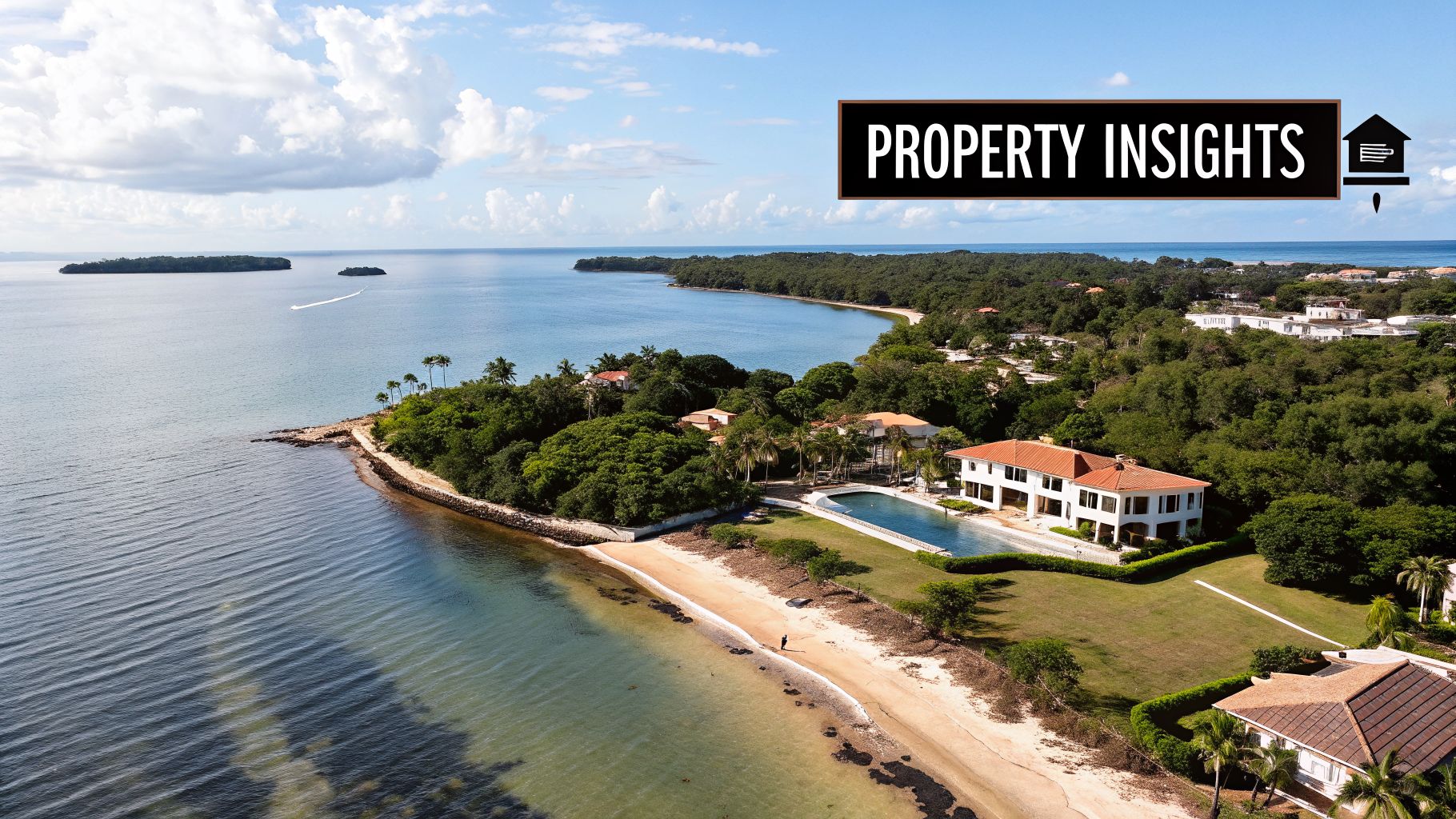
This requires thorough due diligence on the Saint Lucian property market, specifically focusing on the government-approved developments where your investment is permitted. These are almost always high-end tourism properties—such as shares in a luxury resort or a branded villa—designed to bolster the island’s most important economic engine.
Prime Locations and Market Fundamentals
Not all postcodes in Saint Lucia offer equal investment potential. For Citizenship by Investment (CBI) purposes, your focus is naturally directed towards the island’s tourism hotspots. These are the areas with the infrastructure and appeal needed to drive consistent rental demand.
Two areas stand out:
- Rodney Bay: Located in the north, this is the island's undisputed hub for entertainment and recreation. Its vibrant marina, numerous restaurants, and the popular Reduit Beach create a constant draw for tourists, ensuring steady demand for quality rental accommodation.
- Marigot Bay: Often described as one of the most beautiful bays in the Caribbean, this more secluded southern spot attracts a high-net-worth demographic. Investments here typically involve exclusive villas and boutique luxury resorts that can command premium rental rates.
When assessing these areas, it is vital to look past glossy brochures. A key part of your due diligence involves a thorough review of the local market, a process familiar to anyone experienced in investing in overseas property. Analysing the fundamentals will provide a much more realistic picture of your potential return.
Calculating Realistic Rental Yields
The promise of rental income is a primary draw of the property route. However, a pragmatic approach is essential. Gross rental yields in prime Caribbean locations can appear very attractive on paper, but the net yield—the return after all costs are deducted—is the only figure that truly matters.
A realistic net rental yield for a well-managed CBI property in a prime Saint Lucian location typically falls between 2% and 4% annually. Figures quoted higher than this warrant intense scrutiny, as they may not fully account for all operational costs.
Several factors will directly impact your returns:
- Seasonality: Saint Lucia’s peak tourist season runs from December to April. During these months, occupancy and nightly rates are high. However, during the summer and autumn 'shoulder' seasons, a significant drop should be factored into annual income forecasts.
- Property Management Fees: As a non-resident owner, a professional management company is non-negotiable. Their fees, which can range from 20% to 40% of gross rental income for a full-service resort-based setup, will be your single largest operational cost.
- Maintenance and Levies: Ownership in a resort development includes annual maintenance fees or homeowners' association (HOA) charges. These cover the upkeep of pools, gardens, security, and other shared amenities, and they are deducted directly from your bottom line.
The Mandatory Five-Year Hold and Resale Rules
A critical condition of the real estate option is the mandatory five-year holding period. You cannot sell the property before this time has elapsed without jeopardising your citizenship. This forces a long-term perspective and makes the initial property selection even more crucial.
After five years, you are free to sell your asset. A common question is whether the next buyer can also use the same property to qualify for their own citizenship.
The rule is clear: a CBI property can only be resold to another CBI applicant after the initial five-year holding period has been met by the first investor. This creates a secondary market for these properties, which can be an advantage at the point of exit.
Ultimately, the property’s value will be determined by market fundamentals, not just its CBI eligibility. A property that has performed well as a rental asset will always be a more attractive purchase for the next buyer—whether they are seeking citizenship or simply a solid Caribbean investment.
Navigating the Application and Due Diligence Process
Acquiring a Saint Lucia passport is a carefully structured process. For any serious investor, understanding this path is as important as selecting the right property. An applicant cannot apply directly to the government; the entire process is handled exclusively through a government-authorised agent.
This requirement is not merely administrative. It adds a layer of professional oversight, ensuring all submissions are compliant. Your agent acts as your representative, responsible for preparing your file correctly before submitting it to the Saint Lucia Citizenship by Investment Unit (CIU).
The Step-by-Step Application Journey
The path from initial enquiry to holding a new passport is logical and transparent. It is designed to ensure only reputable individuals are granted citizenship, which in turn protects the programme’s value and global standing. While each case has unique elements, the core steps remain consistent.
Here is a practical breakdown of the process:
- Select an Authorised Agent: This is your non-negotiable first step. Your agent will provide the official application forms and a checklist of required documents. They are your sole point of contact with the CIU.
- Prepare Your Documentation: You will need to compile a comprehensive file of personal and financial documents. This includes birth certificates, passport copies, police clearance certificates from your country of birth and any other country of residence for over a year in the last decade, and detailed proof of source of funds.
- Submit the Application: Your agent will review your file for accuracy before submitting it to the CIU. At this stage, you will pay the non-refundable due diligence and processing fees.
- Due Diligence Checks: This is the phase of intense scrutiny. The CIU, along with specialist third-party firms, conducts exhaustive background checks on you and any dependants over the age of sixteen.
- Receive Approval in Principle: Once background checks are complete and the CIU board is satisfied, you will receive an 'Approval in Principle' letter. This confirms your eligibility for citizenship upon making your investment.
- Make Your Investment: Only after receiving official approval do you transfer the funds for your real estate purchase or make the donation to the National Economic Fund. The principal investment amount is never sent upfront.
- Citizenship and Passport Issuance: Once the government confirms receipt of your investment, your Certificate of Citizenship is issued. Your agent then applies for your Saint Lucian passport, which typically arrives within a few weeks.
Understanding Saint Lucia's Due Diligence
Saint Lucia’s background check is rigorous for a reason: it is the foundation of the programme’s international credibility. It is less like a simple identity verification and more like the comprehensive security audit a top-tier bank would conduct before onboarding a high-net-worth client.
The process verifies your identity, investigates your financial history, and scans international databases for any criminal record or connection to illicit activities. This thorough vetting is what gives other countries the confidence to maintain visa-free travel arrangements with the Saint Lucia passport.
This rigour preserves the very benefit you are investing in. As a complementary step, our guide on how to determine a property's investment potential can assist with the due diligence you will perform on your real estate choice.
Costs Beyond the Investment
A prudent investor always assesses the all-in cost. Beyond the headline figure for your property or donation, you must factor in several mandatory government fees. These are non-refundable and are paid regardless of the application's outcome.
| Fee Type | Cost for a Single Applicant (USD) | Notes |
|---|---|---|
| Due Diligence Fee | $8,000 | For the main applicant. |
| Processing Fee | $2,000 | A standard government administrative charge. |
| Real Estate Admin Fee | $50,000 | Only for those choosing the real estate route. |
These fees increase for family applications. A spouse, for example, adds another $5,000 to the due diligence cost. Your agent must provide a clear, itemised breakdown of these government charges, plus their own professional fees, to ensure there are no surprises. From submission to approval, the entire process generally takes between three to six months.
Understanding the Risks and Market Realities
A sound investment decision requires a clear-eyed assessment of both the rewards and the tangible risks. While a Saint Lucia passport offers significant benefits, it is crucial for investors to understand the market realities and geopolitical currents that can alter its value over time.
This is not a theoretical concern. Every Citizenship by Investment (CBI) programme operates within the fluid environment of international diplomacy. A stark, real-world example occurred when the United Kingdom government revoked visa-free access for citizens of Saint Lucia. This move serves as a powerful case study in the geopolitical risk inherent in any CBI programme.
The Impact of Rapid Programme Growth
The UK’s decision was not made in a vacuum. It was a direct response to the programme's rapid growth and concerns about whether due diligence could keep pace with such a high volume of applicants. This offers a critical lesson: the popularity and management of a CBI programme can directly affect its strength.
A key factor cited by the UK Home Office was the sheer volume of new citizens. Saint Lucia's CBI programme saw a staggering 423% annual growth, processing an estimated 5,642 applications in the 2023-24 period. According to the Home Office, this rapid expansion was 'inherently high-risk', prompting the change in visa policy.
This development fundamentally alters the investment calculation. For a discerning investor, the focus can no longer be solely on counting today's visa-free countries. It must extend to judging the stability and international reputation of the CBI programme itself.
A passport's value is not static; it is a dynamic asset influenced by the issuing country's diplomatic relationships and the integrity of its citizenship process. The loss of UK access is a tangible example of this risk in action.
Mitigating Risk with a Sound Property Investment
This is precisely why a dual-focus strategy is so important, especially for those choosing the real estate route. The most effective way to hedge against the risk of a passport's declining power is to ensure your qualifying investment can stand entirely on its own merits.
- Focus on Asset Quality: Treat the property purchase as you would any other international real estate transaction. Analyse its location, verify its rental potential, and scrutinise the build quality.
- Verify Valuations: Ensure the property is not overvalued due to its link to CBI eligibility. It is wise to obtain independent valuations to confirm you are paying a fair market price.
- Assess Your Exit Strategy: Consider the resale market beyond its CBI status. A desirable property in a prime location will always have a market, regardless of its connection to a passport programme.
This approach creates a vital safety net. If the passport's travel benefits were to weaken further, you would still hold a valuable, potentially income-generating asset in a stable Caribbean market. This philosophy is at the heart of all sound property investment strategies.
By anchoring your decision in solid real estate fundamentals, you are not just buying a Saint Lucia passport; you are acquiring a tangible asset. The citizenship becomes an added, powerful benefit, rather than the single pillar upon which the entire investment rests. This balanced perspective is the hallmark of a sophisticated global investor.
The Bottom Line for Global Investors
Ultimately, what is the financial reality of acquiring a Saint Lucia passport? A decision of this magnitude must be rooted in sound investment principles, balancing the appeal of global mobility against a cold, hard analysis of the asset being acquired.

The key takeaway is this: the property must stand on its own two feet. The passport is a significant benefit, but the real estate itself must be strong enough to justify its price tag, independent of the citizenship it facilitates.
The Tax Benefits for Non-Residents
One of the most powerful financial arguments is Saint Lucia’s tax position for non-residents. For investors who do not plan to reside on the island, the tax environment is exceptionally favourable and represents a significant component of a long-term wealth strategy.
Saint Lucia has no capital gains tax, no inheritance tax, and no wealth tax on the worldwide income or assets of its non-resident citizens. This means when you sell your CBI property after the mandatory holding period, any capital appreciation is not taxed by Saint Lucia. The same applies to income earned elsewhere in the world.
This fiscal neutrality is a considerable advantage compared to jurisdictions like the UK or parts of Europe, where multiple layers of tax can significantly erode returns. It allows your capital to work more efficiently, shielded from several common forms of taxation.
Balancing Passport Power with Investment Basics
The appeal of a second passport can be so strong that it is easy to neglect basic investment discipline. However, as demonstrated by recent visa changes, the 'power' of any passport is not static. Geopolitical winds shift, and visa-free access can change, affecting the very benefit you seek.
The most prudent approach is to treat the property as your primary investment and the citizenship as a secondary bonus. A high-quality, well-located, and professionally managed property will hold its value and generate income, providing a financial safety net regardless of shifts in visa agreements.
To execute this correctly, you must run the numbers properly. Our guide on how to calculate the return on investment (ROI) for real estate provides the exact framework for this analysis. It is the best method to cut through marketing hype and base your decision on long-term value.
Your Final Investor Checklist
Before committing capital, you should challenge the opportunity with a few brutally honest questions. Answering these will provide confidence that your decision is grounded in reality, not just optimism.
- Is the property priced fairly? Have you compared its price against similar, non-CBI properties in the vicinity? You must determine if you are paying a hidden 'citizenship premium'.
- What is the real-world net rental yield? After factoring in seasonality, high management fees (often 20-40%), and maintenance, what is the actual cash return?
- How will this be managed from overseas? Investigate the reputation, track record, and fee structure of the appointed management company. Their performance dictates your performance.
- Am I prepared for market and political risks? Are you comfortable with the five-year lock-in period and the possibility that visa-free travel lists could change in the future?
By putting these fundamentals first, you position yourself to acquire not just a Saint Lucia passport, but a genuinely sound international property asset that works for you.
Frequently Asked Questions
Here we address practical questions that frequently arise from investors considering the Saint Lucia programme. These are the details that matter when making a long-term decision for yourself and your family.
Can I Include My Family in the Application?
Yes. The Saint Lucian programme was designed with families in mind, allowing a single application to cover your spouse and a wide range of other dependants.
This is a significant advantage for investors seeking a single solution for their entire family. The list of eligible dependants is generous:
- Children: Your biological or legally adopted children (or your spouse's) who are under the age of 30 and are financially dependent on you.
- Parents: Your parents or your spouse's parents, provided they are over the age of 55 and are also financially dependent on you.
- Siblings: The main applicant’s unmarried siblings, as long as they are under 18 years of age and have the consent of a parent or guardian to be included.
It is important to note that adding each dependant will increase the total investment amount and the associated government fees.
Do I Need to Live in Saint Lucia?
No, and this is one of the programme's most significant advantages. There is no physical residency requirement to obtain or maintain your Saint Lucian citizenship. You do not have to visit the island during the application process, and you do not need to reside there for any period afterwards.
This gives it a considerable edge over many residency-by-investment programmes, particularly those in Europe, which often demand substantial time in-country to maintain status. For a global investor, this hands-off approach provides complete flexibility.
What Happens After the Five-Year Holding Period?
If you choose the real estate investment route, you are required to hold the property for a minimum of five years. Once that mandatory period has concluded, you are free to sell the asset.
This exit strategy is a critical part of your investment analysis. The ability to recover your initial capital is what truly separates the real estate option from the non-refundable donation route.
Crucially, you can then sell your property to another applicant in the Citizenship by Investment programme. This creates a dedicated secondary market for these approved properties, which can make your asset more liquid when you decide it is time to exit. Whether you sell the property or retain it for rental income, your citizenship is for life and is entirely unaffected by the sale.