
Slovenia property sales offer a rare combination for the global investor: the stability of a mature Western European market blended with the growth potential of an emerging economy. This is not a market driven by speculative bubbles. Instead, it is built on solid fundamentals, making it a compelling destination for investors seeking steady, long-term capital appreciation.
Why Invest in Slovenia's Property Market?
For the discerning global property investor, Slovenia represents a calculated move towards resilient, sustainable growth. Unlike some of the more volatile Mediterranean markets, which can be prone to dramatic peaks and troughs, the Slovenian property landscape is built on a foundation of genuine domestic demand. This intrinsic stability makes the market less susceptible to external economic shocks.
A significant factor behind this stability is an exceptionally high owner-occupancy rate. According to data from Eurostat, over 80% of Slovenians own their homes—one of the highest rates in the EU. This cultural preference for ownership means the market is driven by real housing needs, not speculative activity, which helps prevent the formation of asset bubbles.
Conservative Fundamentals and Steady Growth
Slovenia's banking sector also plays a key role in maintaining market equilibrium. Lending practices are notably conservative, with strict criteria for borrowers and loan-to-value ratios typically capped well below those seen in other European nations. This sensible approach, often highlighted in reports from the Bank of Slovenia, prevents over-leveraging and contributes to a healthier, more predictable property cycle.
The result is an environment that encourages steady, demand-driven appreciation rather than the rapid, unsustainable price hikes that often precede market corrections. For investors, this translates into a lower-risk profile, where capital growth is achieved patiently over the long term.
Rather than chasing fleeting trends, investing in Slovenia is about aligning with a market that values substance over speculation. The focus is on quality assets in prime locations, supported by a robust local economy and a growing international profile.
A Market of Opportunity
Slovenia's strategic position in Central Europe, combined with its high quality of life, continues to attract both tourists and skilled professionals. This fuels demand in several key areas:
- Urban Centres: The capital, Ljubljana, benefits from a constant flow of students and professionals seeking long-term rentals.
- Coastal Regions: The Adriatic coast is a magnet for tourism, driving strong demand for holiday lets and second homes.
- Alpine Areas: Ski resorts and scenic mountain regions offer excellent potential for seasonal rental income.
This blend of stability and targeted growth makes Slovenia an attractive proposition. For those looking to diversify, learning more about the top emerging property investment markets can provide valuable context on where Slovenia fits within the global landscape. It offers a unique entry point into the Eurozone—one that prioritises consistency and foundational strength.
Decoding the Current Slovenian Property Market
To accurately assess Slovenia's property market, one must look beyond headline figures. It currently presents a paradox: while transaction volumes have moderated, property values continue their steady upward trajectory. This is not a sign of weakness; rather, it points to a market built on resilient, supply-and-demand fundamentals.
For international investors, this is a clear signal that the market is driven by genuine demand, not speculative froth. Key factors support this stability, including a chronic shortage of new-build housing, rising construction costs that establish a price floor, and persistent demand from domestic buyers. This combination keeps prices firm, even when the pace of sales slows.
This infographic captures the core appeal of the Slovenian market, highlighting its impressive stability, growth potential, and high occupancy rates.
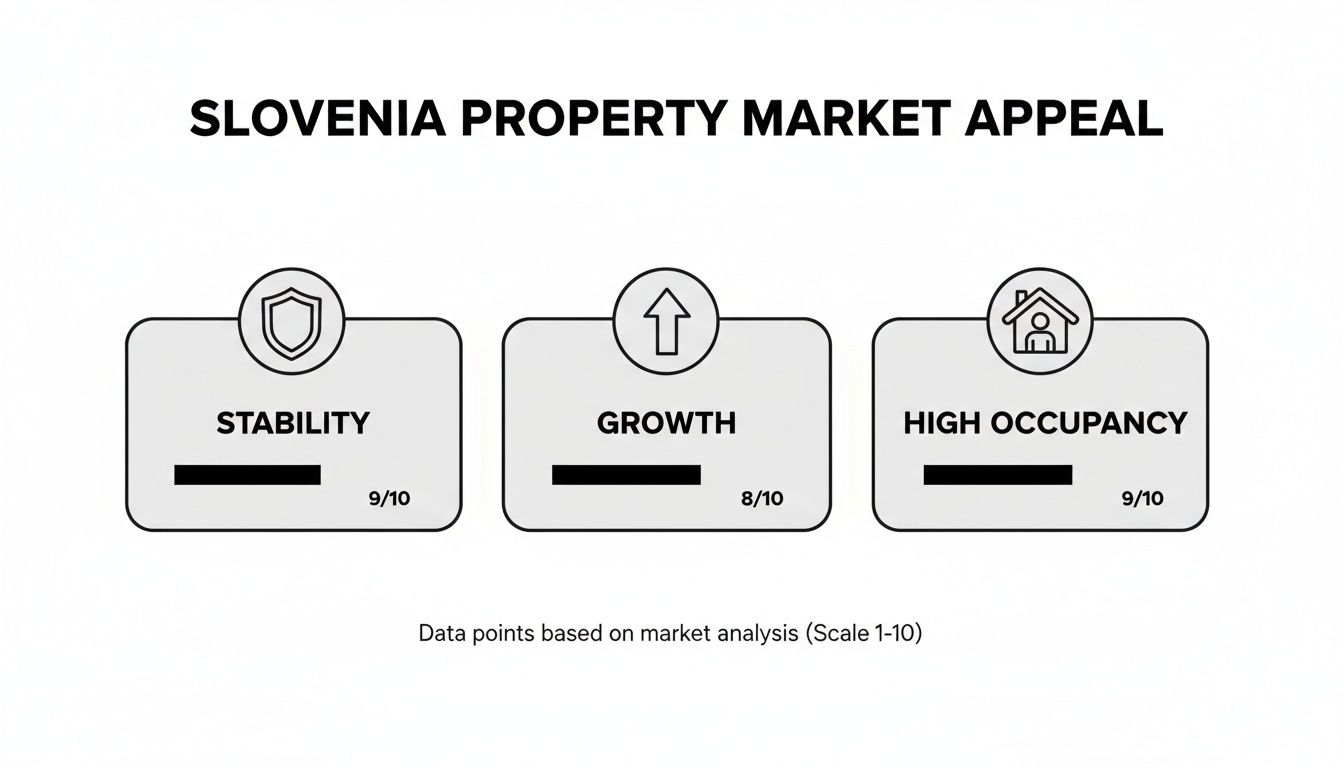
These three pillars give the market its strength, offering a secure footing for long-term investment.
The Story Behind the Numbers
Recent data tells a clear story. The table below, based on figures from the Statistical Office of the Republic of Slovenia (SURS), paints a picture of a market recalibrating after a period of high activity.
Slovenia Property Market Snapshot
| Metric | Figure | Year-on-Year Change | Key Takeaway |
|---|---|---|---|
| Dwellings Sold | 8,124 units | -21.13% | Sales volume has moderated from previous highs. |
| House Price Index | +8.46% | Prices continue their decade-long upward trend. | |
| Total Transaction Value | €1.34 billion | -14.72% | Lower sales volume naturally led to a lower total value. |
The reduction in sales volume is not due to a lack of demand. It is more a function of an affordability squeeze coupled with a scarcity of available properties. Buyers remain active, but they are being more selective, and the limited stock on the market is keeping prices firm. For a deeper analysis of the data, you can explore the full report on Slovenian property price history.
New-Build Versus the Resale Market
For any investor, understanding the distinction between new-build and second-hand properties is crucial. New residential construction in Slovenia is relatively scarce, comprising only about 10-15% of all property listings. This shortage is felt most acutely in prime locations like central Ljubljana and along the Adriatic coast, where strict planning regulations and a lack of available land act as major constraints.
As a result, the resale market is where the majority of transactions occur. It is dominated by apartments, which account for roughly 60% of homes for sale, particularly in urban centres. Detached houses follow, making up around 30% of the market.
Takeaway: While a new-build apartment in Ljubljana's city centre is a prime asset, well-maintained older properties in good locations are the lifeblood of the market and often present more accessible investment opportunities.
This dynamic is key. The intense competition for the limited number of new builds has a knock-on effect, supporting the values of high-quality existing homes in desirable areas.
Long-Term Fundamentals Remain Strong
Despite the dip in transaction numbers, the fundamental drivers of the Slovenian property market remain robust. This is not a market in a downturn; it is one experiencing a recalibration in sales velocity.
Several factors support a positive long-term outlook:
- Strong Domestic Demand: Slovenians have a high owner-occupancy culture, ensuring a constant baseline of interest from local buyers.
- Limited Supply: Structural shortages, particularly in high-demand urban areas, will continue to support price levels for the foreseeable future.
- Growing International Appeal: Slovenia's reputation for safety, natural beauty, and quality of life is attracting a growing number of foreign buyers and professionals.
- Economic Stability: As a stable member of the Eurozone with a healthy economy, Slovenia provides a secure and predictable environment for investment.
For the strategic investor, current conditions could represent an ideal entry point. The more moderate pace of sales allows for considered decision-making, away from the frenzy of an overheated market, while strong underlying fundamentals continue to support long-term capital growth.
Finding Your Investment Hotspot in Slovenia
Successful investment in Slovenian property requires understanding a simple truth: location dictates everything. It shapes the tenant profile, potential returns, and management strategy. Although Slovenia is a small country, it contains three distinct property markets, each powered by different economic and lifestyle drivers.
The key is to align your investment goals with the appropriate region. The three primary hotspots are the capital, Ljubljana; the sun-drenched Adriatic Coast; and the majestic Alpine regions. Whether you are targeting consistent long-term rental income, high seasonal yields from tourism, or steady capital appreciation, one of these markets will fit your criteria.
Ljubljana: The Professional and Student Hub
Ljubljana is the economic and cultural heart of Slovenia, making it the bedrock of the country's long-term rental market. Its property scene is fuelled by a constant, reliable flow of young professionals, international expatriates, and a significant student body—the University of Ljubljana alone has over 37,000 students. This creates a deep and dependable tenant pool that few other areas can match.
Demand here is strongest for modern, well-located apartments. Neighbourhoods such as Bežigrad, Šiška, and the city centre are particularly sought-after, commanding premium rents and experiencing very low vacancy rates, often around 3-4%. For instance, a one-bedroom apartment in Bežigrad can achieve a gross rental yield of circa 4%. Investors in this market typically focus on stable, year-round rental income and solid, long-term capital growth.
The Adriatic Coast: Tourism-Driven Returns
Slovenia's short but stunning coastline, with its historic towns like Piran and Portorož, is a prime market for short-term holiday lets. This region’s property market is almost entirely driven by tourism, attracting a steady stream of visitors from across Europe, particularly from nearby Italy, Germany, and Austria. This intense focus on tourism makes understanding the principles of location in real estate investment success even more critical.
The most desirable properties are traditional stone houses and seaside apartments with easy access to the water. A two-bedroom apartment in Piran, for example, can generate significant income during peak season. Rental yields can be excellent during the summer, with occupancy rates easily reaching 70-80%. However, investors must be prepared for much quieter off-seasons. This market is ideal for those seeking higher potential yields who are comfortable managing the seasonal nature of holiday rentals.
Takeaway: The investment strategies for Ljubljana and the coast differ fundamentally. Ljubljana offers consistency and is relatively hands-off, whereas the coast provides higher peak-season returns but requires more active management to navigate seasonal fluctuations.
Alpine Regions: A Haven for Lifestyle and Holiday Lets
The Alpine regions, home to world-renowned destinations like Lake Bled, Lake Bohinj, and Kranjska Gora, offer an excellent dual-season rental market. These areas are a magnet for hikers, cyclists, and nature lovers in the summer, then transform into a hub for skiers and snowboarders in the winter. This provides a much longer letting season compared to the coast.
Investment properties here are typically traditional chalets, modern holiday apartments, and rural houses. A ski-in/ski-out chalet near Vogel offers direct access to slopes and hiking trails, making it highly attractive to tourists all year. This market appeals to lifestyle investors and those targeting the robust adventure tourism sector. The appeal of Slovenia property sales in these regions lies in the ability to combine a personal holiday home with a lucrative rental asset.
| Region | Primary Demand Driver | Target Tenant / Buyer | Property Type | Investment Goal |
|---|---|---|---|---|
| Ljubljana | Economy & Education | Professionals, Students, Expats | Modern Apartments | Steady Yield & Capital Growth |
| Adriatic Coast | Tourism | European Tourists | Stone Houses, Seaside Apts | High Seasonal Yields |
| Alpine Region | Adventure & Leisure | Skiers, Hikers, Families | Chalets, Holiday Apts | Lifestyle & Dual-Season Rental |
Ultimately, choosing an investment hotspot comes down to your risk appetite and management style. Ljubljana offers a lower-risk, stable return, while the coastal and Alpine areas present opportunities for higher yields but demand a more hands-on approach.
Understanding the Financials of Your Investment

A successful investment in Slovenian property is contingent on a thorough understanding of the numbers. Beyond the purchase price, an investor must have a firm grip on rental yields, transaction taxes, and ongoing costs to build a realistic financial projection. This requires clear, data-driven decisions.
Gross rental yields in Slovenia generally range between 3.5% and 5.5%, but this figure varies significantly depending on location and property type. For example, an apartment in Ljubljana benefits from year-round demand, which might deliver a steady 3.5% to 4.5% yield. A well-managed holiday home on the Adriatic Coast could achieve 5% or more, but this must be balanced against seasonal demand and more intensive management.
Calculating Your Total Acquisition Cost
The purchase price is only the starting point. To avoid unforeseen expenses, you must calculate the total acquisition cost, which includes several mandatory taxes and professional fees. These additional costs typically add another 3% to 5% to the final purchase price.
For a €250,000 apartment in Ljubljana, you should budget an extra €7,500 to €12,500 to cover all associated costs. Factoring this in from the outset is critical for accurate return on investment (ROI) calculations.
Takeaway: A common error among foreign investors is focusing solely on the purchase price and potential rental income. Diligent financial planning requires accounting for every cost—from initial transaction fees to ongoing maintenance—to understand the true net return.
Breakdown of Transaction Taxes and Fees
Navigating the costs of Slovenia property sales is straightforward once the components are understood. The main expenses are standardised across the country, making them predictable and easy to budget for.
Here is a clear breakdown of the costs:
- Property Transfer Tax (DPN): This is the largest single cost, set at a flat 2% of the contract price, payable by the buyer. It does not apply to new-build properties where VAT has already been included in the price.
- Notary Fees: A notary is mandatory for all property transactions in Slovenia. Their fees are regulated by a set tariff and depend on the property’s value, typically falling between €100 and €600.
- Land Registry Entry Fee: A small administrative fee, usually around €60, is paid to the land registry to make ownership official.
- Agency Commission: If a real estate agent is used, their commission is legally capped at 4% (+ VAT), and is often split between the buyer and seller. It is common for the buyer to pay a 2% commission.
Understanding these costs is fundamental. For investors wanting to dig deeper, exploring different strategies for financing investment property can offer a broader perspective on how to structure a purchase. By mapping out every expense, you can accurately forecast net returns and ensure your Slovenian property investment is built on a solid financial foundation.
Your Step-by-Step Guide to Buying Property
Buying property in a foreign country may seem daunting, but the process in Slovenia is refreshingly straightforward and secure. The system is well-regulated and built around the central role of a public notary, which guarantees a high level of transparency and legal certainty for both buyer and seller.
The process begins with finding a suitable property and having an offer accepted. The first formal step is signing a preliminary sales agreement and paying a deposit, which is almost always 10% of the purchase price. This deposit secures the property and takes it off the market while the legal procedures commence.
The Core Buying Process
The Slovenian system is designed to protect all parties involved. After the initial agreement, the transaction moves into a formal, legally binding sequence of steps managed by a public notary. This ensures every detail is handled correctly, from verifying identities to the final, official transfer of ownership.
From an accepted offer to receiving the keys, the typical timeline is 60 to 90 days. This can vary depending on the complexity of the sale and the buyer's EU or non-EU status. Non-EU buyers should factor in additional time for an administrative approval step.
Here is a clear breakdown of the process:
- Obtain a Slovenian Tax Number (Davčna Številka): This is the first mandatory step for any foreign buyer. This number is required for all legal and financial transactions in the country and can be obtained from a local tax office.
- Appoint a Notary: The notary is a neutral, state-appointed legal expert who oversees the entire transaction. They are responsible for drafting the main sales contract, verifying all documentation, and ensuring the legal transfer of the title is executed correctly.
- Sign the Main Sales Contract (Kupoprodajna Pogodba): This is the final legal document outlining all terms of the sale. The notary will ensure it complies with Slovenian law and that both parties fully understand their obligations before signing.
- Pay Property Transfer Tax: As the buyer, you are responsible for paying the 2% property transfer tax. The notary typically handles this payment on your behalf once the contract is signed.
- Final Payment and Title Transfer: With all conditions met and taxes paid, you transfer the remaining purchase price to the seller. The notary then submits the signed contract to the Land Registry (Zemljiška Knjiga) to officially register you as the new owner.
Key Documents and Legal Points
Proper documentation is the bedrock of a secure transaction. The most critical document is the kupoprodajna pogodba—the main sales contract. It details the property description, purchase price, payment schedule, and handover date. The notary is legally obliged to verify the seller’s ownership and check that the property is free of any debts or liens before the contract is finalised.
Takeaway: For non-EU citizens, including those from the UK, an additional step is required: obtaining approval from the Ministry of Justice, based on a principle of reciprocity. This is usually a formality for citizens from countries like the UK, but it can add several weeks to the overall timeline.
This highly structured process is a key reason the market has remained so stable. Slovenia's residential property prices have shown impressive long-term resilience. According to data from Eurostat, the price index climbed from a baseline of 100 in 2010 to around 170 today, a cumulative 70% rise or an average annual growth of 4%. This steady appreciation, driven by genuine demand rather than speculative lending, has insulated the market from over-leveraging. You can find more insights on Slovenia's stable and under-recognised European property market on propertywire.com.
By following these established steps and working with qualified local professionals, investors can ensure their purchase is both secure and legally sound. For more general advice, our guide on investing in overseas property may be useful.
What's Next for the Slovenian Property Market?
Looking ahead, Slovenia is not a market for investors chasing quick speculative gains. It is a market for steady, long-term growth built on solid fundamentals. The narrative here is not one of explosive booms but of resilient appreciation, underpinned by a structural housing shortage and consistent demand from both domestic and international buyers.
This dynamic has created a market where property values have strong support. In hotspots like Ljubljana and the coastal towns, the chronic lack of new housing will not be resolved in the short term. This supply constraint acts as a natural floor for prices, suggesting that steady growth will remain a feature of the market for the foreseeable future.
Where the Real Opportunities Lie for Investors
Several clear trends are shaping the market, creating distinct entry points for the strategic investor. The blend of economic stability, urbanisation, and a booming tourism sector creates multi-faceted demand, supporting both property values and rental income.
- Steady Capital Growth: With construction costs rising and planning regulations remaining stringent, new supply will continue to lag behind demand. This imbalance is the primary engine for long-term capital appreciation, especially for well-located apartments and family homes.
- Robust Rental Demand: In Ljubljana, urbanisation continues to fuel the long-term rental market. Meanwhile, Slovenia’s growing reputation as a top-tier tourist destination drives strong demand for short-term lets in the Alpine and coastal regions.
- Infrastructure Upgrades: Major projects like the Emonika development in Ljubljana and the Divača-Koper railway upgrade are set to improve connectivity and add value to surrounding properties, creating new, localised investment hotspots.
A Clear-Eyed View of the Risks
While the outlook is positive, any prudent investor must consider potential headwinds. As part of the wider European economy, Slovenia is not entirely immune to external pressures.
Shifts in interest rate policy from the European Central Bank can affect mortgage affordability and buyer sentiment. A significant economic slowdown across the Eurozone could cool the pace of price growth, although the market's low reliance on speculative foreign capital provides some insulation. Investors should also monitor potential regulatory changes, such as amendments to foreign ownership laws or rental regulations, although current policies remain stable and investor-friendly.
Takeaway: Slovenia is not a market for short-term flipping. It rewards a patient, fundamentals-driven approach. The key is to focus on quality properties in prime locations, leveraging the country's stable economic foundations to generate reliable, long-term returns.
Despite a recent dip in transaction volumes, price growth has remained remarkably strong. The latest figures show residential prices were up 3.18% year-on-year in March, while official SURS data confirmed a 5.5% annual increase in the second quarter, driven by the persistent supply shortage. The market's small size and high owner-occupancy rate provide a strong buffer. For more data, you can explore the latest trends on Slovenia's residential property prices on TradingEconomics.com. This reinforces Slovenia's position as a fundamentally sound market for investors who value steady growth over risky speculation.
Your Questions Answered: Investing in Slovenian Property
Entering any new property market raises questions. To provide clarity, here are straightforward answers to the most common queries from investors considering property in Slovenia.
Can UK Citizens Still Buy Property in Slovenia After Brexit?
Yes, British citizens can still buy property in Slovenia, though the process now includes an additional step. The system operates on the principle of reciprocity: as a Slovenian citizen can buy property in the UK, a UK citizen can buy in Slovenia.
After signing a sales contract, you will need formal approval from the Ministry of Justice. This is generally a procedural step, but ensuring the application is handled correctly is crucial. Engaging a reputable local solicitor is non-negotiable to manage the paperwork effectively.
What Is the Difference Between Investing in Ljubljana and on the Coast?
These are two entirely different investment strategies. Ljubljana represents a reliable, steady-performing asset class, while the coast is a higher-yield, seasonal market.
Ljubljana’s market is defined by long-term rental demand, driven by a stable, year-round base of professionals, students, and diplomatic staff. This translates into consistent income and predictable capital growth.
The coast, by contrast, is a classic holiday-let market driven by the tourist season. Potential yields can be excellent during the summer, but investors must be prepared for quieter winters and manage for potential vacancies. Our guide on how to understand property taxes may offer further insight into how different tax implications might apply.
Takeaway: Choosing between Ljubljana and the coast depends on your investment goals. Ljubljana offers lower-risk consistency for a more hands-off approach. The coast offers the potential for higher, but more seasonal, returns that demand greater active management.
How Difficult Is It for a Foreigner to Get a Mortgage in Slovenia?
It is challenging. Slovenian banks are known for their conservative lending practices, particularly for non-residents.
Expect to provide a substantial deposit, often in the 30-40% range. You will also need to provide meticulously verified proof of a stable income from your home country. The process tends to be smoother for EU residents or those holding a Slovenian residence permit.
Due to these hurdles, many international buyers purchase with cash or arrange financing in their home country. If you wish to explore local lending, using a Slovenian mortgage broker is the most effective way to navigate the strict criteria and identify a bank willing to work with foreign investors.
At World Property Investor, we provide the data-driven analysis and in-depth guides you need to make confident investment decisions across the globe. Explore our resources at https://www.worldpropertyinvestor.com.