
The popular advice is to compare gross rental yields, deduct mortgage interest and let the tax return follow later. That approach is now dangerously incomplete. Tax implications for landlords can alter the viability of a property long after the purchase price and rent have been agreed, particularly where the owner has significant debt, is non-resident, jointly owns property or earns income from several countries.
The UK is moving towards more demanding digital compliance and a distinct property-income tax regime. Acquisition taxes can also be triggered by homes owned outside the UK. A disciplined investor therefore underwrites tax, financing, ownership and reporting obligations together, rather than treating tax as an administrative afterthought.
Table of Contents
- The Hidden Costs Eroding Global Rental Yields
- Calculating Taxable Rental Income and Allowances
- Navigating Allowable Deductions and Capital Rules
- Mortgage Interest Restrictions and Future Rate Shifts
- Making Tax Digital and Compliance Penalties
- Stamp Duty Surcharges and Global Market Comparisons
- Structuring Your Portfolio for Long-Term Efficiency
The Hidden Costs Eroding Global Rental Yields
Gross yield is a screening metric, not a profit figure. Rent arrives before mortgage interest, repairs, insurance, management charges, void periods, acquisition taxes and income tax. For an international owner, the calculation can also involve currency movements, local filing requirements and the interaction between UK property income and income earned elsewhere.
The most common mistake is to compare a headline yield in one market with a headline yield in another. A property with an attractive rent-to-price ratio can still produce a weak net return if its financing costs receive limited tax relief or if the owner's wider income pushes rental profits into a higher band. Conversely, a lower gross yield may produce stronger distributable cash flow where the ownership structure, debt profile and local tax treatment are better aligned.
Use the distinction explained in this guide to gross yield versus net yield before comparing locations. The calculation should begin with rent expected to be collected, then deduct operating costs, financing, tax and unavoidable compliance expenses.
Tax belongs in the acquisition model
A landlord should model at least three outcomes before committing capital:
- Personal ownership: Rental profits sit with the individual and may be affected by other employment, investment or overseas income.
- Joint ownership: The owners' respective tax positions, beneficial shares and reporting obligations can produce different results from sole ownership.
- Corporate ownership: A company may offer different treatment for financing and retained profits, but introduces administration, extraction and restructuring considerations.
Cross-border investors need a fourth question: where is the owner resident, and where is the property situated? Non-residence doesn't usually remove UK tax exposure on UK rental income. It can change administration, withholding and treaty analysis, but it doesn't turn a UK property into an untaxed asset.
Investment rule: Never approve a purchase on gross yield alone. Approve it only after the projected net return survives financing stress, tax bands and compliance costs.
The right objective isn't the lowest tax bill in isolation. It's a durable net return that remains acceptable if interest costs rise, rents fluctuate or reporting becomes more frequent. That requires accurate records from the first transaction and an ownership structure that reflects the investor's wider wealth plan.
Calculating Taxable Rental Income and Allowances
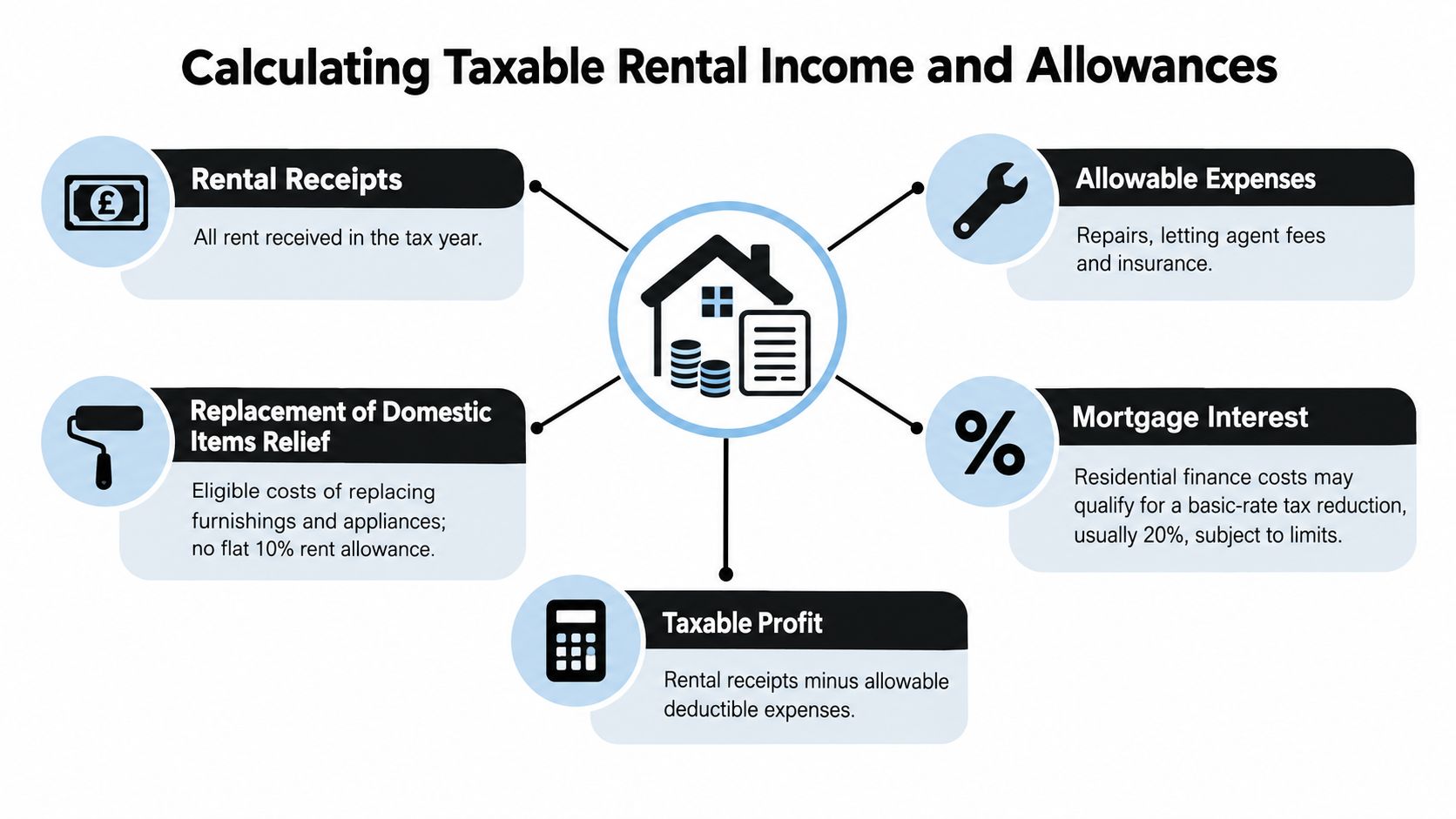
UK rental taxation starts with the difference between gross property income and taxable profit. Rent and other property receipts are considered alongside eligible expenses, while the owner's wider taxable income determines how the resulting profit affects their tax position.
HM Revenue & Customs says property income below £1,000 a year doesn't normally need to be reported and may fall within the property allowance. Where gross property income exceeds £1,000, the landlord may generally choose between the allowance and deducting eligible expenses, but both options can't be claimed for the same income. The detailed rules are set out in HMRC's guidance on rental income and property expenses.
Allowances aren't a substitute for a full calculation
The Rent a Room Scheme is separate. It allows up to £7,500 a year tax-free for furnished accommodation in the owner's home, or £3,750 where the income is shared, as explained by HMRC in its property-income material. That relief is relevant to spare-room arrangements, not a general exemption for a buy-to-let portfolio.
A landlord should calculate the position in this order:
- Identify all receipts. Include rent and relevant property income received during the tax year.
- Separate eligible expenses. Repairs, insurance and qualifying management costs may reduce taxable profit, subject to the applicable rules.
- Check the allowance choice. Compare the property allowance with the eligible-expense route. Don't assume the simpler option is cheaper.
- Add the result to wider income. Rental profit can sit on top of employment, pension, dividend or other taxable income and may affect the owner's marginal band.
- Review ownership and residence. Joint owners and overseas investors need advice on allocation, filing and treaty consequences.
HMRC's statistics provide useful context. 1.3 million taxpayers declared property income of £10,000 or less in the 2024–25 tax year, described by HMRC as nearly half of landlords in that dataset. The figures cover unincorporated landlords filing Income Tax Self Assessment returns, so they aren't a complete count of every property owner or company landlord. The statistical publication is available through HMRC's property, savings and dividend income tax information.
For investors managing several jurisdictions, the calculation benefits from professional financial control. A resource on a fractional CFO for Florida real estate illustrates the type of financial oversight that can help owners organise property-level cash flow, records and reporting across a portfolio. The adviser must still apply UK tax rules separately.
Use rental income tax rates as a market-research starting point, then obtain advice for the owner's exact income profile. A threshold may reduce reporting or offer an election, but it doesn't make broader income-tax planning unnecessary.
Navigating Allowable Deductions and Capital Rules
The key distinction is between revenue expenditure and capital expenditure. Revenue costs arise from operating and maintaining an existing rental business. Capital costs improve, extend or create the asset and are generally dealt with under capital rules rather than deducted directly from annual rental income.
A practical classification is more useful than a long list of expenses.
Revenue expenses
Routine costs normally deserve immediate attention in the bookkeeping system:
- Letting and management fees: Keep the agent's invoices and identify which property each charge relates to.
- Insurance: Record buildings, contents and landlord policies separately where possible.
- Repairs: Replacing a broken component with a modern equivalent is generally different from adding a new feature or materially upgrading the property.
- Professional costs: Retain invoices for relevant accounting, legal and compliance work.
- Utilities and services: Where the landlord pays them, record the agreement and the period covered.
The evidence matters as much as the category. A bank transaction alone may not explain what was purchased, why it related to the rental business or whether it improved the property. Store invoices, contracts, completion statements and correspondence digitally, with a consistent property reference.
Capital expenditure
Structural extensions, substantial improvements and costs incurred before a property enters the letting business may require capital treatment. Initial renovations deserve particular scrutiny. Calling a project “maintenance” doesn't make it revenue expenditure if the work creates a better asset or forms part of acquiring it in a usable condition.
Replacement domestic items also need careful treatment. Don't assume that every furniture or appliance purchase is deductible in the same way. The facts, the type of item, the replacement circumstances and the relevant relief rules determine the outcome.
Practical rule: Photograph significant repairs, save the original invoice and write a short note explaining the defect. That record can be more valuable than a vague spreadsheet description.
For international owners, separate records by property and country. Use a dedicated ledger for acquisition costs, operating expenses, financing and improvements. Keep currency conversion evidence and distinguish the property's local tax records from the UK return.
Capital treatment can also affect the eventual disposal analysis, so the annual rental file should support the wider investment record. The capital gains tax guide by country can help investors compare the broader tax context, but it shouldn't replace advice on the specific asset, owner and transaction.
A strong system has three controls: approval before spending, digital storage immediately after payment and an annual review by someone who understands both property accounts and tax law. That process protects deductions without encouraging aggressive claims that may fail under inspection.
Mortgage Interest Restrictions and Future Rate Shifts
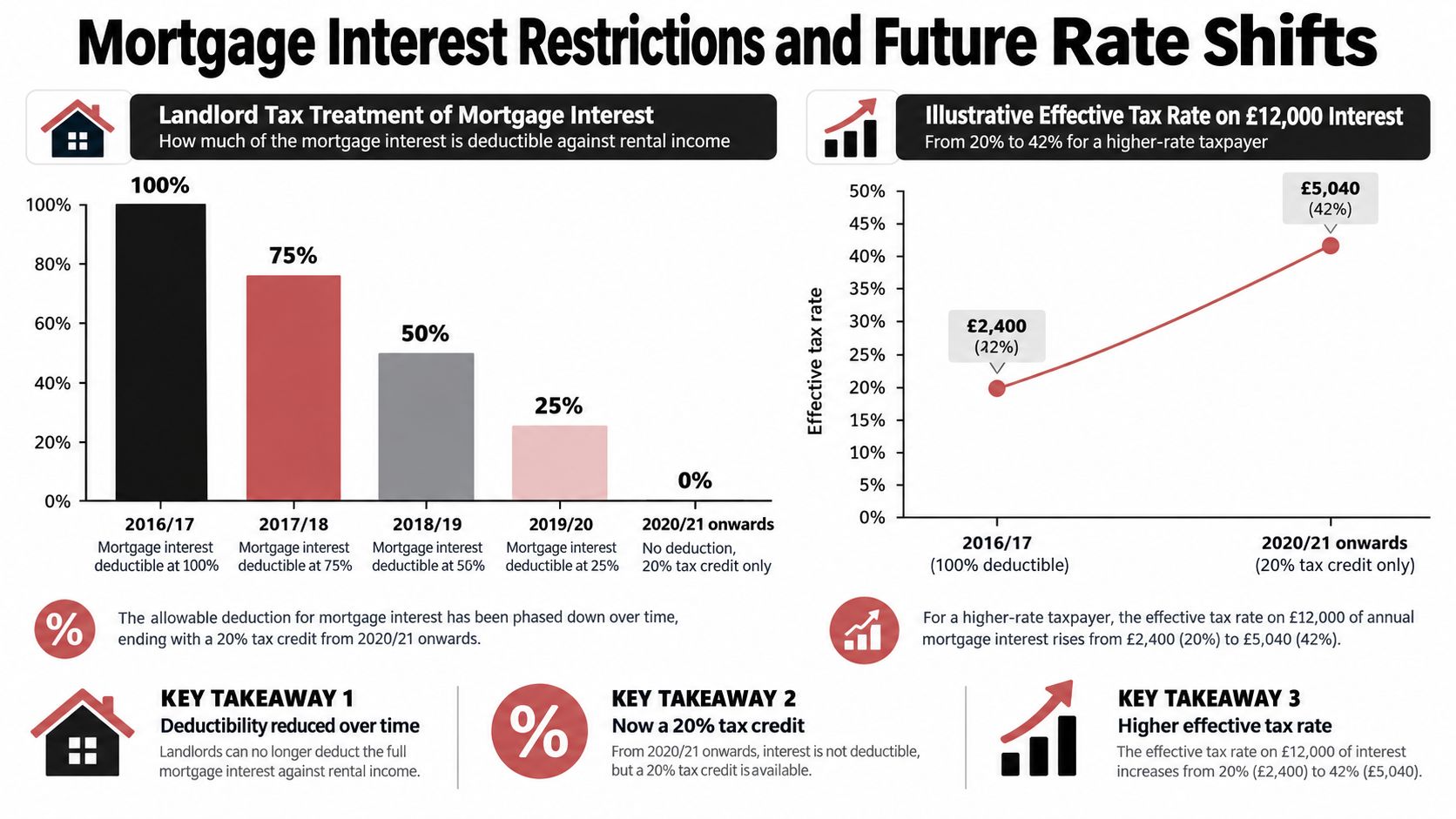
Mortgage interest is where the UK tax implications for landlords become most painful. Section 24 of the Finance (No. 2) Act 2015 changed the treatment of residential finance costs for most individual landlords. The policy was announced in the Summer Budget 2015, phased in over four years from 6 April 2017 and became fully effective on 6 April 2020, according to the HMRC rental-income guidance.
Before the reform, individual landlords could generally deduct residential finance costs from rental income when calculating taxable profit and receive relief at their marginal income-tax rate. Under the completed regime, most individual residential landlords receive a tax reducer broadly equivalent to basic-rate relief instead of deducting the finance cost in full from property income.
Who bears the pressure
The cash interest bill doesn't fall because the tax treatment changes. The strain is greatest for landlords with high debt loads and higher- or additional-rate taxpayers, because the tax benefit attached to interest is capped at the basic rate. HMRC identifies mortgages, loans used for furnishings and overdrafts as relevant finance costs. The repayment of mortgage principal isn't deductible, only the potentially relevant interest element.
The House of Commons Library reported that only one in five individual landlords was expected to pay more tax once the restriction was fully implemented. That doesn't make the reform harmless for the affected group. A portfolio can remain cash-flow positive before tax but become unattractive after tax when interest consumes a large share of rent.
The next structural issue is the announced separation of property-income rates. HMRC's technical note says that, from 6 April 2027, UK property income is planned to be taxed at distinct rates of 22% for basic-rate taxpayers, 42% for higher-rate taxpayers and 47% for additional-rate taxpayers. Those rates are future changes, not rules to apply immediately, and the technical note on property-income tax rates sets out the implementation timetable.
Model the structure, not just the rent
A proper comparison uses the same property, rent, interest and maintenance assumptions across three ownership routes:
- Individual ownership: Simpler administration, but personal bands and finance-cost restrictions can reduce net cash flow.
- Joint ownership: May distribute taxable income between owners, but the result depends on beneficial ownership and each owner's wider income.
- Company ownership: May change the financing and retained-profit analysis, but introduces company administration, extraction taxes and transaction costs.
Don't transfer a portfolio merely because a future rate appears attractive. Model the full life cycle, including acquisition, annual cash flow, refinancing, distributions, sale and inheritance. The best structure is the one that preserves usable wealth after all taxes and costs, not the one with the most appealing headline rate.
Making Tax Digital and Compliance Penalties
Making Tax Digital is not just a software upgrade. For landlords, it changes when records must be maintained, when information must be transmitted and how cash must be reserved for the eventual tax bill.
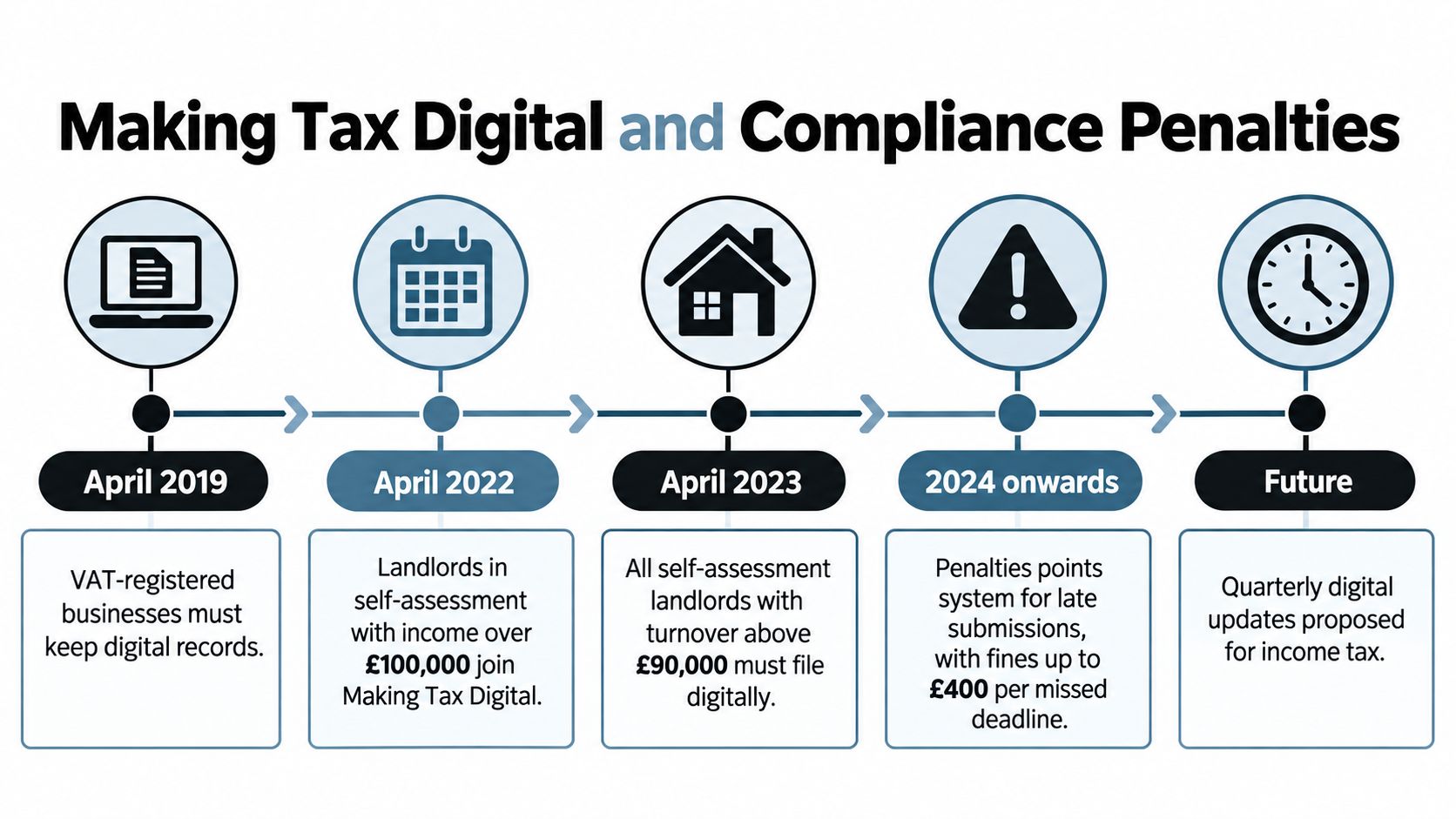
HMRC says landlords with qualifying property and self-employment income above £50,000 must use MTD from 6 April 2026, keep digital records, submit quarterly updates and file an annual return. The threshold falls to £30,000 from April 2027 and £20,000 from April 2028. HMRC also says approximately 970,000 additional individuals will be brought into scope when the threshold reaches £20,000, as reported in its Making Tax Digital announcement.
Gross income, fluctuating rents and joint ownership
The threshold question is practical: does the relevant qualifying income test use gross receipts or profit? Landlords shouldn't guess. They need to establish which income is in scope, how jointly owned property is allocated and whether other qualifying self-employment income is combined for the threshold.
Seasonal income creates a cash-flow trap. Quarterly updates record information during the year, but they aren't the final tax calculation. The first MTD annual return for the 2026–27 tax year isn't due until 31 January 2028, even though quarterly updates begin earlier. A landlord who waits for the annual return to discover the liability may have spent money that should have been reserved for tax.
The initial penalty framework is also misunderstood. HMRC says a £200 penalty applies only after four late-submission points under the initial framework. That doesn't justify late filing. Missing updates creates administrative noise, weakens records and increases the chance that a later correction becomes expensive or rushed.
Watch the practical explanation below, then ask your accountant how your software, bank feeds and property ledgers will connect.
For firms preparing their internal processes, delivering MTD IT the complete practice blueprint offers a structured resource on practice implementation. A landlord should focus on the equivalent personal workflow:
- Digitise the source records. Capture rent, fees, repairs and finance costs as they arise.
- Reconcile quarterly. Don't wait for year-end to identify missing invoices or duplicated transactions.
- Reserve tax cash. Treat quarterly visibility as a forecasting tool, not merely a filing obligation.
- Review ownership records. Make sure joint properties and agent-managed homes are allocated consistently.
International owners should also review UK tax for non-resident landlords alongside their MTD position. An overseas agent may handle collection, but responsibility for accurate records and the final tax position still needs to be assigned clearly.
Stamp Duty Surcharges and Global Market Comparisons
Annual tax is only one part of the investment equation. The entry cost can determine whether a property produces an acceptable long-term return, especially for an investor who already owns homes in several countries.
For an additional residential property in England or Northern Ireland, the higher SDLT bands from 1 April 2025 are 5% on the portion up to £125,000, 7% on the portion from £125,001 to £250,000, 10% on the portion from £250,001 to £925,000, 15% on the portion from £925,001 to £1.5 million and 17% above £1.5 million. These are progressive bands, not a single rate applied to the whole price.
The surcharge can apply where the buyer owns another residential property worth at least £40,000 anywhere in the world. An overseas holiday home can therefore affect the treatment of a UK purchase. Non-UK residents also face an additional 2% surcharge on qualifying residential purchases in England and Northern Ireland, on top of other applicable SDLT rates. The return and payment are normally due within 14 days of the transaction's effective date, according to HMRC's additional-property SDLT guidance.
A structural comparison
International markets shouldn't be ranked by tax rate alone. Ownership rules, financing, local filing, rental regulation and exit taxes may matter just as much.
| Market | Entry or acquisition tax | Rental income tax structure |
|---|---|---|
| UK | Higher SDLT rates may apply to additional residential property, with a further non-UK-resident surcharge in qualifying cases. | UK rental income remains within the UK tax system, with personal finance-cost restrictions and planned distinct property-income rates from April 2027. |
| Dubai | The acquisition cost depends on the emirate, transaction and registration arrangements. | The investor must assess the owner's residence, the property's location and any applicable local and home-country reporting obligations. |
| Spain | Transfer taxes and transaction charges vary by region and property type. | Rental income and ownership may involve Spanish tax filing, local rules and the owner's residence-country obligations. |
| United States | Acquisition taxes and recording charges vary by state and locality. | Federal, state and local rules can interact with entity structure, financing and the investor's residence. |
This comparison is deliberately structural rather than a fabricated rate league table. A market with lighter entry taxation may still impose heavier administration or less favourable exit treatment. Use stamp duty on overseas property when comparing acquisition costs, then obtain local advice before signing a contract.
The correct decision is usually the one that produces the strongest risk-adjusted net return after acquisition tax, annual tax, financing, management and disposal costs. A holiday home held personally may have a different outcome from a professionally managed investment property held through a company. Treat them as different assets, even when both generate rent.
Structuring Your Portfolio for Long-Term Efficiency
Tax planning should begin before the purchase, not after a portfolio has accumulated. A limited company or special purpose vehicle can be useful where profits will be retained and reinvested, particularly for investors who need to manage financing and expansion. It isn't automatically superior. Company administration, extraction, lender terms and eventual transfer costs all need to be modelled.
Existing personal holdings are harder to move. A transfer may create capital gains and stamp duty consequences, and the availability of any relief depends on facts that can't be assumed. The proposed future property-income rates also make it unwise to rely on a historical comparison between personal and corporate ownership.

Decisions for a serious portfolio
Ask your adviser to answer these questions in writing:
- Where should new acquisitions sit? Compare individual, joint, company and, where appropriate, international holding structures before exchange.
- Will profits be extracted or retained? A structure designed for reinvestment may be unsuitable if the owner needs regular personal income.
- How will debt be funded? Compare interest rates, lender restrictions and the tax treatment of finance costs rather than focusing only on borrowing capacity.
- What happens on sale? Model capital gains, company distributions, refinancing and transaction costs together.
- Who controls the records? Assign responsibility for MTD, agent data, joint ownership and overseas filings.
- What is the succession plan? Review inheritance, trusts, insurance and family ownership with specialist advice.
Offshore structures deserve particular caution. They may solve a commercial or succession problem, but they don't erase UK tax on UK property income. The owner must understand residence, beneficial ownership, anti-avoidance rules, treaty treatment and reporting in every relevant jurisdiction.
My recommendation is direct: don't add another property until the portfolio has a documented ownership, financing and compliance strategy. Use a property tax adviser, accountant and solicitor who can coordinate the UK position with local counsel abroad. Compare the numbers on a hold, refinance and sale basis, and revisit the model whenever debt, residence or legislation changes.
World Property Investor provides country and city guides, market analyses, rental-income tax material and buying advice that can help investors compare locations before committing capital. Visit World Property Investor to research markets alongside the tax, ownership and net-yield questions that determine whether an international property purchase deserves your money.