
You've bought a flat in the UK. The purchase completed smoothly, the tenant has moved in, and the rental demand looked strong enough to justify the investment. Then the tax questions start.
Who reports the rent to HMRC. Does your letting agent deduct tax before you see the money. Can you receive the rent gross. If you bought through a company, are the rules the same. For many overseas investors, this is the point where a sensible investment starts to feel administratively messy.
That confusion is normal. The UK is familiar to global investors because the legal system is established, the mortgage market is mature, and cities such as London and Manchester continue to attract international capital. But the tax side is UK-specific, especially once you fall into the non resident landlord tax UK regime.
The practical issue is simple. You need to protect cash flow, stay compliant, and avoid paying the wrong amount at the wrong time. That means understanding how HMRC collects tax from overseas landlords, how the final liability is calculated, and when company ownership changes the answer.
Investors comparing countries often focus on entry prices, rental demand, and legal risk. That matters. So does execution after purchase. If you're still weighing markets, this guide to property investment opportunities in 2025 is a useful starting point for comparing established and emerging locations. Once you own UK property, though, tax administration becomes part of the investment return.
Your Guide to UK Property Tax for Global Investors
A new overseas client usually arrives with the same concern. They aren't asking whether tax exists. They expect that. They're asking how the system works in practice once the rent starts landing.
The first thing to understand is that UK property income doesn't sit in a grey area just because you live elsewhere. HMRC has a structured framework for non-resident landlords, and it starts before your annual tax return. That's why some investors are surprised to find that rent can be paid out net of tax unless they take active steps early.
The first real decision is about control
A hands-off investor often assumes the letting agent will “handle the tax”. Sometimes that means the agent withholds tax and sends it to HMRC. Sometimes it means the landlord has approval to receive rent gross and then settles the liability later through filing. Those are very different cash-flow positions.
A good UK property investment can still become a frustrating one if the tax process is left to chance.
The second issue is structure. Many guides speak only to individual landlords. That leaves a major gap for international buyers who hold property through a non-UK company for asset protection, estate planning, or portfolio management. The filing route, tax regime, and planning points differ.
What usually works best
In practice, the best outcomes come from doing four things early:
- Choose the ownership vehicle before completion: Changing your structure later is usually more cumbersome than choosing it correctly at the start.
- Understand how rent will be paid from day one: Gross rent and tax withholding create very different monthly cash positions.
- Keep records from the first invoice: Letting fees, insurance, repairs, and finance documents are much easier to manage if they're organised immediately.
- Treat UK reporting as a recurring obligation: This isn't a one-off registration exercise. It's an annual compliance cycle.
That's the mindset to bring to non resident landlord tax UK. It's less about chasing clever tricks and more about setting up a reliable system that protects income and avoids preventable HMRC issues.
What Is the Non-Resident Landlord Scheme
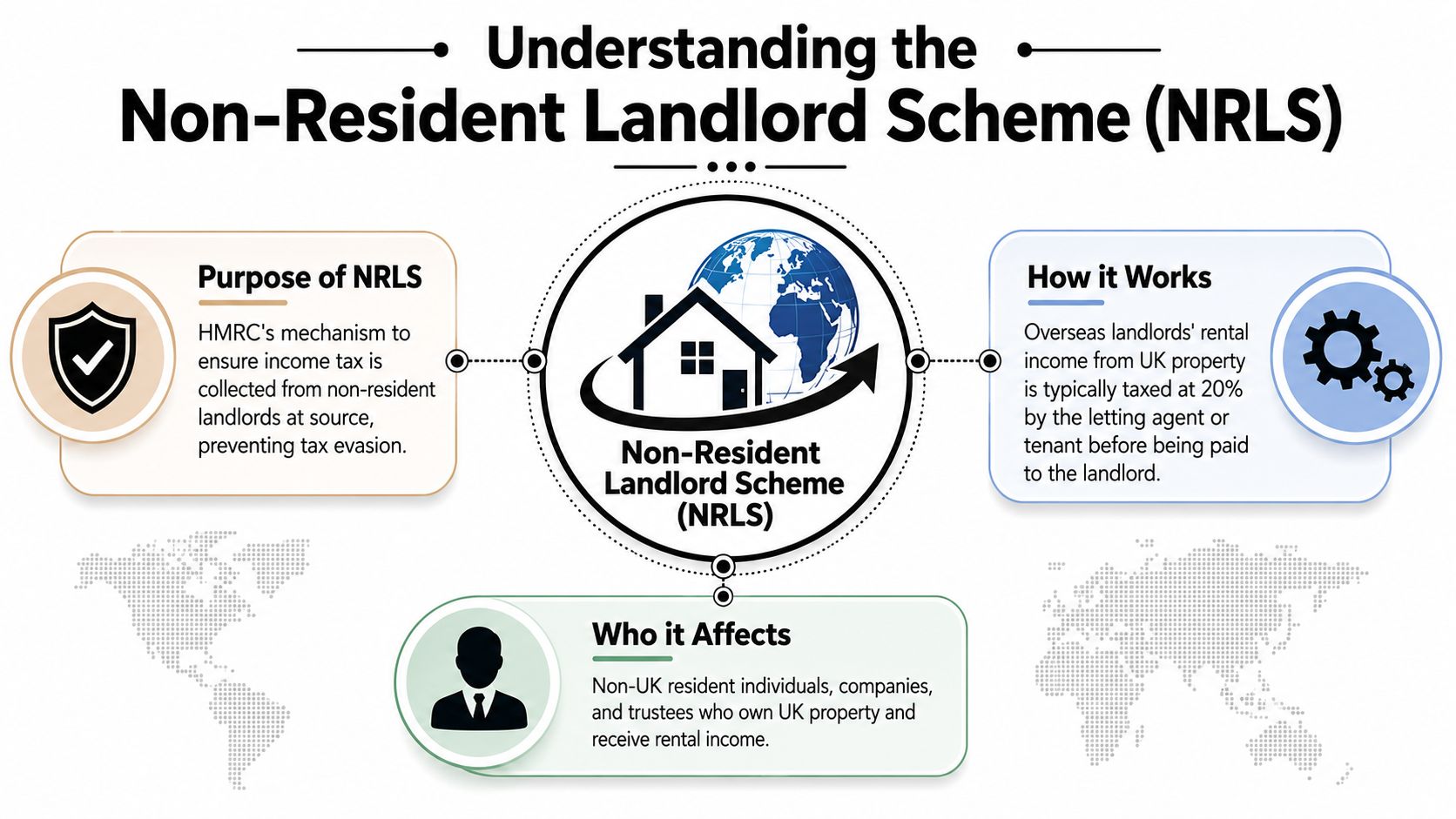
A common first mistake is to treat the Non-Resident Landlord Scheme as the tax itself. It is not. It is HMRC's collection system for UK rental income where the landlord's usual place of abode is outside the UK.
For individual landlords, the scheme sits alongside your Income Tax reporting. For non-UK companies with UK rental property, the wider compliance picture is different because the profits are generally dealt with under Corporation Tax. The withholding rules can still affect how rent is paid in practice, which is why overseas investors need to separate two questions early. Who deducts tax from the rent, and which tax return ultimately settles the position.
The Non-Resident Landlord Scheme, usually shortened to NRLS, has statutory backing in Sections 971 and 972 of the Income Tax Act 2007 and the Taxation of Income from Land (Non-residents) Regulations 1995, which apply to rent received on or after 6 April 1996, as set out in HMRC's NRLS guidance for letting agents and tenants.
Why HMRC uses this system
HMRC wants tax to be collected during the year instead of relying entirely on a landlord overseas to file later. So the scheme puts the withholding obligation on the party paying the rent onward.
That matters because the NRLS affects monthly cash flow before you even get to your final tax computation. If rent is withheld at source, the property may still be profitable on paper while feeling tight in practice once mortgage costs, service charges, insurance, and repairs fall due.
If you own property in your own name, that cash flow issue feeds into your Income Tax position. If you own through a company, it feeds into company treasury and Corporation Tax compliance. The commercial issue is the same. Less cash reaches you during the year unless gross payment approval is in place.
Who has to do what
The default rule is straightforward. A UK letting agent usually deducts basic rate tax from the rent before paying the balance to a non-resident landlord, unless HMRC has approved gross payment.
If there is no letting agent, the tenant can inherit that obligation. That usually becomes relevant where the rent is more than £100 a week.
That creates three separate responsibilities:
| Party | Practical role under NRLS |
|---|---|
| Landlord | Receives UK rental income and remains responsible for the final UK filing position |
| Letting agent | Usually deducts and pays over tax unless HMRC has authorised gross payment |
| Tenant | May need to withhold and account for tax where no agent is involved and the rent exceeds HMRC's threshold |
For many overseas clients, the administrative risk sits with the agent or tenant first, but the commercial risk still sits with the landlord. If the setup is wrong, rent can be withheld unexpectedly, statements can be unclear, and year-end reporting becomes harder than it should be.
What NRLS does and does not do
NRLS withholding is an advance payment mechanism. It is not a substitute for working out the actual tax due.
The tax withheld is later credited against the liability shown on the relevant UK return. If too much has been withheld, you may be due a repayment. If too little has been withheld, there will be more to pay.
That distinction catches both first-time buyers and experienced investors. I often see overseas landlords assume that tax stopped by the agent means the UK position is finished. It is only the first layer of compliance. The final answer depends on the ownership structure, the deductible expenses, finance costs, and the filing route that applies to you. If you need a broader framework for tax on overseas rental income, start there and then map the NRLS into that wider reporting position.
Where investors get caught out
The technical rule is simple. The practical facts often are not.
Joint ownership can change reporting. A period without an agent can shift withholding responsibility to the tenant. A transfer from personal ownership into a company can change the tax regime applying to future profits. Short gaps in occupation, direct rent payments, or poor record-keeping can all create avoidable friction with HMRC.
The sensible approach is to check the NRLS position as soon as the property starts generating rent, and to check it again whenever the ownership vehicle or management arrangement changes. That is particularly important for international investors deciding between personal ownership and a non-UK company, because the withholding process may look similar while the final tax treatment and filing obligations are not.
Receiving Gross Rent vs Paying Tax via Self Assessment
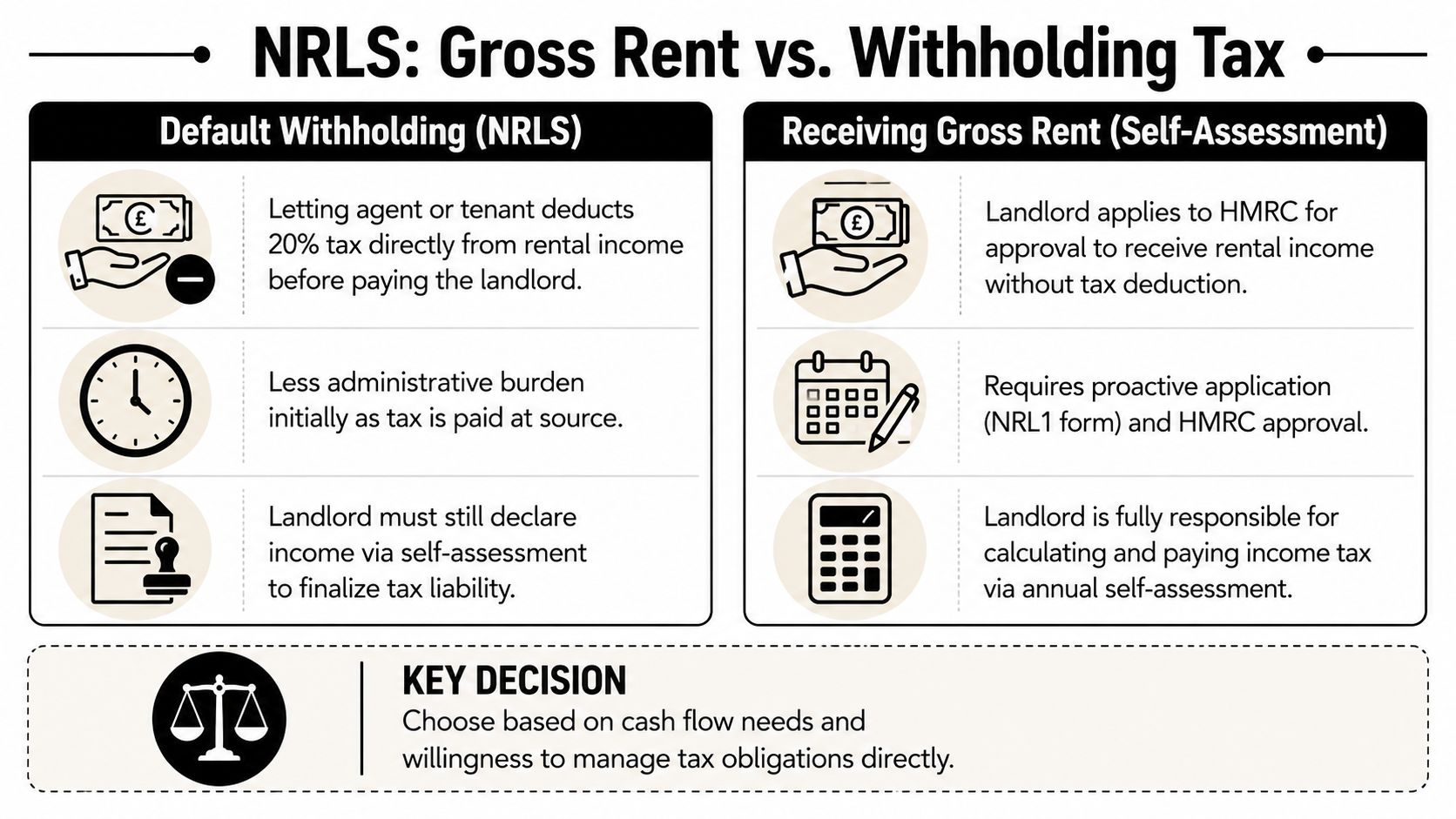
Most overseas landlords face a practical choice. Do you stay in the default withholding system, or do you apply to receive the rent gross and deal with the tax yourself through filing.
That decision affects cash flow more than almost anything else in day-to-day ownership.
The default position
If you do nothing, the usual result is that the letting agent deducts tax before passing on the rent. For some landlords, that's acceptable. It creates a built-in payment flow to HMRC, and the landlord isn't holding funds that should later be reserved for tax.
The weakness is obvious. Your monthly income arrives reduced. If you have mortgage payments, service charges, insurance, and maintenance obligations, the deduction can make the property feel far less liquid than it really is.
The gross rent route
Many landlords prefer to apply for approval to receive rent without deduction and then settle the liability through UK filing. In practice, this gives better control over the timing of cash and lets the landlord manage working capital more intelligently.
For an investor with one property, that may mean easier budgeting. For someone with several units, it can make a material difference to repairs, void management, and debt servicing because more cash stays inside the business until the liability is calculated properly.
A useful overview of overseas rent and reporting mechanics is in this guide to overseas rental income and tax treatment.
Side-by-side comparison
| Issue | Default withholding | Receiving gross rent |
|---|---|---|
| Cash flow | Rent is reduced before you receive it | Full rent arrives before tax is paid later |
| Administrative feel | Simpler at the payment stage | More responsibility sits with the landlord |
| Control | Less flexibility over timing of funds | More control over reserves and planning |
| Risk if disorganised | Lower risk of spending tax money accidentally | Higher risk if you don't reserve for the tax bill |
Here is the comparison in visual form.
What works in practice
For landlords who dislike administration, default withholding can be a sensible holding pattern at the start. The problem is that it often becomes an expensive convenience. If your actual taxable profit is lower than the amount being withheld against gross rent, your money is effectively tied up until your reporting position catches up.
For organised investors, receiving rent gross usually works better. But only if the compliance discipline is real.
- Reserve tax separately: Keep a dedicated balance for HMRC rather than treating gross rent as fully spendable.
- Use proper bookkeeping tools: Xero, QuickBooks, or a well-maintained spreadsheet is far better than trying to reconstruct expenses at year end.
- Reconcile agent statements monthly: Don't wait until filing season to discover missing fees or repair invoices.
- File on time, every time: Gross payment approval is valuable. It should be treated as a privilege that depends on reliable compliance.
If you receive gross rent, act like your own finance department. That's the trade-off.
Which route suits which investor
A first-time buyer living overseas with one lower-maintenance property may start with withholding to avoid early mistakes. A portfolio investor, a landlord with financing costs, or anyone focused on active asset management usually wants the gross route because it preserves operating flexibility.
What doesn't work is indecision. I often see landlords drift into whatever the agent sets up by default. That's backwards. The tax collection method should reflect the investment strategy, not the other way round.
Calculating Your Final UK Tax Liability
A new overseas landlord often looks at one figure only: the rent hitting the account. HMRC taxes a different figure. For individuals, the final calculation is based on taxable rental profit, after allowable deductions, and then tested against the income tax rules that apply to that person.
That difference affects cash flow straight away. A property can produce healthy rent and still have a modest taxable profit once agent fees, repairs, insurance, and other deductible costs are taken into account.
Start with the actual tax calculation
For an individual non-resident landlord, the basic calculation is:
Rental income
minus allowable expenses
equals taxable rental profit
Then apply the relevant income tax position. That includes whether the personal allowance is available and whether any other UK income pushes part of the profit into a higher band.
In practice, this is often a point of confusion. Landlords often mix up three separate numbers:
- Gross rent collected
- Net cash left after property costs
- Taxable profit for HMRC
Those numbers can be close. They are often not.
What usually counts as an allowable expense
The tax result depends heavily on how costs are classified. Some expenses reduce rental profit in the year. Others are capital in nature and do not.
Typical revenue expenses include:
- Letting and management fees
- Repairs and maintenance
- Landlord insurance
- Ground rent and service charges
- Routine running costs linked to the let property
Finance costs need extra care. Individual landlords do not always get relief in the same way they expect, especially if they assume mortgage costs work like any other business expense. Company investors face a different tax framework, which is one reason entity choice can change the numbers materially.
A clean split between repairs and improvements matters as well. Replacing a broken boiler is usually very different from upgrading the property beyond its previous standard. Get that wrong and the return can be wrong.
A practical example
Take an individual landlord with £20,000 of annual rent and £8,000 of allowable expenses.
That leaves £12,000 of taxable rental profit.
If that landlord has no other relevant UK income and can use the personal allowance, there may be little or no final income tax to pay on that rental profit. If tax has already been withheld from the rent during the year, the filed return may show an overpayment and trigger a repayment.
This is why I tell new clients not to judge the year's tax bill from the monthly agent statement. The collection method and the final liability are related, but they are not the same thing.
Gross rent tells you what the property brought in. Taxable profit tells you what HMRC charges tax on.
Record-keeping decides how much profit you can defend
Poor records usually cost landlords more than technical tax rules do.
An annual letting statement rarely gives enough detail on its own. You need to be able to show what each deduction was, when it was incurred, and whether it was revenue or capital. That matters during preparation of the return and matters even more if HMRC ever asks questions later.
A workable file should include:
| Record type | Why it matters |
|---|---|
| Tenancy agreements and rent statements | Confirms income due and received |
| Agent statements | Shows fees, repairs, and deductions at source |
| Invoices and receipts | Supports expense claims |
| Insurance documents | Evidence of recurring deductible costs |
| Purchase and capital works records | Separates improvements from annual running expenses |
If you later dispose of the property, those records will also support the wider tax analysis, including any position on capital gains tax on UK property.
Where landlords go wrong
The repeated mistakes are predictable.
Some individual investors assume tax withheld from rent settles everything. It does not. Others treat every property payment as deductible without checking whether it was really a repair, a pre-letting cost, or capital expenditure. A third group leaves the bookkeeping until the filing deadline, then tries to rebuild a year of transactions from bank entries and old emails.
The better approach is simple. Reconcile monthly, keep invoices as you go, and review larger works before claiming them. That is how you protect cash flow and avoid paying too much tax through bad classification.
For company investors, the same discipline still matters, but the tax regime itself changes. The rates, filings, and treatment sit under corporation tax rather than the individual income tax rules used here.
Special Considerations for Corporate Landlords
Company ownership changes the tax conversation immediately. For this reason, many articles on non resident landlord tax UK fall short, because they explain the rules as if every overseas landlord is an individual. Many aren't.

Companies are not taxed under the same regime as individuals
Non-UK resident companies are taxed under corporation tax on UK rental income, with rates between 19% and 25%, while the NRLS withholding rules still sit in the background for collection and compliance, as explained in Deloitte's note on the non-resident landlords scheme.
That means the company route does not equate to “the same rules but inside a limited company”. The tax regime differs. The filing route differs. The cash-flow consequences can differ as well.
What this means in practical terms
An individual landlord looks at income tax bands and personal allowances. A company owner has to think in terms of corporation tax exposure, company accounting, and the interaction between withholding and the company's final return position.
That creates a few real-world trade-offs:
- Entity choice affects profit extraction: Tax inside the company isn't the only issue. You also need to think about how money eventually leaves the structure.
- Portfolio scale matters more: A company can make administrative sense for some investors, but it also adds governance and filing responsibilities.
- Cash flow can feel uneven: If rent is withheld under the collection rules while the company's final corporation tax profile works out differently, the timing mismatch matters.
Where corporate investors need extra care
I see two recurring misunderstandings.
The first is assuming company ownership automatically produces a better tax outcome. Sometimes it does. Sometimes it doesn't. The answer depends on profit levels, financing, long-term plans, and where the shareholder is tax resident.
The second is treating the company like a passive wrapper. It isn't. A non-UK company with UK rental income needs proper records, proper filings, and a proper compliance calendar. If you bought through a company mainly for liability or succession reasons, that may still be sensible. It just isn't a shortcut.
A useful parallel issue for investors comparing ownership structures is purchase cost, especially if you're weighing personal ownership against a company vehicle. This stamp duty calculator for limited companies is helpful when reviewing the acquisition side of that decision.
Corporate ownership can be efficient. It can also be over-engineered. The right structure is the one you can operate cleanly over time.
What usually works best for company investors
The strongest setups tend to have clear internal discipline. Rent collection, expense coding, director decisions, shareholder expectations, and cross-border reporting all need to align. If the company exists in one country, owns property in another, and has owners in a third, complexity arrives quickly.
For that reason, the company route suits investors who want a durable structure and are prepared to run it properly. It's less suitable for someone who wants a single UK flat to produce uncomplicated personal income.
Double Taxation Treaties and Your Home Country Tax
Most overseas landlords ask the same question once they understand the UK side. If the UK taxes the rental profit, will the home country tax it again.
Often, yes, the income still needs to be declared where you live. But that doesn't automatically mean the same income is taxed twice with no relief. The key concept is the double taxation treaty, sometimes called a double tax agreement.
What the treaty usually does
For UK real estate income, the UK generally has the primary right to tax the rental profits arising from UK property. That means the UK tax position has to be handled properly first.
Your country of residence may still require you to report that same income under its domestic rules. The treaty then usually provides a mechanism so the UK tax paid can be taken into account, often by way of a foreign tax credit or a similar relief method under the terms of that specific agreement.
The practical consequence for investors
A treaty does not usually remove the UK filing obligation. It usually changes how your residence country deals with the same income after the UK has taxed it.
That means your paperwork matters. You need clear evidence of what income arose, what expenses were claimed, and what UK tax was paid or withheld. Without that, claiming relief in the home country becomes far harder than it should be.
- Keep HMRC correspondence: Approval notices, filing confirmations, and tax statements can all matter later.
- Retain proof of tax suffered: If withholding has taken place, keep the records that show it.
- Match tax years carefully: UK and home-country tax years may not align neatly, which creates timing issues.
- Don't assume your domestic adviser knows UK property rules: Cross-border coordination matters.
A related issue for many internationally mobile buyers is how property ownership interacts with wider personal tax exposure. This guide to second home tax implications is useful if you're looking at the bigger picture beyond rent alone.
What doesn't work
The worst approach is informal reporting. Telling your home-country adviser “tax was dealt with in the UK” without documents rarely ends well. Nor does relying on broad internet summaries of treaties.
Read the treaty that applies to your country pair, or have someone do it for you. The wording matters. So does the way your residence country implements relief in practice.
Compliance Checklist and Practical Steps
A typical compliance failure starts like this. The property is let, rent starts arriving, the agent says tax is being handled, and six months later you still do not know whether HMRC expects a return from you personally, from your company, or whether tax has been withheld correctly in the first place.
That is avoidable.
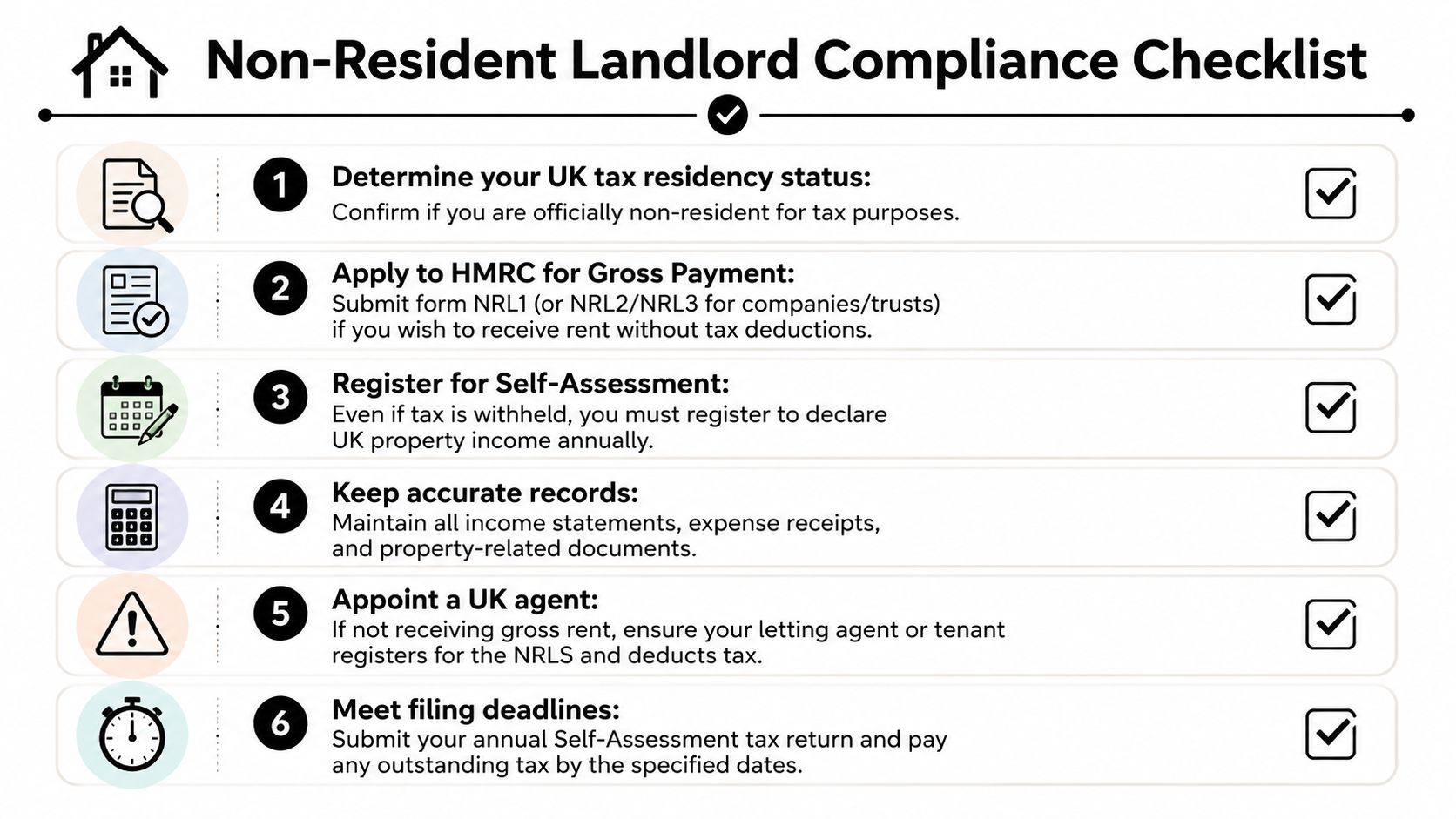
A practical operating checklist
Confirm who owns the property, and how
Start with the legal owner. An individual landlord and a non-UK resident company do not follow the same tax path. Individuals usually end up in Self Assessment. Companies with UK property income usually need to deal with Corporation Tax. If ownership is split between spouses, business partners, or a personal name and a company, get that clear before the first return is due.Register with the correct HMRC regime
Do not assume the letting agent has done this for you. In practice, overseas individual landlords need the right taxpayer references and access to file. Corporate investors need the company set up correctly for UK reporting. Delays here create cash flow problems later, especially if tax has been withheld and you cannot reconcile it promptly.Decide early whether to receive rent gross
Gross payment helps cash flow, but it shifts more discipline onto you. If rent is paid without deduction, you need to reserve money for the eventual tax bill instead of treating the full rent as spendable cash. Some clients prefer withholding at the start because it reduces the risk of underpaying. Others want gross rent because they know deductible expenses will reduce the final liability. The right answer depends on your margins, borrowing costs, and how tightly you manage reserves.Check what your letting agent is doing
A good agent provides clear statements, shows any tax deducted, and keeps records you can use for filing. A weak agent collects rent and leaves you to sort out the tax position later. Ask direct questions. Are they operating under the non-resident landlord rules where required? Will statements show deductions clearly? Can they produce a full year summary without manual reconstruction?Keep records by property and by owner
This matters more than many overseas investors expect. If you own one flat personally and another through a company, keep those records completely separate. The same applies to mixed-use costs, finance costs, repairs, service charges, and insurance. Xero, QuickBooks, Dext, Hubdoc, or a disciplined spreadsheet can all work. The system matters less than using one method consistently from day one.Track filing dates and payment dates in one calendar
Do not rely on memory, especially if you live in a different tax year from the UK. Keep a simple compliance calendar covering HMRC registrations, return deadlines, tax payments, and any tenant or agent reporting obligations that apply where tax is withheld. If no agent is involved, the tenant may also have reporting duties, which is another reason to set the position up properly at the start.
Tools that make compliance easier
Administrative friction is a real cost for overseas landlords. It shows up in missed invoices, unclear exchange rate treatment, duplicated expenses, and year-end chases across time zones.
Digital record-keeping reduces that risk. It also puts you in a better position if HMRC asks questions or if you need figures quickly for refinancing, a remortgage application, or a review of whether the property should stay in personal ownership or move into a company structure.
For landlords who want to understand the direction of UK digital reporting, Receipt Router's MTD guidance is a useful read. It explains how reporting expectations are changing and why paper files and scattered PDFs create avoidable problems.
Clean books support tax compliance, but they also help you judge yield, control cash flow, and spot underperforming properties earlier.
Small habits that prevent larger problems
- Review statements every month: Fixing one missing invoice in the same month is easy. Finding twelve at year end is not.
- Use a separate bank account for the property business: This is close to mandatory in practice if you want clear records.
- Save documents as they arise: Tenancy agreements, mortgage statements, insurance renewals, invoices, and major works paperwork should go into the same folder structure every time.
- Set aside tax as rent comes in: This is particularly important if you are approved to receive rent gross.
- Get advice before major changes: Refinancing, transferring ownership, major refurbishment, a move into short-term letting, or bringing a company into the structure can all change the tax result.
The overseas landlords who stay out of trouble usually do the simple things well. They register early, keep records in order, separate personal and property cash, and treat compliance as part of the investment return, not as an afterthought.
Non-Resident Landlord Tax FAQs
What if my spouse and I own the property jointly
Joint ownership usually means each owner needs their own tax analysis and records. In practice, that means you shouldn't treat the rental income as belonging to just one person unless the legal and beneficial ownership supports that treatment. Both owners should make sure registration, reporting, and supporting records are handled correctly.
Do short-term lets and holiday stays fall outside these rules
Not automatically. The core issue is that the income arises from UK property and the owner is non-resident. The letting model can affect how records are kept and how the business is run, but it doesn't mean the overseas landlord rules disappear.
If tax has already been withheld, can I skip filing
That's a common mistake. Withholding is a collection mechanism, not the final settlement by itself. You still need to complete the appropriate filing process so the true liability can be reconciled against what has already been paid on your behalf.
What happens when I sell the property
A sale raises a separate tax question from rental income. The rental rules and the disposal rules are connected only in the sense that both sit inside your broader UK property tax profile. Keep acquisition papers, capital expenditure records, and ownership documents from the start. They often matter later when a disposal is reported.
Is company ownership always better for overseas investors
No. A company can be sensible for some portfolios, especially where governance, succession, or portfolio growth are central. But a company also creates extra administration and can complicate profit extraction. For a single uncomplicated investment, personal ownership is often cleaner. The right answer depends on your wider tax residence, financing, and long-term plans.
If you're comparing UK opportunities with other markets, reviewing ownership structures, or planning your next international purchase, World Property Investor offers practical market guides and investment research to help you assess deals with more confidence.