
The popular advice for overseas buyers is to wait for a nationwide property correction, or to follow the regions with the strongest headline price growth. Both approaches can mislead. The latest UK property market trends point to a more difficult but more useful conclusion: capital values are moving slowly, while rents remain comparatively resilient, and the investment decision increasingly depends on the local relationship between price, income, supply and financing.
The UK isn't one tradeable market with one risk profile. An investor buying a high-priced property in England faces a different affordability and rental equation from one buying in Wales, Scotland or Northern Ireland. In a low-growth environment, the quality of the cash flow matters more than a national forecast.
Table of Contents
- The Myth of a Single UK Housing Market
- Capital Stagnation Versus Rental Inflation
- Regional Divergence Across the Four Nations
- Macro Drivers and Financing Constraints
- Underwriting Deals in a Low-Growth Environment
- Strategic Portfolio Positioning for 2026
- Actionable Next Steps for International Buyers
The Myth of a Single UK Housing Market
The UK housing market is not a single investment proposition. National averages provide context, but they can obscure the regional pricing, income and supply conditions that determine cash flow and exit risk. The average UK house price reached £273,000 in July 2026, up 1.4% year on year, following annual growth of 2.0% in June and 2.7% in May, according to the UK House Price Index summary for July 2026. The sequence indicates continued growth with weakening momentum and material month-to-month variation.
The earlier ONS series makes the slowdown clearer. Average UK prices were £268,000 in March 2026, with no annual growth, then rose to £271,000 in May, £272,000 in June and £273,000 in July. This is a low-growth market, not a broad collapse. The Office for National Statistics release for August 2026 records a substantial July regional spread: England averaged £293,000, Wales £215,000 and Scotland £196,000.
Why the national average can produce a bad acquisition
A national figure leaves three acquisition variables unresolved:
- Local earnings: Tenant affordability follows wages and employment conditions in the target area, not the UK average.
- Available stock: Limited rental supply can support occupancy and pricing, while more competing stock can weaken both.
- Exit liquidity: A property may generate attractive income yet appeal to a narrower buyer pool on resale.
Northern Ireland shows how sharply local conditions can diverge. Average annual house price growth there was 7.4% in the first quarter of 2026, according to the NISRA Northern Ireland House Price Statistics for Q1 2026. That pace sits well above the UK-wide July reading, but it does not by itself establish superior investment quality. It signals that regional demand, supply and affordability can outweigh the national narrative.
Practical rule: Treat the UK average as an opening question, not an investment conclusion.
International buyers should move from country to region, then to neighbourhood and asset type. A structured approach to property intelligence for trend reads can organise local indicators. Underwriting still depends on achievable rent, comparable sales, operating costs and the likely buyer at exit. In a low-growth market, those inputs determine whether rental income compensates for limited capital appreciation.
Capital Stagnation Versus Rental Inflation
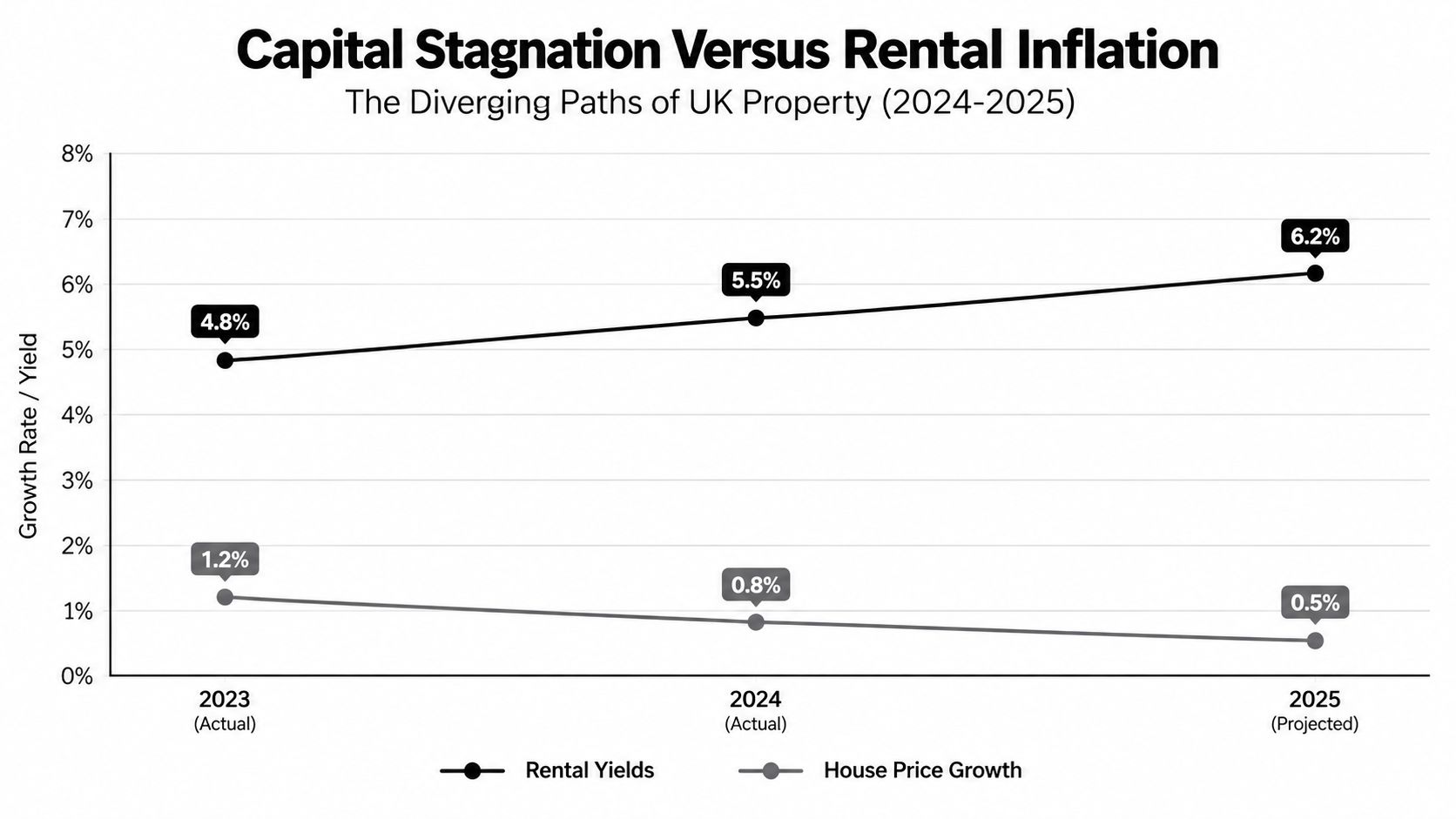
National house-price averages can obscure the more investable signal: rent is still rising while capital growth remains subdued. Average UK private rents rose 3.8% to £1,400 a month in the year to August 2026, compared with average house-price growth of only 1.4% year on year by July. These figures come from separate ONS measures, but their direction matters for investors assessing income rather than relying on appreciation. The ONS housing data records England's average rent at £1,459, up 4.0%, and Wales at £846, up 4.3%.
The earlier observation window points in the same direction. ONS reported average UK rents up 3.4% to £1,377 in the twelve months to March 2026, while house prices remained broadly between £268,000 and £273,000 across the February to July observations. This does not guarantee a higher net return. It does mean that underwriting should give rental durability, operating costs and tenant affordability greater weight than an assumed uplift in resale value.
Why rent growth doesn't equal easy profit
A stable purchase price combined with rising achievable rent can improve gross yield. Gross yield remains only a screening measure. Mortgage interest, management, insurance, repairs, compliance, service charges, voids and taxation may absorb much of the apparent gain.
Tenant affordability sets a ceiling on rent growth. Supply-constrained areas may support stronger revenue, but higher rents can weaken demand where local incomes lag. ONS affordability analysis defines a rental market as affordable when rent is 30% or less of gross income. Its 2024 analysis found that private-rental household incomes had grown faster than rents in England since 2021, but not in Wales and Northern Ireland. That difference affects arrears risk, tenant turnover and the scope for further increases.
Underwrite four separate figures:
- Headline rent: What comparable properties advertise.
- Achievable rent: What a letting agent expects the property to secure.
- Collected rent: What remains after arrears, concessions and voids.
- Net operating income: What remains after property-level costs.
Limited capital growth also changes the exit test. A future sale may not repair weak cash flow or an optimistic purchase assumption. A cash-flow asset therefore needs a credible income case at acquisition, plus resale demand supported by location, condition and the depth of the buyer pool.
A review of the best rental yields in the UK can help investors compare locations, but advertised yield cannot replace a property-level operating model. A lower headline yield may prove stronger when tenant demand is deeper, maintenance exposure is lower and exit liquidity is more dependable.
Regional Divergence Across the Four Nations
A single UK average conceals the investment question that matters most: whether rent can support the acquisition price. In the twelve months to April 2026, average house prices were £290,000 in England, £210,000 in Wales and £187,000 in Scotland, while average UK rent was £1,381 per month, according to the ONS private rent and house price bulletin for May 2026. These figures establish scale, not an individual property's yield. Local rent, operating costs, vacancy risk and financing terms determine the cash-flow case.
| Region | Average House Price | Annual Rent Growth | Affordability Pressure |
|---|---|---|---|
| England | £293,000 in July 2026 | 4.0% | Higher absolute rents, with pressure varying sharply by local income and supply |
| Wales | £215,000 in July 2026 | 4.3% | Strong rent growth, with affordability concerns where earnings lag |
| Scotland | £196,000 in July 2026 | 1.1% | Lower average price and slower rent growth, requiring careful income analysis |
| Northern Ireland | Not stated in the July regional price summary | 1.6% | Different affordability dynamics, with annual house-price growth of 7.4% in Q1 2026 |
The July regional prices and August rental figures in the table are reported by the ONS housing release. The figures do not form a ranking. England combines higher rents with higher acquisition costs. Wales recorded faster rental inflation, but that can increase affordability pressure where earnings and supply do not keep pace. Scotland's slower rent growth limits near-term income momentum, although a lower entry price may still produce acceptable cash flow when occupancy and property costs are favourable.
England
England has the widest selection of cities, commuter markets and employment centres, so its national average has limited underwriting value. The average price was £293,000 in July 2026, average rent was £1,459 in August, and annual rent growth was 4.0%. London and the South East faced downward pressure in survey-based readings, while the South West was identified as the main contributor to the broader slowdown in annual house-price inflation in the July index. The government's July 2026 UK House Price Index release supports analysing English sub-markets separately.
For investors, the trade-off is clear. A higher rent does not automatically offset a higher purchase price. Underwriting should compare achievable rent with the full capital requirement, not with the national average.
Wales and Scotland
Wales combined a lower average price with rent growth of 4.3% in the year to August 2026. That profile may suit income-focused buyers, but affordability varies by local earnings and tenant demand. Scotland's average rent was £1,013, up 1.1%, and its average house price was £196,000 in July. The lower price can improve the entry yield, while slower rental inflation makes current achievable rent more important than optimistic future increases.
Northern Ireland
Northern Ireland requires separate analysis. Its 7.4% annual house-price growth in Q1 2026 differed from the wider UK slowdown, while rent growth was 1.6% in the year to August. Price momentum alone does not establish a durable investment case. Buyers should test local employment, tenant depth, resale demand and ownership costs before treating the region as a growth market. A Northern Ireland property market guide offers a starting point for regional research, but property-level due diligence remains necessary.
Macro Drivers and Financing Constraints
Financing can determine whether a property is an income-producing asset or a monthly liability. In September 2026, the average two-year fixed residential mortgage rate was 5.83%, while the average five-year fixed rate was 5.87%, both reported as their highest levels since late 2023 according to Moneyfacts in a BBC market update. Those rates aren't a universal buy-to-let quote, and overseas borrowers may face different pricing, fees, loan-to-value limits and underwriting requirements. They are nevertheless a clear reminder that debt costs remain central to the investment case.
A financed purchase has two moving parts. Rent provides the operating income, while the mortgage determines how much of that income reaches the investor after financing. When fixed rates remain high, a property with a respectable gross yield can still produce weak or negative cash flow once interest, management and maintenance are deducted.
The rent-growth normalisation problem
The rental market isn't uniformly accelerating. ONS recorded annual rent growth of 4.0% in England, 4.3% in Wales and 1.1% in Scotland to August 2026, while Zoopla reported new-let rent growth of 2.8% in the twelve months to April 2025, down from 6.4% a year earlier. The latter comparison is presented in the market discussion referenced by CBRE's UK real estate outlook. It suggests that investors shouldn't build a financing plan on the assumption that recent rent increases will continue at the same pace.
The micro-level effect is straightforward. A landlord may face a refinancing cost that resets quickly, while rent reviews occur less frequently and tenant affordability limits the amount that can be passed through. That mismatch makes fixed-rate expiry, interest coverage and cash reserves more important than a simple forecast of annual rent growth.
How overseas buyers should approach debt
Non-resident buyers should obtain independent advice on lender eligibility, currency exposure, tax treatment and ownership structure before making an offer. A specialist resource on an overseas mortgage for UK property can help frame the questions, but it can't replace regulated mortgage and tax advice.
Use conservative assumptions. Model the property at the rent a local agent can evidence, include all recurring costs, and test the outcome if refinancing becomes more expensive or rent growth slows. The objective isn't to predict every market movement. It's to ensure the investment remains manageable when conditions are less favourable.
Underwriting Deals in a Low-Growth Environment
A low-growth market removes the easiest justification for a weak purchase price. If an investor can't rely on rapid appreciation, the asset has to stand on its own operating performance. That means treating the rent roll, costs, financing and exit as separate underwriting questions rather than combining them into one optimistic return forecast.
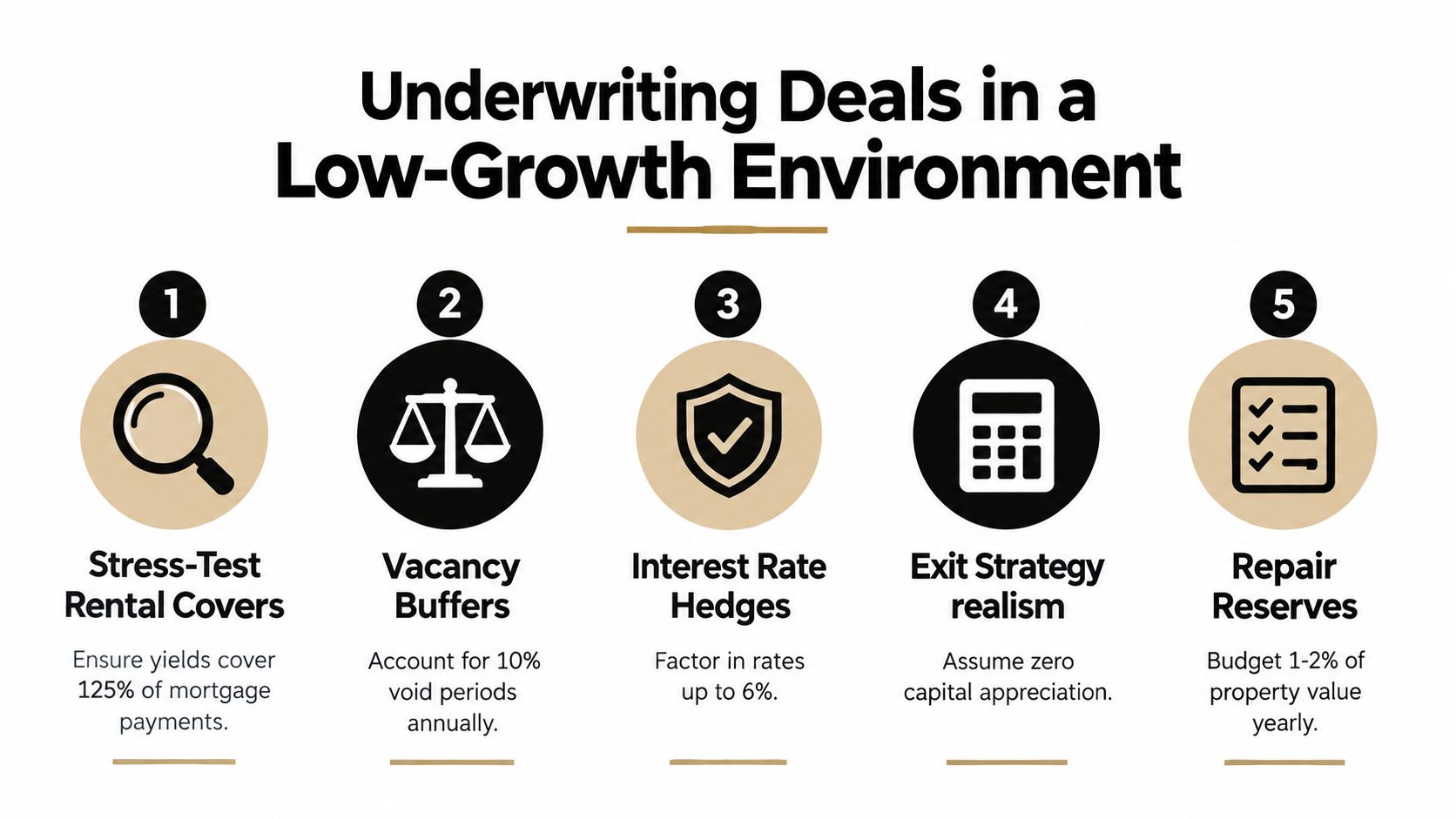
A five-part stress test
Start with achievable income. Use comparable lets and a written agent assessment, then distinguish advertised rent from collected rent. Don't use rent growth as a way to make today's purchase price appear reasonable.
Calculate the unlevered position. Deduct management, insurance, repairs, service charges, compliance, utilities where relevant and voids from gross rent. This shows whether the property works before debt, which is essential when comparing financing options.
Test debt service. Model the actual proposed loan, interest basis, fees and refinancing date. A deal that only works when the mortgage remains unusually cheap has limited resilience.
Build a vacancy and arrears case. A tenant can leave, pay late or require a rent concession even in a tight market. Where rents are rising faster than local earnings, test whether affordability pressure could increase turnover or arrears.
Assume a cautious exit. Underwrite a sale at a flat value rather than treating appreciation as a rescue mechanism. Include selling costs, possible refurbishment and the time required to find a buyer.
The measures that deserve priority
Gross yield is useful for screening, but it isn't the return an investor spends. Net operating income, debt service coverage, cash-on-cash return and reserve requirements provide a more realistic view. Keep assumptions auditable, especially where the property has environmental, building-condition or energy-related obligations. Investors who need a defensible record of property risk may also benefit from a process for collecting auditable ESG data.
Underwriting principle: If the deal fails when capital appreciation is set to zero, identify the exact operating change that would repair it. If no credible change exists, the price or asset is probably wrong.
Negative cash flow isn't always unacceptable. An investor may deliberately accept it for a strategic location, future redevelopment or a specific long-term objective. The decision should be explicit, funded and time-limited, rather than hidden inside a growth assumption. A practical explanation of what negative cash flow means can help investors distinguish a planned contribution from an unmanaged shortfall.
Strategic Portfolio Positioning for 2026
The evidence favours selectivity over national market timing. Investors don't need to choose between “buy the UK” and “avoid the UK”. They need to decide which local income, supply and financing combinations justify exposure, and which areas leave too much return dependent on future price appreciation.
The regional data supports a deliberate search beyond the most expensive markets. Secondary cities and commuter towns may offer a better relationship between purchase price and rent than prime London or South East locations, but that isn't a blanket recommendation. Each candidate still needs evidence of tenant demand, competing stock, transport access, local employment and saleability.
A more resilient allocation logic
An income-oriented portfolio can use different assets for different jobs:
- Core residential: Properties in established rental markets can provide dependable occupancy, though acquisition pricing may be less forgiving.
- Value-oriented stock: Lower-priced homes may offer more attractive entry economics, but condition, management intensity and resale liquidity require close review.
- Specialist or holiday accommodation: These can appeal to overseas owners, but income may be more seasonal and operationally demanding than a standard tenancy.
Lease structure also matters. Longer, stable tenancies may reduce turnover costs but can limit the speed of rent adjustments. Shorter arrangements may provide more flexibility while increasing void and management exposure. The right choice depends on tenant profile and local demand, not on a universal preference.
Survey-based weakness in London and the South East strengthens the case for sub-market comparison, but it doesn't make those regions uninvestable. Prime areas may still suit buyers prioritising liquidity, prestige or personal use over income. Conversely, a lower entry price elsewhere isn't enough if local demand is shallow.
The strategic shift is from passive exposure to active selection. Compare properties on net income, financing resilience and exit depth, then diversify only where the underlying risks differ.
Actionable Next Steps for International Buyers
International buyers should convert the market analysis into a transaction process before choosing a property. The aim is to prevent national headlines from replacing local evidence.
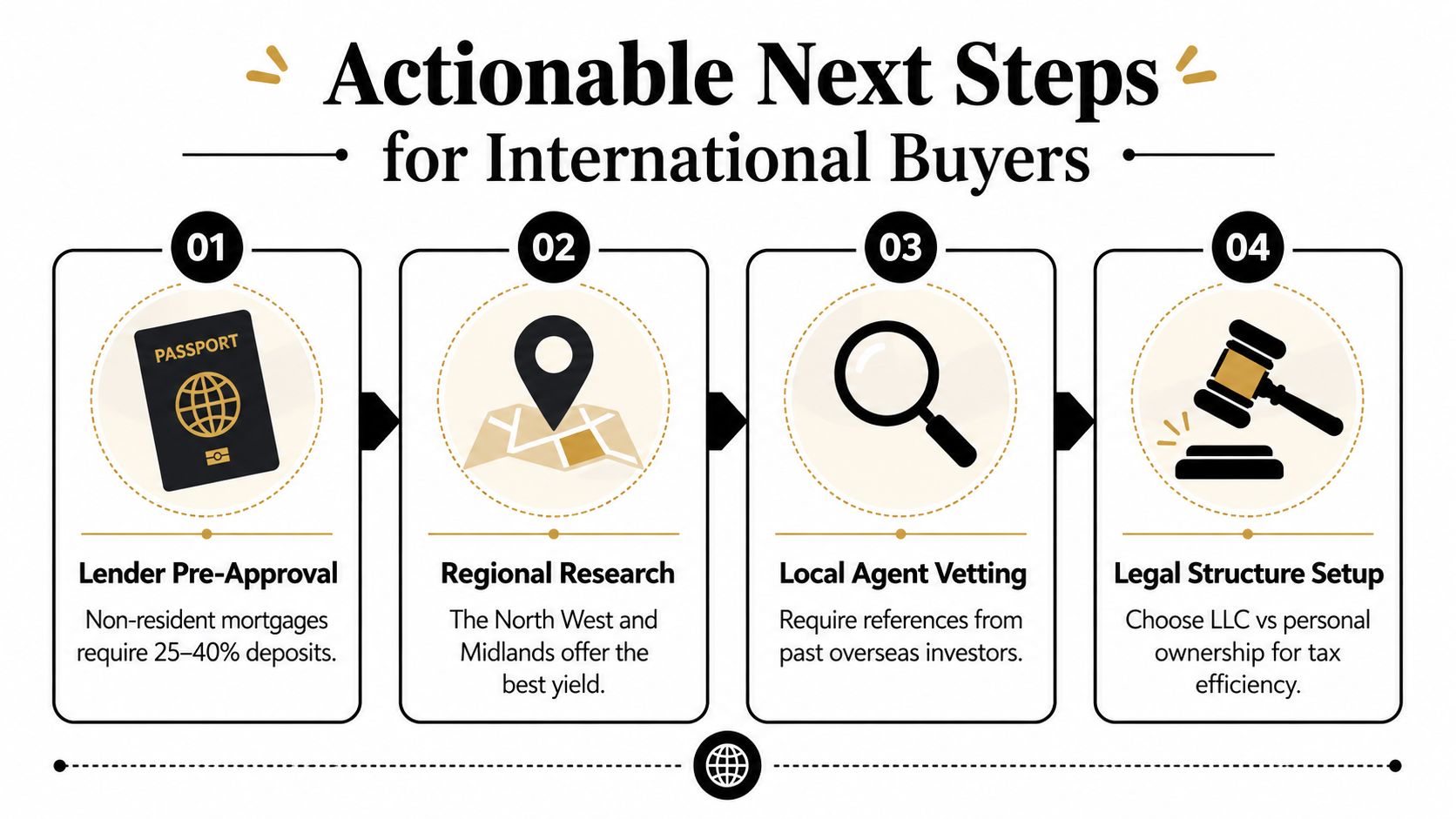
Define the return requirement. Decide whether the priority is income, personal use, long-term preservation of capital or a combination. This determines how much weight to place on yield, liquidity and location quality.
Build a regional shortlist. Compare achievable rents, purchase prices, tenant affordability and supply at town or neighbourhood level. Don't assume that England, Wales, Scotland or Northern Ireland can be represented by one national metric.
Secure financing and professional advice early. Obtain lender feedback before committing to a purchase, then confirm legal, tax, currency and ownership implications with appropriately qualified advisers. Keep the debt model separate from the rental forecast.
Verify the operating team. Ask letting agents for comparable rents, expected voids, tenant demand and maintenance assumptions. Review the building, lease, service charges and compliance position before treating the advertised yield as investable income.
Final check: A property should remain understandable when the assumptions are written down. If the return depends on rapid price growth, uninterrupted occupancy or permanently rising rents, the risk is probably understated.
UK property market trends now reward disciplined selection rather than broad optimism. The investor who compares regional affordability, tests financing and protects net cash flow will have a clearer basis for deciding whether a particular asset deserves capital over the next twelve months.
World Property Investor provides country and city guides, UK market analysis, rental-yield comparisons and practical buying guidance for international investors. Use its research to compare regions and investment approaches, then visit World Property Investor before narrowing your UK property shortlist.