
Negative cash flow is when a property's total expenses exceed its total income over a given period, so the owner has to fund the shortfall. In the UK, that pressure becomes severe as borrowing costs rise: around 100,000 landlords are in negative cash flow at 2% mortgage rates, 400,000 at 4%, and 900,000 at 6%.
If you own a rental and the rent hits your account but the mortgage, insurance, repairs and other costs still leave you out of pocket, you're already dealing with it. Many investors reach this point after a remortgage, a void period, a jump in service charges, or a simple review of the numbers that shows the property isn't carrying itself.
That doesn't automatically make the investment a mistake. Sometimes negative cash flow is a warning sign. Sometimes it's a deliberate strategy. The difference comes down to why the shortfall exists, how long you can carry it, what return you expect elsewhere in the deal, and whether the market fundamentals justify the drag on your liquidity.
An Introduction to Negative Cash Flow
A landlord usually notices negative cash flow in a very practical way. The tenant pays on time, but the account balance still falls by month end. That gap is the issue.
In property terms, negative cash flow means the income from the asset doesn't fully cover operating costs and debt service during the period you're measuring. In plain English, the property needs support from your salary, savings, or another source of capital.
That's why investors need to separate two different questions. First, is the property producing enough income today? Second, can a weak income position still make sense if the wider investment case is strong?
Why the concept matters
Many beginners treat cash flow as a simple pass or fail test. That's too crude. A flat in a mature, yield-led market may be expected to pay its way from day one. A property in a prime capital city or a fast-moving regeneration area may not. The numbers need different interpretation.
Established markets often appeal because they offer clearer rental evidence, deeper tenant demand, and more predictable regulation. Emerging markets can offer stronger upside, but investors may face thinner resale liquidity, weaker data, or more operational risk. In both cases, cash flow is the first discipline, not the whole investment thesis.
Practical rule: If you can't explain exactly why a property is negative cash flow, you shouldn't own it.
A good investor doesn't ask only, “What is negative cash flow?” They ask, “Is this shortfall temporary, structural, or strategic?” That's the question that determines whether to hold, fix, refinance, or sell.
If you need a refresher on how income performance is measured before cash costs are layered in, this guide to rental yield is a useful starting point.
Calculating Property Cash Flow A Worked Example
Most mistakes happen because investors confuse rent with profit. Rent is only the top line. Cash flow is what remains after the property has paid for itself.
In the UK buy-to-let market, negative cash flow is technically the point where Gross Rental Income minus Operating Expenses and Debt Service becomes negative. A common warning sign is failure of the 1% rule, where monthly rent falls below 1% of the purchase price. Lenders also react to this risk by applying stricter limits, often reducing approval levels to 65–70% LTV for these cases, as outlined in August's rental cashflow definition.
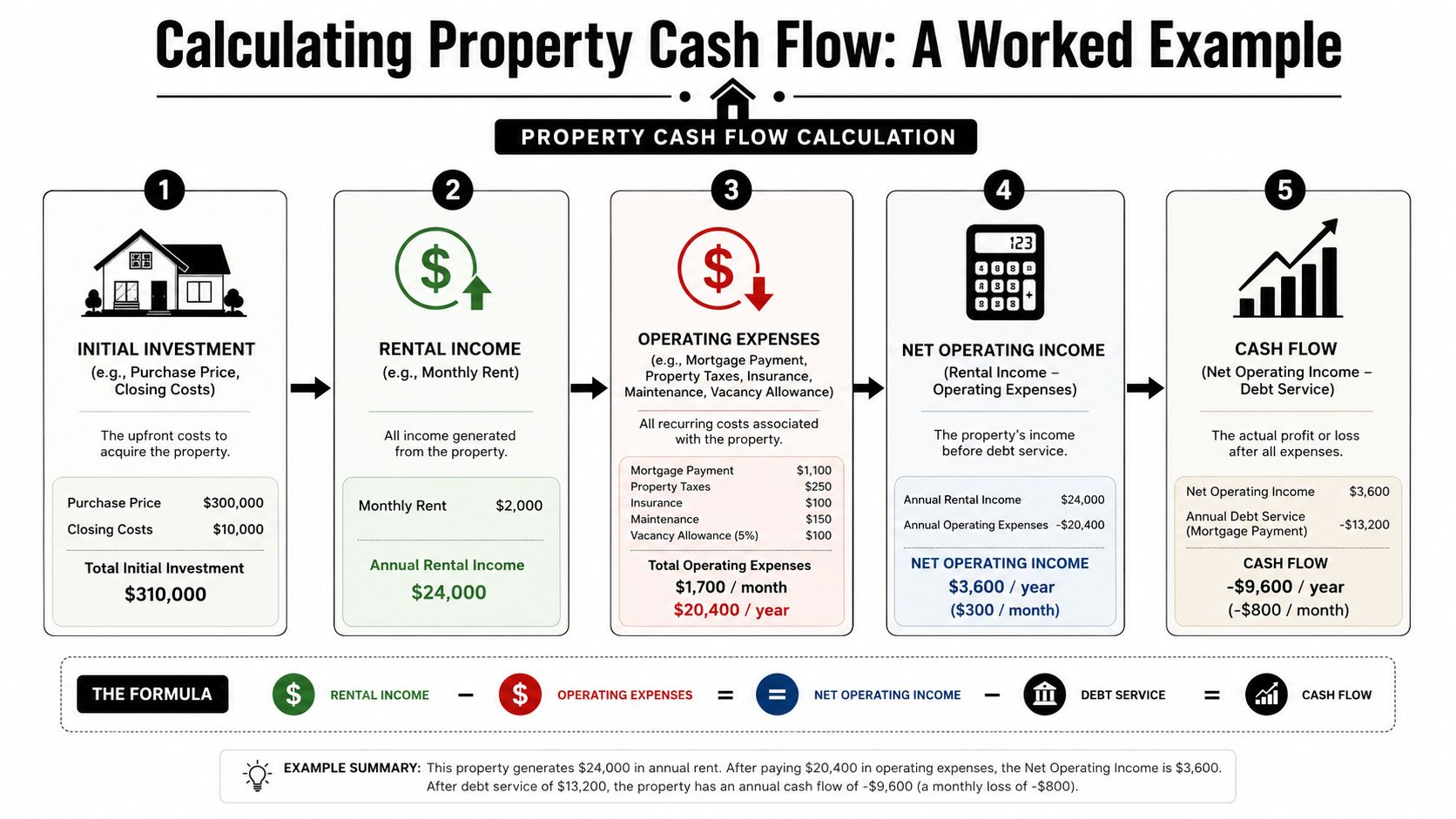
The basic formula
Use this sequence every time:
- Start with gross rental income
- Subtract operating expenses
- Subtract debt service
- The result is monthly cash flow
That sounds simple, but investors often omit irregular costs. That's where deals go wrong.
A worked example without guesswork
Take a hypothetical buy-to-let flat.
| Item | Monthly treatment |
|---|---|
| Gross rent | Income received from tenant |
| Letting or management fees | Operating expense |
| Insurance | Operating expense |
| Maintenance provision | Operating expense |
| Service charges or ground rent if relevant | Operating expense |
| Void allowance | Operating expense |
| Mortgage payment | Debt service |
The key is not the exact figures. The key is that every recurring cost must be counted before you call a property cash-flow positive.
Here's how practitioners should look at it.
- Positive cash flow scenario: Rent comfortably covers mortgage costs, routine maintenance, management, insurance, and an allowance for empty periods. The property pays its way and leaves surplus cash each month.
- Negative cash flow scenario: The mortgage resets at a higher rate, service charges rise, or the rent was overestimated. After the same line items are deducted, the landlord has to transfer money in to keep the property afloat.
What investors often miss
The biggest error is using only current mortgage interest and current occupancy as if both will stay fixed. They won't. Conservative underwriting means assuming friction.
Count the property as negative cash flow before it surprises you, not after.
For that reason, every underwriting model should include:
- A maintenance reserve: Even if the property is currently in good condition.
- A void assumption: Because no tenancy runs perfectly forever.
- Management costs: Even self-managing landlords should price their time or future outsourcing.
- Debt sensitivity: A remortgage or refinance can change the deal quickly.
If you want to test your own numbers more systematically, a UK rental income calculator can help structure the inputs, but the discipline still comes from what you choose to include.
The Four Main Causes of Negative Cash Flow
Most negative cash flow problems come from one of four places. Sometimes two or three hit at once, which is why a property can look fine on purchase and weak a year later.

Rising mortgage costs
Debt is the fastest route from positive to negative. In the UK, the number of landlords in negative cash flow rises sharply with mortgage rates: 100,000 at 2%, 400,000 at 4%, and 900,000 at 6%, according to Property Notify's analysis of landlord selling pressure.
That matters beyond the UK. In established markets with greater reliance on debt, rate shocks feed straight into monthly cash flow. In emerging markets, debt may be less available or more expensive from the start, so investors often rely more on equity. Different structure, same lesson. Funding costs define resilience.
Operating expenses that were underestimated
Apartments with lifts, concierge services, major works exposure, or older building fabric can suffer from chronic expense drag. Investors often focus on the purchase price and rent, then underestimate what it costs to keep the asset lettable.
Capital expenditure is where many spreadsheets become fiction. A practical primer like Towne and Country's CapEx guide is useful because it separates routine maintenance from larger replacement costs, which investors should never treat as optional.
The property doesn't care whether you budgeted for a roof repair. The cash still leaves your account.
Void periods and transition gaps
A rental only works when it's occupied by a paying tenant. Even a decent property in a good area can slip into negative cash flow if re-letting takes longer than expected. In weaker submarkets, that problem lasts longer. In stronger submarkets, it still hurts because fixed costs keep running.
Some investors study rent levels obsessively but spend almost no time analysing local absorption, tenant demand, and turnover patterns. Looking at vacancy rates by city is a much better way to judge income durability.
Later regulatory and operational changes can add further pressure. Under the 2026 UK expense framework, projected structural tenant transitions may create voids lasting 6–8 weeks, and failing to provide the mandatory Renters' Rights Information Sheet can trigger £7,000 fines per tenancy, as noted by Unity Property Investment. For investors planning future acquisitions, that's a direct cash-flow risk.
A short explainer helps show how these risks combine in practice.
Weak management and income leakage
Poor management doesn't always show up as a dramatic event. More often, it shows up as small, repeated losses. Late rent collection, sloppy contractor control, preventable tenant turnover, and bad vendor pricing all chip away at margin.
That's true in London, Berlin, Dubai, or any secondary market where distance makes oversight harder. If you invest cross-border, management quality becomes part of the asset itself. A mediocre manager can turn a decent property into a negative cash flow one without a single headline problem.
When Negative Cash Flow Is a Smart Strategy
Negative cash flow isn't always a sign of bad investing. Sometimes it's the price of entering a market where the investor expects the return to come from future value growth, redevelopment, or tax positioning rather than immediate income.
That's common in expensive, supply-constrained cities and in high-growth districts where prices are pushed up by infrastructure, job creation, or scarcity. Investors in these areas may accept weaker day-one yield because they're buying location quality, long-term demand, and eventual equity build-up.

When the strategy makes sense
In strategic terms, some UK investors deliberately accept negative cash flow as a strategic deficit to capture future capital appreciation, particularly in higher-growth locations. For that to be viable, they need a cash reserve covering at least 6–12 months of the shortfall, as described in this analysis of negative cash flow strategy.
That framework applies globally. A prime-city investor in an established market may tolerate low income because the asset is a store of long-term value. An investor in an emerging market may accept temporary negative cash flow if a property is being repositioned and the local fundamentals support future rent growth or resale demand.
The strategy can work when several conditions line up:
- Strong personal liquidity: You can fund the deficit without stress.
- Clear market thesis: You're buying for a reason beyond hope.
- Defined holding period: You know how long you're prepared to carry the asset.
- Plausible exit routes: Sale, refinance, redevelopment, or rent reset all need to be realistic.
When it's just a financial drain
A lot of investors call a weak deal “strategic” when it is underperforming. That usually happens when the owner has no real buffer, no strong income outside the asset, and no evidence that the market can justify the pain.
A negative cash flow property becomes dangerous when:
| Situation | What it means |
|---|---|
| Shortfall relies on personal debt | You're financing a loss with more leverage |
| No reserve fund exists | A minor shock can force a sale |
| Market growth case is vague | You're speculating, not investing |
| Rent upside is limited | The deficit may become permanent |
A planned monthly shortfall is a strategy. An unexplained monthly shortfall is a problem.
A practical decision framework
Ask these questions before you accept a negative cash flow deal:
Is the location genuinely constrained or improving?
In established markets, look for strong employment, transport access, planning restrictions, and consistent tenant demand. In emerging markets, look harder at legal clarity, financing access, and exit liquidity.Who is the likely future buyer or tenant?
If you can't identify the end user, appreciation assumptions get weak very quickly.Can you absorb the downside for long enough?
A property may be right in principle and still wrong for your balance sheet.What happens if rates, rents, or costs move against you?
If the deal only works in a perfect scenario, it doesn't work.
What works and what doesn't
What works is using negative cash flow selectively in markets where scarcity, income growth, or asset repositioning can plausibly create value over time. What doesn't work is buying poor-yield stock in weak locations and assuming appreciation will rescue the numbers.
Investors with high salaries, diversified portfolios, and long time horizons can sometimes use this approach well. Investors relying on rental income to support themselves usually can't. Same property concept, completely different risk profile.
Global Tax Implications and Negative Gearing
Tax is one reason some investors accept a property that loses cash each month. The key term is negative gearing, used widely in Australia to describe a property where deductible costs exceed rental income, allowing the loss to offset other taxable income subject to local rules.
The concept exists in several jurisdictions, but the treatment is not universal. That's where global investors make expensive mistakes. They assume a strategy that works in one market transfers neatly into another. It often doesn't.
The UK position
A key UK-specific angle is that rental losses may be offset against other income under certain conditions. Recent analysis also suggests that 42% of UK buy-to-let investors underuse this provision because they misunderstand their active versus passive landlord status, which can lead to average annual tax overpayments of up to £3,200, according to this review of UK tax treatment.
That means a cash-flow loss and a tax outcome are related, but they aren't the same thing. A tax deduction may soften the after-tax pain. It does not remove the need to fund the shortfall in real cash.
For a broader view of how landlord taxation affects net returns, this overview of rental income tax rates is worth reviewing alongside local advice from HMRC or a qualified tax adviser.
Australia, the USA and Europe
Australia is the market most associated with negative gearing. Investors there often build a strategy around deductibility and long-term capital growth. That doesn't mean the property is healthy. It means the tax system may make the loss more tolerable.
The USA is different. Federal tax rules often distinguish between passive and non-passive losses, and the ability to offset rental losses against other income depends on investor circumstances and classification. A property can therefore be negative cash flow while offering limited immediate tax relief.
Germany and much of continental Europe usually require a more jurisdiction-specific reading. Loss treatment, depreciation rules, and financing deductions can all vary significantly. Investors who buy through local entities or hold through cross-border structures need coordinated legal and tax advice before assuming any benefit.
The operational point investors miss
Tax planning should support an investment case, not replace one. A property that loses money every month isn't suddenly strong because the tax treatment is favourable.
Still, accurate record-keeping matters. If you own rentals in jurisdictions that permit depreciation, it helps to understand how deductions are documented. A practical resource on how to create a depreciation schedule for rentals can help investors organise the accounting side properly before year-end rather than trying to reconstruct it later.
Tax relief improves efficiency. It doesn't create cash flow.
The discipline is simple. Model the property before tax. Then assess what the tax code changes. Investors who reverse that order usually talk themselves into weak deals.
Four Strategies to Mitigate Negative Cash Flow
If negative cash flow wasn't part of the original plan, the response has to be practical. Start by identifying whether the problem is financing, revenue, costs, or positioning. Then work the least disruptive fix first.

Restructure the finance
Refinancing, changing product type, or reducing debt service can improve monthly cash flow immediately. But this has become harder. In the UK, 68% of buy-to-let lenders require a minimum 145% interest coverage ratio at a 5.5% stress rate, which means borrowers often need strong personal income if the property itself is weak, as explained in Rentila's review of healthy BTL cash flow.
That tells you two things. First, don't assume a refinance will rescue the deal. Second, lenders are now underwriting the investor as much as the asset.
Improve income carefully
The obvious move is to increase rent, but it has to be grounded in local evidence and regulation. In established markets, compare your property with direct local stock rather than broad city averages. In emerging markets, tenant affordability and seasonality may matter more than headline demand.
Other income actions can be stronger than a simple rent rise:
- Upgrade the offer: Furnishing, layout changes, or better amenities can improve tenant quality and pricing.
- Reduce churn: A stable tenant at market rent is often better than aggressive re-letting.
- Adjust the strategy: In some locations, longer lets, student lets, corporate lets, HMOs, or holiday lets can change the income profile. Local rules matter.
Cut costs without damaging the asset
Expense control is where disciplined operators outperform. Audit every recurring cost, then separate essential spending from habitual spending.
That can include:
- Management review: Compare the service level, not just the fee.
- Insurance review: Make sure the policy still matches the actual risk.
- Maintenance planning: Preventive work is usually cheaper than reactive repairs.
- Contractor control: Re-tendering major services can improve margin.
If you need outside support, reviewing property management companies in the UK can help benchmark what good outsourced management should look like.
Reposition or exit
Sometimes the right answer isn't optimisation. It's a different asset strategy. A low-yield flat may perform better after refurbishment, a change in target tenant, or a different letting model. In other cases, the cleanest fix is to sell and redeploy the equity into a stronger market or a better-structured deal.
That's the hard part of professional investing. Not every property deserves to be rescued.
Decision test: If you wouldn't buy the property today on its current numbers, think carefully before putting more capital into keeping it.
Conclusion Making an Informed Decision
What is negative cash flow? It's a property income shortfall that forces the owner to cover costs from elsewhere. Whether that's acceptable depends on context.
A weak property in a weak market is a drain. A carefully chosen asset in a high-conviction market can justify temporary negative cash flow if the investor has liquidity, discipline, and a credible path to equity growth or improved performance. The right approach is to model conservatively, test the downside, understand the tax treatment, and stay honest about your own risk tolerance.
World property investing gets easier when you can compare markets, yields, taxes, and risks in one place. Explore the country guides, city analysis, and practical investment resources at World Property Investor to research opportunities and pressure-test your next deal with more confidence.