
UK homes average an EPC score of 68, which is Band D, meaning much of the buy-to-let stock sits in the middle of the scale, where targeted improvements can create meaningful investment value. An energy efficiency rating is a standardised assessment of a property's estimated energy performance, but it isn't the same thing as a household's actual running costs.
For overseas buyers, landlords and villa investors, that distinction matters. An EPC can influence how you compare properties, budget for refurbishment, assess letting risk and judge whether a seemingly cheap purchase has hidden compliance or operating-cost exposure. A high score may indicate an efficient building, but it doesn't automatically tell you whether the property will feel warm, remain affordable to run or offer worthwhile retrofit potential.
Table of Contents
- Understanding Energy Efficiency Ratings for Property Investors
- Breaking Down EPC Bands and What They Mean for Costs
- How Energy Efficiency Scores Are Calculated and Assessed
- The Investment Case for Targeting Lower-Band Properties
- How EPC Ratings Impact Rental Demand and Compliance Costs
- Practical Steps to Check and Improve Your Property EPC Rating
Understanding Energy Efficiency Ratings for Property Investors
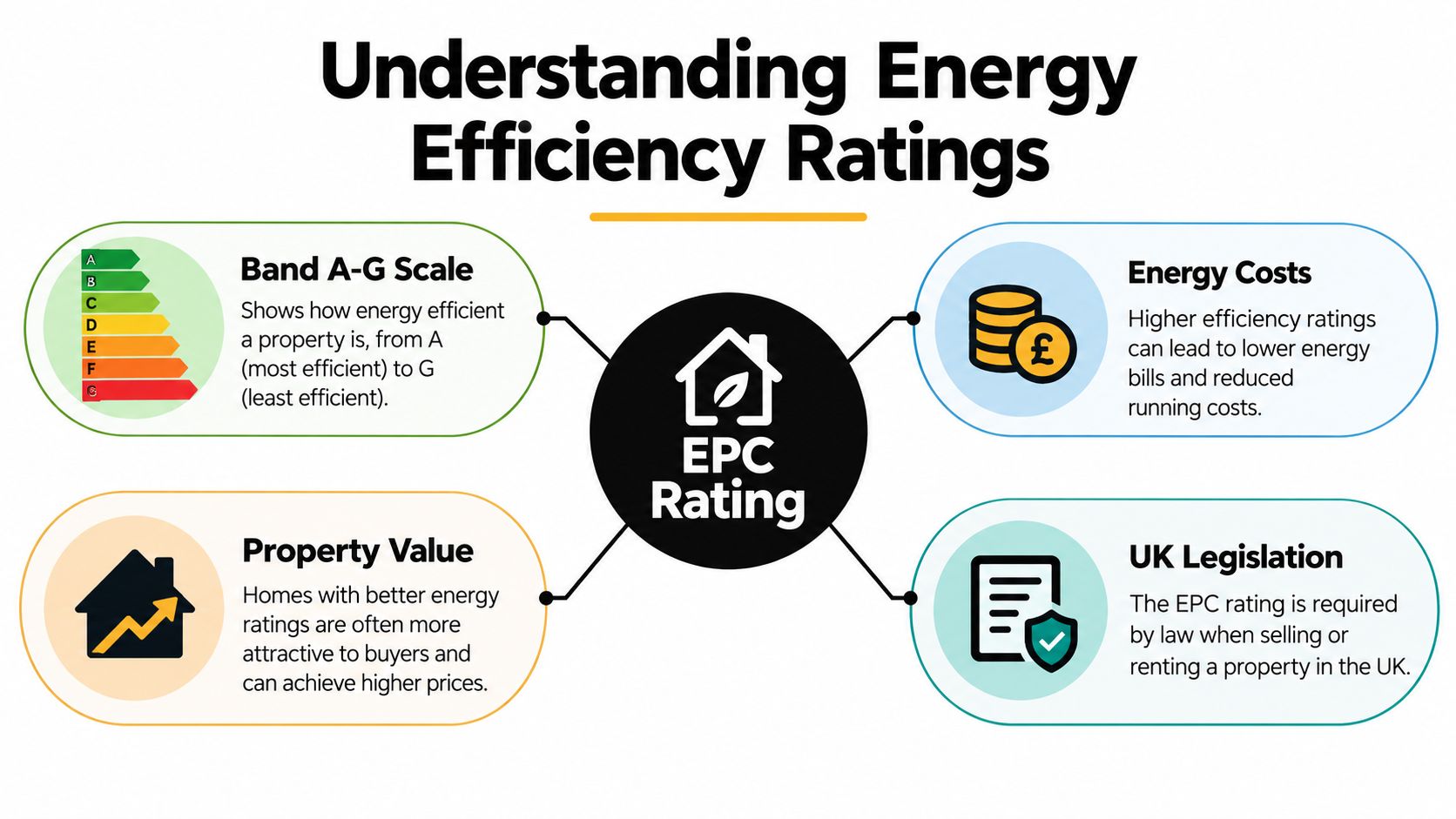
An Energy Performance Certificate, or EPC, gives a property an Energy Efficiency Rating, commonly called the EER or SAP rating. In domestic property, the headline score runs from 1 to 100, with a higher score indicating better calculated efficiency. The score is then grouped into bands from A to G.
The Standard Assessment Procedure, or SAP, looks at the physical characteristics of the building. These include insulation, windows, heating systems, hot water provision, lighting and building materials. It applies standard assumptions about how the property is used, rather than measuring the precise behaviour of its occupants.
That means an EPC is best understood as a comparative property metric, not a promise about a tenant's future bills. Two households in identical homes can use different amounts of energy because they heat rooms differently, occupy the property for different periods or choose different appliances. The certificate focuses on the building, not those personal decisions.
Why the long-term trend matters
The English Housing Survey records a substantial improvement in average housing efficiency over time. The average SAP rating rose from 45 in 1996 to 67 in 2023 and 68 in 2024, while the proportion of dwellings in EPC bands A to C increased from 23% in 2013 to 52% in 2023, according to the English Housing Survey energy-efficiency findings.
The trend shows progress across the housing stock, but it also reveals why the average buy-to-let property still deserves careful inspection. A mid-band score can hide several different situations. One Band D home may need substantial fabric work, while another could be close to Band C after a focused heating or insulation upgrade.
For an investor, the EPC should therefore sit alongside a physical inspection. A property inspection checklist can help you verify whether the certificate's assumptions match the building you're buying. If the property needs broader energy planning, guidance on how to cut your electricity bills with solar may also help you assess whether renewable generation is relevant, although solar alone doesn't resolve every weakness in the building fabric.
Investor rule: Treat the EPC as a starting point for questions, not as a substitute for inspecting the roof, walls, windows, heating system and insulation.
Breaking Down EPC Bands and What They Mean for Costs
An EPC band is a shorthand for a numerical energy-efficiency score. Domestic properties in England and Wales are classified as follows:
| EPC band | Energy Efficiency Rating |
|---|---|
| A | 92 and above |
| B | 81 to 91 |
| C | 69 to 80 |
| D | 55 to 68 |
| E | 39 to 54 |
| F | 21 to 38 |
| G | 1 to 20 |
These are the official domestic score ranges published in the government EPC statistical release. Moving from D into C is therefore a measurable change, rather than a cosmetic upgrade. Because the score reflects features such as insulation, glazing and heating systems, a higher rating generally corresponds with lower estimated fuel costs. It does not guarantee that outcome for every household.
Existing stock versus new construction
Age changes the investment meaning of the same band. In the ten years to March 2024, the median EPC score was 68 in England and 67 in Wales, placing both countries at Band D. In the five years to 2024, new dwellings in both countries had a median score of 84, equivalent to Band B, compared with 82 in England and 81 in Wales in the five years to 2013, according to the Office for National Statistics.
A hypothetical 1990 property rated Band C may have achieved that result through targeted upgrades to an older structure. Its certificate could still identify worthwhile work on glazing, insulation or heating. A hypothetical 2020 property also rated Band C may have fewer straightforward improvements available. Its score could reflect the building design, installed systems or the assumptions used during assessment.
The headline band does not show how the property reached that score. Investors should examine the recommendations page, confirm which measures are installed, test whether proposed work is technically suitable and estimate the effect on rent, void periods and capital value.
A Band C rating on an older property can indicate embedded renovation potential. On a newer property, it may signal that exceeding the band requires more complex or costly intervention.
The financial case depends on more than the label. Improvement costs, disruption, financing and local tenant demand determine whether a higher score creates an acceptable return. Investors can use renovation project management guidance to assess sequencing, contractors and disruption as one coordinated project, rather than treating each recommendation as a separate purchase.
The practical conclusion is clear: compare the measures behind the band, not just the letter beside it. Two properties with the same EPC rating can have materially different running-cost exposure and improvement potential.
How Energy Efficiency Scores Are Calculated and Assessed
The headline rating is generated from a standardised calculation, not from a year of utility bills. An assessor records the property's construction and installed systems, then the methodology estimates energy performance and fuel costs using consistent assumptions.
The important inputs include the building envelope, insulation, windows, heating and hot water systems, lighting and materials. Occupants still affect actual consumption, but their habits don't determine the EPC score. This is why an investor shouldn't use a previous owner's unusually low bills as proof that a property is energy efficient.
What changed with RDSAP10
The methodology was updated in June 2025 through RDSAP10. The revised approach added more detailed inputs, including window measurements, insulation thickness, lighting and suitable heat-pump recommendations. A newer certificate may therefore contain a more granular assessment than an older certificate, even where the headline band appears unchanged.
That creates an important comparison problem. A score from an older methodology and a score from the updated methodology may not be perfectly equivalent in practical detail. When reviewing a portfolio, record the certificate date and assessment methodology rather than comparing headline bands without context.
The government has also acknowledged that the existing headline EER has limitations and provides an incomplete picture of energy performance. EPC reform is moving towards multiple metrics, which reflects a sensible concern: one score cannot fully describe affordability, carbon emissions, thermal comfort, building fabric or the suitability of low-carbon heating.
The government's technical explanation of what EPCs measure confirms that the EER is a 1 to 100 SAP-based rating grouped into A to G bands. It also shows why moving from Band D, 55 to 68, into Band C, 69 to 80, represents a quantified improvement in the property's calculated energy performance.
Assessment caution: A high EPC score can support an investment case, but it can't guarantee low bills, consistent comfort or the absence of defects.
Investors sometimes compare equipment metrics with the building's EPC and assume they measure the same thing. They don't. For example, SEER2 ratings explained can help readers understand a separate cooling-equipment measure, but a UK domestic EPC assesses the property as a whole. Before commissioning an assessment, review the wider property survey process so the EPC is considered alongside structural and maintenance risks.
The Investment Case for Targeting Lower-Band Properties
Lower-band properties can present attractive investment opportunities, provided the improvement route is practical and properly costed. A weak EPC may reduce the purchase price or limit competing bids, but it can also indicate costly defects, restricted letting options and higher tenant sensitivity to energy bills.
The headline band does not describe every property equally. A Band C score on an older building may reflect a narrow set of upgrades, while the same band on a newer build may result from different construction, heating and insulation assumptions. Investors should therefore examine the measures behind the score and compare them with likely running costs, rather than treating the letter grade as a complete investment signal.
Recent household data illustrates the available gap. ONS records up to March 2025 put the median EPC score at 69 in England, Band C, and 68 in Wales, Band D. In England in 2025, 93.0% of low-income households lived in A-to-D homes, but only 65.2% lived in A-to-C homes, according to the ONS housing energy-efficiency analysis. Many households therefore occupy homes below the commonly discussed C threshold, even where the properties are not in the lowest bands.

Where value can be created
A Band E, F or G property warrants a feasibility assessment before investors draw conclusions about value. The central question is whether the building has a realistic improvement route that fits its purchase price, construction type and rental market.
Assess four areas:
- Fabric potential: Loft, wall and floor insulation can improve thermal performance, although construction details may make some measures unsuitable or expensive.
- Heating-system scope: Replacing an ageing system may improve the calculated rating, but the right option depends on the building, fuel supply and installation constraints.
- Renewable suitability: Solar and other renewable measures may support the case, but they cannot resolve every weakness in insulation or ventilation.
- Tenant economics: A warmer, cheaper-to-heat home may attract stronger demand, while local rents and void risk still determine returns.
ONS certificate volume data also shows a rising flow of domestic assessments in England, including a year-on-year increase in the 12 months to December 2025. Older certificates may therefore provide a weaker basis for current portfolio decisions.
For a wider framework, sustainable property investment guidance places energy upgrades alongside resilience, tenant demand and long-term asset management. The most promising lower-band purchase is not automatically the property with the lowest score. It is the one where achievable improvements, costs and local-market benefits align.
How EPC Ratings Impact Rental Demand and Compliance Costs
An EPC affects property investment in two connected ways. It describes estimated energy performance for prospective occupants, and it creates an operational document that matters when property is built, sold or let. That makes the certificate relevant to both marketing and transaction planning.
For non-domestic buildings in England and Wales, the rating is based on likely fuel costs and carbon dioxide emissions, rather than comfort alone or the efficiency of individual appliances. The government states that a better rating means lower fuel bills, while the certificate is required when a building is constructed, sold or let, as set out in the energy performance certificate statistical release.
Reading the rating as a risk signal
A landlord should ask three separate questions:
- Can the property be marketed and let under the applicable rules?
- Will the estimated energy costs weaken tenant demand or increase negotiation pressure?
- What work would improve the rating without damaging the building or returns?
The EPC doesn't answer all three, but it helps identify where to investigate. For commercial or mixed-use property, an A to G band can act as a practical retrofit-priority signal. Fabric upgrades and heating-system changes that improve the SAP inputs are usually more relevant than cosmetic changes that leave the building's energy characteristics untouched.
Tenant demand is also more nuanced than “higher band equals higher rent”. In a price-sensitive market, occupiers may value predictable heating costs, fewer draughts and reliable systems more than the label itself. A holiday villa creates a different proposition again. Guests may notice temperature control, air conditioning and comfort immediately, while the owner must still manage capital expenditure and seasonal use. Holiday rental property management can help investors assess those operating considerations alongside the EPC.
The practical conclusion is that an EPC should be built into the acquisition timetable. Obtain and review it before committing to a purchase, check whether its recommendations remain relevant and allow for specialist advice where the building has unusual construction or heating constraints. A certificate discovered late can turn a straightforward letting plan into an expensive redesign.
Practical Steps to Check and Improve Your Property EPC Rating
A Band C is not a running-cost guarantee. On a newer property, it may reflect efficient fabric and modern systems. On an older property, the same headline band can coexist with draughts, expensive heating, weak documentation and greater maintenance risk. Start with the certificate, then test its assumptions against the building and the investment model.

A practical acquisition checklist
- Check the certificate date and methodology: A newer RDSAP10 assessment may record details that older certificates missed. Compare scores only after checking when and how each assessment was produced.
- Inspect the heating system: Identify the fuel source, boiler or heat-pump type, controls, age and maintenance condition. A replacement may improve the score, although a qualified professional must confirm whether it suits the property.
- Verify insulation evidence: Ask whether loft, cavity, solid-wall or floor insulation exists. Request documentation instead of relying only on an agent's description.
- Review window specifications: The updated methodology gives more attention to window measurements. Check glazing, frame condition and draughts, particularly in older buildings.
- Read the recommendations in order: Prioritise work that improves performance without creating moisture, ventilation or conservation problems.
- Model the investment: Compare purchase price, improvement cost, disruption, tenant appeal and resale implications. A recommended measure will not necessarily repay its cost through higher rent or lower bills.
The domestic A-to-G bands provide a screening framework, as noted earlier. Use the thresholds to identify a possible target, then examine the score behind the label. A one-point improvement does not demonstrate that the building has become materially more efficient, and two properties with the same band may have very different heating demand and operating costs.
Estimate work before you negotiate
Ask an assessor or retrofit professional to confirm which recommendations are technically appropriate. A measure that appears inexpensive may be unsuitable for solid-wall construction, a listed property or a home with weak ventilation. A poorly documented property may also have improvement potential that the current certificate does not fully capture.
The useful comparison is the complete improvement case. Set the current score beside the work required, expected disruption, likely effect on tenant appeal and the return required from the property. Modest heating controls or insulation work may fit the investment plan. Extensive fabric upgrades or system replacement may require more capital than the eventual EPC improvement justifies.
The certificate should also be read alongside evidence of actual use. Meter records, fuel type, equipment condition and occupant behaviour can affect running costs without being fully represented by the headline score. For homeowner-oriented ideas, energy efficiency tips for Tucson homeowners reinforce the practical importance of equipment maintenance and operating behaviour, even though those factors are not fully captured by a UK EPC.
Use the following video as a visual introduction to the assessment process, then validate proposed work with UK-specific advice:
Buy the building you can improve, not merely the certificate you can describe. An EPC review can expose avoidable risk, yet construction, location, tenant demand, project costs and required return still determine whether the purchase works.
World Property Investor provides country and market guides, rental analysis and practical buying advice for comparing EPC requirements and energy-efficiency risks across international property markets. Visit World Property Investor to research a target location and assess a property beyond its EPC band.