
For global property investors, Greece has transitioned from a post-crisis recovery narrative to a stable, growth-focused market. It now presents a compelling blend of attractive returns and manageable risks, making it an excellent candidate for portfolio diversification. The country's powerful tourism engine, coupled with investor-friendly government initiatives and major infrastructure upgrades, creates a unique opportunity for capital growth and strong rental income.
Understanding the Greek Rental Market in 2026

The Greek property market has shown remarkable resilience. Its current growth is built on solid fundamentals, not the speculative fervour of previous cycles. For investors considering renting out houses in Greece, the 2026 landscape is shaped by key economic drivers that signal long-term stability and the potential for healthy returns on investment.
A primary driver is the country’s world-class tourism sector, which fuels consistent demand for both short-term holiday lets and long-term residential rentals in key destinations. However, the market is not solely dependent on tourism. Significant foreign investment, much of it channelled through initiatives like the Golden Visa programme, continues to inject capital and confidence into the market, spurring development and modernisation across the country.
Key Market Fundamentals for Investors
Before committing capital, a thorough understanding of the core market dynamics is essential. Unlike more mature European markets, Greece offers a unique mix of established hotspots and emerging opportunities.
- Established Markets: Locations such as Athens, Mykonos, and Santorini are proven performers. They guarantee high demand and liquidity but are accompanied by higher acquisition costs, which can compress gross rental yields. The investment case here often includes a significant component of long-term capital appreciation.
- Emerging Markets: Regions like Crete, the Peloponnese, and certain districts of Thessaloniki present a different value proposition. Here, entry prices are lower, and gross rental yields can be notably higher, offering a clearer path to strong cash flow for investors willing to look beyond the headline locations.
Key Takeaway: Success in the Greek market requires balancing capital appreciation with rental income. While prime Athenian suburbs may offer strong long-term value growth, neighbourhoods in Piraeus or Thessaloniki can deliver superior initial rental yields—a crucial factor for cash-flow-focused investors.
A Comparative Perspective
To place Greece's appeal into context, it is instructive to compare it with other European markets. The UK rental market, for example, is forecast to see rent growth slow to around 2.6% in 2026 as it normalises after a period of rapid post-pandemic increases. According to ONS data, a persistent housing shortage continues to sustain rental demand, but the market is clearly in a different, more mature phase.
In contrast, Greece is at an earlier stage of its growth cycle. Data from the Bank of Greece showed strong apartment price growth in 2025, supported by rising rents. This points to a market driven by genuine demand rather than speculation. As our detailed property market forecast for 2025 explains, understanding these different market cycles is vital for effective global diversification.
For investors, this makes renting houses in Greece a compelling strategy for achieving growth that may well outpace more saturated European markets.
Analysing Rental Yields and Rents Across Greece
For any global property investor, rigorous financial analysis separates a sound investment from a liability. When renting out houses in Greece, success hinges on two core metrics: the average monthly rent achievable and the resulting gross rental yield.
These figures are not uniform; they vary dramatically between islands and cities, creating a diverse landscape of opportunity for the informed investor.
A crucial first step is to understand how to calculate rental yield. This simple metric quantifies the income a property generates relative to its cost, providing the most effective way to compare different markets and asset types. Our guide on what are rental yields delves deeper, but the formula is straightforward: annual rental income as a percentage of the property’s value.
Prime Markets vs. Emerging Opportunities
Greece presents a classic investment dichotomy: acquire assets in established, high-value markets, or pursue higher returns in up-and-coming regions. Making this decision correctly is fundamental to building a successful Greek rental portfolio.
Established Prime Markets (e.g., Athens, Mykonos): These locations are globally recognised, with deep tourism markets and high liquidity. This popularity, however, commands a significant price premium. A premium apartment in the southern suburbs of Athens, for example, may fetch a high rent but only deliver a gross rental yield of 3.8% to 4% due to its high acquisition cost. Here, the investment rationale is as much about long-term capital growth as it is about monthly income.
Emerging High-Yield Markets (e.g., Crete, Peloponnese): In contrast, locations such as Crete, the Peloponnese, or central districts of Thessaloniki offer a different financial equation. Property is more affordable, yet strong demand from locals, students, and tourists keeps rents robust. It is in these areas that investors can find gross rental yields reaching 5.5% or even 6%. This makes them ideal for an investment strategy prioritising strong, immediate cash flow.
Key Takeaway: The core decision for an investor in Greece is whether to prioritise the security and prestige of a prime market, accepting lower yields, or to pursue the superior cash flow potential found in emerging regions, which may carry different risk profiles, such as greater seasonality.
Average Rental Yields in Key Greek Property Markets (2026 Estimates)
To make a truly informed decision, it is necessary to examine the data. This table compares estimated gross rental yields and average monthly rents for a standard two-bedroom apartment across established and emerging Greek property markets.
Local demand drivers have a significant impact. For instance, data from Greek housing authorities shows that properties within 500 metres of an Athens metro station can command rents 15% to 25% higher than similar properties reliant on bus routes.
| Region | Property Type | Average Monthly Rent (€) | Estimated Gross Rental Yield |
|---|---|---|---|
| Athens (Centre) | 2-Bed Apartment | €800 – €1,065 | 4.5% – 5.6% |
| Athens (South) | 2-Bed Apartment | €1,100 – €1,500 | 3.8% – 4.5% |
| Mykonos | 2-Bed Villa | €2,500+ (Seasonal) | 3.0% – 4.0% |
| Thessaloniki | 2-Bed Apartment | €650 – €850 | 5.0% – 6.0% |
| Crete (Chania) | 2-Bed Apartment | €700 – €900 | 4.8% – 5.8% |
| Peloponnese | 2-Bed House | €600 – €800 | 5.2% – 6.2% |
These figures provide a clear starting point for comparing what your capital can achieve in different parts of the country, from the bustling capital to the sun-drenched islands.
A Wider European Context
It is always helpful to place these numbers into a broader European context. The UK rental market, for example, is at a very different stage of its cycle. Recent analysis from major property groups indicates UK rent growth is cooling, with a projected 2% national increase in 2026. This is driven more by a long-term supply-demand imbalance than the intense tenant bidding wars of previous years.
While some regions, such as the North West of England, still post impressive 7.2% yields according to industry reports, the national trend in the UK is towards slower, more controlled growth.
This comparison highlights the opportunity in Greece. While the market's recovery is maturing, certain regions still offer the potential for much stronger yield performance than is typically found in more established European countries. For savvy global investors, that presents a very distinct and appealing advantage.
Navigating Greek Tenancy Agreements and Legalities
A firm grasp of the local legal framework is non-negotiable when renting out property in Greece. For any foreign investor, understanding the intricacies of a Greek tenancy agreement—known as a μισθωτήριο συμβόλαιο—is the cornerstone of a secure and profitable rental business.
While template agreements are available online, engaging a local solicitor to draft or review your contract is a prudent investment. This simple step ensures your interests are protected and that every clause complies with current Greek law, mitigating the risk of future legal and financial complications.
Before exploring the specifics, it is useful to visualise the returns a legally sound rental can generate.
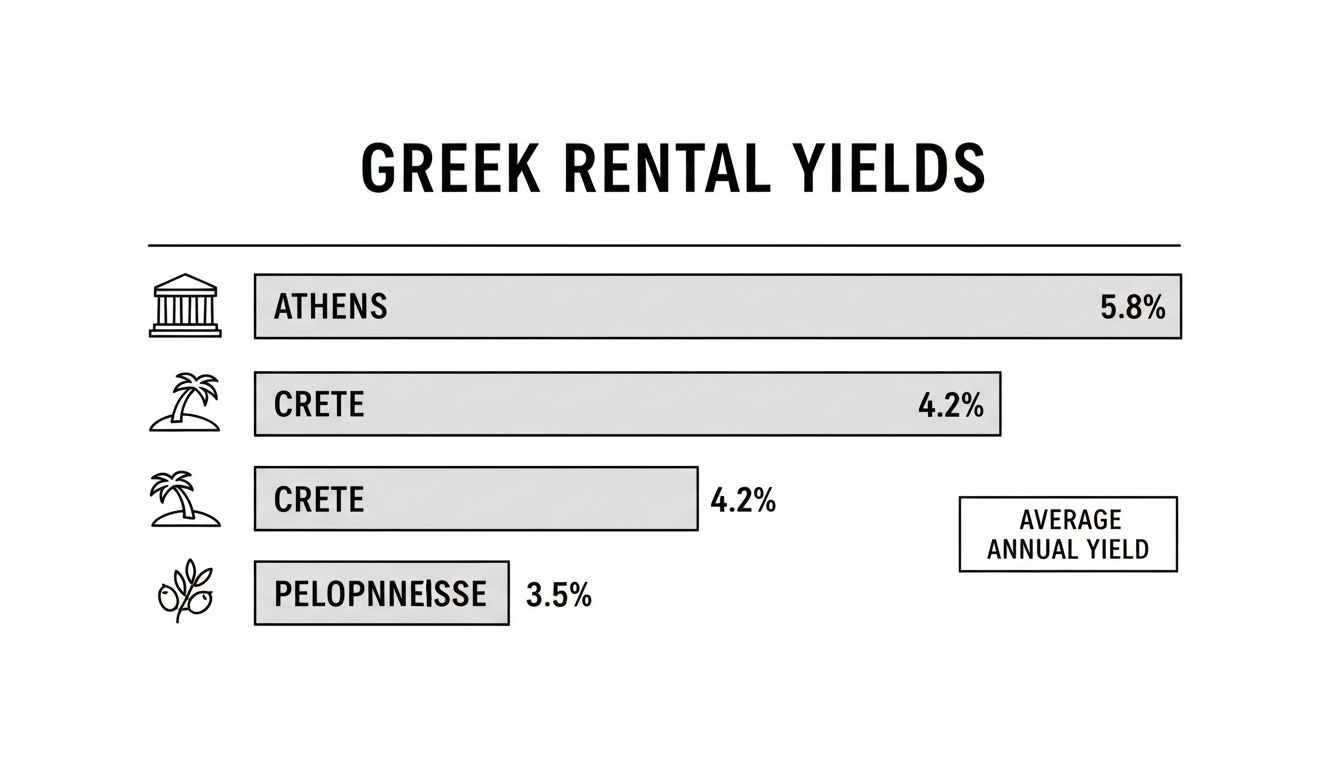
As the chart indicates, returns vary significantly by region. This reinforces the need for a robust legal strategy tailored to your specific market.
Long-Term Residential Leases
Regarding long-term lets, Greek law provides strong tenant protections. The single most important rule for landlords to understand is the minimum three-year lease term for any property used as a primary residence.
This provision often surprises foreign investors. Even if a contract is signed for only one year, the law automatically grants the tenant the right to occupy the property for a full three years. This measure is designed to provide housing stability but requires investors to be prepared for longer tenancies than they may be accustomed to. For investors diversifying their portfolios, it is vital to grasp how Greek leases differ from concepts like freehold vs leasehold in the UK.
Rent reviews are another key consideration. While the initial rent can be set freely, any increases during the three-year term must be mutually agreed upon. The only way to pre-determine increases is to include specific indexation clauses in the original contract, making the initial negotiation all the more critical.
Short-Term Holiday Lets
The regulations for short-term holiday lets, driven by platforms like Airbnb, are entirely different and have become much stricter in recent years. To operate legally, a specific protocol must be followed.
First and foremost, you must register your property with the Greek tax authorities (AADE) to obtain a Property Registration Number (AMA). This number is not merely for your records; it must be displayed clearly on all online listings.
Risk Alert: The Greek government is enforcing this rule rigorously. Failure to display a valid AMA number can lead to substantial fines, starting from €5,000, and the removal of the listing from booking platforms. This is a key mechanism for ensuring all rental income is declared for tax purposes.
Furthermore, new restrictions are being implemented in popular tourist areas. Some central districts in Athens, for example, have frozen the issuance of new AMA numbers to counter the effects of over-tourism on local housing. Similar caps are planned for Thessaloniki and several islands, so verifying local regulations before investing is absolutely critical.
Landlord and Tenant Obligations
Beyond the lease itself, both landlords and tenants have clearly defined responsibilities. Understanding these upfront will help you manage your property smoothly and avoid potential disputes.
Key Landlord Obligations:
- Handing over a property that is fit for habitation, with all major systems (plumbing, electrics) in safe, working order.
- Covering the cost of major repairs, provided the damage was not caused by the tenant's negligence.
- Respecting the tenant’s right to quiet enjoyment of the property.
Key Tenant Obligations:
- Paying rent on time through traceable methods. Cash payments are no longer permitted for rental agreements.
- Paying for utilities and handling minor repairs resulting from everyday use.
- Returning the property in the same condition it was received, allowing for normal wear and tear.
Whether managing your property remotely or locally, maintaining a clear understanding of these obligations is central to a successful Greek rental investment.
A Step-by-Step Guide to Renting Your Greek Property

Transforming a Greek property from a simple acquisition into a profitable rental asset requires a clear, methodical approach. For investors based abroad, the local bureaucracy and market nuances can seem daunting. The key is to break the process down into manageable, sequential steps. Success is a function of diligent preparation and thorough due diligence.
The first critical hurdle is establishing your legal and financial footing. Before earning a single euro, you must obtain an AFM (Arithmos Forologikou Mitroou). This is your personal Greek tax identification number, and it is non-negotiable for any property transaction or income declaration in the country.
Concurrently, you will need to open a Greek bank account. From 2026, Greek law mandates that all rental payments must be made via bank transfer; cash payments are prohibited. This rule is designed to enhance transparency and ensure all rental income is properly declared to the AADE, Greece's tax authority.
Preparing and Marketing Your Property
With the administrative requirements met, you can focus on preparing the property for tenants. When ready to list, remember that presentation is paramount. First impressions are critical, so you may wish to learn how to elevate your property listings with engaging content. High-quality photographs and a detailed, accurate description are essential, especially when targeting international tenants on major online portals.
You have two primary routes for finding tenants:
- Local Estate Agents: A reputable local agent provides invaluable on-the-ground knowledge, handles viewings, and manages initial negotiations. This is often the optimal path for remote investors who lack local contacts or language proficiency.
- Online Property Portals: Websites such as Spitogatos.gr and XE.gr are the leading platforms in Greece. Listing directly can reduce agency fees, but it requires you to manage all enquiries and viewings yourself.
Actionable Insight: Define your ideal tenant profile. A villa aimed at the expatriate market will perform well on international websites. An apartment in a university district like Zografou in Athens, however, will gain the best traction on local Greek sites frequented by students.
Screening Tenants and Signing the Lease
A robust tenant screening process is your most effective defence against late rent, property damage, and other potential issues. Do not rush this stage. A thorough check should always involve verifying a potential tenant's employment status, income level, and, where possible, previous rental history.
Once you have selected a suitable tenant, the next step is signing the tenancy agreement (μισθωτήριο συμβόλαιο). As previously noted, engaging a solicitor for this task is a wise investment. Upon signing, you will collect the security deposit, which is typically one or two months’ rent. For a higher-value apartment in a prime Athens neighbourhood, requesting two months is standard practice.
The final, signed agreement must then be uploaded to the AADE tax portal. This officially registers the tenancy with the authorities, a legal requirement for every landlord in Greece. For a wider view on how this fits into your overall strategy, our guide on building an international buy-to-let portfolio offers valuable context.
Ongoing Property Management
Your final major decision is how to manage the property on a day-to-day basis. You can either self-manage or hire a professional property management company.
Self-management can maximise your net yield but is only practical if you reside in Greece or have a trusted, capable contact nearby. For most overseas investors, hiring a management company is the more sensible option. They will handle everything from collecting rent and coordinating maintenance to tenant communication, providing peace of mind for a fee that is almost always a worthwhile expense.
Calculating the True Costs and Taxes of Greek Rentals
The headline rental figure is only half of the financial picture. To accurately assess the profitability of a Greek property, you must look beyond the gross income and analyse the operational costs and taxes that determine your real-world return.
These recurring expenses represent the true cost of ownership. A precise forecast of these costs separates a high-performing asset from one that appears profitable on paper but disappoints in reality. The purchase price is merely the starting point; it is the ongoing liabilities that dictate your actual cash flow.
Ongoing Property Expenses
For most investors managing a property from another country, a reputable property management company is less a luxury than a necessity. These firms typically charge a fee of 8% to 15% of the monthly rent. In return, they handle tenant communication, rent collection, and maintenance coordination, providing essential peace of mind.
You must also budget for the building’s common charges, known locally as Koinoxrista. These monthly fees cover shared services like lift maintenance, cleaning of communal areas, and sometimes central heating. Depending on the building's age and amenities, they can range from €50 to €180 per month.
Finally, minor repairs are an inevitable part of being a landlord. A prudent approach is to set aside approximately 1% of the property's value each year to cover unforeseen plumbing issues or appliance failures.
Understanding the Greek Tax System
The Greek tax system for rental income is progressive, meaning the rate increases as your rental income rises. For non-resident landlords, understanding these brackets is critical for calculating your net yield.
- Rental Income Tax: The income tax on rent is applied in tiers. As of 2026, the first €12,000 of annual rental income is taxed at 15%. Income between €12,001 and €35,000 is taxed at 35%, and any income above that threshold is taxed at a 45% rate.
- ENFIA Property Tax: This is an annual tax all property owners must pay, regardless of whether the property is rented. The amount varies significantly based on location, size, age, and other "objective value" factors set by the tax authorities. For a typical city apartment, expect to pay between €200 and €800 per year.
Real Example: Assume your apartment in Athens generates €10,000 in annual rent. Your income tax liability would be €1,500 (15% of €10,000). If your annual ENFIA tax is €400 and your Koinoxrista amounts to €960 for the year, your net income before other maintenance costs is €7,140.
It is also crucial for international investors to consider how this income and any future capital gains will be treated in their home country. Our guide on capital gains tax on foreign property offers valuable insights on this topic.
The dynamics in the Greek market are quite different from those in more mature markets like the UK. There, rental inflation for new lets has cooled to a more modest 1.9% by March 2026, primarily due to affordability pressures and a slight increase in rental supply. As detailed in recent research from major UK property bodies, this stabilisation presents a very different set of opportunities for investors compared to Greece's current growth-focused environment. Discover more insights about UK rental market trends in the full report.
Frequently Asked Questions About Renting in Greece
When investing from overseas, a number of practical questions inevitably arise. Here are straightforward answers to some of the most common queries from global investors about the Greek rental market.
How Do I Handle Evictions for Non-Paying Tenants?
Dealing with a non-paying tenant in Greece is a formal legal process that is neither swift nor inexpensive. The first step is to issue a formal payment demand via a solicitor. If the rent remains unpaid, your solicitor must apply to the court for a payment order and, ultimately, an eviction order.
This can be a slow and costly procedure. Given that tenants have significant legal protections, especially under the three-year minimum lease term, prevention is the best strategy. Thorough, professional tenant screening is not just a recommendation—it is the most effective way to protect your investment from the outset.
Can a Foreigner Easily Open a Greek Bank Account for Rental Income?
Yes, and it is a mandatory step. Opening a Greek bank account is a core part of establishing your investment correctly. To do so, you will need your Greek tax number (AFM), your passport, and proof of your home address.
From 2026, all rental payments in Greece must be made via bank transfer by law. A local account is essential for compliance and simplifies the management of all financial aspects, from receiving rent to paying local taxes like ENFIA and Koinoxrista (common charges).
Key Takeaway: Think of a Greek bank account as your operational base. It simplifies your tax reporting to the AADE (the Greek tax authority) and provides a clear, transparent record of your income and expenses. It is a foundational step for any serious investor.
What Are the Main Differences in Regulations for Short-Term vs Long-Term Lets?
The rules for short-term and long-term lets are entirely distinct, as they are treated as separate activities. Long-term rentals fall under tenancy law, which prioritises housing stability, whereas short-term lets are viewed as a commercial tourism activity.
Long-Term Lets: The focus is on tenant rights. You have the mandatory three-year minimum lease for a primary residence, and all contracts must be officially lodged on the AADE tax portal. Rent increases are subject to negotiation, not unilateral landlord decisions.
Short-Term Lets: This is governed by tourism regulation. You must obtain a Property Registration Number (AMA) and display it on every online listing. Be aware that many popular areas, such as central Athens and key islands, have now frozen new AMA registrations to manage the impact of over-tourism.
Is It Better to Hire a Property Manager or Self-Manage from Abroad?
For nearly all investors based abroad, hiring a professional property manager is the only realistic choice. While self-managing avoids the 8% to 15% management fee, it is only practical if you reside in Greece or have an exceptionally reliable and capable contact on the ground.
A good manager handles all operational aspects, from finding and vetting tenants to collecting rent, dealing with emergency maintenance, and ensuring you remain compliant with all local regulations. It is a service that provides peace of mind and, more importantly, protects the value of your asset when you are managing it from a distance.
At World Property Investor, we provide the in-depth analysis and on-the-ground insights you need to make confident investment decisions worldwide. Explore our comprehensive guides and start building your global portfolio today. Learn more at World Property Investor.