
An investor visa, often referred to as a ‘Golden Visa’, is a residency permit offered by a country in exchange for a significant financial commitment. For most global property investors, the most tangible and popular route involves purchasing real estate.
This is more than a simple entry permit; it is a strategic tool that can unlock enhanced global mobility, long-term security, and new opportunities for you and your family.
Understanding the Visa for Investors
For a global property investor, a visa for investors provides a formal pathway to living, working, and, in many cases, eventually gaining citizenship in a new country. This long-term right distinguishes it from a standard tourist visa, which only grants short-term access.
The arrangement is a straightforward exchange. A country invites foreign capital to stimulate its economy—often by fuelling the local property market—and in return, it provides the investor and their family with a secure, long-term base.
What Is the Real Motivation for Investors?
Investors pursue these programmes for several core reasons, nearly always tied to long-term strategic objectives rather than short-term travel. The primary drivers include:
- Securing a ‘Plan B’: In an increasingly unpredictable world, a second residency provides a reliable safe haven for your family and your capital. It is a fundamental component of building personal and financial resilience.
- Greater Global Mobility: A residence permit from a country with strong international ties, such as an EU member state, can provide visa-free travel across entire economic zones, simplifying international business and personal travel.
- Access to New Opportunities: It opens doors to different business markets, superior educational systems for children, and world-class healthcare. The benefits often extend across generations.
For many high-net-worth individuals, a second residency is no longer a luxury but a core component of a diversified wealth preservation strategy. It’s about building resilience against unforeseen global shifts.
The primary benefits these programmes offer can be a significant advantage for international investors. The most common advantages are summarised below.
Core Benefits of Investor Visa Programmes at a Glance
| Benefit Type | Description and Typical Offering |
|---|---|
| Residency Rights | Offers the right to live, and often work and study, in the host country for the long term. |
| Family Inclusion | The main applicant's spouse, dependent children, and sometimes parents can also be included. |
| Visa-Free Travel | A residence permit from an EU or Schengen country typically grants visa-free travel within the zone. |
| Pathway to Citizenship | After a set number of years, many programmes offer a route to apply for full citizenship and a passport. |
| Asset Ownership | Allows you to hold a tangible asset (property) in a stable foreign jurisdiction. |
| Lifestyle & Security | Provides access to better education, healthcare, and a secure 'Plan B' in another country. |
As is evident, the appeal extends far beyond owning a holiday home. It is about fundamentally reshaping a family's global footprint.
Property Investment as the Most Popular Route
While some programmes allow investment in government bonds or business creation, property investment remains the most popular and tangible option. This approach allows you to acquire a real asset that can either generate rental income or serve as a second home, blending the residency benefit with a classic real estate investment.
To gain a broader perspective on immigration through capital, it is useful to explore the various options for business and investment migration to understand the full context.
This guide will focus on the specifics of these property-linked visas, comparing the financial requirements, risks, and potential returns across the world’s most popular markets. By understanding the fundamentals, you will be better positioned to assess how an investor visa could fit into your global portfolio. If you are specifically interested in Europe, you can learn more about the golden visa for Europe in our detailed guide.
A Head-to-Head Look at Europe's Top Golden Visas
When it comes to securing a foothold in Europe through investment, the choice for most global property buyers narrows to three principal markets: Portugal, Spain, and Greece. While they all appear to offer a residency permit in exchange for capital, the critical differences lie in the details.
Each programme has unique characteristics, with significant variations in cost, residency rules, and long-term citizenship potential. Making the right choice means matching the programme not only to your budget but also to your lifestyle and future objectives.
Portugal: The Smart Pivot to Funds
For years, Portugal’s Golden Visa was the leading choice for direct real estate investment. This changed in 2023 when the government shifted the programme's focus away from property. Despite this, Portugal remains a top-tier option, valued for its stability, high quality of life, and arguably the most attractive citizenship pathway in Europe.
The primary route now is a €500,000 investment into qualifying investment funds. While this is not direct property ownership, many of these venture capital or private equity funds have significant real estate exposure, offering an indirect link. This change has attracted a new type of investor who prefers a hands-off, managed investment over the demands of being a landlord.
Portugal's key strengths are clear:
- Minimal Residency Requirement: The programme’s most significant attraction is its minimal stay requirement, averaging just seven days per year. This allows investors to maintain residency and work towards a passport without needing to relocate.
- A Clear Path to a Powerful Passport: After only five years, investors can apply for permanent residency and, more importantly, Portuguese citizenship. A Portuguese passport is one of the most valuable in the world for visa-free travel.
- Full Family Inclusion: The visa extends to a spouse, dependent children, and even dependent parents, making it a comprehensive solution for the entire family.
Spain: The Real Estate Powerhouse
While Portugal pivoted, Spain’s Golden Visa has remained focused on its property roots. It offers a clear and simple proposition: invest €500,000 in real estate and gain residency. It is a compelling choice for investors who wish to own a tangible asset in one of Europe’s most dynamic economies and desirable lifestyle destinations.
The investment can be in a single property or spread across several, but the qualifying amount must be mortgage-free. The visa immediately grants the right to live and work in Spain. While there is no minimum stay required to maintain the permit, establishing physical residency is necessary to pursue permanent residency or citizenship in the future.
The Spanish programme is tailored for those who see value in owning a prime asset in a major European economy. It provides instant access to the Schengen Area and the right to live in a country with fantastic infrastructure and an unbeatable lifestyle.
These residency programmes represent more than just a visa; they are a strategy for personal and financial security.
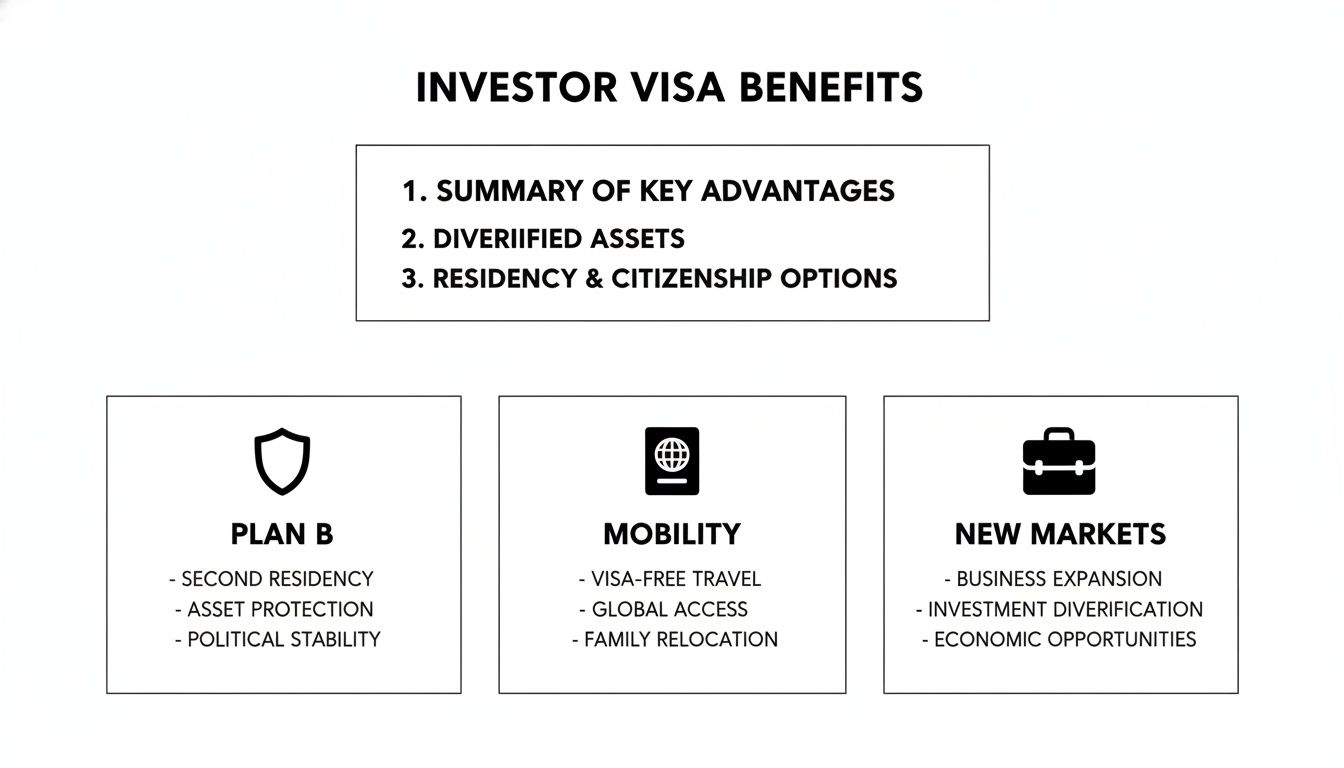
As the chart illustrates, the benefits range from creating a "Plan B" to unlocking global mobility and new business horizons—all powerful motivators for today's investor.
Greece: The Most Accessible Entry Point
For investors seeking the most affordable route into the EU, the Greek Golden Visa is difficult to surpass. It has long offered one of the lowest investment thresholds in Europe, making it an exceptionally popular choice.
The minimum real estate investment starts at just €250,000 in most of the country. However, due to significant demand, this threshold has been increased to €500,000 in prime areas such as Athens, Thessaloniki, Mykonos, and Santorini. This tiered system offers investors a choice: pursue lower-cost opportunities in emerging regions or acquire premium assets in established tourism and business hubs.
Greece’s standout advantages are:
- The Lowest Cost: At €250,000, the entry point remains one of the most competitive in the entire European Union.
- Quick Turnaround: Greek authorities are known for their efficiency, often processing applications and issuing permits in just a few months.
- No Stay Requirement: You are not required to live in Greece to maintain your residency status, which is ideal for investors who simply want the visa without the need to relocate.
The path to Greek citizenship is longer than in Portugal, typically taking seven years of continuous residency and requiring demonstration of genuine ties to the country, including some language ability. If the primary goal is simply residency and visa-free EU travel, it is an unbeatable option. For a similar island proposition, you can check out our guide on the Cyprus Golden Visa for comparison.
Comparison of Key European Investor Visa Programmes 2026
To help you see the differences at a glance, here’s a direct comparison of the three leading European programmes.
| Country | Minimum Investment | Residency Requirement | Citizenship Pathway | Key Advantage |
|---|---|---|---|---|
| Portugal | €500,000 (Funds) | Just 7 days per year | 5 years, with minimal stay | Fastest, most flexible path to a top-tier EU passport. |
| Spain | €500,000 (Property) | None to renew residency | 10 years (requires presence) | Direct ownership of property in a major EU economy. |
| Greece | €250,000 (Property) | None to renew residency | 7 years (requires presence) | The lowest-cost and fastest route to EU residency. |
Ultimately, your choice will hinge on what matters most. If a clear and fast track to citizenship with minimal disruption is the priority, Portugal is the standout choice. If you wish to own a significant real estate asset in a major economy, Spain is the natural fit. If your goal is the quickest, most affordable access to EU residency, Greece leads the pack.
Exploring Alternative Investor Visa Destinations
While Europe’s Golden Visa programmes often dominate the conversation, savvy investors are increasingly looking beyond the Schengen Area. Established markets like the UAE are strong contenders, while emerging options in countries like Turkey offer compelling alternatives directly linked to residency and even citizenship.
These destinations provide different advantages, from tax-efficient living to a direct path to a second passport. For any investor building a truly global portfolio, understanding what these non-European programmes offer is crucial. They often provide a strategic counterpoint to more traditional Western markets.
The UAE and the Dubai Golden Visa
The United Arab Emirates, and Dubai in particular, has cemented its position as a global centre for business, finance, and luxury living. The country’s Golden Visa programme is a direct extension of this ambition, designed to attract and retain entrepreneurs, professionals, and high-net-worth property investors.
The most direct property route to a 10-year renewable Golden Visa involves an investment of at least AED 2 million (approximately £450,000) in real estate. This offers considerable flexibility—the investment can be a single home or spread across multiple properties, and even includes off-plan purchases from approved developers.
The appeal of the Dubai Golden Visa is powerfully simple, driven by three key factors:
- A Zero Personal Income Tax Environment: This is often the single most compelling factor. The ability to manage finances from a zero-tax jurisdiction is a significant tool for wealth preservation.
- Strong and Mature Rental Market: Dubai’s property market is well-regulated and known for producing some of the most attractive rental yields among major global cities. Based on data from local authorities, gross rental yields in prime areas frequently range between 5-8%, allowing investors to generate a robust income stream while securing residency.
- World-Class Infrastructure and Lifestyle: The visa opens the door to a secure, high-quality lifestyle with modern infrastructure, excellent schools, and top-tier healthcare, making it a viable relocation option for families.
It is important to note this is a long-term residency solution, not a citizenship programme. The visa does not lead directly to a UAE passport but provides a stable, tax-efficient base in one of the world’s most dynamic economic hubs.
Turkey's Citizenship by Investment Programme
For investors whose primary goal is obtaining a second passport quickly, Turkey’s Citizenship by Investment (CBI) programme is a global leader. It offers a direct and relatively swift path to full citizenship through a real estate purchase, granting a powerful passport with significant travel and business advantages.
To qualify, an investor must purchase real estate valued at a minimum of $600,000. A key condition is that the property must be held for at least three years. After this holding period, the investor is free to sell the asset, potentially recouping their initial capital.
The Turkish programme’s core appeal lies in its efficiency. It provides a direct path to a passport in as little as six to nine months, making it one of the fastest citizenship-through-property options available globally.
The strategic benefits of a Turkish passport are considerable. It gives visa-free access to over 110 countries and allows investors to leverage Turkey’s unique position as a bridge between Europe and Asia. Furthermore, Turkey holds an E-2 Treaty with the USA, allowing Turkish citizens to apply for an E-2 Investor Visa to live and work in the United States by establishing a business there.
However, investors must proceed with caution. The Turkish Lira has experienced significant volatility, which introduces currency risk. While property values in US dollar terms have often proven resilient, particularly in prime Istanbul districts, this risk demands careful management and a long-term perspective. For those interested in the broader subject, our guide on citizenship by investment provides further context.
The UK Investor Visa: A Look at Past and Present Options
For years, the United Kingdom was a primary destination for wealthy individuals seeking a prestigious and secure base. London, in particular, was seen as a safe harbour for capital, and the Tier 1 Investor visa was the well-trodden path to UK residency.
However, in a move that sent ripples through the global investment community, the UK government closed the Tier 1 Investor visa route in February 2022. This was not a minor adjustment; it brought the era of passive investment for UK residency to an abrupt end. For investors accustomed to classic 'Golden Visa' programmes, a new strategy is now required for the UK.
The Impact of the Tier 1 Visa Closure
The government’s decision was a strategic pivot. The official rationale, according to Gov.uk statements, was a desire to shift from passive wealth accumulation towards active investment that creates genuine jobs and economic growth. This has significant implications for anyone considering the UK for a property-based immigration plan.
While purchasing property no longer directly qualifies for a visa, understanding the old programme’s effect on the market is instructive. The substantial capital inflow from Tier 1 visas had a direct and measurable impact on the prime property market, particularly in London and the home counties. This serves as a clear example of how immigration policy can act as a powerful driver of property demand and values.
The UK's decision to close its passive investor route reflects a broader global trend. Governments are increasingly favouring active business investment over simple asset purchases, demanding a more tangible economic contribution from new residents.
This history helps savvy investors appreciate the underlying strength and enduring appeal of the UK market, even without a direct visa-for-property arrangement. The demand from the world’s elite has not vanished—the pathway to entry has simply evolved.
Present-Day Pathways to UK Residency
With the Tier 1 visa no longer available, high-net-worth individuals must now adopt an entrepreneurial mindset. The main alternative is the Innovator Founder visa, a route designed for experienced business people who wish to establish an innovative company in the UK.
This is fundamentally different from the old, passive investor route. To qualify, an applicant must:
- Have an innovative, viable, and scalable business idea. This is the core of the application and is what truly sets it apart from a passive investment.
- Secure endorsement from an approved body. These organisations act as gatekeepers, assessing whether a business plan has genuine potential for growth and job creation.
- Actively run the business. The visa holder is expected to be at the helm, driving the company’s day-to-day growth.
There is no fixed minimum investment, but applicants must demonstrate they have sufficient funds to launch and scale the business. Critically, these funds can be used to acquire commercial property as a business asset, creating an indirect link between real estate and residency. This route will appeal to investors with a genuine entrepreneurial drive who wish to combine their business goals with establishing a property footprint. While it is not a Golden Visa, it reflects how countries are diversifying their offerings, much like the popular digital nomad visa in Portugal.
A Lesson from the Past: The Tier 1 Visa's Peak
For evidence of the direct link between investor visas and property markets, one need only look at the data from the Tier 1 programme’s final days. Just before its closure, it was experiencing a significant resurgence.
In the third quarter of 2021, official Home Office statistics show the UK granted investor visas to 100 main applicants and 165 dependents. This represented a 52% increase from the previous quarter and the highest number since before the pandemic. The figures revealed a powerful, pent-up demand from global investors focused on the UK, with the leading nationalities being 23 from China, 10 from the USA, and 8 from Russia.
This wave of high-net-worth individuals, each investing a minimum of £2 million, injected a substantial amount of capital into the economy. A significant portion of that money traditionally found a home in prime residential property, supporting—and sometimes inflating—prices in London's most desirable postcodes. This final surge is a perfect case study of how a visa for investors can directly fuel a nation's high-end property sector.
Navigating the Application Process and Avoiding Common Pitfalls

Securing an investor visa is a structured process that requires meticulous attention to detail. While each country has its unique regulations, the journey for a property-based application follows a predictable path. A methodical approach is paramount; minor errors can lead to frustrating delays or even outright rejection.
This section provides a practical roadmap for the application process, highlighting critical checkpoints and common mistakes that can catch out even experienced investors.
The Six Core Stages of Your Application
Almost every property-linked investor visa follows a similar blueprint. Familiarising yourself with these stages helps you anticipate what is required and when.
Professional Consultation: Your first step should always be to assess your eligibility with legal experts. This is non-negotiable. A reputable immigration solicitor will confirm if you meet the criteria and help map out the optimal strategy.
Property Sourcing and Due Diligence: Next, you must find a qualifying property and perform thorough due diligence. This involves verifying that the property not only meets the minimum investment value but also complies with the programme’s specific rules on location or property type.
Documentation and Fund Sourcing: This is often the most demanding stage. You will compile an extensive file of documents, including police clearance certificates, birth certificates, and, most importantly, a crystal-clear audit trail for your investment funds.
Executing the Investment: Once a property is selected and your paperwork is in order, you will transfer the funds and legally complete the purchase. You must obtain official deeds or title documents as proof of ownership.
Submitting the Visa Application: With proof of your investment in hand, your legal team will submit the official visa application to the relevant government immigration authority.
Biometrics and Final Approval: Finally, you and any family members on the application will likely need to attend a biometrics appointment to provide fingerprints and photographs. After a final review, you will receive your residence permits.
Avoiding Costly and Common Pitfalls
While the process appears linear, several common errors can jeopardise an application. Awareness of these is your best defence. For a deeper dive into one country's specific rules, our guide on Portugal Golden Visa requirements offers detailed insights.
The most frequent pitfalls are:
- Unclear Source of Funds: You must provide a clean, documented trail showing exactly how you lawfully acquired the investment capital. Any gaps, ambiguities, or missing paperwork will raise immediate red flags with immigration officials.
- Investing in Non-Qualifying Assets: Purchasing a property in a non-designated area or one that does not meet specific government criteria is a classic mistake that can render your entire investment ineligible.
- Miscalculating Total Costs: Investors often focus solely on the property price and overlook ancillary costs. Stamp duty, legal fees, and government application charges can easily add another 10-15% to your total outlay.
The single biggest mistake an investor can make is underestimating the complexity of the process. To ensure you successfully navigate the complex requirements and avoid common pitfalls in the investor visa application process, seeking specialized immigration law guidance is highly recommended.
The sustained global demand for these programmes is clear. Historical data from the final months of the UK's former Tier 1 Investor visa showed approvals peaking in Q3 2021, with 100 main applicants and 165 dependents—a post-pandemic high and a 52% increase from Q2. This surge, led by investors from China, the US, and Russia, highlights how these programmes directly channel funds into local property markets. You can read the full UK government report for more details.
Your Questions on Investor Visas Answered
As you delve into the world of investor visas, practical questions will naturally arise. Understanding the theory is one thing, but knowing how it works on the ground is another. This final section tackles some of the most common queries from investors, providing clear, straightforward answers.
How Long Does the Application Process Usually Take?
Timelines can be unpredictable and vary significantly between countries, so patience is essential. The duration depends heavily on the efficiency of the government’s administration and its current application backlog.
In faster jurisdictions like Turkey or Greece, approval might be granted in as little as 3-6 months. However, for hugely popular programmes like Portugal's, it is not unusual to face waits of 12-18 months or even longer. The complexity of your own financial paper trail will also influence the total timeline.
Can I Use a Mortgage to Fund the Property Investment?
Almost without exception, the answer is no. The fundamental purpose of a visa for investors is to bring fresh, direct foreign capital into the country's economy.
Governments require proof that the full qualifying investment was made with your own, unencumbered funds. While you may be able to secure a mortgage for any property value above the minimum investment threshold, you cannot use borrowed money to meet the core requirement itself.
This rule is a foundational principle of residency by investment. The programme’s integrity rests on the applicant injecting new, personal capital into the country, not leveraging local credit.
What Are the Tax Implications of Gaining Residency?
This is a critical, and often misunderstood, component. Securing residency can make you a tax resident in your new country, which could expose your worldwide income to local taxes.
However, many countries offering investor visas also provide special tax regimes to make the proposition more attractive. These often include non-domiciled (“non-dom”) status or flat-rate tax schemes that apply only to foreign-sourced income. It is absolutely essential to seek advice from a tax professional who specialises in international and expatriate tax law before you commit.
What Happens if a Country Cancels Its Programme?
This is a valid and growing concern for investors, given several high-profile closures in recent years. Historically, when governments have cancelled or altered their programmes, they have almost always included 'grandfather clauses'. These clauses protect existing residents and those with applications already in the system, allowing them to complete their journey to permanent residency or citizenship under the original rules.
For example, when the UK closed its Tier 1 Investor visa, existing visa holders were generally permitted to stay and follow their original path to settlement. Even so, the risk of legislative change is always present and should be factored into your decision-making.
At World Property Investor, we provide the data and analysis you need to make confident decisions in the global property market. Explore our in-depth guides at https://www.worldpropertyinvestor.com to find your next investment opportunity.