
For global property investors considering Ireland, a firm grasp of the tax system is non-negotiable. It is the critical factor that separates a deal that looks good on paper from one that delivers strong, predictable returns.
The Irish framework is logical and, compared to many established markets, refreshingly straightforward. It is built around a few key taxes encountered at different stages of the investment lifecycle: a one-off tax on purchase, an annual cost during ownership, and taxes on rental income and eventual profit.
An Investor's Guide to Irish Property Taxes
Navigating the tax liabilities of an international investment can be complex, but Ireland’s system is structured and predictable. This clarity is a major advantage for any serious investor seeking to model returns accurately.
To place it in context, Ireland’s property tax burden is moderate. A market like the UK, for instance, raises approximately 2.57% of its private capital stock in property taxes, according to OECD data. Ireland’s figure is a far more manageable 0.306%. That differential alone makes it a compelling option for investors looking to diversify their portfolio without facing excessive holding costs.
This guide provides the foundational knowledge required to forecast your numbers accurately from day one. We will analyse each tax you will face, when you will pay it, and what it means for your bottom line.
The Three Stages of Property Taxation
The simplest way to understand your tax obligations is to link them to the three distinct phases of property ownership: buying, holding, and selling. Each stage has its own specific tax, and knowing what to expect is crucial for forecasting total costs and net returns.
- Purchase: When you acquire the property, you will pay Stamp Duty. This is a one-time charge based on the property's market value at the time of purchase.
- Holding: As an owner, you have two ongoing responsibilities: the annual Local Property Tax (LPT) and, if you are a landlord, income tax on your rental earnings.
- Sale: When you eventually sell your asset, you will need to calculate and pay Capital Gains Tax (CGT) on any profit realised.
This diagram offers a clear visual summary of how these taxes fit into the investment lifecycle.
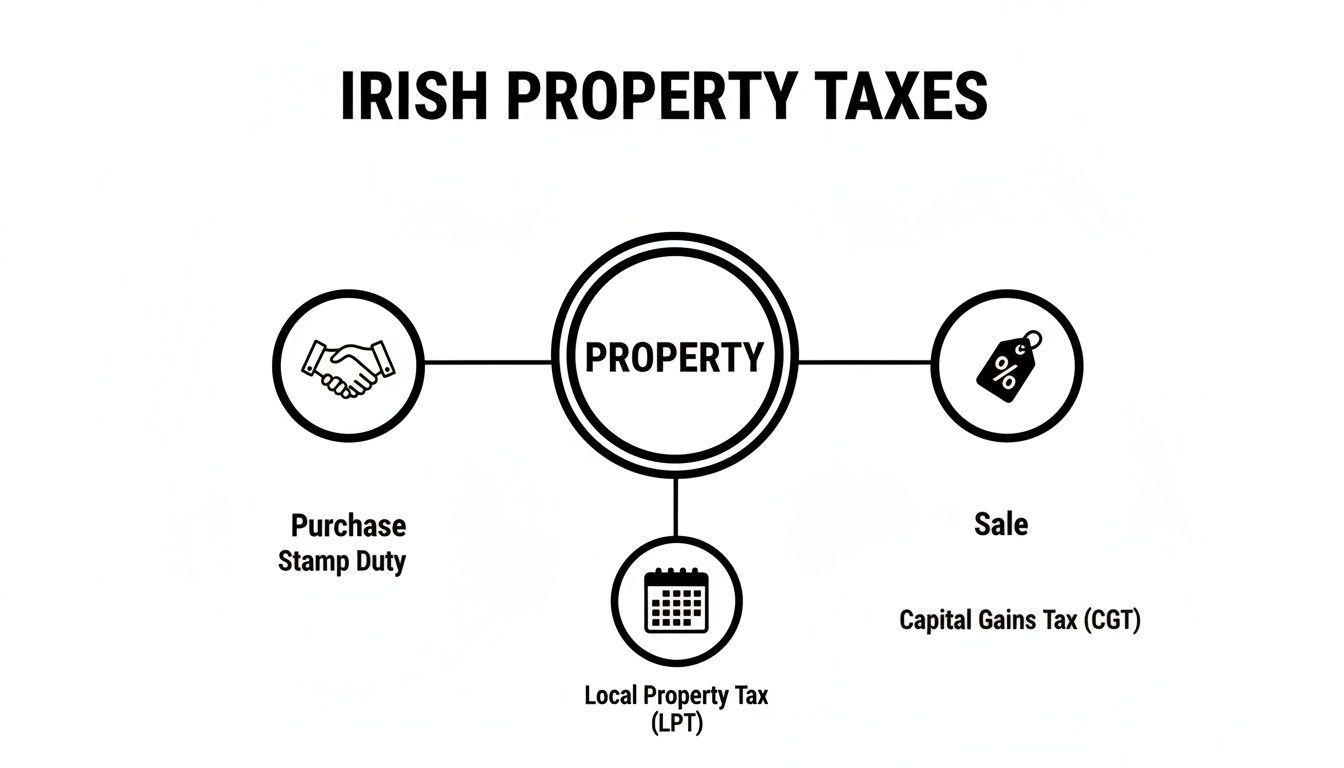
As you can see, tax is not a single event. It is an ongoing consideration from the initial acquisition to the final sale, and understanding this flow is essential for building a successful portfolio.
To help you keep these key taxes straight, here’s a simple summary table.
Overview of Key Irish Property Taxes for Investors
This table outlines the primary property-related taxes you'll encounter in Ireland, clarifying who is responsible for payment and when it's due.
| Tax Type | Who Pays | When It's Paid | Primary Purpose |
|---|---|---|---|
| Stamp Duty | The Buyer | Upon purchasing the property | A one-off transaction tax on acquisition |
| Local Property Tax (LPT) | The Property Owner | Annually | Funds local council services |
| Rental Income Tax | The Landlord | Annually | Tax on profits from rental income |
| Capital Gains Tax (CGT) | The Seller | Upon selling the property | A tax on the profit made from the sale |
This structure gives investors a clear roadmap for financial planning, reducing the risk of unexpected liabilities and making it easier to forecast long-term performance.
Key Taxes Demystified
The Local Property Tax (LPT) is a cornerstone of this system. Introduced in 2013, it has become a vital source of funding for local authorities. In 2024 alone, it brought in €532 million with an impressive 97% compliance rate across more than two million properties, as reported by the Revenue Commissioners.
Key Takeaway: For global investors, the predictability of Ireland's tax system is a significant advantage. The clear rules for LPT, Stamp Duty, and CGT allow for precise financial modelling, reducing the risk of unexpected costs and improving return on investment calculations from day one.
While Ireland’s tax framework is straightforward, its rules differ from other European countries. For a useful comparison, our guide on property taxes in France outlines how another major market handles its levies, providing valuable context for building a geographically diverse portfolio.
Calculating Your Annual Local Property Tax (LPT)

The Local Property Tax (LPT) is the most consistent tax you will face as a property owner in Ireland. It is a critical line item to factor into your annual cash flow projections and holding costs.
Unlike some markets where property taxes can be unpredictable, Ireland's system is structured and self-assessed. This places the responsibility on you, the owner, to value your property and calculate what is owed. The system is built on a clear national base rate, which gives investors a degree of certainty when modelling long-term returns.
- For properties with a market value up to €1 million, the national base rate is 0.18%.
- For the portion of a property's value above €1 million, the rate increases to 0.25%.
This self-assessed model has proven remarkably successful. According to Revenue data, the LPT system recorded an impressive 97% compliance rate in 2024, with returns filed for over two million properties. The total collected hit €532 million, a figure that shows how central this tax is to funding essential local services.
The Impact of Local Authority Adjustments
This is where the real nuance for an investor comes into play. While the national rate provides a baseline, each local authority has the power to adjust this rate up or down by a maximum of 15%.
This is known as the Local Adjustment Factor, and it can create significant variations in your tax bill depending on where you invest. For example, Dublin City Council has consistently applied the maximum -15% reduction, giving a discount to property owners in the capital.
Conversely, a council like Cork County Council might choose not to apply any reduction or even apply a positive adjustment, leading to a higher tax bill than the national rate would suggest.
Actionable Insight: As a global investor, you must analyse the Local Adjustment Factor for your target area. This single percentage point change directly impacts your net operating income and, consequently, your property's yield. Always check the specific council's decision for the current year when finalising your budget.
This local variation is a key feature of the Irish system. It demands a granular approach to due diligence, as two identical properties in different council areas can have noticeably different holding costs.
A Worked Example of an LPT Calculation
Let's translate these percentages into a concrete figure. Imagine you purchase a buy-to-let apartment in Dublin for €450,000. The LPT is not calculated on the exact price but on official valuation bands.
A value of €450,000 falls into Valuation Band 6, which covers properties from €437,501 to €525,000. The mid-point of this band is €481,250, and this is the value used for the LPT calculation.
Calculate the Base LPT: First, apply the national base rate of 0.18% to the band's mid-point value.
- €481,250 x 0.18% = €866.25
Apply the Local Adjustment Factor: Now, factor in Dublin City Council's typical -15% adjustment.
- €866.25 x 15% = €129.94
- €866.25 – €129.94 = €736.31
Your final LPT bill for the year would be €736.31. This is the tangible figure you need to accurately forecast your investment's performance. For a deeper dive into financial modelling, check out our guide on how to calculate the return on investment for property.
Important Exemptions and Deferrals
Finally, a complete investment plan always considers potential reliefs. While most properties are liable for LPT, certain conditions can offer an exemption. For instance, properties certified as having significant pyrite damage may be exempt.
Deferral options are also available for owner-occupiers facing financial hardship, although interest will accrue on the deferred amount. For an investor, it is crucial to understand that these reliefs are generally not applicable to buy-to-let properties. Your LPT bill will almost certainly be a fixed annual cost.
Stamp Duty: Your Main Upfront Acquisition Cost

Before you receive the keys, you will encounter Stamp Duty. This is the government's one-time charge for transferring a property into your name, and it is a cost you, the buyer, must cover in full at purchase. Unlike recurring irish property taxes, this is a significant upfront expense that must be factored into your budget from day one.
Calculating this number correctly is not merely an administrative task; it directly impacts your total capital outlay and shapes the real-world return on your investment from the beginning.
Thankfully, Ireland keeps things relatively simple for residential property. There are no complex, multi-layered bands to navigate, which makes forecasting costs much cleaner than in some other countries.
- For properties valued up to €1 million, the Stamp Duty rate is a flat 1%.
- For any portion of the value above €1 million, that part is taxed at 2%.
This clean structure means you can run your numbers with confidence. For a deeper look at the initial buying journey, our guide on how to buy an investment property covers all the essential steps.
A Different Rate for Portfolio Investors
Here is a critical point for anyone looking to scale up: the rules change if you are buying in bulk. If you acquire ten or more residential properties in a single deal (or a series of connected deals), a much higher Stamp Duty rate applies. This was designed specifically to distinguish between individual homebuyers and large-scale investors.
Key Takeaway: When you buy ten or more residential units together, the Stamp Duty rate jumps to 7.5% on the entire transaction value. This is a game-changer for anyone planning to build a sizeable Irish rental portfolio and must be built into your financial modelling from the start.
This higher rate completely alters the financial dynamics of a bulk acquisition compared to buying properties individually over time. It is a key strategic point to consider when planning your entry into the Irish market.
A Practical Stamp Duty Calculation
Let's put this into practice. Imagine you are buying a €350,000 apartment in Dublin. Since the price is well below the €1 million mark, the calculation is straightforward.
- Purchase Price: €350,000
- Stamp Duty Rate: 1%
- Total Stamp Duty Payable: €350,000 x 1% = €3,500
That €3,500 is a direct cost of acquisition you will need to pay on top of the property price. It is not something you can add to your mortgage; the funds must be ready in cash at closing.
How and When to Pay
The timeline for Stamp Duty is non-negotiable. The tax must be paid, and the return filed, within 30 days of signing the deed of transfer. Missing this deadline will trigger penalties and interest charges from Revenue.
For overseas investors, this is where your solicitor proves their worth. They will handle the entire process for you—calculating the exact amount owed, filing the Stamp Duty return with the Revenue Commissioners, and making the payment using the funds you have provided. It makes compliance a seamless, stress-free part of the transaction.
Planning Your Exit Strategy with Capital Gains Tax (CGT)
The mark of a seasoned investor is thinking about the exit before a deal is even signed. When it comes to Irish property, your exit plan is tied directly to Capital Gains Tax (CGT) – the tax levied on your profit when you eventually sell.
Understanding CGT is fundamental to knowing what your real, take-home return will be and helps you decide the optimal moment to sell.
In Ireland, you will pay tax on your 'chargeable gain'—essentially, the profit you make from the sale—at a flat rate of 33%. While that figure might sound high, the real story lies in what you can legitimately deduct from your gain to reduce the final bill.
Calculating Your Chargeable Gain
On the surface, the calculation is straightforward: the sale price minus the acquisition cost. However, the art is in defining what "cost" actually means. Irish tax law allows you to tally a range of expenses that reduce your taxable profit.
These allowable deductions are your primary tool for managing CGT:
- The Original Purchase Price: This is your starting point.
- Acquisition Costs: Do not forget the Stamp Duty you paid, plus all legal and surveyor fees from when you bought the property.
- Enhancement Expenditure: This covers any capital spending that genuinely added value, such as building an extension or a major refurbishment. Routine painting and decorating do not qualify.
- Disposal Costs: When you sell, you can deduct the costs of making that happen, including your solicitor, auctioneer, and advertising fees.
This is why meticulous record-keeping is non-negotiable. Every one of these costs directly lowers your final tax bill.
A Worked Example of a CGT Calculation
Let's run the numbers on a real-world scenario. Imagine you bought a rental property in 2018 and you are now selling it in 2026.
Property Sale Details:
- Sale Price (2026): €500,000
- Original Purchase Price (2018): €320,000
- Stamp Duty & Legal Fees (Acquisition): €5,000
- Cost of New Extension (Enhancement): €40,000
- Estate Agent & Legal Fees (Sale): €8,000
First, we calculate the total deductible cost.
Calculate the Total Deductible Cost:
- €320,000 (Purchase Price) + €5,000 (Acquisition Costs) + €40,000 (Enhancement) + €8,000 (Disposal Costs) = €373,000
Calculate the Initial Gain:
- €500,000 (Sale Price) – €373,000 (Total Cost) = €127,000
This €127,000 is your chargeable gain before we factor in any personal reliefs.
Actionable Insight: Keep every single receipt. Every euro you can prove you spent on buying or improving the property is a euro that works to reduce your CGT liability down the line. Without the paperwork, you cannot make the claim.
Using Your Annual Exemption
Every individual in Ireland receives an annual CGT exemption. It is the amount of capital gain you can make in a year without paying any tax. For 2024, that amount is €1,270. It is not a large sum, but it is yours to use.
Let's apply it to our example:
- Chargeable Gain: €127,000
- Less Annual Exemption: – €1,270
- Final Taxable Gain: €125,730
Now we can calculate the final tax bill.
- CGT Payable: €125,730 x 33% = €41,490.90
That final figure of €41,490.90 is the actual tax you will owe from the sale. It is a critical number for any exit strategy. To see how this fits into the bigger picture of global property taxes, our guide explaining what Capital Gains Tax on property involves offers excellent context.
For non-resident investors, it is vital to know that you are fully liable for CGT when selling an Irish property. The calculation works in exactly the same way. To ensure the tax is paid, your solicitor will often be required by Revenue to hold back a portion of the sale proceeds until the CGT is settled. This makes professional tax advice not just a good idea, but essential for a smooth, compliant, and profitable exit.
Managing Tax on Your Rental Income
For any buy-to-let investor, understanding how your rental income is taxed is where theory meets reality. This is how your gross rent turns into spendable profit, and mastering the rules is fundamental to calculating your true yield.
While other property taxes are one-off or annual events, the tax on your rental income directly shapes your ongoing cash flow. The Irish system treats rental profit as another form of income. It is added to your other earnings and is subject to Income Tax, the Universal Social Charge (USC), and PRSI, depending on your circumstances.
A key point for global investors is that the rules for Irish residents and non-resident landlords differ. This distinction dictates not just what you owe, but how the tax itself is collected.
Calculating Your Taxable Rental Profit
The most important principle is that you are taxed on your profit, not the total rent collected. To find your taxable profit, you start with the gross rent received for the year and then subtract all the legitimate expenses incurred while letting out the property.
Irish tax law allows for a broad range of deductible expenses. This makes meticulous record-keeping one of the most valuable habits you can build as an investor.
A comprehensive list of these "allowable expenses" includes:
- Mortgage Interest: You can claim a deduction for 100% of the interest paid on the mortgage used to buy, improve, or repair your rental property.
- Repairs and Maintenance: This covers the day-to-day costs of upkeep—think plumbing repairs, decorating between tenancies, or fixing a faulty appliance. Note that initial renovations to make a newly bought property liveable are considered capital expenses and cannot be deducted here.
- Insurance: Premiums for your building and contents insurance are fully deductible.
- Management and Agent Fees: If you use a letting agent to find tenants or manage the property, their fees are an allowable expense.
- Local Property Tax (LPT): The LPT you pay each year on your rental property can be written off against your rental income.
- Service Charges and Ground Rent: For apartments, any regular fees for the upkeep of common areas are deductible.
- Advertising Costs: Money spent listing your property can be claimed.
- Accountancy Fees: The cost of hiring an accountant to prepare your rental accounts is also a valid deduction.
By tracking these costs diligently, you can significantly lower your taxable income and boost your net yield. For a wider perspective on handling rental profits from abroad, our guide to managing overseas rental income offers valuable extra insights.
A Worked Example of a Landlord's P&L
Let's put this into practice. To see how it works, we can walk through a simple profit and loss statement for a typical buy-to-let apartment. This table shows exactly how you arrive at the final figure that Revenue will tax you on.
Calculating Taxable Rental Income Example
| Item | Amount (€) |
|---|---|
| Gross Annual Rental Income | 24,000 |
| Less Allowable Expenses: | |
| Mortgage Interest | (7,000) |
| Letting Agent Fees (10%) | (2,400) |
| Property Insurance | (400) |
| Repairs and Maintenance | (800) |
| Local Property Tax (LPT) | (750) |
| Accountancy Fees | (500) |
| Total Allowable Expenses | (11,850) |
| Taxable Rental Profit | 12,150 |
As you can see, the landlord’s taxable income from this property is just €12,150—not the €24,000 that initially came in. It is this much lower figure that will be subject to Income Tax, USC, and PRSI. This makes a huge difference to your final return.
Special Rules for Non-Resident Landlords
If you are a landlord living outside of Ireland, the tax system works differently. To ensure compliance, Ireland uses a withholding tax system.
Under these rules, either your tenant or an Irish-based collection agent you appoint is legally required to deduct tax at the standard rate (currently 20%) from the gross rent. They then pay this amount directly to the Revenue Commissioners on your behalf.
Key Takeaway: For a non-resident investor, this means you do not receive the full rent upfront. However, this is not your final tax liability. You are still entitled to claim all the same allowable expenses as a resident landlord.
To receive credit for your expenses, you must file an annual Irish tax return. In it, you declare your total rent, subtract your allowable costs to determine your true profit, and the tax that was withheld is then set against your final tax bill. In many cases, this leads to a significant tax refund, as the tax withheld from gross rent is almost always higher than the tax due on the smaller net profit.
For most overseas investors, appointing an Irish collection agent is the most practical way to manage this process and ensure you receive your refund efficiently.
Tax Compliance and Strategy for Global Investors

Finding the right property is only half the battle. Successful investors manage their assets efficiently, and for anyone buying in Ireland from overseas, that means getting tax compliance right from day one.
Think of it as the non-negotiable groundwork for a profitable portfolio. Correct compliance ensures you meet legal obligations, retain more of your returns, and can expand your investments with confidence. Missing a deadline is not just a forgotten payment; it triggers interest and penalties that erode your profits.
Your Year-Round Compliance Calendar
To avoid any surprises, it is best to have a simple calendar of your key tax dates. While exact days can shift, the main deadlines are consistent.
Here is a simplified checklist of what your year will look like:
- Local Property Tax (LPT): You will usually choose your payment method for the upcoming year in November. The payment itself depends on what you pick—it could be a one-off debit in January or spread out with monthly direct debits.
- Income Tax Return (Form 11): This is where you declare your rental income and expenses from the previous year. The deadline is typically 31 October.
- Capital Gains Tax (CGT): The due date depends on when you sell the property. For sales between 1 January and 30 November, the tax is due by 15 December of that same year.
Beyond Compliance: Smart Tax Planning
Meeting deadlines is the minimum standard; optimising your tax position is where you add real value. With smart, legal strategies, you can reduce what you owe and boost your net returns. It all starts with meticulous records.
Tracking every single allowable expense is one of the most powerful tools. Every euro spent on mortgage interest, repairs, agent fees, and insurance is a direct deduction from your taxable income. Another key tactic is timing a property sale to make full use of the annual CGT exemption of €1,270, which resets every year.
Actionable Insight: For global investors, one of the most critical elements of the Irish tax system is the network of Double Taxation Treaties. These agreements, which Ireland holds with over 70 countries including the UK, USA, and Germany, are designed to prevent you from being taxed twice—once in Ireland and again in your home country—on the same income.
This treaty protection is a cornerstone of Ireland’s appeal to international investors, offering peace of mind that your returns will not be unfairly eroded by being taxed in two different jurisdictions.
The Non-Negotiable Role of Professional Advice
Navigating the fine print of irish property taxes from another country is a significant challenge. The rules for non-residents, the specifics of allowable deductions, and the workings of Double Taxation Treaties all demand specialist knowledge.
This is why hiring qualified, local professionals is not an optional extra—it is an essential part of your investment strategy. A good Irish tax advisor and solicitor are your team on the ground. They will keep you compliant, help structure your investment for tax efficiency, and manage all the paperwork with the Revenue Commissioners. This support is the single best tool for reducing risk and allowing you to invest with genuine confidence.
Frequently Asked Questions About Irish Property Taxes
Even with a clear understanding of the main taxes, investors often have specific questions that arise time and again. Here are straight-to-the-point answers to some of the most common queries.
Do I Pay Irish Property Taxes As A Non-Resident Investor?
Yes, absolutely. When it comes to property, your tax obligations are tied to the asset's location, not your own. Non-resident investors are liable for the exact same Irish property taxes as a resident owner.
This includes the annual Local Property Tax (LPT), Stamp Duty when you buy, Capital Gains Tax (CGT) when you sell, and income tax on any rental income you earn.
For rental income, Ireland uses a withholding system for non-residents. This means your tenant (or an appointed collection agent) is required to deduct tax at the standard rate of 20% from the gross rent and pay it directly to Revenue. You can then file an Irish tax return to claim your allowable expenses, which often results in a tax refund.
Key Takeaway: A common misconception is that non-residency provides a shield from local tax obligations. In Ireland, the property’s location is the determining factor, making compliance essential for all overseas owners.
How Is The Value Of My Property Determined For LPT?
Local Property Tax is a self-assessed tax, which places the responsibility for valuing the property squarely on you, the owner. Your valuation needs to reflect the property's realistic market value as of the official valuation date, the most recent being 1 November 2021.
To assist with this, Revenue provides an online valuation guide. However, you should not rely on that alone. It is wise to cross-reference their figure with actual sales data from the Property Services Regulatory Authority's register or by consulting a local estate agent. This ensures your declaration is realistic and defensible if Revenue ever questions it.
What Are The Penalties For Late Payment?
Failing to meet tax deadlines in Ireland comes with significant penalties that can quickly erode your returns. Revenue takes this matter very seriously.
For LPT, late payments trigger daily interest charges. Revenue also has strong enforcement powers, including the ability to take the money directly from your bank accounts.
For late filings of income tax or CGT, automatic surcharges are applied, and interest accrues on any tax owed. Consistent non-compliance will also make it impossible to obtain a tax clearance certificate—a document you absolutely need for many financial transactions in Ireland, including selling your property.
At World Property Investor, we provide the in-depth analysis and data you need to make confident investment decisions across the globe. Explore our guides to uncover your next opportunity at https://www.worldpropertyinvestor.com.