
The most popular advice on foreign property investment in australia is also the least useful: “check whether foreigners can buy”. That's not the true decision.
The real decision is whether a deal still works after Australia's approvals, taxes, surcharges, holding rules, and compliance costs have all taken their share. Investors who focus only on legal access often end up analysing the wrong property. Investors who model net return first usually dismiss weak deals quickly and find the few structures that still make sense.
Australia isn't a simple open market, and it isn't a shut one either. It is a selectively open market. Capital is welcome where policy makers believe it adds supply, fits the rules, and can be monitored. That distinction matters far more than the headline debate.
An Investor's Overview of the Australian Property Market
Australia still attracts substantial international capital, but the housing headlines often distort what foreign participation looks like. In residential property, foreign ownership is small relative to the overall market. Data drawn from the Australian Taxation Office and summarised by Hotspotting's foreign investment analysis shows that about 40,000 of roughly 11 million residential dwellings are foreign-owned, or around 0.36%, with Victoria holding the largest share at 16,929, followed by New South Wales at 8,862, Queensland at 8,129, and South Australia at 2,129.
That small ownership share doesn't mean foreign capital is irrelevant. It means you need to look at where it concentrates. In practice, foreign demand has mattered far more in new build stock, development land, and larger institutional-grade real estate than in the broad owner-occupier housing market.
For experienced investors, that changes the framing. The question isn't whether Australia offers a path to ownership. It's whether the asset type you're considering sits inside the channels the system still favours. If your strategy depends on buying an established suburban home and passively holding it, Australia has become far less workable. If your strategy fits new supply, development, or professionally managed income-producing assets, the conversation changes.
That's also why investors using property as a long-term allocation tool should think beyond simple entry rules. A sensible primer on real estate for wealth building is useful here because Australia rewards investors who treat property as a structured portfolio decision, not a lifestyle punt.
A second point is market maturity. Australia should be viewed alongside other established destinations, not as an opportunistic frontier market. Price discovery is strong, legal enforcement is serious, and compliance is real. In that sense it belongs in the same discussion as other mature global markets covered in this property market forecast for 2025, where access alone rarely determines return.
Australia is still investable for foreign capital. It just punishes loose underwriting more quickly than many overseas buyers expect.
Understanding Australian Foreign Investment Rules
The central rule in foreign property investment in australia is simple. What you can buy matters more than whether you can buy.
The Australian government's own position is explicit. The ATO's guidance on the ban on foreign purchases of established dwellings states that from 1 April 2025 to 31 March 2027 foreign persons are barred from purchasing established dwellings unless an exception applies. The policy objective is to direct foreign capital into new housing supply rather than existing homes.
The asset type is the first filter
For most international buyers, there are three practical categories.
- New dwellings tend to be the most straightforward route because policy still channels foreign money into stock that adds supply.
- Vacant land can be possible, but it comes with build conditions. That suits developers and investors with an active execution plan, not buyers who want to sit on land indefinitely.
- Established dwellings are the problem category for non-residents under the current rules. If your plan starts with an existing house or resale flat, you need to assume restriction first and only proceed if a specific exception clearly applies.
That distinction is the whole market. Many overseas buyers lose time because they start with suburb, finish, and developer reputation before checking whether the asset class itself is viable under the foreign investment regime.
Approval is part of the investment, not paperwork after the fact
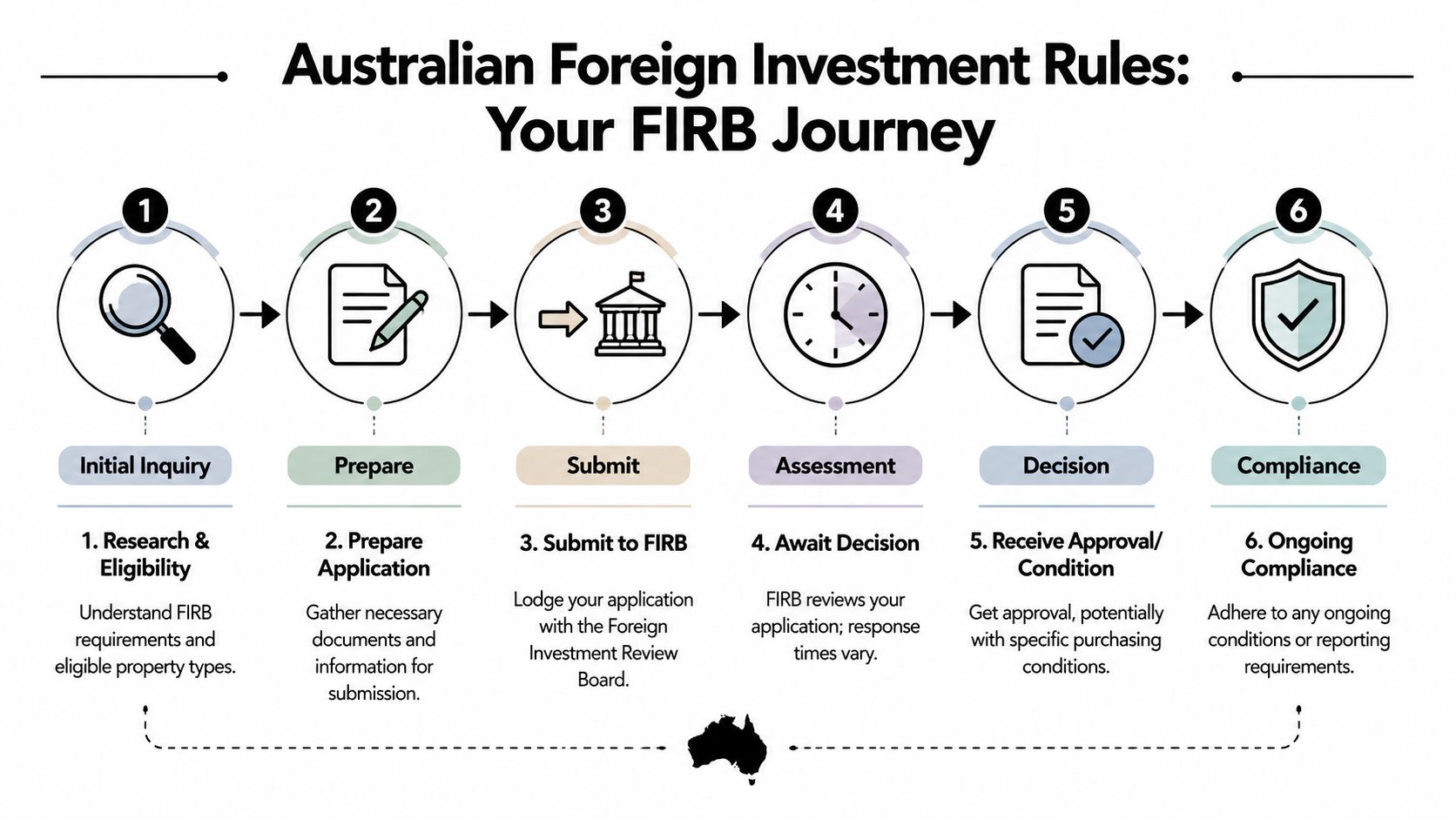
Foreign buyers generally need approval under the FIRB framework before completing the purchase. In practice, that means treating compliance as part of deal structuring from day one.
A workable process usually looks like this:
- Confirm foreign status early. Temporary residents, foreign companies, and foreign-controlled entities need to be clear on how they are classified.
- Select only FIRB-suitable stock. Don't negotiate hard on a property you may not be allowed to own.
- Prepare documents before offer stage. Identity, funding evidence, entity documents, and property details should be organised in advance.
- Expect conditions. Approval may come with use, build, or reporting requirements.
- Plan for ongoing compliance. The purchase approval is only the start. Occupancy, development, and reporting obligations still matter after settlement.
Practical rule: In Australia, compliance isn't a side issue handled by your solicitor after exchange. It shapes which deals are investable in the first place.
Why experienced investors use advisers selectively
Legal support matters, but generic conveyancing isn't enough for cross-border transactions. You need professionals who understand how ownership structure, tax treatment, financing, and approval conditions interact. A broad piece on investment property legal considerations isn't Australia-specific, but it's a good reminder that the legal wrapper around an acquisition often affects return as much as the asset itself.
The mistake I see most often is assuming the rules are hostile in every category. They aren't. They are directional. Australia still permits foreign capital where it supports new development, structured investment, and monitored ownership. The investor who accepts that logic can still operate. The investor who tries to fight it usually ends up frustrated, overcharged, or both.
Navigating Taxes Duties and Hidden Costs
Most overseas buyers spend too much time comparing asking prices and not enough time modelling leakage. In foreign property investment in australia, the best-looking gross yield can produce a weak net result once taxes, fees, and compliance costs are layered in.
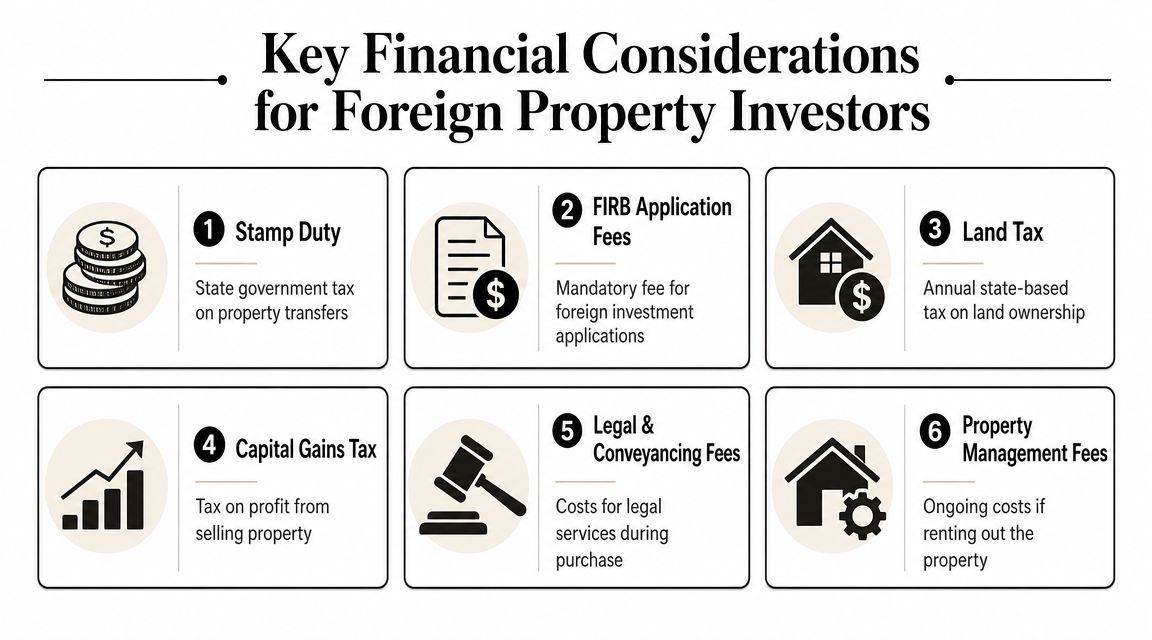
That's why purchase price is only the starting number. Your real underwriting model needs to include FIRB fees, state duties, foreign buyer surcharges, land tax exposure, vacancy-related costs, legal fees, and management costs. Miss one layer and your return estimate can become fiction.
The return drag is the real issue
The sharpest overlooked point is that the market may be legally open to you and still economically unattractive. An industry analysis in Financier Worldwide's discussion of foreign property investment in Australia notes that revenue-tax treatment and surcharges can create roughly 30% to almost 50% taxation leakage.
Gross yield can survive weak marketing, a noisy tenant, or a mediocre managing agent. It usually doesn't survive a bad tax model.
That's the practical divide between amateur and professional underwriting. The amateur asks whether the apartment rents well. The professional asks what remains after every compulsory charge, every state impost, and every recurring compliance cost has been paid.
Costs that change the deal
A foreign buyer usually needs to think in layers rather than line items.
| Cost layer | Why it matters |
|---|---|
| FIRB application fees | They are a direct entry cost and can materially affect smaller deals |
| Stamp duty and foreign buyer surcharges | These hit upfront return and raise your real basis in the asset |
| Land tax and absentee-style surcharges | These can erode annual holding income |
| Vacancy-related charges | A property that sits empty can become expensive beyond lost rent |
| Legal and conveyancing fees | Cross-border documentation is rarely as simple as a domestic purchase |
| Property management and compliance admin | Necessary for remote ownership and easy to underestimate |
That's why two properties with similar headline rents can deliver very different net outcomes. The stronger deal is often the one with cleaner tax treatment, fewer surcharge exposures, and easier compliance, not the one with the flashier brochure.
What actually works in practice
A sensible approach is to model the investment in this order:
- Start with net rent, not gross rent. Assume management, maintenance, and compliance will all cost money.
- Add acquisition leakage next. Include duties, FIRB charges, and legal costs before you calculate any yield.
- Stress-test the holding period. If the property is empty, delayed, or slow to lease, does the structure still work?
- Review deductions carefully. A practical guide to deductible expenses for Australian real estate can help frame the right questions for your accountant.
- Check transfer taxes separately. A reliable stamp duty calculator on property is useful for scenario testing, especially when comparing states.
The investors who do well in Australia aren't necessarily buying the cheapest or highest-yielding asset. They're buying the asset where the net yield survives the state and federal cost stack.
Australian Property Market Analysis for Investors
The market is often discussed as if “Australia” were one investment location. It isn't. Sydney, Melbourne, Brisbane, and Perth behave differently, attract different buyer profiles, and suit different return objectives.
For international buyers, especially from the UK, the competitive context matters. According to DFAT's foreign investment statistics, the United Kingdom recorded US$3,254.4 billion in foreign direct investment in 2024, placing it among Australia's major source economies for inward FDI. That matters because it shows foreign capital is not unusual or marginal. It is embedded, institutional, and often concentrated in larger commercial and development-style opportunities.
What this means for residential investors
A private residential buyer is operating in a market where large pools of capital already understand Australia well. That doesn't make residential investment impossible, but it does mean sloppy acquisition strategies are exposed quickly.
In practical terms:
- Sydney suits investors who prioritise liquidity, global recognisability, and depth of tenant demand, but who can tolerate higher entry pricing and tighter net yields after costs.
- Melbourne has long appealed to international buyers because of scale, stock variety, and developer pipeline depth. The key discipline is stock selection. New apartment supply can be investable, but not every tower is.
- Brisbane often attracts yield-focused investors who want a major-city market without Sydney pricing. It can make sense for buyers looking for a better balance between affordability and rental performance.
- Perth usually appeals to investors comfortable with a more cyclical market. It can offer a different risk-return profile, especially for buyers who understand local employment drivers and tenant demand.
A practical comparison framework
The plan for any city comparison should centre on four questions.
| City | Investor lens |
|---|---|
| Sydney | Best for scale, liquidity, and globally familiar prime districts |
| Melbourne | Best for broad stock choice and deep new-build pipeline, but requires careful project selection |
| Brisbane | Best for investors seeking a middle ground between price and income |
| Perth | Best for investors who accept more cyclicality in exchange for a different entry profile |
The planned table heading below is useful as a working framework for due diligence, even where exact local metrics change over time:
| City | Median New Apartment Price (2-Bed) | Gross Rental Yield | Vacancy Rate | 3-Year Capital Growth Forecast |
|---|---|---|---|---|
| Sydney | Qualitative assessment required | Qualitative assessment required | Qualitative assessment required | Projection requires current local market data |
| Melbourne | Qualitative assessment required | Qualitative assessment required | Qualitative assessment required | Projection requires current local market data |
| Brisbane | Qualitative assessment required | Qualitative assessment required | Qualitative assessment required | Projection requires current local market data |
| Perth | Qualitative assessment required | Qualitative assessment required | Qualitative assessment required | Projection requires current local market data |
I'm keeping those cells qualitative because precise city-level figures weren't provided in the verified data, and using invented numbers would be worse than using none. In practice, that's how a professional investor should treat any market snapshot anyway. Local pricing, vacancy, and yield data should be refreshed at the point of execution, not copied from a generic guide written months earlier.
Market test: If a city only works in your model before foreign-specific taxes and compliance are applied, it doesn't work.
Established versus emerging market thinking
Australia sits closer to the UK, parts of Western Europe, and prime North American cities than to fast-growth frontier markets. Returns tend to depend less on finding an undiscovered area and more on buying the right stock, in the right structure, at a sensible basis.
Established markets such as Sydney and Melbourne usually offer depth and transparency. Emerging domestic growth hubs such as Brisbane or selected Perth submarkets may offer a more attractive balance for income-led investors, but they demand sharper local research. The decision is not just “capital growth versus yield”. It is whether the local market can support your strategy after foreign-buyer friction is fully priced in.
Financing Your Australian Property Purchase
Finance is where many international deals slow down. The property may qualify. The buyer may qualify under the foreign investment rules. The lender may still be the problem.
Australian banks and non-bank lenders usually assess non-resident borrowers more conservatively than domestic applicants. That affects borrowing capacity, documentation, currency treatment, and timing. You shouldn't assume the lending process will mirror the UK or another familiar market.

What lenders typically care about
Most lenders want clarity on the same core issues:
- Income quality. Foreign salary, business income, and investment income may all be assessed differently.
- Residency and citizenship status. This affects which lenders are even available to you.
- Deposit strength. A larger equity contribution usually improves lender appetite.
- Property type. New apartments, off-plan stock, serviced units, and unusual titles can all produce different credit outcomes.
- Documentation quality. Missing or inconsistent paperwork causes delays faster than almost anything else.
This is why financing should be arranged early, not after you've mentally committed to a property. In cross-border purchases, pre-approval isn't just a convenience. It's part of risk control.
The practical route for overseas buyers
Most international investors do better with a specialist mortgage broker than by approaching major banks one by one. A broker who regularly works with non-residents can screen lenders by borrower profile, acceptable jurisdictions, income treatment, and property type before an application goes in.
Your preparation should normally include:
- Proof of identity and residency status
- Evidence of income
- Tax documentation from your home country
- Statements showing deposit source
- Entity documents if you're buying through a company or trust
- Approval-related paperwork where required
A lender also wants confidence that the transaction itself is compliant and executable. That means legal advisers, accountants, and brokers should all be working from the same facts. If one adviser assumes you are buying personally and another assumes a company purchase, problems follow.
A good starting point for comparing lender options is this guide to the best investment property loans. The key is not finding the cheapest headline rate first. The key is finding a lender that will fund your transaction, on your residency profile, against your chosen asset type.
The best time to discover a lender dislikes your property type is before you pay reservation deposits, not after.
The Step-by-Step International Buyer Checklist
A successful foreign purchase in Australia usually follows a disciplined sequence. Most expensive mistakes happen when buyers reverse the order, fall in love with a property first, and only then ask whether the structure, tax profile, and financing stack hold together.
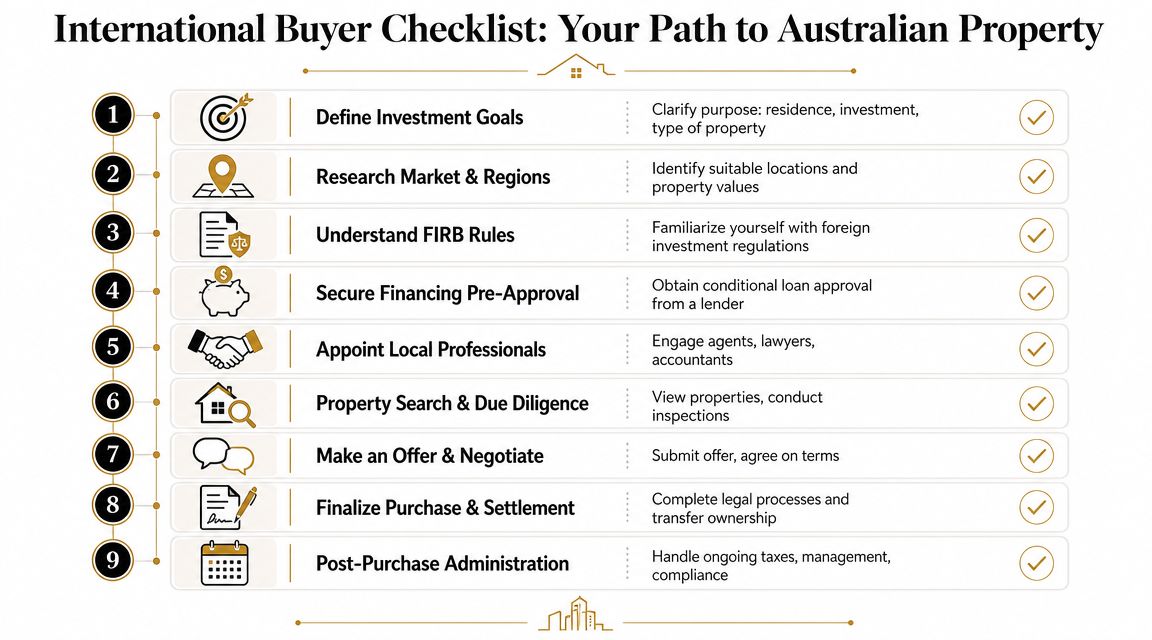
Phase one before you look at any property
Start with your objective. Are you buying for rental income, long-term capital preservation, future occupation, or development? Australia treats those paths differently in practice, even when the headline market looks the same.
Then model the deal at net level. Include all expected friction before you shortlist locations. If a deal only looks attractive before foreign-buyer costs, it isn't attractive.
Phase two line up the advisers
The right team usually includes a solicitor or conveyancer with foreign-buyer experience, an accountant who understands cross-border tax treatment, and a mortgage broker if debt is involved. If the ownership structure is more complex, add corporate and trust advice early.
At this stage, a broad international framework such as this guide to international buy-to-let is useful for pressure-testing your assumptions around income, management, and remote ownership.
Phase three search only for compliant stock
This sounds obvious, but many buyers still waste weeks on the wrong inventory. Focus on stock that fits your legal route, financing route, and target tenant profile at the same time.
A practical shortlist should answer these points:
- Is the asset type eligible? New dwelling, compliant development land, or another permitted category.
- Does the building rent well in normal conditions? Don't rely on peak-season letting assumptions.
- Is the developer or seller credible? Construction quality and completion discipline matter.
- Will the title or scheme create lending problems? Some assets are legally purchasable but operationally awkward.
Phase four make the offer with conditions in mind
Offers should be structured with legal review, finance, and approval timing in mind. The biggest cross-border errors usually come from signing too quickly, paying money too early, or misunderstanding what happens if approval or finance runs late.
A sound process often looks like this:
- Reserve or negotiate only after basic compliance checks are done
- Send contract papers to your adviser immediately
- Coordinate lending and approval steps together
- Review all acquisition and holding costs again before exchange
- Proceed only when the deal still works under conservative assumptions
Buying remotely doesn't just increase administrative risk. It increases the chance that small misunderstandings become expensive ones.
Phase five settlement and aftercare
Settlement isn't the finish line. Once the property completes, you still need administration around leasing, tax registration, record-keeping, insurance, and ongoing compliance.
Foreign investors can lose control of return through various factors. A vacant property, poor manager, missed filing, or weak rent review process can do more damage over a holding period than a slightly high purchase price. Good post-purchase management is part of the investment case, not an afterthought.
Calculating ROI and Avoiding Common Pitfalls
The cleanest way to assess foreign property investment in australia is to stop asking “what will this property make?” and start asking “what survives after friction?” That shift changes almost every decision.
The official transaction data supports the point that viable deals do still happen. According to the ABS release incorporating FIRB residential real estate data, there were 4,228 foreign residential real estate purchase transactions in 2021–22 with a total value of $3.9 billion, and 52.1% of those purchases were new dwellings. So the issue isn't whether transactions can be completed. It's whether the specific one you are considering produces an acceptable net return.
A practical ROI method
Use a simple sequence.
- Start with total acquisition cost, not just the agreed purchase price.
- Add all foreign-buyer-specific charges and ordinary closing costs.
- Estimate realistic annual rent, then subtract management, maintenance, letting friction, and compliance-related holding costs.
- Review tax treatment carefully with your accountant.
- Only then calculate yield and expected return.
If you need a framework, this guide on how to calculate return on investment property is a useful benchmark for building the spreadsheet properly.
Two examples without invented numbers
Consider a new apartment in Melbourne. It may fit the foreign investment rules and may also be easier to finance and let than more unusual stock. But if the project is priced aggressively, management costs are high, and state-level taxes are heavy, the net return may end up thin even with decent occupancy.
Now consider vacant land in Queensland. At first glance it may look flexible and policy-compliant. In reality, the build requirement changes the risk profile completely. You are no longer underwriting land value alone. You are underwriting planning, construction timing, contractor execution, and holding risk.
The right comparison isn't apartment versus land. It's passive income asset versus execution-heavy project.
Pitfalls that repeatedly damage returns
- Ignoring net yield. Gross rent never tells the full story for a foreign buyer.
- Treating approval as routine. Conditions shape timing and use.
- Buying weak new-build stock. “New” and “good investment” are not synonyms.
- Underestimating remote ownership risk. Property management quality matters more when you are offshore.
- Confusing legal access with commercial viability. A deal can be allowed and still be poor.
A serious investor in Australia usually wins by rejecting more deals, not by chasing more of them. Selectivity is the edge.
World Property Investor helps international buyers compare markets, analyse returns, and understand the rules that affect investment performance. If you're weighing Australia against other established and emerging destinations, explore World Property Investor for country guides, city analysis, and practical buy-to-let research built for cross-border investors.