
You've completed the purchase. The legal work is done, funds have cleared, and the asset is finally yours. Then the practical questions start. Who's checking the tenant file, who's arranging the safety certificates, who's chasing arrears, and who's taking the midnight call when a leak starts in a flat you can't visit because you live in Singapore, Dubai, New York, or Hong Kong?
For a non-resident investor, the UK property itself is often the easy part. Ongoing control is harder. Distance creates blind spots, and the wrong manager can erode returns through poor tenant selection, weak compliance, slow maintenance, and opaque reporting.
That's why serious investors treat management as part of the investment model, not as an afterthought. If you're comparing property management companies UK, the right question isn't just “what do they charge?” It's “how well do they protect income, preserve the asset, and reduce legal and operational risk when I'm not on the ground?”
Why You Need a UK Property Manager
The UK market is large enough, regulated enough, and operationally complex enough that professional management has become standard for many investors, especially those based overseas. IBISWorld projects 20,266 businesses in the UK Property Management Services industry in 2026, with industry revenue reaching £17.8 billion and growing at a 3.8% compound annual rate between 2021 and 2026 (IBISWorld UK property management services). That scale tells you something important. Management in the UK isn't a side service. It's a substantial professional sector.
For an international landlord, the job goes well beyond collecting rent. A competent manager acts as your local operating partner. They sit between you and a long list of avoidable problems, including tenant disputes, compliance failures, maintenance delays, missed inspections, and poor contractor control.
Distance changes the risk profile
A UK-based landlord can inspect a property, meet an agent in person, and challenge weak decisions quickly. You can't. That means your manager's systems matter more than their sales pitch.
A good firm gives you:
- Local execution: They handle viewings, check-ins, inspections, contractor attendance, and tenant communication.
- Faster issue resolution: Problems are dealt with before they become expensive.
- Documented oversight: You need clear records, statements, and audit trails, not verbal reassurance.
- NRL awareness: A non-resident landlord has extra tax administration considerations, so your manager must understand where their role starts and stops.
If you're still learning the mechanics of building a cross-border portfolio, this guide to beginner property investment is a useful foundation before you appoint anyone.
Practical rule: Overseas landlords should assume that anything not documented won't be managed properly.
Management is part of the investment strategy
The biggest mistake I see is treating management as a procurement exercise. Investors compare headline fees, choose the cheapest option, and only discover later that low-cost management often means weak tenant screening, poor communication, and reactive maintenance.
A better approach is to view management as yield protection. Strong rent collection, sensible contractor control, proper compliance tracking, and disciplined inspections all support long-term performance. If you want a practical landlord-focused view on operating from abroad, these effective overseas landlord strategies are worth reviewing.
Understanding Core Property Management Services
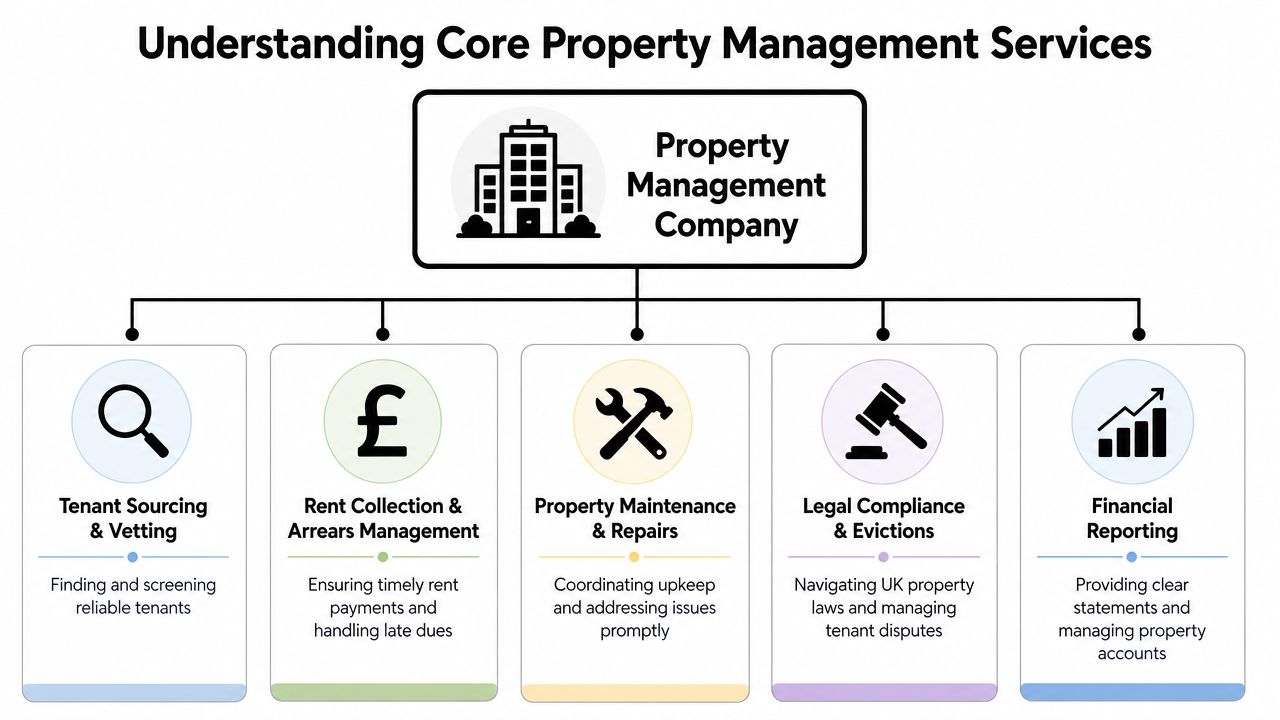
A full-service manager does far more than “look after the property”. In practice, they manage five moving parts at once: tenants, money, legal obligations, repairs, and reporting.
Modern UK firms increasingly rely on software rather than manual spreadsheets. Leading platforms such as Re-Leased, MRI, and Goodlord automate rent collection, compliance tracking, and maintenance workflows, which makes services more transparent and auditable (UK property management software overview).
Tenant sourcing and day-to-day tenancy handling
The first layer is getting the right tenant into the property. That includes marketing, arranging viewings, referencing, affordability checks, right-to-rent administration, tenancy paperwork, move-in coordination, and deposit handling.
Weak managers often fail by focusing on speed of let rather than tenant quality. For an overseas landlord, a void is painful, but a poor tenant is usually worse.
Look for firms that can explain, in plain English, how they decide whether an applicant is suitable. If the answer is vague, that's a warning.
Rent collection, owner payments, and reporting
Rent collection sounds simple until it isn't. Once arrears begin, the manager's process matters. You want prompt follow-up, a documented escalation path, and clear owner reporting.
Financial administration usually includes:
- Rent processing: Collecting rent and transferring net funds to the owner.
- Arrears management: Chasing late payment early, not after a long delay.
- Statement production: Monthly or periodic owner statements that are easy to reconcile.
- Deposit administration: Proper registration and end-of-tenancy procedures.
- NRL coordination: Understanding how non-resident landlord arrangements affect payment workflows and documentation.
Good reporting should let you understand the property's position without needing three follow-up emails.
Compliance and legal coordination
Compliance work is where many international investors underestimate the value of a solid manager. The job includes tracking certificate dates, arranging renewals, maintaining records, and handling prescribed processes correctly.
A reliable manager should be comfortable coordinating:
- Safety certification: Gas and electrical compliance where applicable.
- Deposit rules: Proper protection and recordkeeping.
- Right to Rent checks: Carried out in line with requirements.
- Tenancy paperwork: Signed documents, notices, and renewal administration.
- Licensing issues: Especially if the property is an HMO or sits in a locally regulated area.
Maintenance and inspections
Maintenance is where returns leak away. Delayed repairs upset tenants, increase future cost, and damage the asset. Poor contractor oversight is another common issue. Some managers merely pass through invoices. Better ones triage repairs, obtain sensible quotes where appropriate, and monitor work quality.
For broader operational thinking, Facility Management Insights' guidance is useful because it frames maintenance as a control system, not a series of one-off emergencies.
If you want to see the software side from an owner's perspective, this look at the best rental property app helps when assessing whether a manager's portal is useful or just a marketing feature.
The Cost of Management UK Fee Structures Explained
Fees in the UK aren't uniform, and that catches out many overseas buyers. Two firms can quote very different prices while including very different levels of service. Unless you compare on a like-for-like basis, the cheaper quote tells you very little.
The main models are let-only, rent collection, and full management. Some firms also charge separately for inventories, tenancy renewals, check-outs, major works supervision, court attendance, or project coordination.
What you're usually paying for
Let-only is transactional. The agent finds a tenant, completes the setup, and hands the property back to you. That model rarely suits a non-resident landlord unless you have a separate local representative.
Rent collection adds a layer of financial administration, but it still leaves many operational and compliance tasks in the owner's hands.
Full management is what most overseas investors need. It usually includes tenant communication, inspections, repair coordination, compliance tracking, and routine issue handling.
| Comparison of UK Property Management Fee Structures (2026) | Typical Fee (% of Monthly Rent) | Services Included |
|---|---|---|
| Let-only | Varies by firm | Marketing, viewings, referencing, tenancy setup, move-in coordination |
| Rent collection | Often a mid-range monthly charge | Let-only services plus rent collection, statements, and arrears follow-up |
| Full management | Usually the highest monthly charge | Rent collection, tenant liaison, inspections, repair coordination, compliance administration, ongoing tenancy management |
The trade-off behind the fee
A low fee can still be expensive if it creates hidden costs later. I'd rather pay a capable manager a sensible amount than save money upfront and then lose months of rent through weak arrears handling or poor maintenance control.
Watch for these fee issues:
- VAT treatment: Ask whether the quoted management fee includes or excludes VAT.
- Contractor margin: Some firms add a management margin to repair invoices.
- Renewal and admin charges: These can turn an apparently cheap agreement into an expensive one.
- Major works supervision: Larger repair projects may attract separate oversight fees.
- Exit terms: Notice periods and termination charges matter if service slips.
Cheap management often means the landlord becomes the real property manager from a different time zone.
For investors modelling net returns, this guide on what is good rental yield is useful because management cost needs to be assessed against realistic income, not gross rent alone.
How to compare proposals properly
Ask each company for a full written fee schedule and compare it against an actual operating scenario. Include a new tenancy, one repair issue, one certificate renewal, a tenancy continuation, and eventual check-out.
That exercise usually exposes who has a genuine management platform and who is merely selling a low headline percentage.
Navigating UK Property Law and Compliance
For most non-resident investors, legal compliance is the strongest argument for appointing a proper manager. UK lettings law isn't impossible to comply with, but it is procedural, and procedural mistakes are exactly what cause avoidable disputes, penalties, and possession problems.
The risk is higher if you're managing from abroad because you're less likely to spot missed deadlines, poor paperwork, or a local licensing issue until it has already become expensive.

The main compliance duties a manager helps control
At a practical level, your manager should already have a compliance calendar and workflow for the property. If they don't, you're relying on memory and goodwill, which isn't a system.
The key areas usually include:
- Deposit protection: Residential deposits must be handled correctly and within an approved framework.
- Safety certification: Gas and electrical requirements must be monitored and renewed when due.
- Right to Rent checks: These need to be done correctly and retained properly.
- Tenant Fees Act awareness: The manager must know what can and cannot be charged.
- Licensing: HMOs and some locally regulated properties need extra attention.
- Notice procedure: If a tenancy deteriorates, paperwork needs to be accurate from the start.
One ownership issue also matters. If you hold a leasehold flat, your manager needs to understand the practical limits imposed by the building and freeholder. That affects service charges, repair responsibility, access, and lease restrictions. If you're comparing title structures, this guide to leasehold vs freehold is worth reading.
Why oversight matters so much
A UK government market study found that many poor outcomes in residential property management are rooted in the leasehold structure itself, where landlords appoint and supervise managers while leaseholders bear the cost. The same review noted that weak landlord oversight can allow poor service and higher charges to persist (GOV.UK property management market study).
That matters to overseas investors because distance reduces your ability to supervise. If your manager is passive, or if they only react when chased, service quality can deteriorate without immediate visibility.
The legal problem usually isn't the first mistake. It's the chain of small unmanaged mistakes before it.
What a strong manager does differently
Strong firms don't just know the rules. They build routine around them. They calendar expiry dates, issue reminders before deadlines, retain records centrally, and use standard workflows for tenancy changes and contractor access.
Ask a prospective manager one blunt question: “Show me how you track compliance across a tenancy.” If they can't demonstrate a process, don't assume they have one.
How to Choose the Right Property Manager
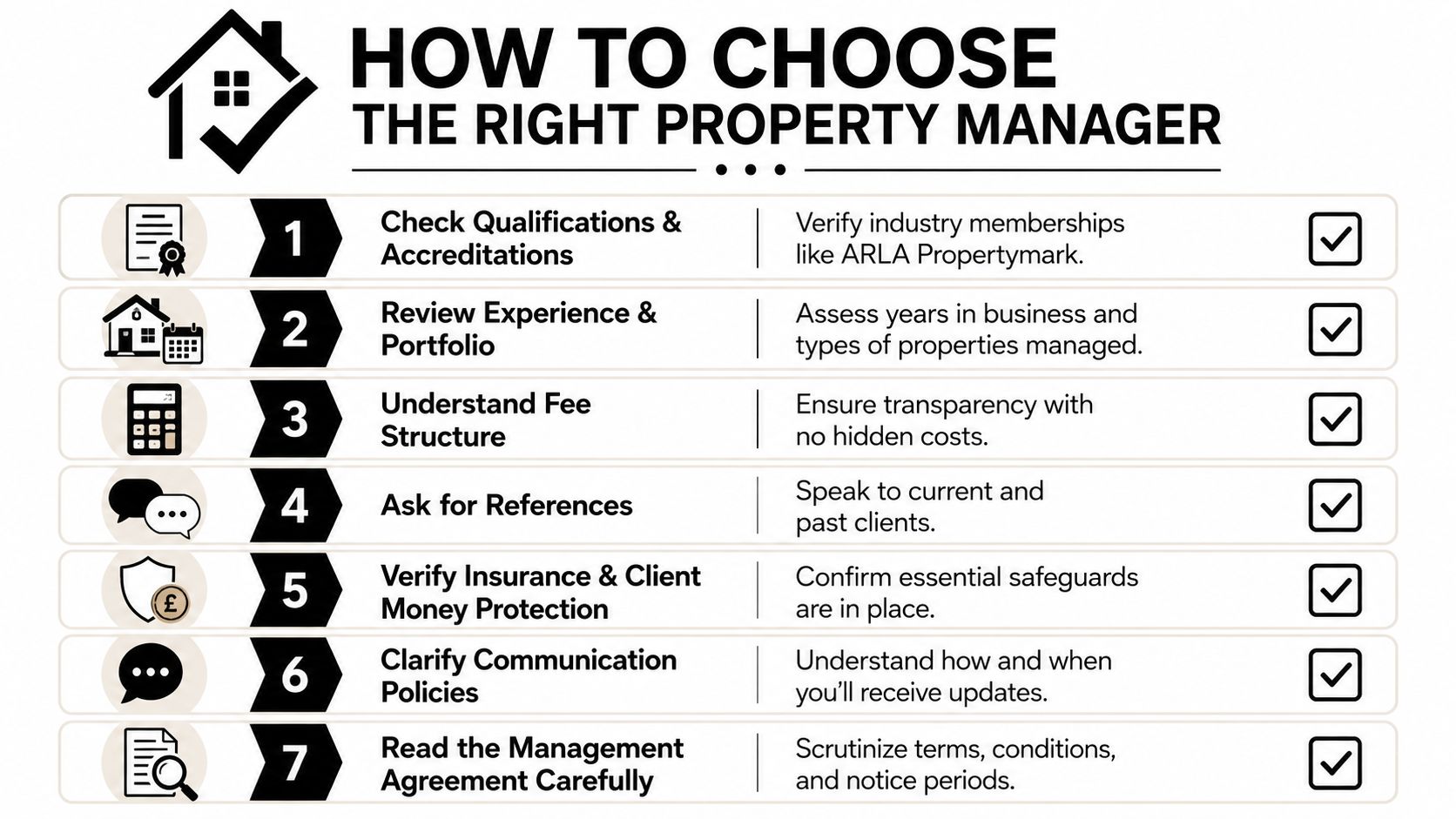
Choosing a manager is due diligence, not brand shopping. The largest firm isn't automatically the best, and the smallest boutique isn't automatically more careful. You need evidence that the company can run your specific property type in your specific location with disciplined reporting.
The shortlist test
Start with basic verification. You want a firm that can prove it is properly organised before you even discuss rent levels.
Check these points first:
- Accreditations: Membership of recognised industry bodies helps, especially where standards and training matter.
- Client Money Protection: This is essential.
- Redress scheme membership: There should be a formal complaints route.
- Relevant experience: A company that mainly handles student stock may not suit a prime apartment or an HMO.
- Local fluency: They should know the micro-market, not just the city name.
A useful general companion for broader investor due diligence is this guide to property investor tips.
What to ask in the interview
Most investors ask soft questions and get polished answers. Ask operational ones instead.
Use questions like these:
- How do you handle arrears in the first days after rent is missed?
- What's your out-of-hours emergency process?
- Who approves repairs, and at what threshold do you seek owner consent?
- How often do you inspect, and what does the report include?
- How do you manage contractor selection and invoice control?
- What software do owners use to see statements and documents?
- Who in your team will manage my property day to day?
- How do you deal with overseas landlords under the Non-Resident Landlord framework?
The answers should be specific. If you hear “it depends” too often, you're dealing with improvisation.
This short video gives a useful owner-level perspective on what to probe when comparing agents:
Policy changes matter too
UK regulation keeps moving. A manager who was competent two years ago may now be behind. For landlords trying to keep up with current obligations, this overview of landlord duties under Renters' Rights Act is a useful reminder of why your manager's legal awareness needs to be current, not historical.
Ask for a sample inspection report, a sample owner statement, and a copy of the management agreement before you sign anything.
What usually works
The best appointments usually come from firms that are boring in the right ways. They answer directly, send documents promptly, explain edge cases clearly, and don't make theatrical promises about “premium tenants” or “guaranteed” outcomes.
That calm competence is what you want if you live thousands of miles away.
UK Regional Variations for Investors
The UK isn't one rental market. A manager who is excellent in Manchester may be the wrong fit for prime central London, and a firm built around suburban family lets may struggle with city-centre apartments or student stock.
Overseas investors often search nationally, then assume management quality and operating style are interchangeable. They aren't.
London versus the regional cities
London management tends to be more expensive and more layered. The stock is diverse, building management can be more complex, leasehold issues are common, and tenant profiles can include corporate renters, relocations, and high-expectation professionals.
Regional cities such as Manchester and Birmingham often reward managers who understand fast-moving rental demand, investor-led apartment stock, and practical turnaround speed between tenancies. Glasgow brings its own legal and operating nuances, so local knowledge matters even more.
The point isn't that one region is better. It's that the operational pressure points differ.
Tenant profile changes the management model
Consider how these markets often differ in practice:
- Prime London flats: You may need a high-touch manager who is polished with tenants and efficient with block-management communication.
- Regional city apartments: Speed, availability, and contractor coordination often matter more than concierge-style service.
- Student or HMO stock: Compliance and room-by-room operational discipline matter far more than branding.
- Family houses in commuter areas: Tenant retention and maintenance quality become central.
A good manager should speak fluently about the actual tenant base for your area. If they can only give generic “strong demand” language, that's not enough.
Emerging versus established markets
Established markets such as central London often have deeper agent competition and more specialist managers. Emerging or fast-changing regional pockets may offer stronger yield potential, but they also require sharper local execution because the wrong rent level, poor marketing, or weak tenant selection can have a greater effect on performance.
For international buyers, that means the “best” property management companies UK search result is rarely the national answer. It's usually a location-specific answer.
Red Flags and Matching Managers to Your Portfolio
The wrong manager usually reveals themselves early. Investors often miss the signals because the firm sounds professional, has a clean website, and responds quickly during the sales process.
The red flags are more practical than cosmetic.
Red flags to take seriously
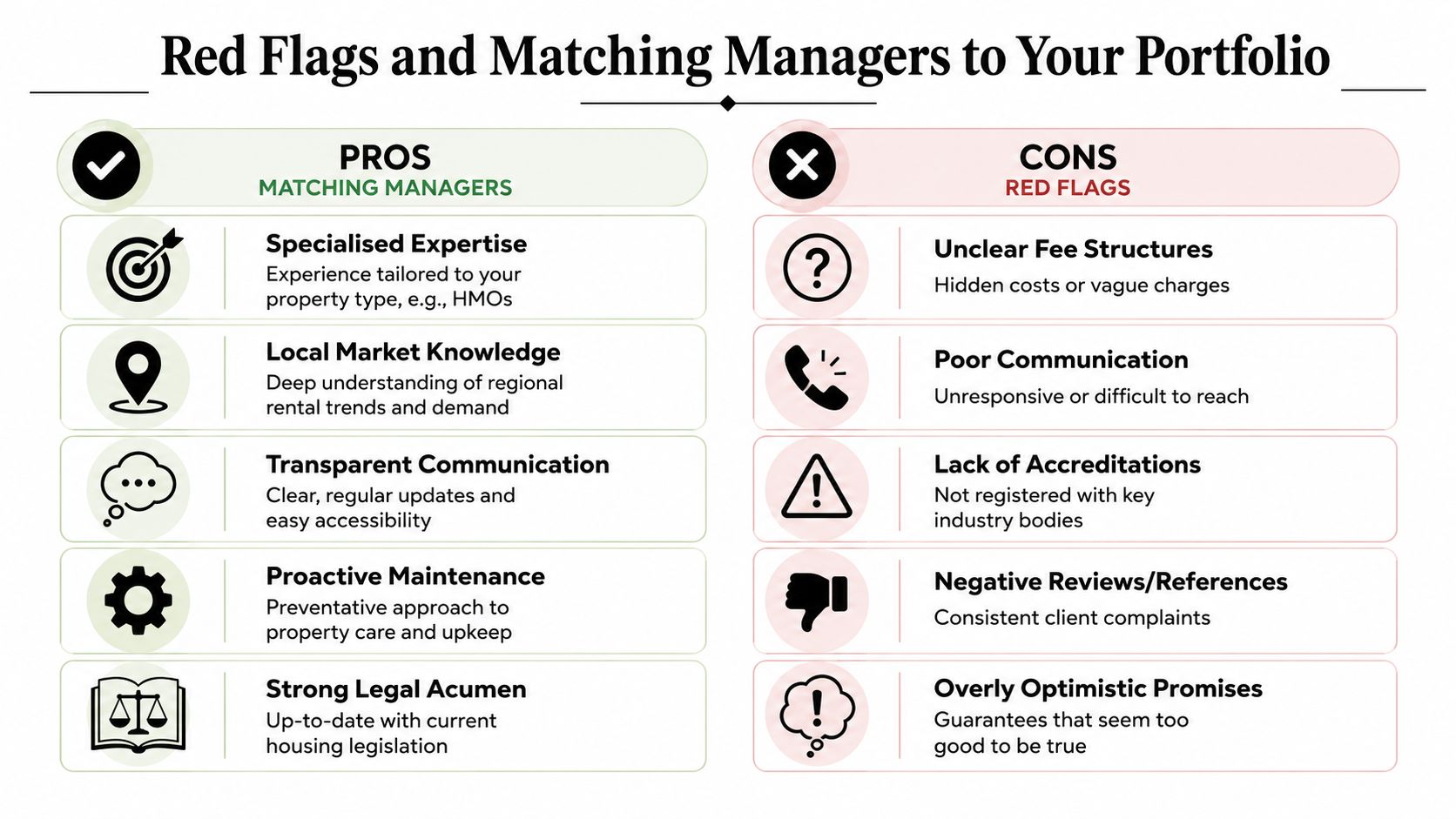
Watch for these problems:
- Unclear fees: If charges are hard to pin down before signing, they won't become clearer later.
- Weak communication: Slow responses during onboarding usually get worse after instruction.
- No process evidence: If they can't show reports, workflows, or templates, systems are probably thin.
- Over-promising: Guaranteed rent levels, frictionless tenancies, and “hands-free” ownership claims deserve caution.
- Poor tenant feedback: Landlord reviews matter, but tenant reviews often reveal operational discipline.
Match the manager to the asset
Different portfolios need different management styles.
- Single buy-to-let flats: A reputable process-driven firm can work well if reporting is strong.
- HMOs: Use a specialist. Licensing, room turnover, and compliance are too important to improvise.
- Prime or high-value units: A boutique manager may be better if tenant experience and presentation are central.
- Scaled regional portfolios: A larger operator with standardised systems can be effective if local staffing is strong.
The correct choice isn't the most famous manager. It's the one whose operating model fits the asset you own.
Frequently Asked Questions
What's the difference between a letting agent and a property manager
A letting agent often focuses on the transaction. They market the property, find the tenant, and arrange the initial paperwork. A property manager handles the ongoing relationship after move-in, including rent collection, maintenance coordination, inspections, compliance administration, and tenant issues.
Some firms do both. Don't assume their management service is strong just because they're good at lettings.
Can I self-manage one UK property from abroad
You can, but in most cases I wouldn't recommend it. Distance slows decision-making, contractors are harder to control, inspections are difficult, and compliance administration becomes easy to miss.
If you still want to self-manage, you need a reliable local support network, strong systems, and a clear understanding of UK tenancy procedure. Most non-resident investors are better served by professional management.
Does a property manager deal with the Non-Resident Landlord scheme
A manager may play an administrative role in the payment process and should understand how non-resident status affects rent handling, but that doesn't replace tax advice. You should still use a qualified accountant or tax adviser for your own reporting obligations.
A good manager will know where management ends and tax advice begins.
Can I change property management companies during a tenancy
Usually yes, but the management agreement controls the process. Review the notice period, document handover obligations, tenant notification process, and how keys, certificates, and deposit records will be transferred.
The smoothest transitions happen when the incoming manager is organised and the outgoing one is given clear written instructions.
Should I choose a national brand or an independent local firm
Either can work. National brands may offer process consistency and broader systems. Strong local firms may offer better market knowledge and closer day-to-day oversight.
Judge the specific office and team, not just the logo.
If you're comparing UK cities, rental strategies, and cross-border buying options, World Property Investor is a strong place to continue your research. It helps international buyers assess markets, yields, risks, and ownership structures before they commit capital.