
You're reviewing a sale, not just a property.
The gross gain looks healthy on paper. Then the tax position starts to narrow the result. Was the seller resident where the property sits, or resident somewhere else? Did a treaty allocate taxing rights cleanly? Does the local regime reward longer holding periods, or does it tax non-residents almost identically to domestic owners? Those questions often matter more than the headline market story.
That's why any serious review of capital gains tax by country has to go beyond a simple rate list. For a global property investor, the effective tax outcome sits at the intersection of residency, timing, exemptions, reliefs, ownership structure, and filing discipline. Two markets can appear similar until one catches a departing investor under an anti-avoidance rule, while another offers a cleaner path to disposal.
Understanding Capital Gains Tax on Property
A property investor can spend months choosing the right city, negotiating the right entry price, and improving the asset, only to lose control of the final outcome at the point of sale.
Capital Gains Tax (CGT) is the tax charged on the profit made when you dispose of a capital asset, including investment property in many jurisdictions. In practice, that means your gain isn't just sale price minus purchase price. The taxable amount usually depends on local rules about allowable costs, ownership period, exemptions, and whether the tax authority treats you as resident or non-resident.

A good starting point is understanding the mechanics of property taxation before comparing jurisdictions. This overview of Understanding property capital gains tax is useful because it frames CGT as part of the full investment lifecycle rather than an afterthought. For a broader primer focused on international investors, what capital gains tax on property means in practice is also worth reviewing.
Why headline rates mislead
The common mistake is to compare countries only by the published rate. That's too shallow for cross-border investing.
A lower rate can produce a worse result if the country denies meaningful deductions, taxes non-residents aggressively, or applies anti-avoidance rules after you leave. A higher nominal rate can still be manageable if the jurisdiction offers a main residence exemption, a time-based relief, or a treaty credit in your home country.
Practical rule: Always model the disposal before you buy. Entry yield matters, but exit taxation often determines whether the investment thesis survives.
What belongs in your profit calculation
When investors assess return on investment, they usually focus on purchase price, rental income, finance costs, and resale value. CGT belongs in that same model.
Your working file should normally include:
- Acquisition costs such as legal fees and transaction taxes where deductible under local rules.
- Improvement expenditure that may increase base cost if it qualifies as capital rather than routine maintenance.
- Residency analysis covering both the country where the property sits and the country where you personally file tax.
- Exit timing because the date of disposal can affect reliefs, allowances, and banding.
Investors who handle this early tend to make better decisions on hold period, ownership structure, and expected net proceeds.
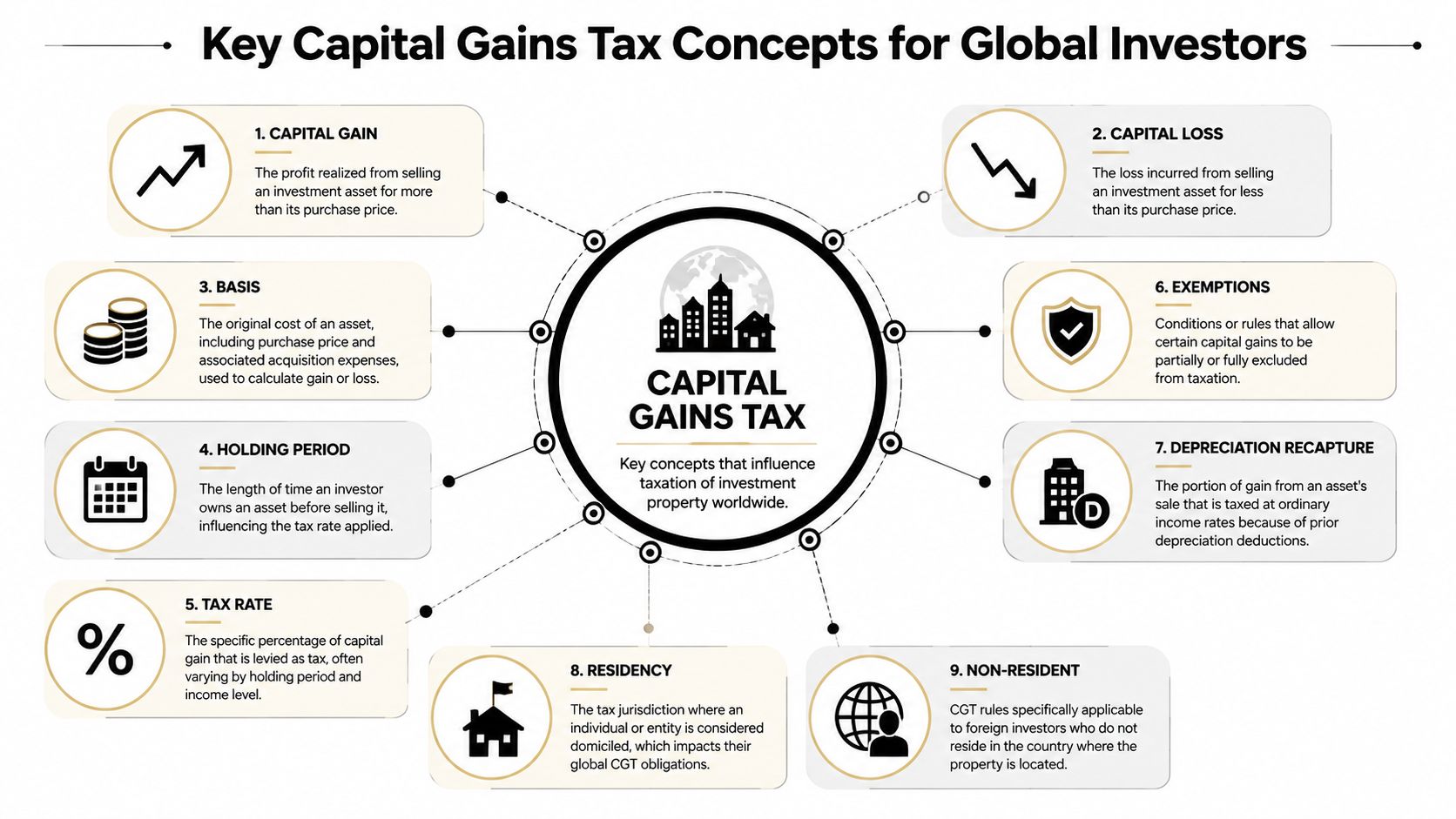
Key CGT Concepts for Global Investors
Before comparing countries, you need a common language. Without that, investors end up comparing unrelated tax regimes as if they were interchangeable.
A useful parallel sits outside property. Traders dealing across borders face the same need to separate asset classification, residency, and reporting obligations, which is why this guide to understanding forex tax for traders is a helpful reminder that tax treatment depends on legal character, not investor assumptions. Property investors also need to consider ongoing income exposure alongside exit tax, especially where rental income tax rates by country interact with the eventual sale.
Residency and non-residency
This is usually the first filter.
Some countries tax residents on worldwide gains and non-residents only on local property. Others focus heavily on situs, meaning immovable property is taxed where it is located regardless of where the owner lives. For a high-net-worth investor with multiple residencies or a recent move, this question needs legal precision, not guesswork.
If you relocate before sale, don't assume the old country has lost its taxing rights. Anti-avoidance rules can keep those rights alive.
Basis and allowable costs
Your basis is usually the starting value used to calculate gain. In straightforward terms, that begins with the acquisition cost and may be adjusted by eligible capital expenses.
Many investors under-document improvement works. If you can't support the expenditure properly, the tax authority may not accept it as part of the cost base. A renovation that improved rental appeal may also reduce the eventual taxable gain, but only if records are comprehensive.
Holding period and relief design
Some jurisdictions tax short-term and long-term gains differently. Others attach relief to the number of years held, or reserve better treatment for a main home rather than an investment asset.
That creates a strategic issue. The right sale date isn't always the first date at which you can achieve your target price. Sometimes the stronger move is to wait until a relief matures or a classification changes.
Investors should treat the holding period as a tax variable, not just a market-timing decision.
Main residence relief and similar exemptions
Many countries distinguish between your principal private residence and an investment property. That distinction can remove or reduce CGT if the occupancy conditions are met.
The trap is obvious. Investors often assume occasional personal use, short stays, or informal family occupation creates a residence exemption. In many systems, it doesn't. The legal test is usually stricter than the lifestyle narrative.
Losses, recapture, and treaty interaction
Capital losses can sometimes offset gains, but the rules vary widely. So does the treatment of depreciation and any recapture on sale in jurisdictions that permit depreciation deductions against rental income.
Keep these questions in one file:
- Can local losses offset local gains only, or wider gains?
- Does prior depreciation create a harsher tax outcome on disposal?
- Will your home country grant a credit for tax paid abroad, or exempt the gain altogether under treaty rules?
Without that integrated view, your “capital gains tax by country” comparison will be too narrow to guide a real transaction.
Comparing Capital Gains Tax Regimes A Deep Dive
A useful comparison doesn't stop at rates. It asks a harder question. What does a non-resident pay after the local rules, exemptions, timing rules, and treaty position are applied?
The United Kingdom is the clearest example of why nuance matters. Generic guides often miss the anti-avoidance problem for departing owners. As noted in this analysis of capital gains tax by country and the UK non-residence trap, UK residents selling residential property pay 18% within the basic rate band and 24% above it, while non-residents can still face UK tax on property gains unless they remain non-resident for five complete UK tax years.
Capital Gains Tax Comparison for Property Investors 2026
| Country | Non-Resident CGT Rate on Property | Typical Holding Period Rules | Key Exemptions/Reliefs for Non-Residents |
|---|---|---|---|
| United Kingdom | 18% within the basic rate band and 24% above it for residential property, based on the UK framework noted above | Anti-avoidance can matter more than hold length if the investor has recently left the UK | Non-residents still need to consider continuing UK exposure on property gains; treaty analysis remains essential |
| Portugal | Qualitative only | Holding period, residency status, and local relief design determine the practical outcome | Investors should check whether any residence-based reliefs are available and whether they apply to non-residents at all |
| France | Qualitative only | Long holding periods can materially change the effective position depending on the asset and taxpayer profile | Relief design matters more than the headline rate alone; local surcharges and filing mechanics can affect the net result |
| UAE or Dubai | Qualitative only | The key issue is often whether tax arises elsewhere, not just in the UAE | A low-tax environment doesn't remove the need to analyse home-country taxation and treaty exposure |
United Kingdom and the hidden residency risk
The UK deserves special attention because many international investors assume that leaving the country ends the tax story. That assumption can be wrong.
If the asset is UK property, the UK keeps a strong claim to tax the gain. If the owner has moved abroad, the non-residence period itself becomes a planning variable. A rushed relocation before sale may achieve very little if the anti-avoidance rules still pull the gain back into charge.
Portugal and France as examples of rule-heavy markets
Portugal and France regularly attract lifestyle-driven and portfolio-driven buyers. Both can look attractive at acquisition stage because the investor is focused on residency pathways, financing, or urban demand.
The disposal analysis is where many buyers are underprepared. In these markets, investors need to distinguish between the headline CGT framework and the finer points that shape the actual cost, including whether the investor is resident, how long the asset has been held, and whether the relief in question applies to non-residents in substance rather than theory.
For France in particular, local tax due diligence should sit alongside the broader legal review. A practical starting point is understanding how French property taxes affect foreign owners before you model the exit.
UAE and the false comfort of zero-tax assumptions
Dubai often enters capital gains tax by country discussions as a low-tax benchmark. That can be useful, but it can also create a false sense of simplicity.
A low or absent local capital gains charge doesn't automatically mean a tax-free outcome. If the investor remains tax resident elsewhere, the home country may tax the gain under its own domestic rules. In that setting, the UAE's local position matters less than the investor's residence status and treaty profile.
The country where the property sits doesn't always determine the whole answer. The investor's residence jurisdiction often decides whether the gain remains lightly taxed or becomes fully reportable.
The UK Capital Gains Tax Rules A Case Study
The UK is a good case study because it shows how quickly the economics of disposal can change when allowances are tightened.
According to the UK government's guidance on Capital Gains Tax rates and allowances, the annual exempt amount for individuals fell from £12,300 in the 2022/23 tax year to £3,000 for the 2025/26 and 2026/27 tax years. The same guidance states that for the 2026/27 tax year, gains on residential property are taxed at 18% within the basic rate income tax band and 24% above it.
Why the allowance cut matters
That reduction changes investor behaviour.
A smaller annual exemption means relatively modest gains become taxable much sooner. Investors who once treated a medium-sized disposal as administratively minor now need a tighter record of costs, ownership dates, and income position for the year of sale. For international owners, this also increases the cost of getting the filing wrong.
A practical calculation method
The clean way to approach a UK buy-to-let disposal is sequential.
- Start with the sale proceeds.
- Deduct the acquisition cost.
- Deduct allowable capital costs if they qualify.
- Arrive at the net gain.
- Apply the annual exempt amount if available.
- Test how much of the taxable gain falls within the basic rate band and how much sits above it.
- Apply 18% to the part within the band and 24% to the balance for residential property, using the Gov.uk framework above.
Many investors make an analytical mistake. They jump straight to the higher rate and assume the whole gain is taxed there. In practice, the gain has to be read against the individual's taxable income position for that year.
Where international investors slip
Cross-border sellers often focus on the rate and ignore the compliance pathway. That's risky.
The UK position can interact with residency status, reporting requirements, and landlord tax issues already present during the holding period. If you own UK rental property from abroad, it helps to understand how the non-resident landlord tax regime works in the UK because the sale doesn't happen in isolation from the years of ownership before it.
A disposal calculation is only as strong as the records behind it. If legal fees, improvement invoices, and ownership history are incomplete, the tax result usually becomes worse, not better.
The strategic lesson from the UK
The main lesson isn't just that UK CGT exists or that rates have changed. It's that policy risk is real.
A market can remain attractive on rental fundamentals and legal security while becoming less forgiving on exit. High-net-worth investors should treat CGT policy as a live part of portfolio monitoring, especially in mature markets where governments can tighten reliefs without changing the core appeal of the asset class.
How Tax Treaties Prevent Double Taxation
Double taxation agreements matter because they stop the same gain being taxed twice without relief. They don't usually remove tax altogether. They allocate taxing rights and set the mechanism for relief.
For immovable property, the core principle is usually straightforward. The country where the property is located normally has the primary right to tax the gain. Your residence country then decides how to relieve that foreign tax under its treaty method, often by giving a credit or applying an exemption approach.
A simple cross-border example
Take an investor resident in Country A who sells a rental apartment in Country B. Country B taxes the gain because the property is physically there. Country A also taxes residents on worldwide gains under its domestic law.
The treaty then steps in. It doesn't erase Country B's right. Instead, it usually tells Country A to recognise the foreign tax already paid, so the investor isn't taxed twice on the same economic profit.
Why this still requires planning
Treaties reduce double taxation. They don't cure bad planning.
Investors still need to confirm residence status, treaty eligibility, filing deadlines, and whether the gain is classified consistently in both jurisdictions. Estate and succession planning can complicate this further, especially where ownership passes across borders, which is why foreign owners should also understand how inheritance tax can apply to overseas property.
- Check treaty coverage early: Not every cross-border holding sits within the cleanest treaty framework.
- Match documentation: The tax paid abroad must usually be evidenced properly if you want credit at home.
- Watch classification issues: A gain treated one way in the property country may be read differently in the residence country if the structure is unusual.
Strategic Tax Planning for Property Investors
Good CGT planning starts on the day you buy, not the day you decide to sell.
That means building a file that can survive scrutiny years later. Investors who do this well don't rely on memory. They keep purchase contracts, legal invoices, evidence of improvement works, loan records where relevant, and a clear note of intended use. If the property later shifts from personal use to rental use, or from one owner to another, that history needs to be documented contemporaneously.
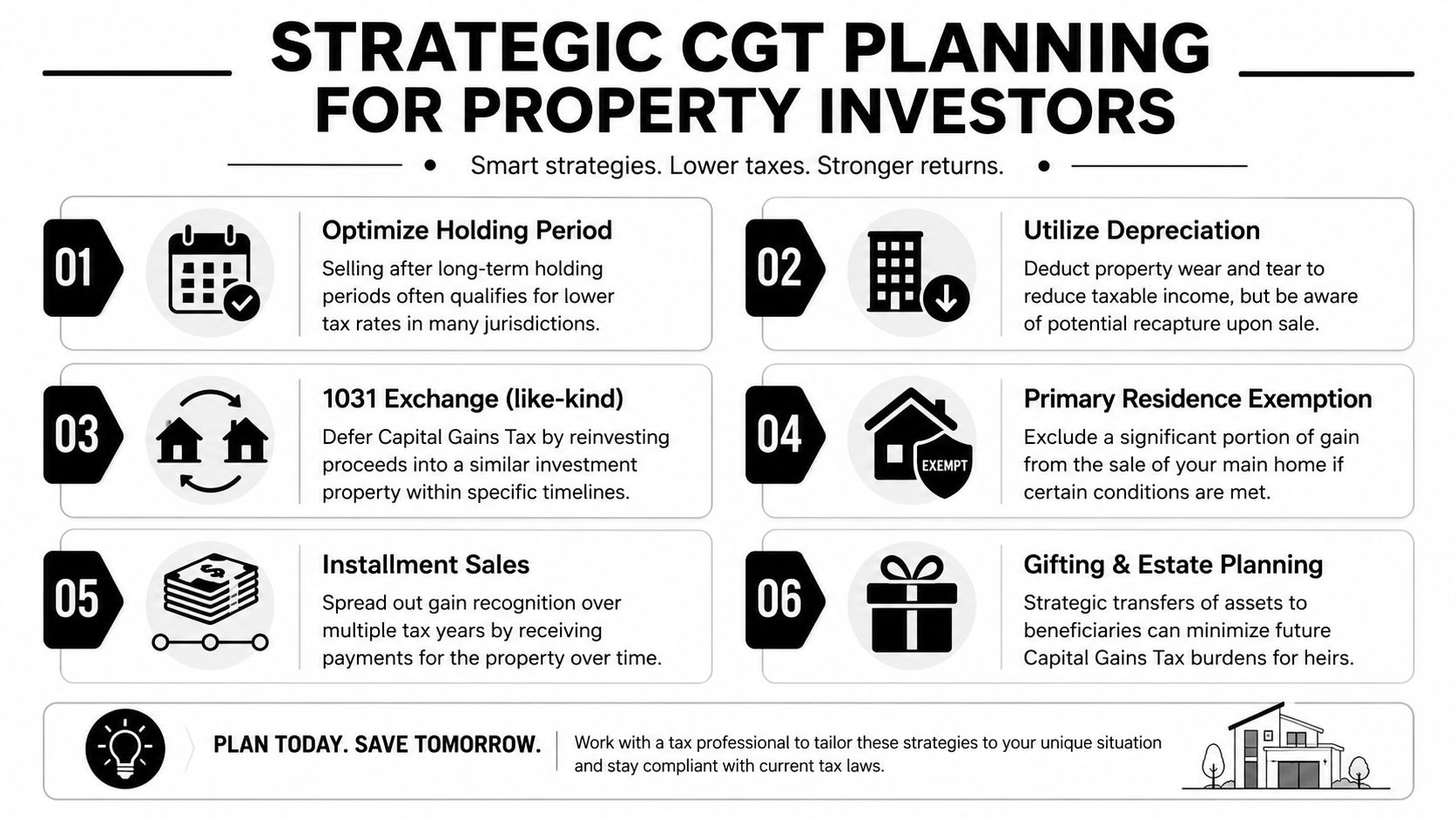
Planning levers that actually matter
Some tax strategies are durable across countries even though the detailed rules differ.
- Ownership structure: Personal ownership, joint ownership, and corporate ownership can produce very different tax outcomes on both income and disposal.
- Timing of sale: The disposal date can affect annual exemptions, residency status, and qualification for reliefs linked to holding period.
- Cost tracking: Capital improvements, legal fees, and transaction costs may reduce the chargeable gain if the local rules permit them.
- Residence analysis: A move abroad or a return home should never be planned without checking anti-avoidance rules and treaty consequences first.
A broader operational issue also matters for internationally mobile investors. If you run property through offshore entities or hold assets across several jurisdictions, disciplined financial administration becomes part of tax risk management. This overview of an expert perspective on offshore accounting is useful because it highlights the governance side of cross-border ownership rather than treating tax as a filing-only exercise.
A short visual explanation can also help clarify how investors commonly think about timing and structure:
Practical habits that reduce risk
The most effective tax planning is usually procedural, not exotic.
Keep a disposal file while you own the property, not after you've accepted an offer.
That file should include evidence of acquisition costs, planning permissions, contractor invoices, title changes, and records of occupation if residence-based relief might ever matter. Where a spouse or family member is involved, review ownership well before sale rather than trying to rearrange everything at the last minute.
For high-net-worth investors, the strongest result often comes from coordinating tax, legal, and estate advice in one timeline. A property can be profitable on gross yield and still disappoint badly if the exit triggers avoidable tax friction.
Key Takeaways Calculating Your Effective Tax Rate
The most useful way to think about capital gains tax by country is this. The published rate is only the starting point. Your effective tax rate depends on who owns the asset, where they're resident, how long they've held it, what reliefs apply, and whether a treaty changes the final burden.
The UK demonstrates the point clearly. Allowances can contract sharply, rates can interact with income bands, and non-residence doesn't always remove exposure. Other markets create different risks. Some rely on relief design, some on holding period, some on the investor's home-country tax system. That's why a country ranking based only on nominal CGT is too simplistic for real capital allocation.
Use this checklist before you buy or sell:
- Residency first: Confirm where you're tax resident and whether any recent move triggers anti-avoidance concerns.
- Property classification: Establish whether the asset is an investment property, a main residence, or part of a broader structure.
- Reliefs and exemptions: Check whether they exist, whether they apply to non-residents, and what evidence is required.
- Treaty position: Verify who has primary taxing rights and how foreign tax relief works at home.
- Records: Maintain proof of acquisition costs, improvement costs, ownership dates, and use of the property.
A discerning investor doesn't ask only, “What is the CGT rate?” The better question is, “What will I keep after the sale, after local tax, after home-country tax, and after the treaty is applied?” That's the calculation that protects long-term returns.
World Property Investor helps international buyers compare markets, tax exposure, rental fundamentals, and ownership rules before capital is committed. If you're evaluating where to buy next, or planning an eventual sale across borders, explore the research and country guides at World Property Investor for practical, data-led analysis.