
Prime property still attracts global capital, but the entry ticket has become hard to justify for many investors. You may want exposure to London, Paris, or a lifestyle market in southern Europe, yet tying up a large lump sum in a single property can distort your whole portfolio.
That's why fractional property ownership has moved from a niche idea to a serious consideration. In the UK, platforms have reduced entry barriers from hundreds of thousands of pounds to £100 to £500 per share, and they've delivered consistent annual returns of 5 to 9% over the past five years, combining rental income and capital appreciation, according to Property Research Partner's review of UK fractional property ownership.
For an international investor, that sounds compelling. It can open access, spread risk across markets, and reduce day-to-day management. But low entry cost isn't the same as low risk. Important questions sit elsewhere. What exactly do you own. How can you exit. Who controls the asset. Which structures fall inside financial regulation, and which don't.
Those details decide whether fractional ownership behaves like a disciplined portfolio tool or an expensive legal misunderstanding.
A Smarter Way to Own Prime Property
You want exposure to a London rental block or a high-demand holiday asset in southern Europe, but not at the cost of tying a large share of your portfolio to one title deed, one tax regime, and one exit decision. Fractional ownership appeals in that scenario because it changes position sizing. It lets an investor allocate to a specific property opportunity without taking on the full capital burden of direct acquisition.
The investment case is therefore less about making prime property cheap and more about using capital with more discipline. A smaller ticket can preserve liquidity for other deals, reduce concentration in a single jurisdiction, and limit the financing drag that often comes with cross-border purchases. For internationally mobile investors, that can be a genuine portfolio advantage.
The appeal for many investors is not replacing direct ownership, but solving a portfolio problem:
- Position sizing: Prime assets often require more capital than is sensible for one exposure.
- Concentration risk: One whole property can leave you overexposed to a single city, legal system, tenant profile, or currency.
- Operating burden: Cross-border ownership can create administrative work that is disproportionate to the size of the investment.
A broader framework for weighing these trade-offs appears in this guide to property investment strategies and risk factors. Fractional structures need separate analysis because they sit in an awkward middle ground. Economically, they are sold as property. Legally, they may look more like a contractual claim, a beneficial interest, or a share in a special purpose vehicle.
That distinction is where many investors misprice the risk.
In the UK, the market is more developed, but that does not automatically make every offering comparable. Two platforms can market the same promise of passive exposure to prime residential property while giving investors very different rights on voting, distributions, resale, and insolvency protection. One structure may give a clear claim over an SPV that owns the asset. Another may leave the investor dependent on platform terms and a limited secondary market that works only when new buyers are available.
Liquidity is the part brochures tend to understate. A low minimum investment can create the impression of flexibility, yet fractional property is often less liquid than listed real estate securities and more procedurally constrained than selling a directly owned asset at a discount. In stressed markets, the practical exit route may narrow to platform-operated resale windows, board approval, or a wait for the full property to be sold.
What global investors often miss
Many buyers focus on access, yield projections, and the convenience of remote ownership. Those features are relevant, but they are not the main due diligence questions.
Fractional ownership changes three core variables:
- Your legal interest in the underlying asset
- Your control rights over management, major costs, and sale timing
- Your liquidity profile, including who provides the resale mechanism and on what terms
For a global investor, the UK deserves special attention because regulatory labels can change the risk profile materially. Some arrangements fall within established financial promotion and investment rules. Others are structured to sit closer to direct property participation, where consumer protections and disclosure standards may be thinner than investors assume. The result is a market where headline economics can look familiar across offerings, while investor protections differ sharply once fees rise, governance breaks down, or an exit is needed quickly.
The practical rule is simple. Assess the legal structure before assessing the property story. In fractional ownership, the structure determines whether returns, control, and exit rights hold up under pressure.
What Is Fractional Property Ownership Exactly
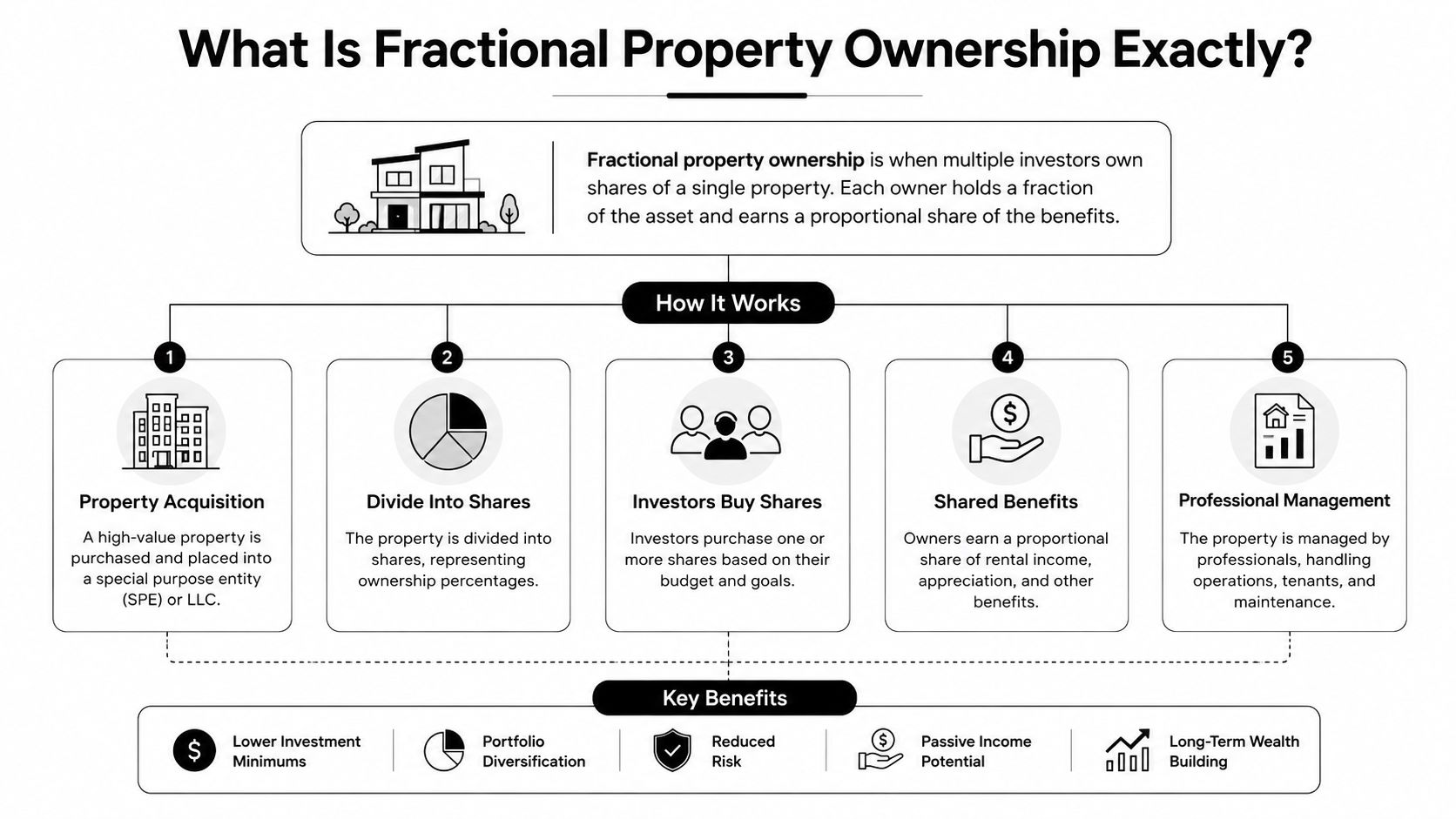
Fractional property ownership means multiple investors own interests linked to one property rather than one investor owning the entire asset. The simplest way to think about it is this: you're not buying a tiny slice of a diversified property fund. You're buying exposure to one identified property through a defined legal structure.
That distinction matters. With a fund, you usually own units in a portfolio managed at arm's length. With fractional ownership, your economics often depend on one building, one management arrangement, and one resale mechanism.
The main legal structures
The label “fractional” covers several forms. Investors should separate them before looking at yield projections or lifestyle benefits.
Tenancy in common
Under tenancy in common, each owner holds a direct interest in the asset. Shares can be equal or unequal, depending on the agreement. This structure is conceptually straightforward because each participant owns a defined portion rather than a general claim on a platform.
Its weakness is governance. Decision-making can become slow if owners disagree on costs, repairs, sale timing, or use rights.
SPV or company structure
A common alternative is a special purpose vehicle, often a limited company that owns the property. Investors then own shares in the company rather than holding title directly. This is often cleaner for administration because the company signs contracts, pays expenses, and appoints managers.
The trade-off is that your rights depend heavily on the shareholder agreement, company constitution, and manager powers. If those documents are weak, your “property investment” can behave more like a minority stake in someone else's operating vehicle.
Deeded co-ownership model
In the UK luxury second-home segment, the standard model is often more specific. A 1/8 deeded share is held within a property-specific LLC, giving owners around 45 days of exclusive personal use annually, while the asset participates directly in English market appreciation, as outlined in this explanation of England's fractional ownership structure.
The key question isn't only “what percentage do I own?” It's “what legal instrument gives me that ownership, and who can act on the asset without my consent?”
Why definition affects investment outcomes
Two deals can both be marketed as fractional property ownership and still produce very different outcomes in dispute, taxation, financing, and resale.
For an income-focused investor, the structure influences who collects rent, who deducts costs, and how distributions are made. For a lifestyle buyer, it determines whether usage rights are strong or merely contractual. For an offshore investor, it can also alter tax treatment in ways that aren't obvious from the sales material.
That's why the legal wrapper shouldn't be treated as admin. It is the investment.
Fractional Ownership vs Timeshares REITs and Direct Ownership
A London buyer acquires a 1/8 interest in a townhouse through a platform and assumes the position sits halfway between a holiday home and a listed property fund. That assumption is where mistakes start. The legal rights, exit options, and regulatory treatment can differ so sharply that two investments with similar marketing language can produce very different outcomes.
The practical test is simple. What exactly do you own, who controls key decisions, how do you exit, and which regulator, if any, oversees the structure you are buying into.

Investment Model Comparison
| Attribute | Fractional Ownership | Timeshare | REIT | Direct Ownership |
|---|---|---|---|---|
| Ownership | Equity interest linked to a specific property or holding entity | Usually a right to use for a period, not true equity | Shares in a listed or private property vehicle | Full ownership of the asset |
| Capital appreciation | Usually linked to the property and structure | Commonly weak in resale markets | Linked to portfolio performance and market pricing | Directly linked to the property |
| Liquidity | Depends on platform, buyer demand, and legal structure | Often poor | Typically more liquid than private property holdings | Sale depends on local market conditions |
| Control | Limited and shared | Very limited | Minimal asset-level control | Full control |
| Personal use | Often available in lifestyle models | Core feature | None | Full use rights |
| Management burden | Usually outsourced | Outsourced | Outsourced | Owner-led or delegated |
A useful primer on listed property vehicles is this explanation of what a real estate investment trust is. The key distinction is concentration risk. A REIT gives exposure to a pool of assets, management teams, tenants, and financing decisions. Fractional ownership usually ties your outcome to one address, one operator, and one resale process.
That difference matters more in the UK than many buyers expect. Some fractional structures look economically similar to collective investments but are marketed as direct exposure to property. Others are closer to co-ownership clubs with contractual usage rights attached. For an international investor, that is not a technical footnote. It affects disclosure standards, complaint routes, resale mechanics, and whether you are relying mainly on company law documents rather than the stronger market infrastructure that supports listed securities.
Why fractional ownership is not a timeshare by another name
The similarity is mostly commercial, not legal. Both models may offer scheduled occupancy and shared costs. The core question is whether the buyer acquires an ownership interest with economic rights in the asset, or only a contractual right to stay for a defined period.
That distinction shapes resale value and enforceability. A timeshare buyer is often purchasing access. A fractional buyer is usually purchasing equity in a property-specific vehicle or a deeded interest, subject to the terms governing that vehicle. In practice, many UK investors still overestimate what “equity” solves. Equity does not guarantee a functioning secondary market, a transparent valuation method, or an easy exit.
Where direct ownership still has the edge
Direct ownership remains the clearer option for investors who want discretion over financing, refurbishment, rental strategy, and timing of sale. It also avoids minority investor friction. If the roof needs replacing, the property must be refinanced, or a sale should be delayed, a sole owner can act immediately.
Fractional ownership trades that control for lower capital concentration and outsourced administration. That trade can be sensible, especially in high-value locations where full ownership ties up too much equity in one asset. But the investor should be honest about what is being surrendered. Shared ownership means shared decision-making, and in some structures the manager holds broad powers that reduce investor influence well beyond what the headline ownership percentage suggests.
Where REITs often beat it
REITs usually offer cleaner liquidity, broader diversification, and more standardised reporting. A listed REIT investor can often sell in the market without waiting for another buyer to approve a property-specific valuation or legal transfer.
That comparison exposes one of the least discussed risks in UK fractional property. Liquidity is usually episodic, not continuous. The platform may advertise resale support, but support is not the same as a market. If buyer demand weakens, if mortgage conditions change, or if a property falls out of favour, the investor can be left with a perfectly valid ownership interest that is difficult to price and slow to sell.
Fractional ownership makes more sense when the buyer wants a specific asset, a specific location, or personal use rights that a REIT cannot provide. As a pure investment tool, it should be judged against direct ownership and listed property vehicles on exit certainty, governance, and regulatory protections, not only on entry price.
The strongest comparison is not “which model is cheaper to enter?” It is “which model gives me the rights, liquidity profile, and oversight that match my real objective?”
Benefits and Risks for the Global Investor
Fractional property ownership can solve real problems for cross-border investors. It can also create new ones. The difference usually comes down to liquidity, management quality, and how clearly the investor understands the exit route before entering.

Where the model works well
For global investors, the main appeal is strategic flexibility.
- Lower capital commitment: You can access markets that would otherwise require a much larger cheque.
- Geographic spread: Capital can be allocated across more than one city or country rather than concentrated in one unit.
- Professional operations: Many structures appoint managers to handle maintenance, scheduling, compliance, and reporting.
- Lifestyle plus investment use: Some formats allow personal use while still preserving ownership economics.
This can be especially useful in established markets with expensive entry points. In emerging markets, the same lower-capital format may help investors test demand before taking direct ownership risk.
A separate issue for international buyers is currency exposure. Even a sound property thesis can underperform in home-currency terms if exchange rates move against you, which is why practical currency planning matters. This guide on how to hedge currency risk is worth reviewing before any overseas purchase.
Here's a useful overview before looking deeper at platform risk:
The overlooked risk is exit friction
The biggest gap between marketing and reality is often resale. In luxury English second-home formats, the resale market for 1/8 shares remains underdeveloped, and some developers offer guaranteed buybacks largely because there isn't a well-developed secondary market, according to this analysis of fractional ownership resale limitations.
That point changes how you should assess return projections. If the only practical buyer is the platform, the operator, or a narrow pool of like-minded purchasers, your exit price may depend on them more than on the underlying property market.
Other risks that deserve more attention
The standard risks aren't unique to fractional ownership, but the structure can amplify them.
Management dependency
A poor manager can weaken occupancy, maintenance standards, reporting quality, and owner confidence. In a direct ownership model, you can replace underperforming service providers more freely. In a fractional structure, manager replacement may be contractually difficult.
Co-owner conflict
Usage calendars, refurbishment budgets, and sale timing can all produce friction. This matters more in lifestyle properties than in passive income structures, but it shouldn't be dismissed in either case.
Valuation disconnect
A prime asset can rise in underlying market value while the fractional interest remains hard to price if buyer demand is thin or governance is weak.
Buy the exit before you buy the share. If the resale mechanism is vague, discretionary, or controlled by one operator, treat liquidity as limited even if the brochure says otherwise.
Legal and Tax Considerations in Key Markets
A Dubai-based investor buys a small stake in a London property through a sleek online platform. The brochure highlights prime postcode exposure, modest entry capital, and projected rental income. The harder questions usually appear later. Is the investor buying a direct legal interest in property, shares in a company, or only contractual rights against an operator, and who regulates that arrangement if something goes wrong?
That distinction matters more in the UK than many buyers expect. The legal wrapper determines investor rights, tax treatment, disclosure standards, and, in practice, resale options.
The UK regulatory fault line
The UK fractional market uses similar commercial language for structures that are legally very different. Some arrangements may fall within the FCA perimeter if they are structured as collective investment schemes or involve regulated activities. Others are simple co-ownership or SPV share arrangements and may sit outside that perimeter altogether, as discussed in this review of UK fractional ownership regulation and tax issues.
For an international investor, this is not a technical drafting point. It affects who holds client money, what disclosures you should expect, how complaints are handled, and whether you are relying mainly on contract law rather than financial services regulation. In a stressed market, that difference can shape both loss severity and recovery options.
It also affects liquidity. An unregulated co-ownership interest can be legally valid but still hard to sell because there is no organised secondary market, no standard pricing convention, and no obligation on the platform to provide an exit. In other words, legal ownership does not automatically produce market liquidity.
Structure drives tax. It also drives who pays it.
Tax analysis starts with the asset you own. In England, an investor buying shares in a company that owns property may face stamp duty on the share transfer rather than SDLT on the underlying property purchase. Ongoing tax can also differ materially depending on whether returns are distributed as rent, dividends, or gains. For cross-border investors comparing jurisdictions, this overview of rental income tax rates and related property taxes is useful context.
Income tax is only one layer. You also need to test how the home jurisdiction treats the same cash flow, whether double tax relief is available, and whether the holding structure creates filing obligations even when net income is modest.
Exit taxation needs the same discipline. A gain on the sale of a fractional interest may be taxed differently from a gain on the sale of the underlying real estate, particularly where the investor holds shares in a property-owning vehicle rather than title to land directly. The promotional material often compresses these distinctions. Your tax adviser should not.
Inheritance and estate planning add another layer of complexity for internationally mobile families. Exposure can depend on residence, domicile-related concepts, situs rules, and the legal form of the holding. The recent UK changes have made this area more fact-specific, not simpler, so generic platform summaries are a weak substitute for personalized advice. For broader context, this guide to inheritance and estate planning for fractional property owners outlines the issues investors should review.
Why key markets do not present the same legal risk
Established markets such as the UK and parts of the US usually offer clearer title systems, more standardised transaction documents, and advisers who have seen co-ownership disputes before. That lowers execution risk. It does not remove it.
Emerging resort jurisdictions can present a different problem set. The property may be attractive and the entry price may look efficient, but enforcement can be slower, nominee arrangements may be common, and investor protection may depend heavily on one promoter's contracts and local counsel. If governance rights are weak, a legally enforceable interest can still be commercially difficult to realise.
US investors often examine tenancy structures closely for that reason. The legal framing of each co-owner's interest affects transfer rights, tax planning, and control. For comparison with another system, this guide to tenants in common 1031 is a useful reference point.
What an international investor should verify before subscribing
Before wiring funds, confirm the following with local legal and tax advisers in both jurisdictions:
- Regulatory status: Is the offering regulated, partially regulated, or outside the financial services perimeter?
- Legal interest: Are you acquiring title, a beneficial interest, shares in an SPV, or only contractual participation rights?
- Money flow: Who receives rent, who deducts fees, and where are reserve accounts and client funds held?
- Transfer and exit rights: Can you sell freely, only through the platform, or only with board or co-owner consent?
- Tax exposure: How are acquisition taxes, rental income, gains, withholding, and estate taxes treated locally and at home?
- Dispute mechanics: Which law governs the documents, which court or arbitration forum applies, and can judgments be enforced where the asset sits?
A fractional investment can be well structured and legally sound. It can also be marketed as simple while hiding a narrow exit route, thin regulatory protection, and tax leakage across two countries. In this segment of the market, those details usually decide whether the investment is merely accessible or investable.
How to Invest in Fractional Property A Step-by-Step Guide
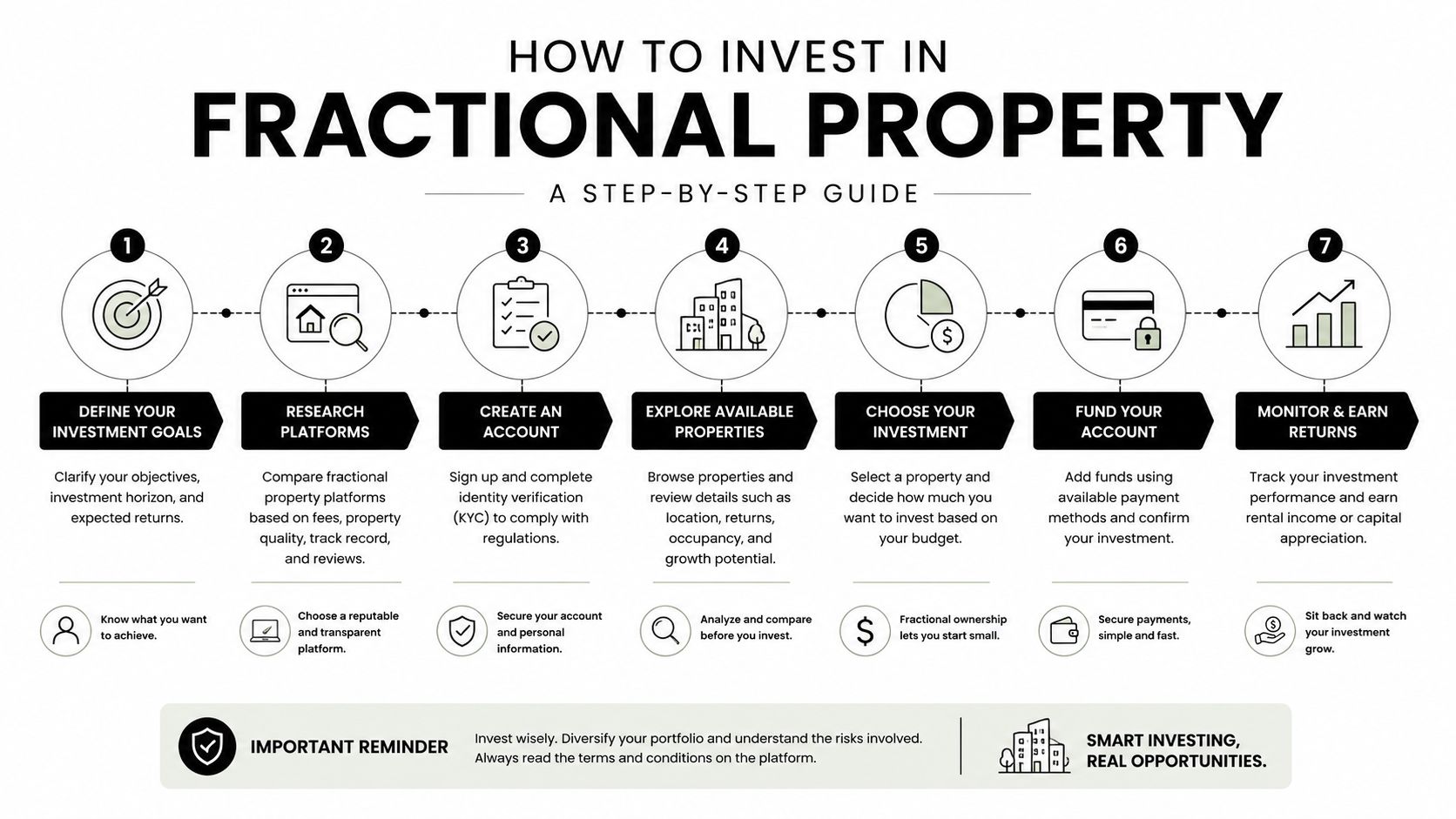
A disciplined process matters more here than in many conventional purchases. With direct ownership, you can often inspect title, survey the asset, model costs, and proceed. With fractional property ownership, you must underwrite the property and the wrapper around it.
A practical decision sequence
1. Define the objective
Be specific. Are you buying for passive income, personal use, diversification, or eventual direct-market entry. A lifestyle purchase should be evaluated differently from a yield-focused allocation.
2. Screen the market and platform
Look at jurisdiction, asset type, operating history, and who directly manages the property. Established markets tend to provide better documentation and service depth. Emerging markets may offer stronger value narratives but often come with more execution risk.
If financing is part of the plan, start there. Cross-border borrowing can be difficult even for ordinary purchases, and it becomes more specialised in shared-ownership structures. This overview of buying property abroad with a mortgage helps frame that question early.
3. Underwrite the economics
Model the investment on conservative assumptions. Don't rely on headline yield alone. Focus on net cash flow after management, repairs, legal fees, and any platform charges.
Due diligence checklist
This is the part many investors rush. It shouldn't be rushed.
- Review the legal documents: Check the shareholder agreement, co-ownership agreement, title position, voting rights, and dispute process.
- Test the exit mechanism: Ask who can buy your share, how pricing is set, whether the platform controls the marketplace, and what happens if no buyer appears.
- Verify management authority: Confirm exactly what the manager can spend, approve, or change without owner consent.
- Check valuation method: Understand how entry pricing was set and how resale value will be determined.
- Examine cost allocation: Identify every recurring fee and every exceptional cost trigger.
- Stress the use rules: If personal use is relevant, inspect booking priority, blackout periods, guest rules, and conflict resolution.
- Assess local operations: For short-stay or holiday-oriented assets, practical management standards matter. Even a US-focused resource like this advice for rental property owners is useful because it highlights the operational discipline needed when guest turnover and maintenance quality drive long-term value.
Ask one direct question before signing anything: “If I want to exit during a weak market, exactly how does the sale happen?” If the answer is vague, the risk is high.
Execution and monitoring
Once you invest, don't become passive in the wrong way. Read reporting packs, track occupancy or usage performance, monitor maintenance quality, and keep your own record of fees and distributions.
Fractional ownership can work well, but only for investors who keep treating it like a live asset, not a set-and-forget app balance.
Conclusion Your Next Steps in Fractional Investing
Fractional property ownership is a useful modern tool, but it isn't a shortcut around investment discipline. Its real advantage is access. You can reach better assets, spread capital more intelligently, and in some structures combine ownership with personal use. Its real cost is complexity. You give up control, depend more heavily on documents and operators, and may face a far less certain exit than direct ownership would offer.
That trade-off is manageable if you approach the sector with institutional habits. Read the legal structure before the marketing summary. Underwrite fees before projected returns. Assume liquidity is limited unless the resale process is clearly evidenced.
For investors building a research workflow, this BatchData's guide to analysis tools is a helpful starting point for comparing deals and organising due diligence across markets.
The right next step isn't to buy quickly. It's to narrow your target market, review the ownership structure, and take local legal and tax advice in the country where the asset sits and in the country where you pay tax.
World Property Investor helps global buyers compare markets, assess risks, and make better property decisions across the UK, Europe, the USA, and other international destinations. Explore World Property Investor for in-depth country guides, market analysis, tax breakdowns, and practical buying strategies designed for cross-border investors.