
Predictive modelling is a statistical technique that uses historical and current data to forecast future outcomes, such as property price movements or rental demand. In the UK, 72% of businesses were using these tools in 2026 and companies reported an average ROI of USD 12.5 million per organisation after implementation, which shows how far the method has moved from theory into day-to-day decision-making.
If you're comparing a flat in Manchester with an apartment in Warsaw or a holiday let in Dubai, you're already dealing with the core problem predictive modelling is built to solve. Property investors rarely fail because they can't read a listing. They fail because they misread what happens next.
That matters more in global markets. Established cities often offer deeper data, steadier financing conditions, and clearer comparables. Emerging markets can offer stronger upside, but they also punish weak assumptions. Predictive modelling helps investors test those assumptions before capital is committed.
Why Predictive Modeling Matters for Property Investors
A cross-border investor comparing a buy-to-let in Leeds, a short-stay unit in Lisbon, and a value-add apartment block in Kuala Lumpur faces the same problem every time. The listing shows the asset today. The return depends on what the market does next.
That gap between current facts and future performance is where predictive modelling matters. For property investors, its value is practical. It improves acquisition decisions, sharpens pricing discipline, and reduces the odds of tying up capital in the wrong market at the wrong point in the cycle.
Better decisions under uncertainty
Property decisions rarely fail because the headline numbers were missing. They fail because assumptions were weak. Rent growth gets overstated. Vacancy risk gets brushed aside. Exit demand looks strong until supply catches up.
Predictive modelling forces those assumptions into testable variables. Instead of relying on broad confidence in a city or asset class, investors can assess questions that affect yield and downside directly:
- Pricing risk: Does the purchase price still work if growth slows or financing costs stay high?
- Income durability: Is tenant demand broad-based, or does it depend on one employer, one visa trend, or one tourism cycle?
- Micro-location strength: Are two nearby postcodes pricing different levels of risk, liquidity, and rental depth?
- Exit resilience: Will future buyers see the same value drivers, or are current conditions flattering the asset?
That discipline matters in both mature and emerging markets. In London, Singapore, or Munich, the danger is often overpaying for stability. In Ho Chi Minh City, Tbilisi, or parts of the Gulf, the danger is confusing momentum with permanence. A sound investment process combines local knowledge with structured forecasting and broader real estate market analysis.
One rule I use is simple. If an investment case cannot be expressed in variables you can test, it is still a story, not an investment process.
Why this changes outcomes, not just analysis
Good predictive work does not promise certainty. It improves the quality of the bet.
For example, a model may show that a “cheap” apartment in an emerging district only performs if rent growth stays unusually high for three years. That is a fragile thesis. Another asset in a steadier submarket may look less exciting on paper but produce stronger cash flow with lower vacancy risk. Investors who can see that trade-off early usually protect yield and preserve optionality at exit.
This also helps with portfolio construction. Global investors are not choosing a single property in isolation. They are allocating capital across currencies, legal systems, tenant profiles, and demand drivers. Predictive modelling helps rank those opportunities on a like-for-like basis, which is far more useful than treating every market narrative as equal.
The method depends heavily on the quality of the inputs. Features such as transit access, local supply pipelines, tenant income mix, flood exposure, and planning activity often determine whether a model is useful or misleading. For a good technical explanation of how those inputs are prepared, see ThirstySprout on feature engineering.
The standard has already changed
Institutional investors, lenders, and major operators already use predictive methods as part of routine decision-making. Independent investors do not need a large data science team to benefit from the same approach. They do need to stop treating market selection, underwriting, and exit planning as separate judgement calls.
The practical advantage is clear. Investors who use predictive modelling can spot overstated assumptions earlier, compare markets more consistently, and commit capital with a clearer view of likely yield, risk, and timing. In global property investing, that is often the difference between owning an asset that merely looks promising and owning one that performs.
How Predictive Models Actually Work
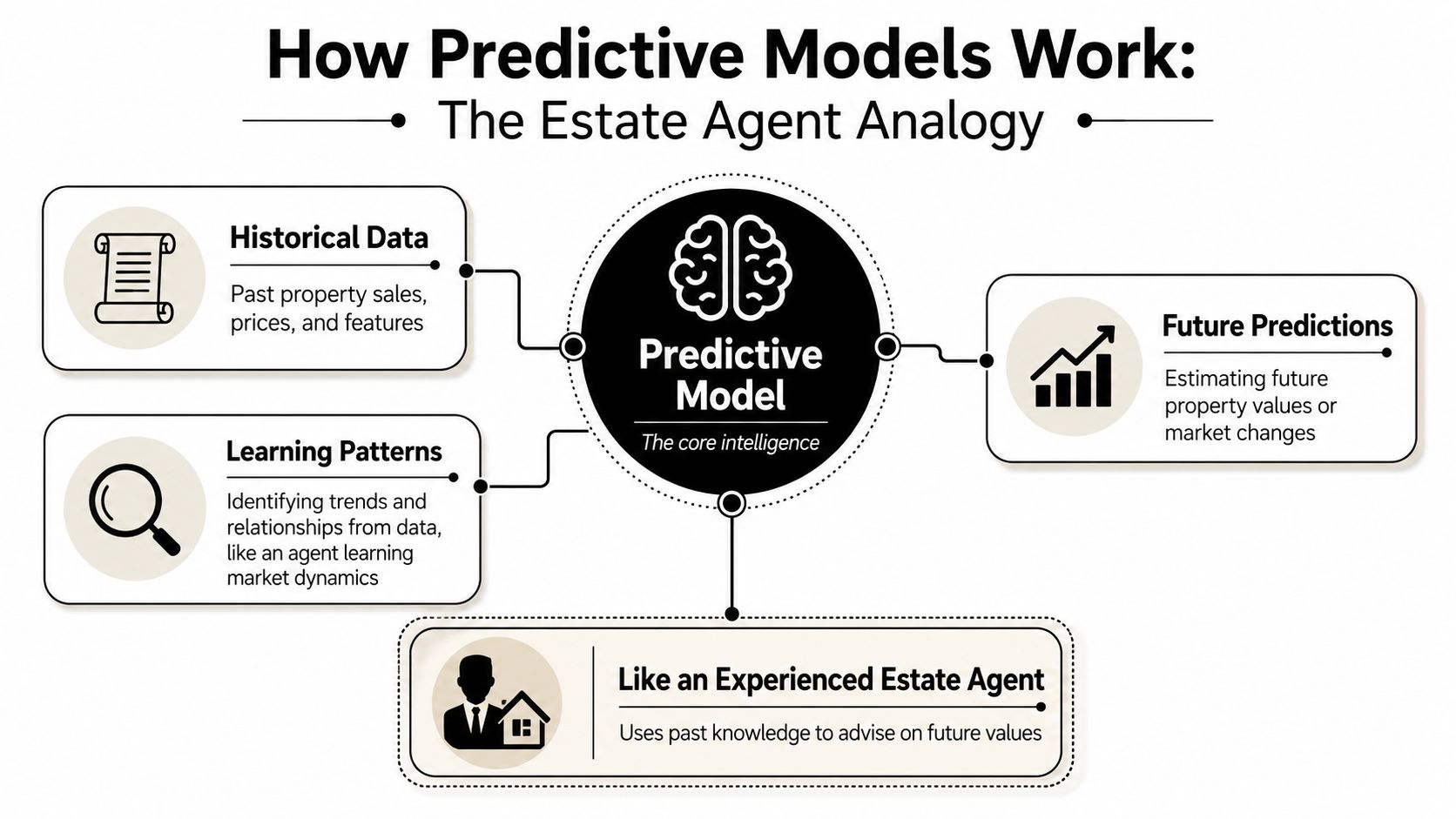
A predictive model isn't magic. It's closer to an experienced estate agent who has remembered every sale, every rent review, every failed listing, and every street-level change for years, then turned that memory into a structured process.
That agent doesn't guess randomly. They notice patterns. Certain building types let faster near transport hubs. Flood exposure changes buyer appetite. Energy efficiency matters more in one postcode than another. Predictive modelling does the same thing, but across far more data than any person can hold in their head.
The data
Everything starts with inputs. In property, that usually includes historical sale prices, achieved rents, vacancy history, property size, tenure, condition, planning context, transport links, and local economic indicators.
Good data is specific. Hyper-local data usually beats national averages because properties trade in local markets, not in abstract national ones.
A model built on broad averages often misses what investors care about. Two assets in the same city can perform very differently because of street-level factors, tenant profile, stock quality, or local supply pressure.
The algorithm
The algorithm is the method that learns from the data. Think of it as the recipe rather than the ingredients.
Some algorithms are simple and transparent. Others are better at spotting non-linear relationships that standard spreadsheet analysis misses. The right choice depends on the question. Estimating value, classifying default risk, and forecasting rents over time are related tasks, but they're not identical.
A lot of the practical edge comes from selecting and shaping the variables properly. If you want a useful non-technical primer on that stage, ThirstySprout on feature engineering is a solid resource because it explains how raw data becomes variables a model can learn from.
The best property models usually win before the algorithm starts. They win at the data and feature stage.
The forecast
The output is the part investors see. A projected sale value. A likely rental band. A probability that vacancy rises. A ranking of locations by expected resilience.
That forecast is never a guarantee. It's a probability-based estimate shaped by the quality of the underlying data and the relevance of the assumptions.
Here's the practical test. A useful property model should help you answer one investment question more clearly than before. If it produces elegant charts but doesn't improve underwriting, it isn't doing its job.
For investors who want to compare datasets, indicators, and screening methods before building their own approach, these market research tools are the kind of resources worth reviewing alongside public data from ONS, Gov.uk, Land Registry, and local housing authorities.
Key Predictive Modeling Techniques for Investors
Investors don't need to memorise every machine learning term. They do need to know which type of model fits which property question.
Three techniques matter most in practice. Regression estimates a number. Classification sorts an outcome into a category. Time-series forecasting projects how a market variable may move over time. Each solves a different problem in underwriting.
The three questions investors actually ask
When an investor asks, "What will this asset likely be worth?" that's a regression problem.
When they ask, "Is this tenant, borrower, or location high risk or low risk?" that's a classification problem.
When they ask, "How might rents, occupancy, or values move over coming periods?" that's a time-series problem.
That distinction matters because investors often use the wrong tool. They ask a trend question but use a static valuation model. Or they ask a risk question but rely on average market commentary.
| Predictive Modeling Techniques in Property Investment | What It Predicts | Property Investment Example |
|---|---|---|
| Regression | A numeric outcome | Estimating the future sale price of a London flat based on size, tenure, EPC rating, local deprivation measures, and nearby transport access |
| Classification | A category or risk band | Assessing whether a holiday let in Dubai is likely to fall into a higher or lower vacancy-risk group |
| Time-series forecasting | Change over time | Projecting rental demand trends for an emerging Lisbon neighbourhood across future periods based on past and current market behaviour |
Where each technique works best
Regression for value and yield estimation
Regression is the workhorse for pricing and income analysis. It helps investors estimate values, rents, and sometimes gross yield ranges.
It works well in established markets with strong comparables, but it can also be useful in emerging markets if the model includes the right local inputs. The weakness is obvious. If the underlying data is stale, thin, or biased toward premium stock, the outputs can still look precise while being directionally wrong.
Classification for risk screening
Classification is especially useful when an investor needs triage. Not every deal deserves equal attention. A classification model can help sort properties, areas, or tenant profiles into broad risk groups so analysts can focus where risk is highest.
The logic has already been used in the public sector. The UK government's Supporting Families Programme uses predictive analytics to assess large quantities of information to identify trends and risk factors, demonstrating how machine learning algorithms can learn connections between multiple indicators autonomously, as discussed in this research on predictive analytics in UK public-sector applications. In property, the same idea translates well to risk analysis around arrears, churn, or local stress signals.
Time-series forecasting for market timing
Time-series methods matter when the investor's real question is timing rather than valuation. If you're deciding whether to enter an established market now or wait, or whether an emerging district is gathering momentum, this is often the more relevant approach.
For rental strategy, demand forecasting tools can also be useful to understand what a mature software workflow looks like in practice. PadPulse demand forecasting gives a practical overview of how demand-focused systems are structured.
Use regression to price. Use classification to screen. Use time-series methods to track movement.
If yield is the first filter in your process, it's worth grounding model outputs in the basics of how to calculate rental yields before you let any forecast influence a purchase decision.
The Investor's Predictive Modeling Workflow
Strong predictive work starts long before a model is trained. Most failures happen because the investor asks a vague question, uses weak data, or trusts outputs they haven't challenged.
The workflow below is practical because it mirrors how disciplined investors already think. The difference is that each step is formalised.
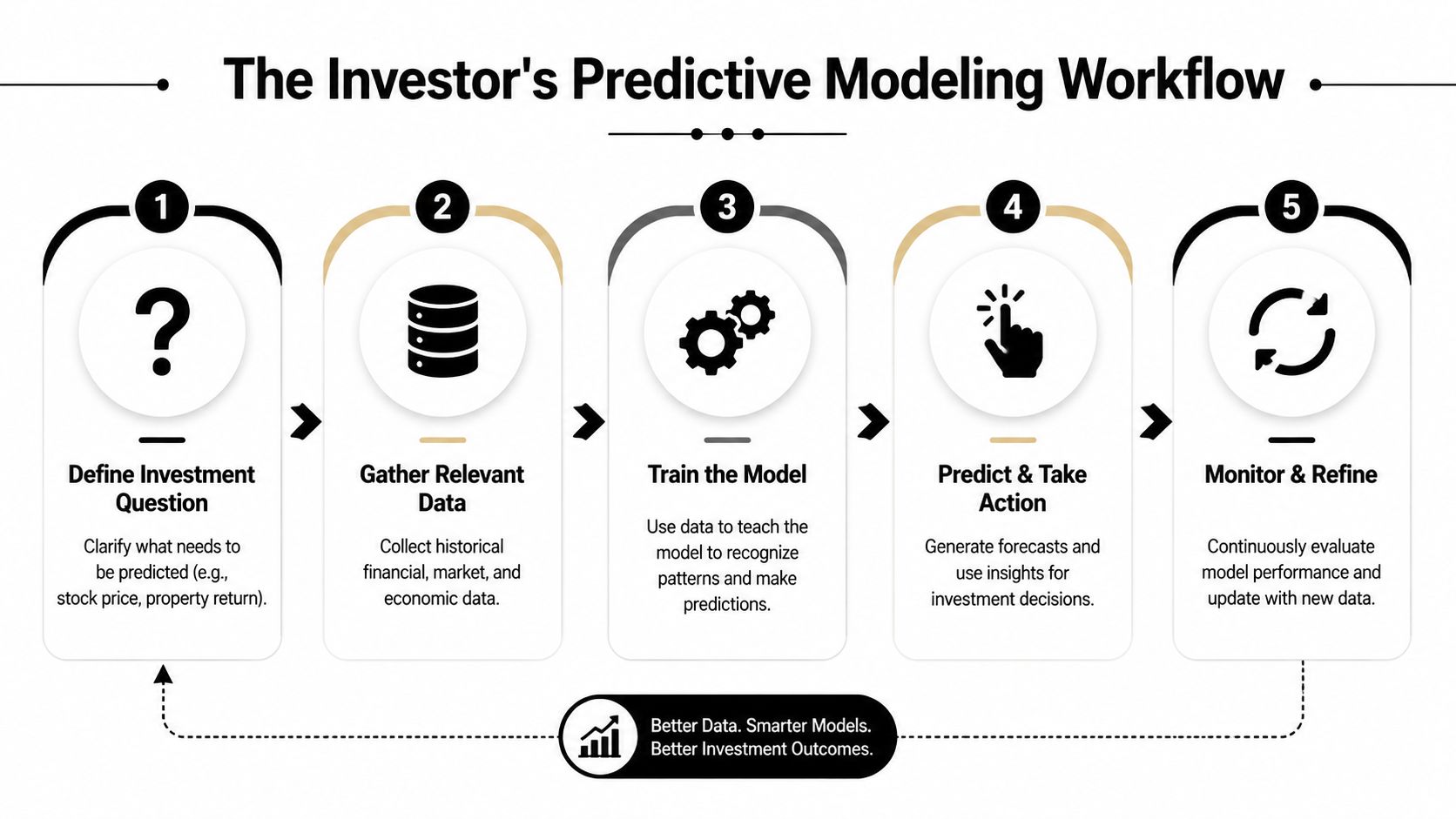
Start with one investment question
Don't begin with software. Begin with the decision.
Are you trying to estimate exit value, forecast rents, identify neighbourhoods with improving fundamentals, or compare risk across markets? A clear question determines the data you need and the model you should use.
A vague objective produces vague outputs. "Find the best market" is not a modelling question. "Which submarkets show the strongest probability of rental resilience under weaker economic conditions?" is closer.
Gather data that matches the property reality
Experienced investors gain an edge by not relying solely on headline national data. They pull from Land Registry, ONS, Gov.uk, local planning portals, local housing authorities, energy performance data, transport information, and market-specific leasing evidence.
Established markets usually provide richer historical records. Emerging markets often require more manual collection and more scepticism about comparability.
Use a mix of:
- Transaction data: Sold prices, achieved rents, listing history.
- Property attributes: Size, tenure, EPC ratings, condition, use class.
- Location signals: Transport, flood exposure, deprivation context, planned supply.
- Economic indicators: Employment drivers, company formation, business activity.
Choose a model that fits local volatility
In volatile UK commercial real estate markets, XGBoost machine learning models consistently outperform standard linear regression by integrating forward-looking data like regional Gross Value Added and new business registrations from Companies House, rather than relying solely on backward-looking national GDP figures, according to analysis of predictive modelling in UK commercial real estate.
That lesson travels well beyond the UK. In established markets, backward-looking averages can hide turning points. In emerging markets, they can miss acceleration entirely. Forward-looking and hyper-local indicators usually matter more than broad national summaries.
On-the-ground test: If the model treats every district in a country as if they respond the same way to growth, financing, and supply, it isn't investor-grade.
Interpret the output like an investor, not a technician
A forecast should feed a decision. It should never replace judgement.
The useful questions are practical. Which assumptions drive the result? What happens if rents soften? Which variables carry the most weight? Does the forecast align with what local brokers, valuers, and planning data suggest?
Tools can help translate forecasts into underwriting decisions. A rental yield calculator is a simple example of how investors can pressure-test whether a predicted rent level still produces an acceptable return once costs and risk are considered.
Monitor and refine
Markets change. New transport links open. Regulations tighten. Supply arrives. Interest-rate conditions shift. A model that isn't updated becomes an archive, not a decision tool.
The best workflow is iterative. Investors ask a precise question, build the model, compare output with reality, refine the variables, and improve over time.
Predictive Modeling in Action Real World Scenarios
Theory becomes useful when it changes a live investment decision. In property, predictive modelling is most valuable when it helps an investor compare likely return against likely risk in a specific market, not in the abstract.

Scenario one in an established market
Take a flat in London. The investor isn't just asking whether London is a strong city. That's too broad. The key question is whether this specific unit, in this specific micro-location, is priced below, at, or above its probable future performance.
A useful model would combine transaction history, building characteristics, local transport access, energy efficiency, tenure, nearby supply, and neighbourhood context. In the UK property market, Automated Valuation Models using machine learning achieve property price predictions with 94% accuracy by incorporating property attributes like EPC ratings and tenure, alongside location features such as LSOA-level deprivation indices and flood risk zones, according to this review of AI property valuation in the UK.
That doesn't mean every London purchase is easy to price. It means good models are already proving that details many investors used to treat as secondary now materially influence accuracy.
Scenario two in an emerging neighbourhood
Now shift to Lisbon. The investor is looking at an area that still feels early. Comparables are thinner. The market story is attractive. New cafes, stronger remote-worker demand, improving public realm, and changing tenant mix all look positive.
Predictive modelling helps control optimism. Instead of assuming the neighbourhood will "catch up", the investor can test leasing velocity, asking rents, local inventory, transport accessibility, and signs of business activity against more established nearby districts.
A useful model in this setting won't be perfect. Emerging markets rarely offer the same data depth as mature ones. But they can still support a disciplined decision by ranking likely outcomes, highlighting which assumptions matter most, and identifying where the margin for error is thin.
For investors exploring where sector-specific AI is going beyond generic dashboards, this overview of Industry-specific AI solutions is useful background reading because property technology increasingly benefits from models designed around industry data rather than generic business analytics.
Scenario three for occupancy and vacancy risk
Holiday lets and short-stay assets create a different problem. Value matters, but occupancy often matters more.
A landlord considering a short-term rental in Dubai needs to understand how seasonality, local competition, property type, transport access, and guest demand patterns interact. A predictive model can classify periods or units into higher and lower vacancy-risk profiles, helping the investor decide whether the expected income justifies the operating complexity.
Here's a practical walk-through of how investors think about prediction in markets like these:
What works and what doesn't
What works is specificity. Models become useful when they focus on one asset type, one location level, and one decision.
What doesn't work is trying to force a single universal model across every market. London, Lisbon, Warsaw, and Dubai don't behave the same way. Data quality differs. Tenant profiles differ. Regulation differs. Supply cycles differ.
A model should travel in method, not in assumption.
That is the practical answer to what is predictive modeling for investors. It isn't a generic AI layer sitting on top of property data. It's a way to turn market evidence into a better buy, hold, price, or exit decision.
Getting Started and Avoiding Common Pitfalls
Most investors don't need to build a complex machine learning stack on day one. They need a repeatable way to ask better questions and organise better evidence.
Start with one market and one use case. Pick a city you already understand. Then choose one decision to improve, such as purchase pricing, rent estimation, or vacancy risk. Pull a small dataset from Land Registry, ONS, Gov.uk releases, local housing authority material, planning portals, and your own comparable evidence.
A practical starting checklist
- Define one outcome: Choose a single target such as future sale value, likely rent, or occupancy risk.
- Use local evidence: Match national indicators with borough, district, or neighbourhood data wherever possible.
- Keep the model explainable: If you can't explain why the output changed, you won't trust it when money is on the line.
- Compare with reality: Pressure-test model outputs against broker feedback, site visits, and recent transactions.
- Track decisions, not just forecasts: The goal is better investment judgement, not elegant spreadsheets.
Common mistakes investors make
Poor predictive work usually fails for familiar reasons.
- Bad inputs: If your sales comparables are inconsistent or your rental evidence is stale, the model will formalise the error.
- Overfitting the past: A model can look brilliant on historical data and still fail in a changing market.
- Ignoring local nuance: Numbers won't tell you everything about planning friction, building quality, or tenant perception.
- Using one model for every market: Established and emerging markets need different assumptions and often different levels of caution.
- Confusing correlation with causation: Some variables move together without one driving the other.
Don't outsource judgement to the model. Use the model to sharpen judgement.
If you're building an investment process from the ground up, these tips for investment property are a useful complement to predictive analysis because they keep underwriting anchored in fundamentals rather than software outputs.
The investors who benefit most from predictive modelling aren't always the most technical. They're the most disciplined. They know what they want to predict, they respect data quality, and they never confuse a forecast with a guarantee.
World markets are easier to compare when you have clear, data-led research behind every decision. World Property Investor publishes practical guides, market analysis, yield breakdowns, and international buying insights to help you assess locations, compare risk, and invest with more confidence.