
You're in London comparing two very different Australian purchases. A Sydney apartment appears on your screen at AUD 1.1 million, while a Brisbane townhouse is listed at AUD 780,000. The cheaper property may not be cheaper after tax, finance and foreign-ownership rules, and the Sydney purchase may not even be legally available to you.
That's the reality of buying a home in Australia in 2026. The right decision depends first on who you are, then on what you're allowed to buy, how you'll finance it and which state taxes apply. Australian residents and overseas buyers follow different tracks, and treating them as one audience leads to expensive mistakes.
Table of Contents
- The Two Tracks for Buying a Home in Australia
- Choosing Where to Buy and What to Buy
- FIRB Approval and Foreign Ownership Rules
- Stamp Duty, Surcharges and State Taxes
- Conveyancing and Settlement Step by Step
- Mortgages, Deposits and First Home Buyer Support
- Your 90-Day Plan and Common Questions
The Two Tracks for Buying a Home in Australia
Priya and James are a UK couple weighing up a move to Australia. James has Australian permanent residency, while Priya remains a UK-based non-resident. They're looking at a Sydney apartment priced at AUD 1.1 million and a Brisbane townhouse priced at AUD 780,000.
At first glance, the choice looks like a location and lifestyle question. In practice, their residency status could determine whether the property is eligible, whether a foreign purchaser surcharge applies, whether government assistance is available and which lender will consider the application.
This guide separates two buyer tracks:
- Australian-resident buyers: Australian citizens, permanent residents, New Zealand citizens and some temporary residents on long-stay visas.
- Foreign buyers: British expats living abroad, non-resident investors and other people who don't hold a status that provides the same access to Australian housing rules.
The distinction matters because residency affects stamp duty surcharges, FIRB approval, access to the First Home Guarantee, eligibility for Help to Buy, permitted dwelling types and mortgage availability. A permanent resident may be able to pursue an established home using mainstream domestic finance. A temporary resident or overseas investor may face restrictions on established dwellings and need approval before proceeding.
Australia has maintained home ownership at around 68% since 1976, and the ABS has published first-home-buyer loan data since 1991, reflecting how central ownership is to Australian household wealth-building and housing policy. In 2019–20, Australia recorded about 1,115,000 recent home buyers, with 38% first home buyers, or roughly 420,100 households entering ownership for the first time. The Australian Bureau of Statistics provides the first-home-buyer context and lending data.
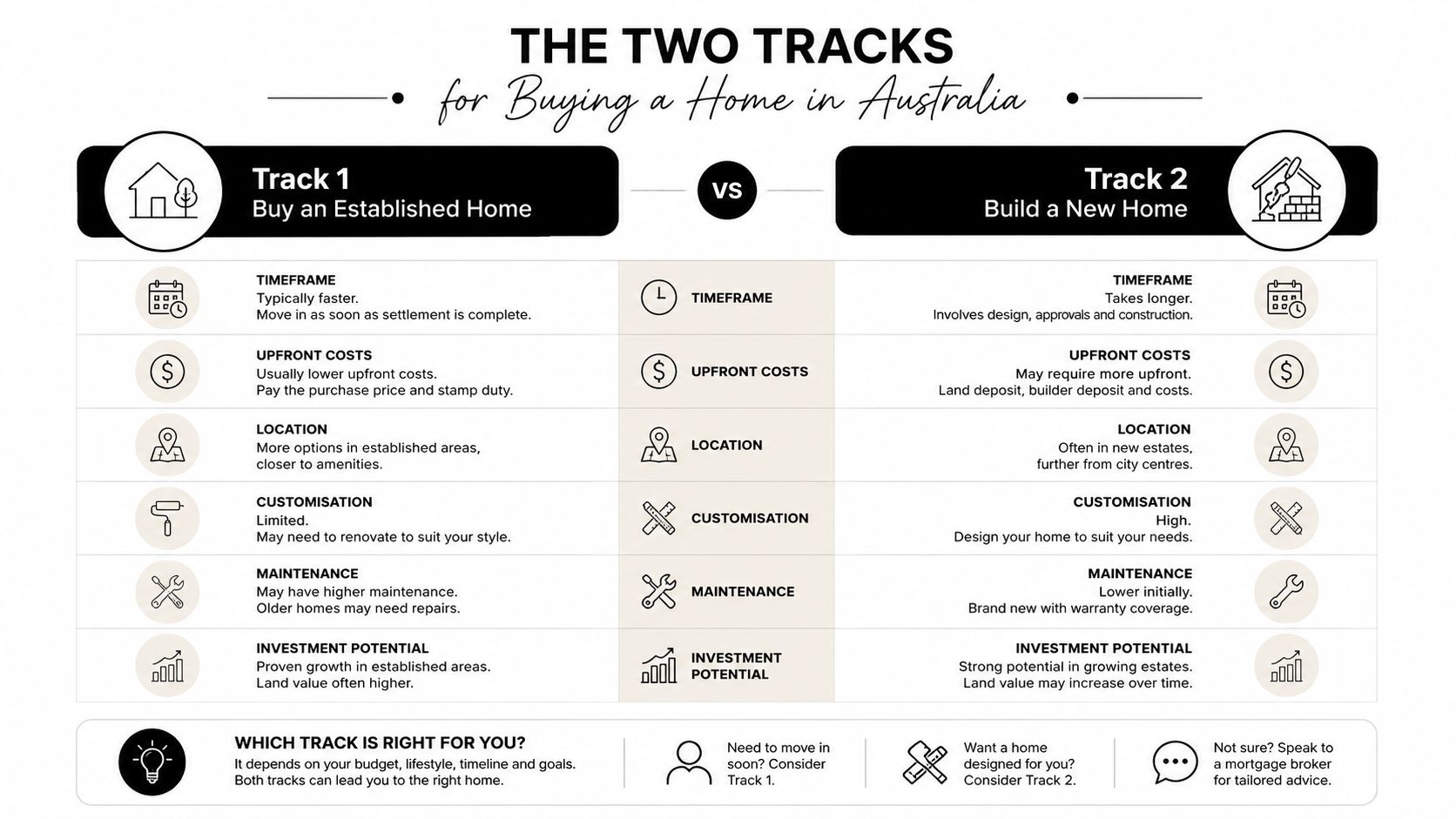
Priya and James shouldn't make an offer until they've identified which track applies to each buyer. If the purchase is in joint names, one buyer's eligibility doesn't automatically remove the other buyer's obligations. Get the ownership structure, approval pathway and borrowing plan checked together before comparing listings.
Choosing Where to Buy and What to Buy
Start with the state, not the suburb. State governments control transfer duty, foreign-buyer surcharges, land tax and many first-home concessions. They also create different trade-offs around employment, climate, infrastructure and housing supply.
Queensland is particularly relevant for first-home buyers because the government has announced the abolition of stamp duty for eligible first home buyers purchasing houses up to AUD 800,000 from mid-2026. Treat that as a policy condition to verify at the time of purchase, not as a reason to rush into a contract. Western Australia and South Australia can offer a more accessible entry point than Sydney, while Sydney and Melbourne deserve closer tax scrutiny for overseas buyers.
Choose the market in four decisions
State first. Compare the tax regime and the type of property you're permitted to buy. A lower purchase price can lose its advantage if the state imposes a substantial foreign purchaser surcharge.
Then choose the city or regional hub. Sydney and Melbourne provide deep employment and established services, but their entry costs are demanding. Brisbane, Perth, Adelaide and Hobart offer different combinations of affordability, lifestyle and local demand. A regional centre can work well if you understand its employment base rather than relying on a holiday-home narrative.
Select the dwelling. Houses usually provide more land exposure. Townhouses sit between houses and apartments for maintenance and ownership structure. Apartments can improve access to central locations, but owners must examine strata levies, building defects, sinking-fund needs and future special levies. Off-the-plan property adds construction and settlement risk, with projects sometimes taking two to four years to settle.
Finally, decide between an emerging suburb and a proven pocket. An emerging area may offer newer stock and infrastructure upside. A blue-chip suburb usually gives stronger established amenity and resale recognition, but buyers pay for that certainty.
Use World Property Investor's market research tools to compare locations, ownership rules and investment fundamentals before you narrow the search.
Indicative budget ladder
The table below is a practical comparison framework. It uses no invented price figures because median prices vary by source, dwelling definition and release date. Check current city-level data before treating any market as affordable.
| City | Median house (AUD) | Median unit (AUD) | Annual growth (last 12m) |
|---|---|---|---|
| Sydney | Verify current median | Verify current median | Verify current measure |
| Melbourne | Verify current median | Verify current median | Verify current measure |
| Brisbane | Verify current median | Verify current median | Verify current measure |
| Perth | Verify current median | Verify current median | Verify current measure |
| Adelaide | Verify current median | Verify current median | Verify current measure |
| Hobart | Verify current median | Verify current median | Verify current measure |
Don't select a city from a headline ranking. Select a property that remains viable after duty, insurance, body-corporate costs, finance, vacancy and resale restrictions.
FIRB Approval and Foreign Ownership Rules
For an overseas buyer, FIRB approval belongs at the pre-offer stage. Do not treat it as paperwork to complete after signing. A rejected application, ineligible dwelling or missed condition can create a contract problem and leave you paying professional costs without securing the home.
Australian citizens and permanent residents are generally exempt from FIRB approval. Non-residents and temporary residents must assess the rules before choosing a property, especially if it is an established dwelling. The Australian Taxation Office summarises foreign-investment compliance considerations, reinforcing that foreign ownership is monitored and subject to defined conditions.
Since 1 April 2025, established dwellings have generally been prohibited for foreign buyers, with the restriction set to expire on 30 June 2029, subject to limited exceptions. The rule generally applies to foreign persons, including temporary residents and foreign-owned companies. Read the ATO's explanation of the established-dwelling restriction.
Run this checklist before making an offer
- Classify every buyer. Citizenship, permanent residency, temporary residency and overseas residence can lead to different outcomes.
- Screen the dwelling. New homes, off-the-plan property and some redevelopment opportunities may be treated differently from established dwellings.
- Apply before exchange. Build approval time into the purchase plan, and confirm whether the application fee is refundable.
- Check the contract wording. Your solicitor should confirm that the contract protects you if approval is refused or delayed.
- Confirm the exit obligation. Temporary residents may need to sell when their residency ends, depending on the approval and applicable rules.
Application fees can start at AUD 14,100 for property valued over AUD 2 million, with higher tiers for more expensive purchases. A 30-day decision window is commonly used when buyers want FIRB certainty before auction. It does not remove every contractual risk, so do not exchange contracts until your solicitor has reviewed the position.
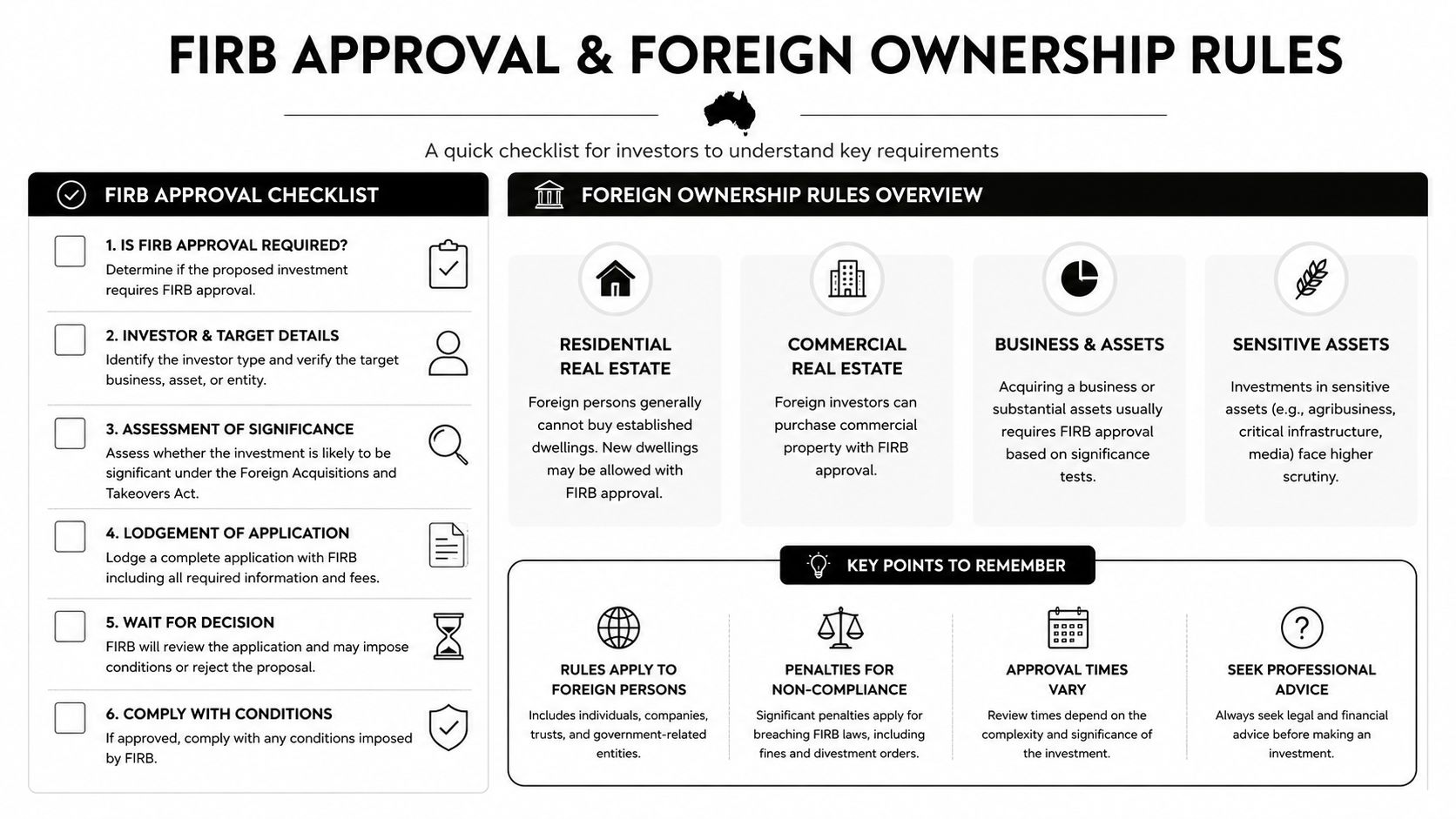
FIRB fees and state surcharges can materially change the acquisition budget. World Property Investor's guide to Australian foreign ownership rules provides a useful starting reference, but an Australian property solicitor must confirm the rules for your buyer status and dwelling type.
Auction buyers face the greatest timing pressure. Do not bid until the approval pathway, finance and contract position have been reviewed.
Stamp Duty, Surcharges and State Taxes
The purchase price is only the first line of the budget. Australian buyers may pay standard transfer duty, while foreign buyers can also face a state foreign purchaser surcharge and, in some cases, an absentee-owner land-tax surcharge.
New South Wales provides the clearest warning. The foreign buyer surcharge duty is 9%, and the annual land-tax surcharge for foreign owners is 4%. On a AUD 1.5 million apartment, one market guide calculates the foreign surcharge alone at about AUD 135,000, before ordinary transfer duty. The New South Wales foreign-buyer guide explains how these costs affect an overseas purchase.
Victoria and Queensland remain at 8% for many foreign residential purchases, while New South Wales lifted its rate to 9% from 1 January 2025. The Northern Territory is the main jurisdiction without a comparable foreign-buyer surcharge. This Australian foreign-property tax guide outlines the state-rate differences.
Why a simple comparison can mislead
Duty usually follows brackets or a sliding scale. The amount can change depending on whether the purchase is:
- an established dwelling;
- a new or off-the-plan home;
- vacant land;
- a principal place of residence;
- a first-home purchase qualifying for a concession;
- a purchase by a foreign person.
A AUD 1.2 million apartment therefore cannot be represented with one universal duty figure. The buyer type, state, contract structure and concession eligibility all matter.
| Cost item | NSW local | NSW foreign | VIC local | VIC foreign | QLD local | QLD foreign |
|---|---|---|---|---|---|---|
| Standard transfer duty | State calculator | State calculator | State calculator | State calculator | State calculator | State calculator |
| Foreign purchaser surcharge | Not generally applicable | 9% surcharge | Not generally applicable | 8% for many purchases | Not generally applicable | 8% for many purchases |
| Absentee-owner surcharge | Check individual status | May apply | Check individual status | May apply | Check individual status | May apply |
| First-home concession | Eligibility dependent | Often restricted | Eligibility dependent | Often restricted | Eligibility dependent | Often restricted |
| Total transfer cost | Case-specific | Can be materially higher | Case-specific | Can be materially higher | Case-specific | Can be materially higher |
For foreign buyers, total transfer costs can reach 8% to 12% of the purchase price, depending on the state and circumstances. Don't use that as a substitute for a calculation. Use the relevant state revenue office calculator before offering, then have the conveyancer confirm the result. A practical explanation of stamp duty on property can help you identify the questions to ask.
Land tax is an ongoing holding cost, not a settlement-day detail. Model it alongside insurance, strata charges and finance, especially if the property won't be your principal residence.
Conveyancing and Settlement Step by Step
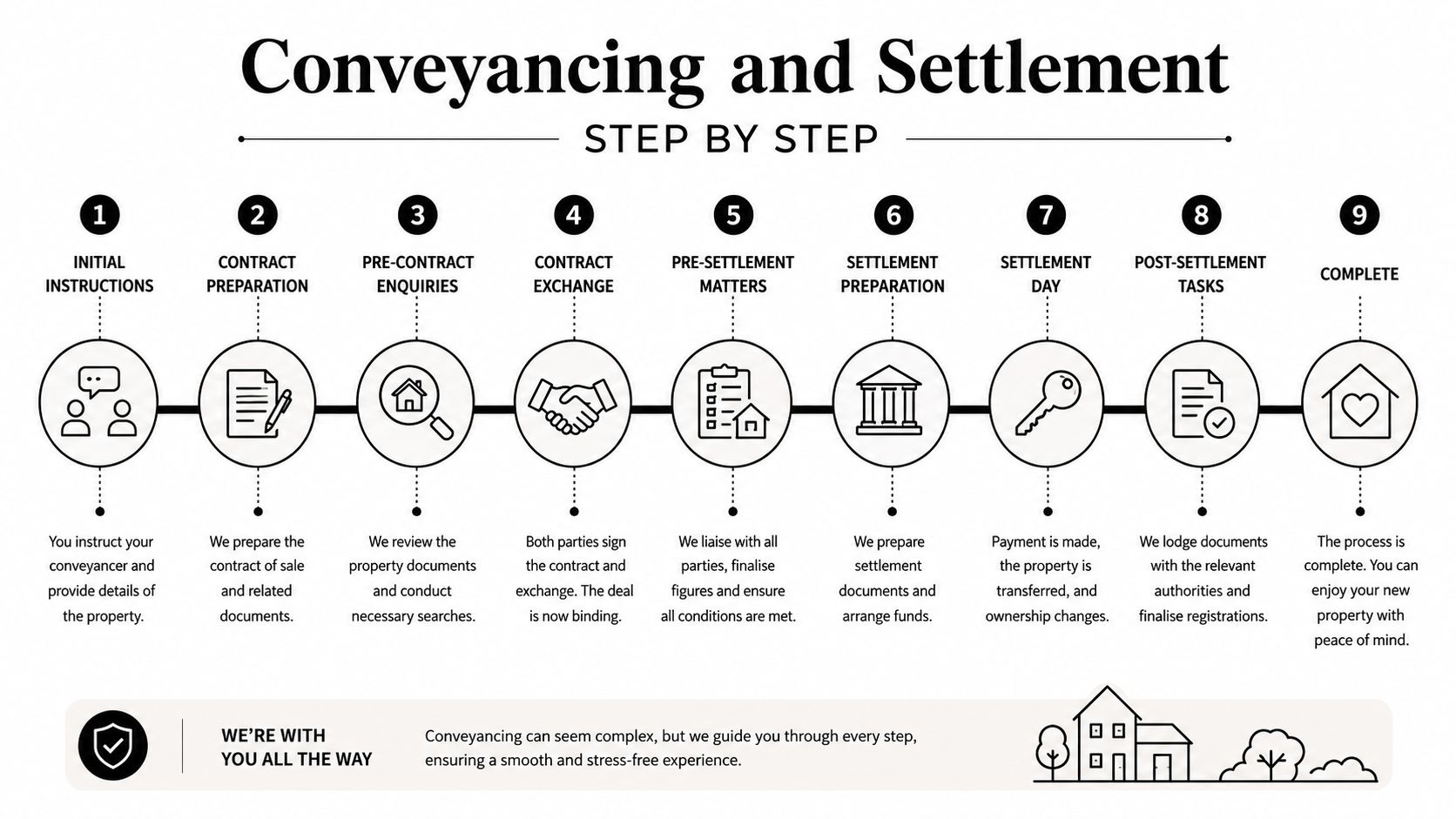
Australian conveyancing starts with the contract, but the buyer's protection often depends on what happens before signing. A conveyancer handles the legal and settlement administration for a straightforward transaction. A solicitor is the safer choice where FIRB conditions, trusts, complex title issues, development, family arrangements or unusual contract terms are involved.
Before exchange
Read the contract before making an offer. Arrange a building and pest inspection where the property type and location make that appropriate, and have the conveyancer check title, easements, covenants, zoning, inclusions and outstanding notices.
A finance approval that depends on the sale of another property needs special attention. So does a lender valuation. The bank may value the property below the agreed price, leaving you to fund the difference or renegotiate.
Cooling-off periods vary by state. They're typically five business days in New South Wales, two in Victoria and none in Queensland, although exemptions and contract circumstances apply. Auction purchases often have fewer protections, which is why legal review belongs before bidding.
From exchange to settlement
After exchange, the buyer pays the deposit and the conveyancer manages searches, lender requirements, transfer documents and settlement adjustments. Rates, water charges and other outgoings are apportioned so each party pays for the period they own the property.
Settlement commonly takes 42 to 90 days, depending on the contract and transaction. During that period, keep your finances stable. Don't take new credit, change employment without telling the lender or move money without preserving a clear source-of-funds trail.
Run this checklist during the final seven days:
- Finance: Confirm the lender has everything required for drawdown.
- Title: Ensure searches and transfer documents are complete.
- Inspection: Check the property shortly before settlement and confirm agreed inclusions remain.
- Adjustments: Review rates, water, rent and strata calculations.
- Funds: Confirm the exact balance, bank transfer limits and cleared funds.
- Keys: Establish where and when the agent will release them.
On settlement day, the lender releases funds, the electronic PEXA system or paper process transfers title, and the buyer receives possession and keys. Common derailers include failed finance, late defects, title encumbrances and a bank valuation below the contract price.
Use a specialist if the matter is cross-border. World Property Investor's guide to property conveyancing costs helps buyers understand which legal and settlement questions belong in the initial quote.
Mortgages, Deposits and First Home Buyer Support
A buyer who finds the right property before arranging finance can lose it through a slow approval, an inadequate deposit or a lender's valuation. Set the borrowing strategy first. Australian residents generally have wider lender choice, while overseas buyers often need a specialist lender, a larger deposit and clearer evidence of income, assets and Australian connections.
The main routes are:
| Route | Min deposit | Max LVR | Eligibility | Key restriction |
|---|---|---|---|---|
| Standard domestic mortgage | 10% to 20% | 80% to 90% | Australian residents meeting lender criteria | Lenders Mortgage Insurance may apply above 80% LVR |
| Non-resident loan | Commonly higher than domestic borrowing | 70% to 80% | Selected foreign buyers and expats | Higher rates, stricter income and currency checks |
| Home Guarantee Scheme | 5%, or 2% for eligible single parents | Depends on lender and scheme rules | Eligible Australian first-home buyers and other qualifying groups | Owner-occupier rules, price caps and scheme eligibility |
| Help to Buy | Minimum set by scheme rules | Depends on scheme structure | Eligible participants buying a principal residence | Government equity contribution, no investment use |
An 80% LVR often avoids Lenders Mortgage Insurance. Borrowing above that level can add a premium unless a guarantee scheme changes the requirement. Investor loans also commonly carry different pricing from owner-occupier loans. Compare like with like, and have the lender assess the correct occupancy purpose from the start.
The Home Guarantee Scheme offered 50,000 places in 2023–24, including 35,000 First Home Guarantee places, 10,000 Regional First Home Buyer Guarantee places and 5,000 Family Home Guarantee places. Housing Australia reported that around one in three first home buyers nationwide were supported in that year, compared with about one in ten in the scheme's first year in 2020. Housing and occupancy data from the ABS provide the lending context.
Help to Buy changes the deposit calculation more substantially. Treasury says the shared-equity scheme can contribute up to 40% of a new home or 30% of an existing home, with 40,000 places over four years and 10,000 per year from 2025–26. The buyer must occupy the property as their principal place of residence, and investment use is prohibited. Treasury's Help to Buy documentation sets out the scheme parameters.
State assistance can alter the affordability calculation as much as the deposit. Guidance identifies a AUD 10,000 Victorian grant for qualifying new homes under AUD 750,000, a AUD 30,000 Queensland grant for qualifying builds under AUD 750,000, and New South Wales first-home duty relief up to AUD 800,000, all subject to detailed conditions. UK-style buyers should check status carefully. Temporary residents and foreign buyers cannot assume they qualify, and FIRB permission is separate from state first-home assistance.
By the December quarter of 2025, new first-home-buyer owner-occupied loans reached 31,783, up 6.8% quarter on quarter and 9.1% year on year, with loan value reaching AUD 19.3 billion. Arrange pre-approval before inspecting seriously, then use a mortgage approval timeline to organise income records, identity documents, deposit evidence and currency transfers early.
Your 90-Day Plan and Common Questions
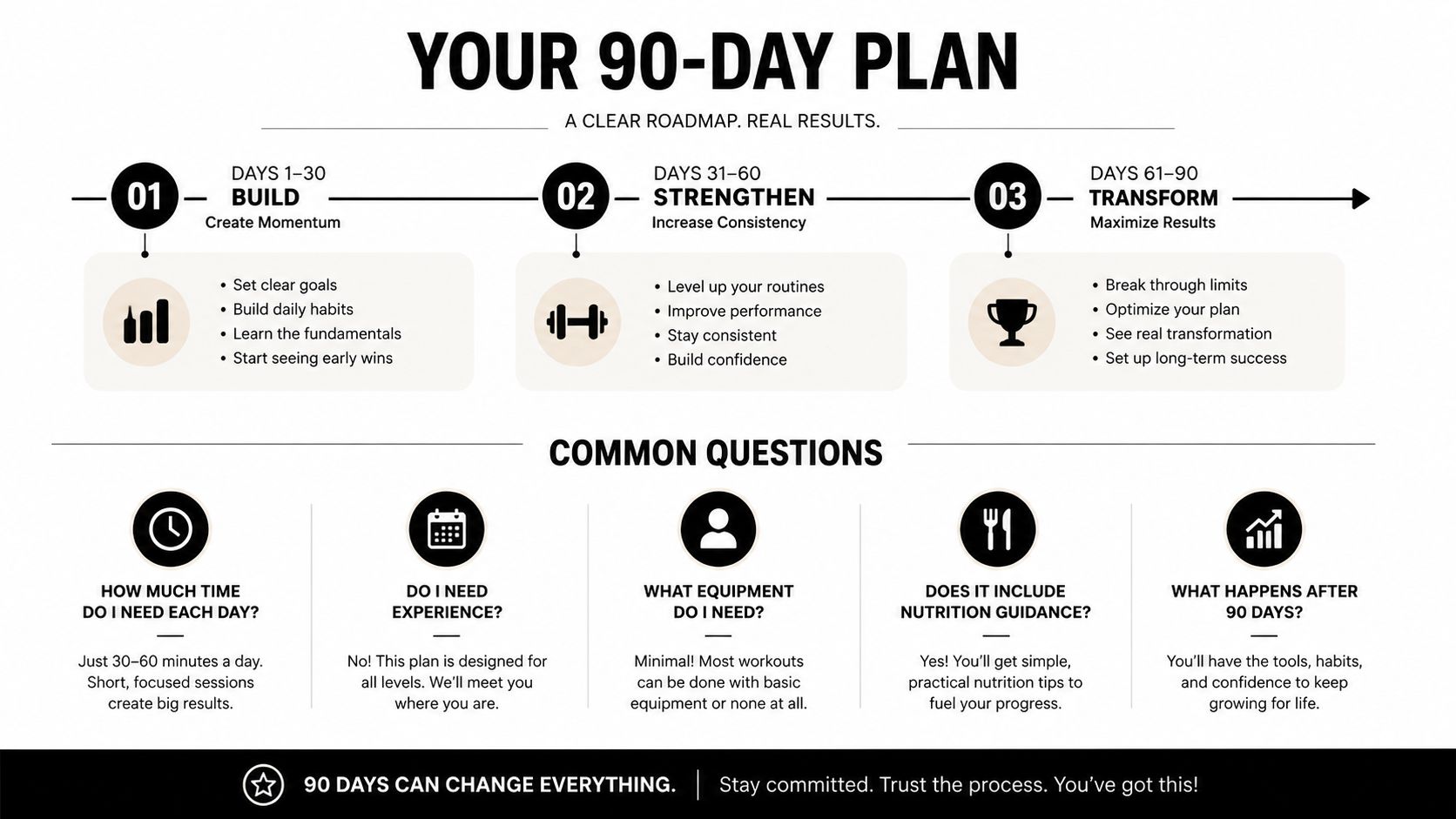
A good purchase becomes much easier when every dependency has an owner and a deadline. Keep the plan on one page and don't make an offer until the legal, finance and tax checks line up.
Days 1 to 30
- Research: Compare states, city markets, dwelling types and foreign-buyer restrictions.
- Confirm status: Establish citizenship, permanent residency, temporary residency or non-resident status for every buyer.
- Pre-check FIRB: Identify whether approval is required and whether the target dwelling is eligible.
- Arrange finance: Obtain domestic or non-resident mortgage guidance, not a generic online estimate.
- Shortlist markets: Keep two viable locations rather than one preferred suburb.
Days 31 to 60
- Inspect properties: Review building condition, strata records and local resale evidence.
- Instruct a conveyancer or solicitor: Get the contract reviewed before signing or bidding.
- Prove the deposit: Document savings, transfers, gifts, sale proceeds and currency conversions.
- Check assistance: Apply for relevant grants, duty concessions, the Home Guarantee Scheme or Help to Buy where eligible.
- Model holding costs: Include land tax, insurance, strata, utilities, management and finance.
Days 61 to 90
- Make the offer: Confirm the contract conditions and approval pathway first.
- Exchange carefully: Pay the deposit only after the legal team confirms the contract position.
- Use cooling-off correctly: Know the state rule and any exemption before relying on it.
- Complete finance: Keep the lender updated and avoid financial changes that could affect approval.
- Inspect before settlement: Check the property, inclusions and agreed repairs.
- Settle: Confirm cleared funds, title transfer and key collection.
A signed contract to keys can take 42 to 90 days under the settlement periods discussed earlier. The final operational window can feel like 10 to 14 working days once the parties have completed the key legal and finance tasks, but FIRB or Help to Buy involvement can extend the process.
Questions overseas buyers ask
Can a non-resident live in the home full-time?
Ownership permission and immigration permission are separate. Buying property doesn't itself grant a right to live in Australia. Check visa conditions before treating a purchase as a permanent-home solution.
How is rental income taxed?
Australian rental income is generally assessed under Australian tax rules, while your country of tax residence may also require reporting. Get advice that covers both jurisdictions before collecting rent.
Can superannuation fund the deposit?
Don't assume ordinary superannuation can be used freely for a home deposit. The First Home Super Saver rules apply to eligible voluntary contributions and release conditions, so obtain an ATO-based assessment before relying on those funds.
What happens if exchange rates move before settlement?
Your Australian dollar obligation doesn't fall because sterling weakens. Keep a currency buffer, confirm transfer timing and avoid leaving the deposit or settlement balance to the final moment.
Can an Australian property sit inside a family trust or SMSF?
Possibly, but the structure changes borrowing, tax, compliance and permitted-use questions. An SMSF isn't a shortcut to buying a holiday home for personal use, and a family trust needs advice before the contract names the trustee.
World Property Investor offers market research tools, Australian foreign-ownership guidance and practical property analysis for buyers comparing locations, taxes and investment conditions. Visit World Property Investor before you shortlist a property, then use the research to prepare sharper questions for your broker, solicitor and tax adviser.