
You've found the listing: a village apartment with faded shutters, a coastal home that looks remarkably affordable, or a rural house promising the lifestyle you've imagined for years. The asking price may seem almost too good to ignore. Yet the purchase price is only the first calculation. Buying property in Sicily works best when you assess the building, the paperwork, the tax position and the cost of running it together, rather than treating a cheap listing as an investment case.
For UK buyers, Sicily can offer character, climate and value beyond Italy's most expensive destinations. It can also present planning complications, inheritance issues, renovation demands and ongoing ownership costs that turn a bargain into an unproductive asset. The practical question isn't only whether you can buy a property in Sicily. It's whether the property, location and intended use still make sense after every cost and obligation has been included.
Table of Contents
- Why UK Buyers Are Turning to Sicily
- Choosing the Right Sicilian Region
- The Italian Purchase Process Explained
- Budgeting for Total Acquisition Costs
- Understanding Property Values and Yields
- Tax Implications for Foreign Buyers
- Pre-Purchase Checklist for UK Buyers
Why UK Buyers Are Turning to Sicily
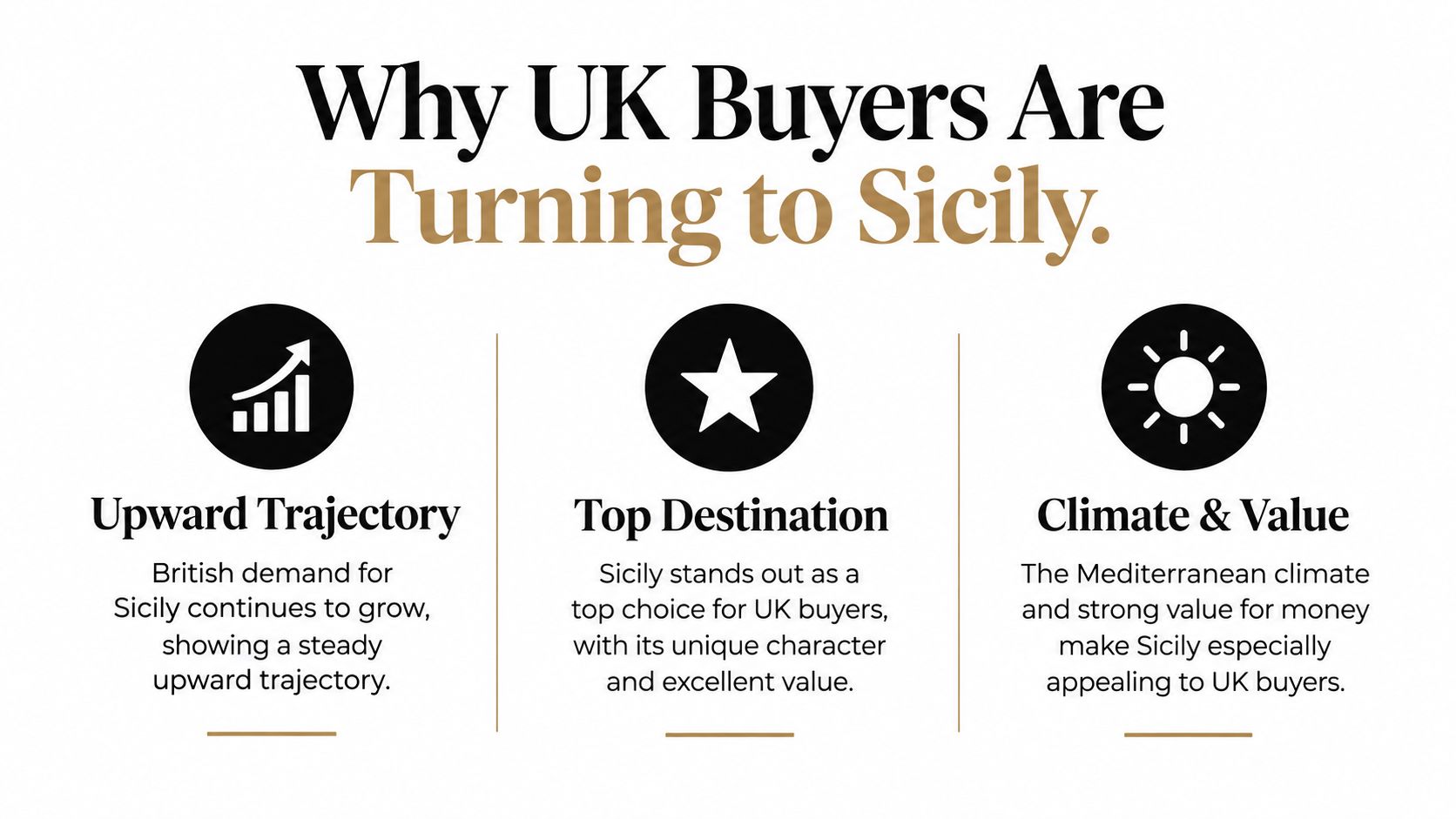
British interest in Italian property has strengthened, and Sicily has moved from an alternative choice to a major part of the search. In the first half of 2025, UK buyers generated 12.72% of all requests for Italian properties, an annual increase of 28.01%. Sicily attracted 16.79% of UK enquiries, with interest almost doubling compared with the first half of 2024, an increase of 99%. These figures come from Gate-away's H1 2025 Italian property demand data.
The longer-term direction is also significant. In 2023, Sicily represented 8.92% of British requests for Italian properties, placing it among the top five Italian regions searched by UK buyers, behind Tuscany, Abruzzo, Puglia and Piedmont. Overall UK interest in Italian property was 62.3% higher in 2023 than in 2019, according to reported historical market data.
What's attracting British buyers
Sicily appeals to several different types of buyer:
- Lifestyle purchasers want historic towns, outdoor space, food, climate and a slower pace of life.
- Second-home buyers can access coastal and inland markets that often sit below the prices associated with Italy's best-known destinations.
- Holiday-let operators are attracted by visitor demand in established coastal and cultural locations, although income depends heavily on seasonality, management and local compliance.
- Renovation buyers see potential in older village homes, rural buildings and properties requiring substantial work.
The attraction is real, but it isn't uniform across the island. A property near a functioning town, airport connection, beach or established visitor route has a different commercial profile from a remote farmhouse that requires a car for every basic errand. The low asking price may be the compensation for limited liquidity, infrastructure work or a narrow pool of future buyers.
| Metric | Value |
|---|---|
| UK share of all Italian property requests in H1 2025 | 12.72% |
| Year-on-year change in UK requests | +28.01% |
| Sicily's share of UK enquiries in H1 2025 | 16.79% |
| Change in interest in Sicily versus H1 2024 | +99% |
| Sicily's share of British requests in 2023 | 8.92% |
| UK interest in Italian property, 2023 versus 2019 | +62.3% |
Demand growth doesn't guarantee price growth or rental profitability. It does, however, show why more British buyers are comparing Sicily with established markets rather than treating it as a fringe option. Buyers also need to consider practical relocation questions, and resources such as planning your university move to Italy can help families understand the wider implications of living in the country.
For readers researching unusual entry points, the guide to houses in Sicily for one euro is useful, but these schemes should be assessed as renovation projects with obligations, not as free homes.
Choosing the Right Sicilian Region
Sicily isn't one property market. Palermo, Taormina, western coastal towns and inland villages serve different buyers, and the right choice depends on whether you're prioritising personal use, reliable access, tourism or the lowest possible entry price.
Palermo offers urban energy, historic architecture, services and a broad local market. It suits buyers who want restaurants, culture and year-round life, but property condition can vary sharply between streets and buildings. Taormina and the eastern tourist coast offer stronger visitor recognition and a more polished holiday environment, yet buyers should expect greater competition for attractive stock and a higher price profile than in less prominent areas.
Western Sicily, including areas around Trapani, Marsala and Mazara del Vallo, often appeals to buyers seeking coastal access with a more rural atmosphere. Smaller towns can provide better value and authentic local life, but a cheaper home may require more work and deliver less immediate tourist footfall.
Match location to the intended use
| Location | Character | Best For |
|---|---|---|
| Palermo | Historic, urban and service-rich | Full-time living, city use and cultural access |
| Taormina and eastern tourist coast | Scenic, established and visitor-oriented | Premium lifestyle use and holiday demand |
| Trapani, Marsala and Mazara del Vallo | Coastal, agricultural and comparatively relaxed | Value-led lifestyle purchases and mixed personal use |
| Smaller coastal villages | Quieter, local and seasonal | Second homes and selective holiday letting |
| Inland hill towns | Traditional, tranquil and more remote | Renovation projects, retreats and low-entry purchases |
A holiday-let strategy needs more than attractive photographs. Guests care about access, parking, air conditioning, outdoor space, reliable internet, restaurants and the ease of reaching beaches or attractions. An inland property can be excellent for personal use and still be difficult to fill consistently as a short-term rental.
Location rule: Choose the town first, then the property. A well-priced house in the wrong location is rarely a good investment.
Visit at different times if possible. Check whether shops, services and restaurants operate beyond the high season, and test the actual journey from the airport rather than relying on a map estimate. Also investigate the physical setting. A peaceful listing may sit beside an agricultural operation, depend on an unmade access track or require significant work to connect utilities.
The Italian Purchase Process Explained
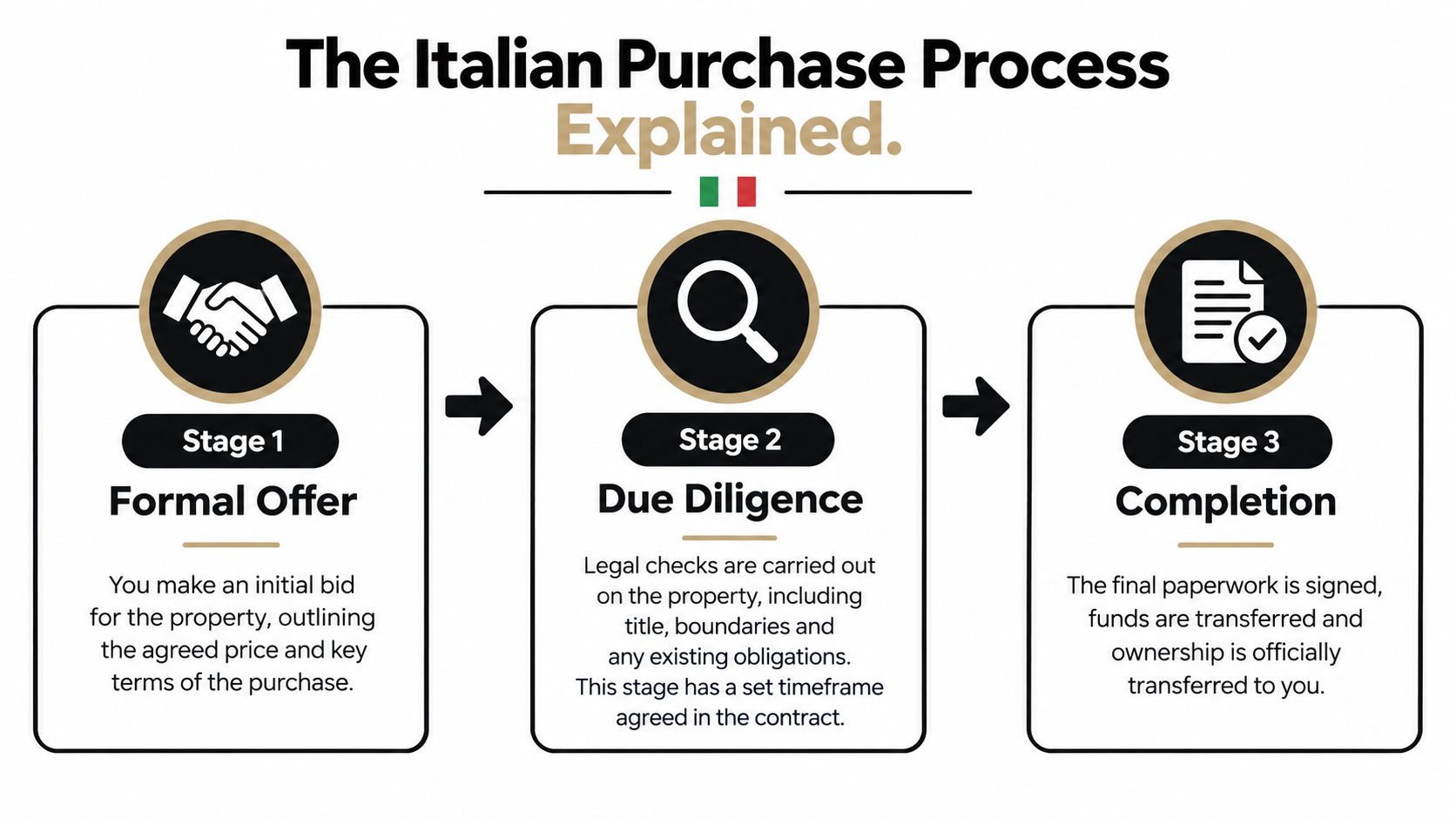
The Italian process has three legally distinct stages. UK buyers who treat the first signed document as an informal expression of interest can expose themselves to unnecessary risk, particularly when the property has planning, ownership or cadastral complications.
The formal offer
The proposta d'acquisto is the formal offer. It records the proposed price and terms and can become binding once accepted, depending on how it's drafted. Before signing, confirm who owns the property, what fixtures are included and whether the proposed conditions give your professionals enough time to investigate the building.
This is also the stage to organise your Italian tax identification number, known as a codice fiscale, if you haven't already done so. You'll need it for the property transaction and related administration.
The compromesso
The accepted offer generally leads to the compromesso, the binding preliminary contract. This document sets out the agreed terms before completion. The deposit at this stage is commonly 10% to 20% of the purchase price, as explained in Wise's guide to buying property in Sicily.
The compromesso isn't a harmless reservation. The buyer can lose the deposit if they withdraw without a contractual reason. That's why the technical and legal checks should happen before signing, or the contract should contain carefully drafted conditions that protect the buyer.
Your independent lawyer should review the Italian wording and your geometra should check the physical and planning position. The notary investigates title and handles the formal transfer, but the notary is neutral and doesn't replace an adviser acting specifically for you. A clear overview of the Italian conveyancing process can help you understand how these professional roles differ.
The rogito
Completion takes place through the rogito, the final deed signed before an Italian notary. The notary completes title checks, registers the relevant taxes and records the transfer so ownership passes correctly. Buyers who aren't sufficiently fluent in Italian should arrange appropriate interpretation for the signing.
The sequence is straightforward in outline, but each stage carries consequences. Don't allow an agent's enthusiasm, a seller's urgency or a low price to push you into signing before the property has been checked.
A visual explanation of the process is available below:
Budgeting for Total Acquisition Costs
A Sicilian property advertised at an attractive price can still require a much larger cash commitment. For a resale transaction, build your initial budget around roughly 10% to 15% above the purchase price, before renovation and long-term operating costs. The estimate reflects the combined effect of registration tax, notary fees and agency commission, as outlined in this breakdown of Sicilian property costs for foreign buyers.
The most important distinction is between market price and cadastral value. Registration tax is generally calculated against the cadastral value rather than the advertised or negotiated market price, which can materially alter the tax calculation. You still need professional confirmation for the specific transaction, because the treatment depends on the seller, property and buyer's status.
| Cost Component | Estimated Percentage/Fee |
|---|---|
| Registration tax, second home resale | 9% of cadastral value |
| Registration tax, qualifying primary residence | 2% of cadastral value |
| Notary fees | Around 1% to 2.5% |
| Agency commission | About 2% to 4% plus VAT |
| Overall additional acquisition budget | Roughly 10% to 15% above purchase price |
A low cadastral value can make the initial tax bill less severe than a buyer might assume from the headline rate. It doesn't remove the other costs, and it doesn't make renovation, insurance, utilities or property management free.
Build the budget in layers
Start with the agreed price. Add acquisition costs. Then create a separate allowance for the building itself, including surveys, structural repairs, permits, utilities, furnishing and professional oversight. A renovation property must be assessed on its completed cost, not its purchase price.
Currency conversion creates another variable for UK buyers. The exchange rate can move between offer, deposit and completion, while bank charges and transfer spreads reduce the sterling value available for the purchase. Review international transfer fees before moving funds, and ask your solicitor or bank how payment timing will work.
The mistake I see most often is treating the extra costs as a final administrative detail. They belong in the offer calculation. If the full project only works when every fee is ignored, it doesn't work.
Understanding Property Values and Yields
Sicily's low prices are a genuine feature of the market, but they're also the source of one of the most persistent investment mistakes. Buyers see a cheap purchase and assume a strong yield, even though rental income depends on location, condition, seasonality, management and taxation.
One 2026 market overview cited an average of €363 per square metre in one of Italy's cheapest markets. On that basis, an 80 m² flat would cost about €29,040, before acquisition costs and any work, as reported by Idealista's overview of Italy's cheapest places to buy.
Recent coverage of Balestrate also reported renovation homes at about €600 to €700 per m², with habitable homes around €900 per m² in August 2026. These examples support Sicily's value-led reputation, but they don't establish a rental return.
| Property Type | Price per m² |
|---|---|
| Low-cost Sicilian market example | €363 |
| Balestrate renovation home | About €600 to €700 |
| Balestrate habitable home | Around €900 |
Why the cheapest listing can underperform
A renovation property may have a low entry price but require structural work, technical design, permits, utility installation, furnishing and ongoing supervision. Every month it remains unavailable for guests is a month without rental income, while taxes and ownership obligations continue.
A habitable home reduces construction risk, but it can carry a higher purchase price and may still need air conditioning, exterior maintenance, compliant guest facilities and local management. A location with modest visitor demand can produce weak occupancy even when the property itself is attractive.
Investment test: Calculate the net return after acquisition costs, renovation, IMU, TARI, maintenance, cleaning, management, insurance and rental taxation. Don't use the asking price as the denominator and call the result a yield.
For a holiday let, compare at least two uses before committing. A home designed around personal enjoyment may justify itself through use and lifestyle value. A property bought solely for income must withstand conservative assumptions about occupancy and operating costs. Sicily can provide excellent value, but low entry cost and high net yield are separate propositions.
Tax Implications for Foreign Buyers
UK nationals can buy property in Italy under the reciprocity principle, provided the relevant conditions are met. For a resale, the main acquisition tax is normally 2% of cadastral value when the home qualifies as a primary residence, or 9% of cadastral value when it's a second home or holiday home. The Italian Embassy guidance for foreign buyers also identifies fixed cadastral and mortgage taxes of €50 each in the relevant resale scenario.
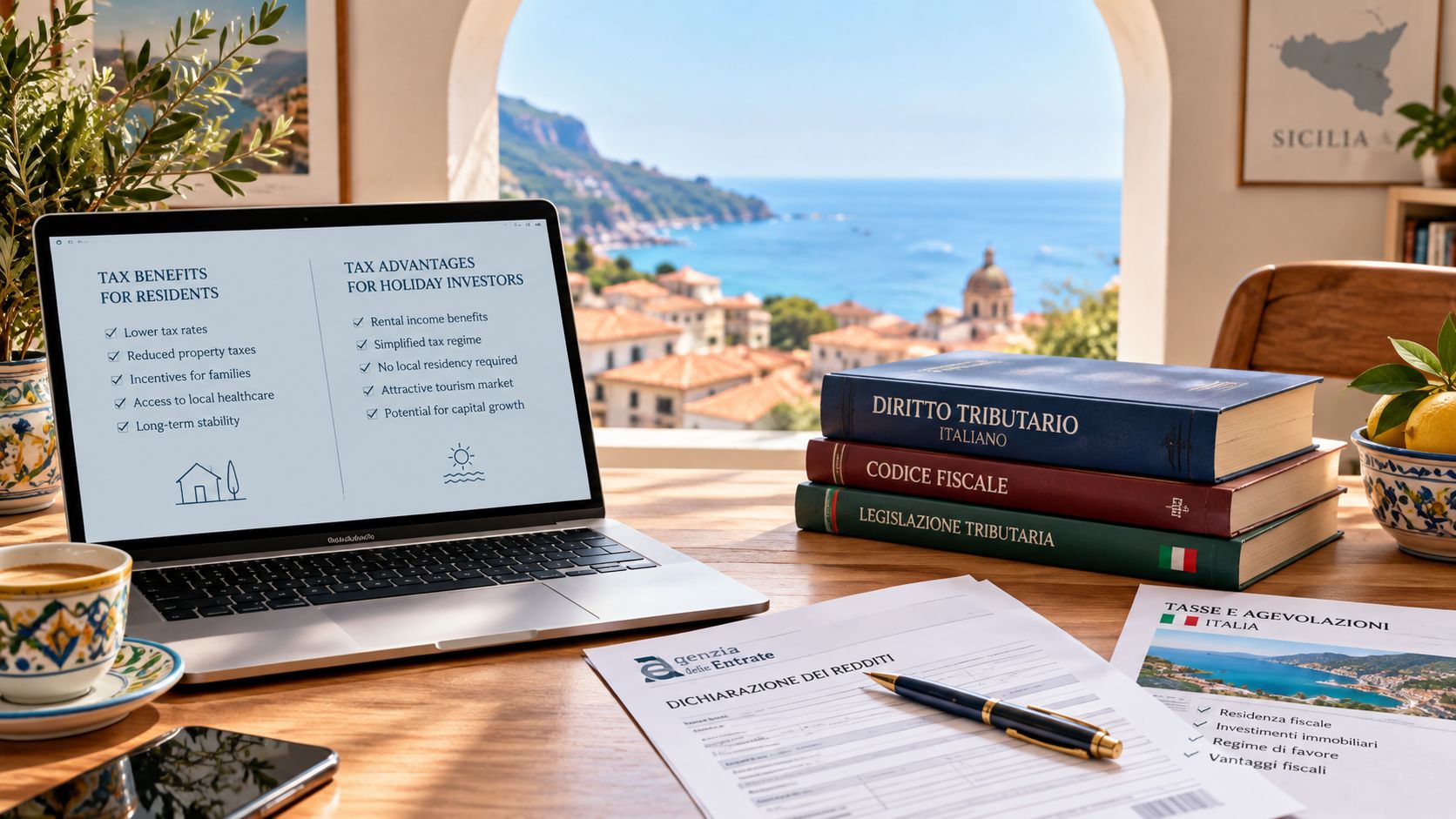
The primary-residence treatment is where buyers often make an incorrect assumption. A UK buyer purchasing a holiday home or investment property will commonly be looking at the second-home treatment, rather than assuming the lower primary-residence rate applies automatically. Your tax adviser must confirm the position before you make an offer.
The costs that continue after completion
The purchase tax is only the beginning. Second-home owners also need to account for IMU, the municipal property tax, and TARI, the waste collection tax. The market coverage provided for this guide identifies IMU bands of approximately 0.4% to 1.06%, while TARI depends on the property and municipality, as discussed in this analysis of double taxation treaties.
These charges affect the investment case in different ways. IMU reduces the income left after letting, while TARI remains a cost of ownership regardless of whether guest bookings meet expectations. A rural property may also generate maintenance obligations that don't appear in a listing, including access, gardens, roofs, damp and utility systems.
Rental income brings a separate tax question. The correct treatment depends on the letting arrangement, the owner's circumstances and the applicable Italian and UK rules. Don't assume that a popular holiday-let model automatically produces a simple tax position.
The contrarian calculation
The cheapest listing can have the weakest net return if it needs extensive work, sits far from demand and carries persistent running costs. A more expensive but habitable property in a functioning town may produce a more manageable operation, even though the initial price is higher.
Assess tax as part of the property selection process. If the deal only works under the primary-residence rate, but you intend to use the home as a holiday let, the model is based on the wrong assumption.
Pre-Purchase Checklist for UK Buyers
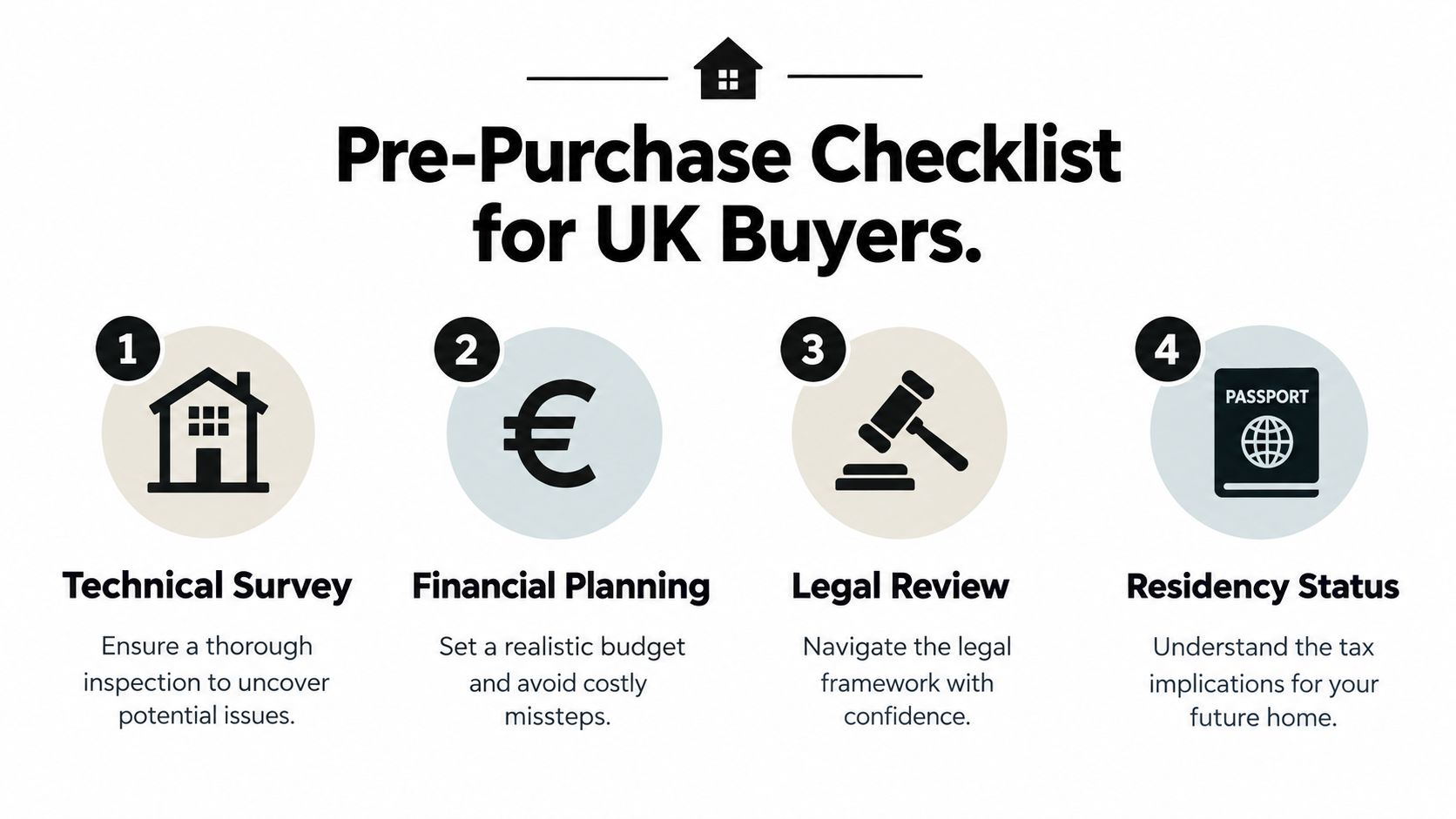
The safest purchase is organised before the offer is signed. Sicilian property can contain discrepancies between the building you see, the records held by the authorities and the ownership history described by the agent. None of those issues automatically kills a deal, but each one needs to be identified, priced and resolved before you become contractually committed.
Technical checks
Commission an independent geometra to inspect the property and compare the physical building with the cadastral records. Ask for confirmation of planning permissions, building alterations, land boundaries, access rights and the legal status of extensions or outbuildings. A structural inspection should look beyond cosmetic presentation and identify roof, damp, floor and weatherproofing risks.
Check the practical infrastructure too:
- Utilities: Confirm whether water and electricity are connected, disconnected or technically available.
- Access: Verify that roads and tracks provide legally recognised access, not merely customary access.
- Renovation scope: Separate essential structural work from improvements that can wait.
- Local constraints: Ask whether heritage, coastal or municipal rules affect the proposed works.
The property inspection checklist for international buyers provides a useful framework, but a local professional must assess the actual building.
Legal and financial checks
Instruct an independent Italian lawyer to review the proposta d'acquisto and compromesso. The notary will investigate title and formalise the transfer, while your lawyer can focus on your interests, contractual protections and any unusual circumstances.
Have the notary confirm the ownership chain, mortgages, liens and inheritance position before you pay the deposit. Make sure every required owner can sign. Obtain your codice fiscale early, establish how you'll fund the purchase in euros and model the second-home tax treatment if you aren't moving your main residence to Italy.
Operational planning
Decide who will manage repairs, guest communication, cleaning, check-ins, tax administration and emergencies before completion. If the property is remote, local management isn't an optional convenience. It can determine whether the home remains usable and whether a holiday-let strategy is practical.
Finally, visit the area with the intended use in mind. Walk the route to shops, inspect access after poor weather if possible, speak to local professionals and consider how the town feels outside the busiest period. A property should pass both the legal test and the operational test before you commit.
World Property Investor provides location guides, market analyses, rental-yield breakdowns and step-by-step advice for international buyers comparing opportunities such as Sicily. Visit World Property Investor to research Italian property markets, assess overseas purchase risks and build a more realistic investment plan before making an offer.