
You've found the villa, agreed the price and arranged funds in another currency. The estate agent is pressing for a completion date, your lender is asking for documents, and the seller's solicitor has sent a contract pack filled with unfamiliar terms. At this point, many overseas buyers assume the legal work is a short administrative step. It isn't.
The conveyancing process is the legal bridge between an accepted offer and secure ownership. For an international investor, it also tests whether the title, planning history, lease terms, funding trail and transaction structure can withstand scrutiny. A property can look ideal on a viewing and still carry restrictions that affect resale, letting, financing or future development.
Table of Contents
- Understanding the Conveyancing Process for International Buyers
- The Core Stages of a Property Transaction
- Realistic Timelines and Structural Market Delays
- Navigating Legal Fees and Statutory Disbursements
- Selecting the Right Legal Representation
- Cross-Border Risks and Market-Specific Pitfalls
- Investor Checklist and Frequently Asked Questions
Understanding the Conveyancing Process for International Buyers
Conveyancing transfers legal ownership from seller to buyer. In England and Wales, that transfer involves checking the seller's title, reviewing contractual terms, ordering searches, raising enquiries, satisfying lender requirements where relevant, transferring purchase funds and registering the new ownership with HM Land Registry. The process protects your capital by identifying legal problems before you become responsible for the asset.
An overseas purchase adds another layer of friction. Your solicitor may need to verify a foreign passport and address, establish the source of funds, understand whether you're buying personally or through a company, and coordinate documents signed outside the jurisdiction. Banks can also require additional information before releasing money, particularly where funds arrive from more than one country.
Why international buyers face more exposure
The legal risks depend on the property and the jurisdiction. In a UK purchase, the conveyancer may investigate title restrictions, rights of way, planning permissions, lease obligations, service charges and environmental matters. In another country, the equivalent checks may involve a different land registry, notarial process, cadastral records or permissions for foreign ownership.
That difference matters because ownership is only as secure as the local records and legal documents supporting it. A buyer who relies solely on an estate agent's description may miss an unregistered extension, a restriction on holiday letting or a charge affecting the title.
Practical rule: Treat the legal review as an investment-control function, not a paperwork expense.
The safest approach is to appoint a lawyer early, before paying a non-refundable commitment or transferring substantial funds. Ask for written confirmation of what the lawyer will check, what falls outside the scope of the retainer and which risks require advice from a tax adviser, surveyor or local specialist.
Buyers considering Israel or other overseas markets can use the RNC Group foreign property guide as a starting point for understanding the broader issues that surround foreign investment. It shouldn't replace independent legal advice, but it can help you identify questions before instructing local counsel.
The Core Stages of a Property Transaction
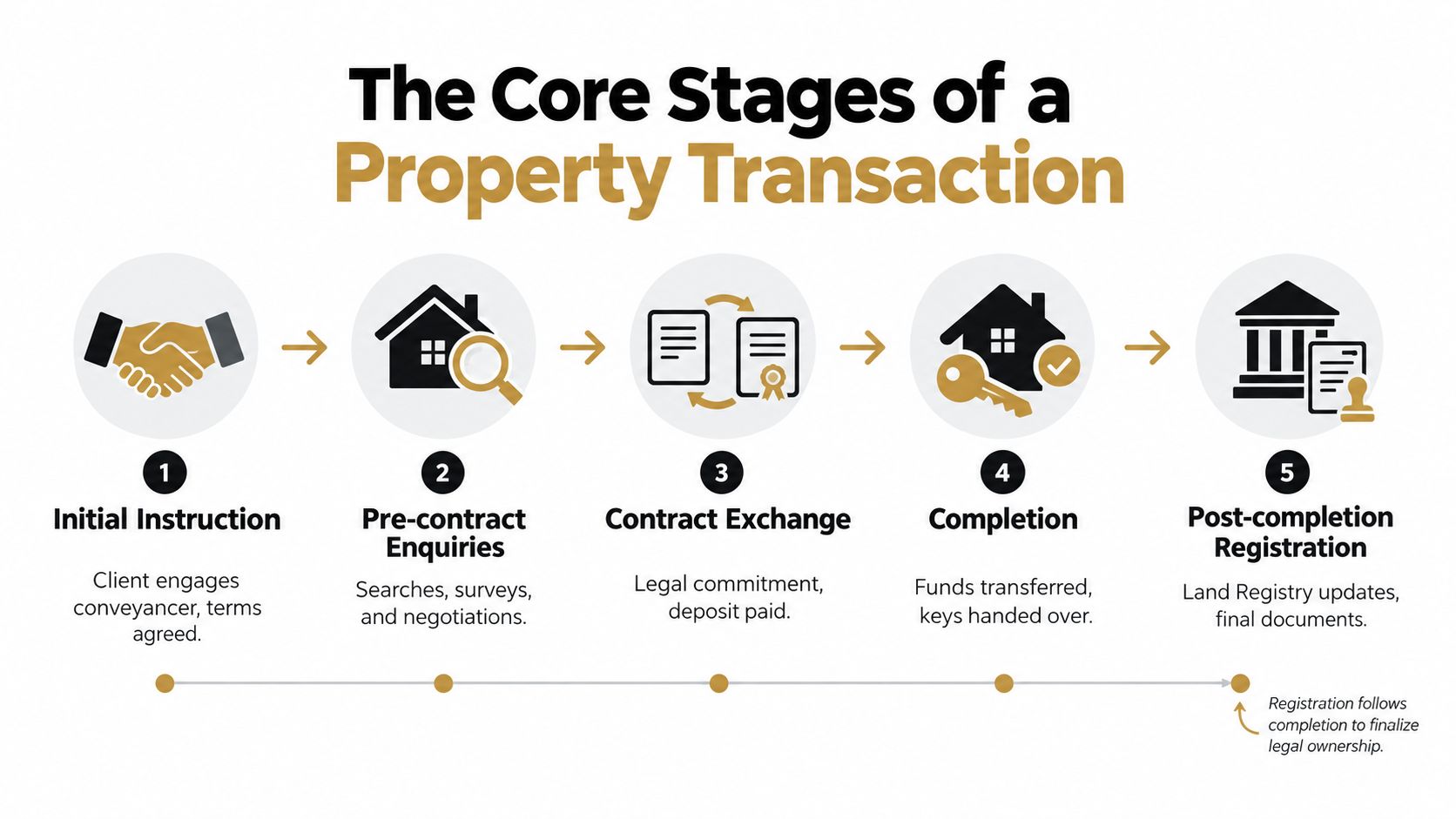
A purchase usually moves through a sequence of checks rather than one single legal event. Consider an overseas buyer purchasing a UK apartment as a holiday home. The buyer instructs a conveyancer after the offer is accepted, supplies identity and funding documents, and waits for the seller's side to provide the title and contract information.
Initial instruction and document collection
The conveyancer opens the file, issues client-care information and requests proof of identity, address and funds. An international buyer should also disclose the intended use of the property, the proposed ownership structure and the source account from which the purchase money will come.
The seller's representative prepares the contract pack. This commonly includes title information, property forms, lease documents where applicable, planning paperwork and guarantees. The buyer's conveyancer checks whether the documents describe the asset accurately and whether the seller has the right to sell it.
Searches and pre-contract enquiries
Searches investigate matters that a viewing or survey may not reveal. Depending on the property, they can cover local authority records, planning and building control matters, environmental risks, drainage and water arrangements, and title restrictions.
The conveyancer then raises enquiries. These questions may concern missing permissions, boundary arrangements, access rights, service charges, repairs or lease conditions. A good enquiry is specific and evidence-led. A long list of generic questions can create noise without improving protection, while a focused request for the missing document can move the file forward.
For overseas buyers, source-of-funds verification guidance can help clarify why banks and lawyers ask for a coherent documentary trail. Prepare bank statements, sale agreements, loan documents or inheritance evidence before the file reaches a critical deadline.
Exchange and completion are different events
Exchange of contracts creates the contractual commitment. Before exchange, either side may usually withdraw, although costs may already have been incurred. Once exchange occurs, the parties are bound to complete under the agreed contract.
Completion is the money-and-keys stage. As the UK government explains in its guidance on transferring ownership through conveyancing, the buyer's solicitor transfers the purchase money, and completion follows that transfer. The buyer doesn't become operationally entitled to collect the keys merely because contracts have exchanged.
The distinction is essential when arranging international funds. A bank transfer delay after exchange can become a contractual problem, not just an inconvenience. Buyers should confirm transfer limits, bank holidays, intermediary-bank requirements and the solicitor's cleared-funds deadline well in advance. A practical preparation resource is New American Funding, LLC's guide to get ready for clear to close, although the legal mechanics of a UK transaction remain governed by the UK contract and your appointed conveyancer.
Realistic Timelines and Structural Market Delays
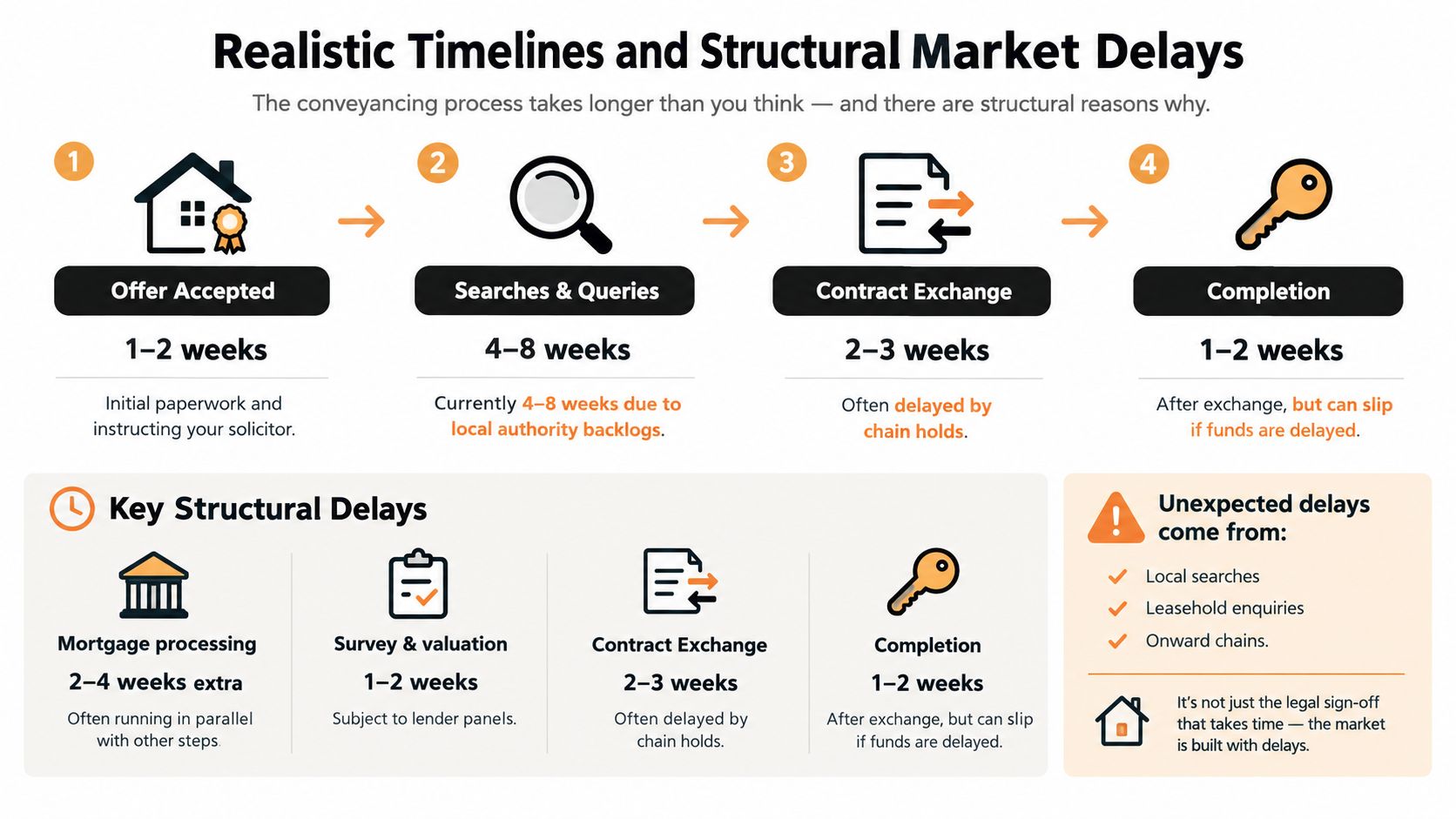
The familiar idea of a 12 to 16-week conveyancing journey no longer describes every modern UK transaction. Landmark Information Group reported that the average period from conveyancer instruction to completion for purchase transactions reached 123 days in 2023, compared with 75 days in 2007, a 64% increase over that period. Its evidence also recorded purchase-side conveyancing queries taking an average of 60 days in 2023, despite lower volumes than in earlier years, which indicates that market activity alone doesn't explain the delay. Landmark's evidence to Parliament provides the underlying figures.
Landmark's 2024 follow-up showed only modest improvement. Purchase transactions averaged 120 days from instruction to completion, while sale transactions averaged 160 days. For an investor coordinating finance, contractors, currency conversion and a planned rental launch, that is a timeline of roughly 17 weeks or more, not a short legal sign-off.
Why the process is taking longer
Several bottlenecks overlap:
- Transaction chains: Your completion depends on other buyers, sellers, lenders and conveyancers. One unresolved title issue can hold up multiple transactions.
- Searches and enquiries: Local authority responses, planning records and leasehold information can arrive at different speeds.
- Mortgage coordination: A lender may need valuation information, legal certificates or specific title protections before releasing funds. Buyers planning borrowing should allow for the separate mortgage approval timeline.
- Legal capacity: A 2026 report cited 5,904 UK conveyancers in January 2026, down from 6,763 in 2021, a decline of 12.7% over five years. Another reported 3,425 registered conveyancers in England and Wales in January 2026, down from 3,539 a year earlier and more than 4,000 at the end of 2022. These figures are reported in coverage of the conveyancer shortage.
The capacity issue changes how you assess a quote. A low fee isn't attractive if the firm lacks the staff to review documents, answer enquiries and react to a lender deadline. Landmark's Q1 2026 reporting found completion volumes in England and Wales were down 18% year on year, while sale-agreed volumes were down 8%, reinforcing the point that converting an agreed transaction into completion remains difficult. The Q1 2026 residential property trends report sets out that comparison.
Property type and region alter the timetable
Leasehold purchases generally require more documentation because the conveyancer must examine the lease, management information, charges, restrictions and relationships between the freeholder and managing agent. A 2026 industry analysis reported leasehold transactions taking 155 days to reach exchange, compared with 98 days for freehold properties, a difference of 57 days. It also recorded regional variation, from 3.6 months to exchange in the North-East to around 4.6 months in Outer London and the East of England. The LSSA market analysis gives the relevant context.
Build your investment model around the property's actual legal profile. A freehold house with clean title and no chain may be relatively straightforward. A leasehold flat in a managed development, particularly one involving overseas funds and mortgage finance, needs a larger time reserve and more active case management.
Navigating Legal Fees and Statutory Disbursements
An overseas buyer can receive a low headline quote, then face extra charges for leasehold administration, lender work, document certification or international payments. Read the quote as a scope of work, not just a total. Professional fees pay the solicitor or licensed conveyancer for handling the transaction. Disbursements go to third parties, including search providers and HM Land Registry, and generally cannot be negotiated like the firm's own charge.
HM Land Registry's registration fee depends on the property value and the submission route. For standard electronic or portal applications affecting all of a registered title, the published bands run from £20 to £500, increasing as the price band rises. This is a statutory cost rather than a discretionary solicitor add-on. Check the HM Land Registry registration services fee scale before approving a quote.
International buyers may also incur foreign-currency transfer costs, intermediary-bank charges, document certification, apostille or legalisation expenses, specialist searches and additional work for a corporate purchaser. Whether an item applies depends on the transaction. Ask the firm to separate fixed costs, anticipated disbursements and provisional allowances, then confirm what could increase if the matter is delayed or the ownership structure changes.
Typical Conveyancing Cost Breakdown
| Cost Category | Description | Estimated Range |
|---|---|---|
| Professional legal fee | Work carried out by the solicitor or conveyancer | Obtain a written quote |
| Property searches | Third-party searches relevant to the property | Confirm with the provider |
| HM Land Registry fee | Statutory registration charge based on value and route | £20 to £500 for the stated standard electronic or portal bands, HM Land Registry |
| Bank transfer costs | Payments arranged through the firm or banking system | Confirm before instruction |
| Certification and legalisation | Identity, corporate or foreign documents where required | Depends on documents and jurisdiction |
| Currency conversion | Exchange and transfer costs for international funds | Depends on provider and currency |
| Leasehold information | Management-pack or notice-related charges where applicable | Confirm with the managing agent |
Use this property conveyancing costs guide to compare quotations, but compare scope as carefully as totals. One firm may include lender work, leasehold administration and bank transfers, while another may charge for them later.
The lowest quote can conceal limited responsiveness, unclear file ownership or weak escalation procedures. Before signing the client-care letter, request the fee assumptions, the events that trigger additional charges and the firm's treatment of a failed transaction. For an international purchase, preserving cash-flow flexibility matters because structural delays can keep funds committed while legal work continues.
Selecting the Right Legal Representation
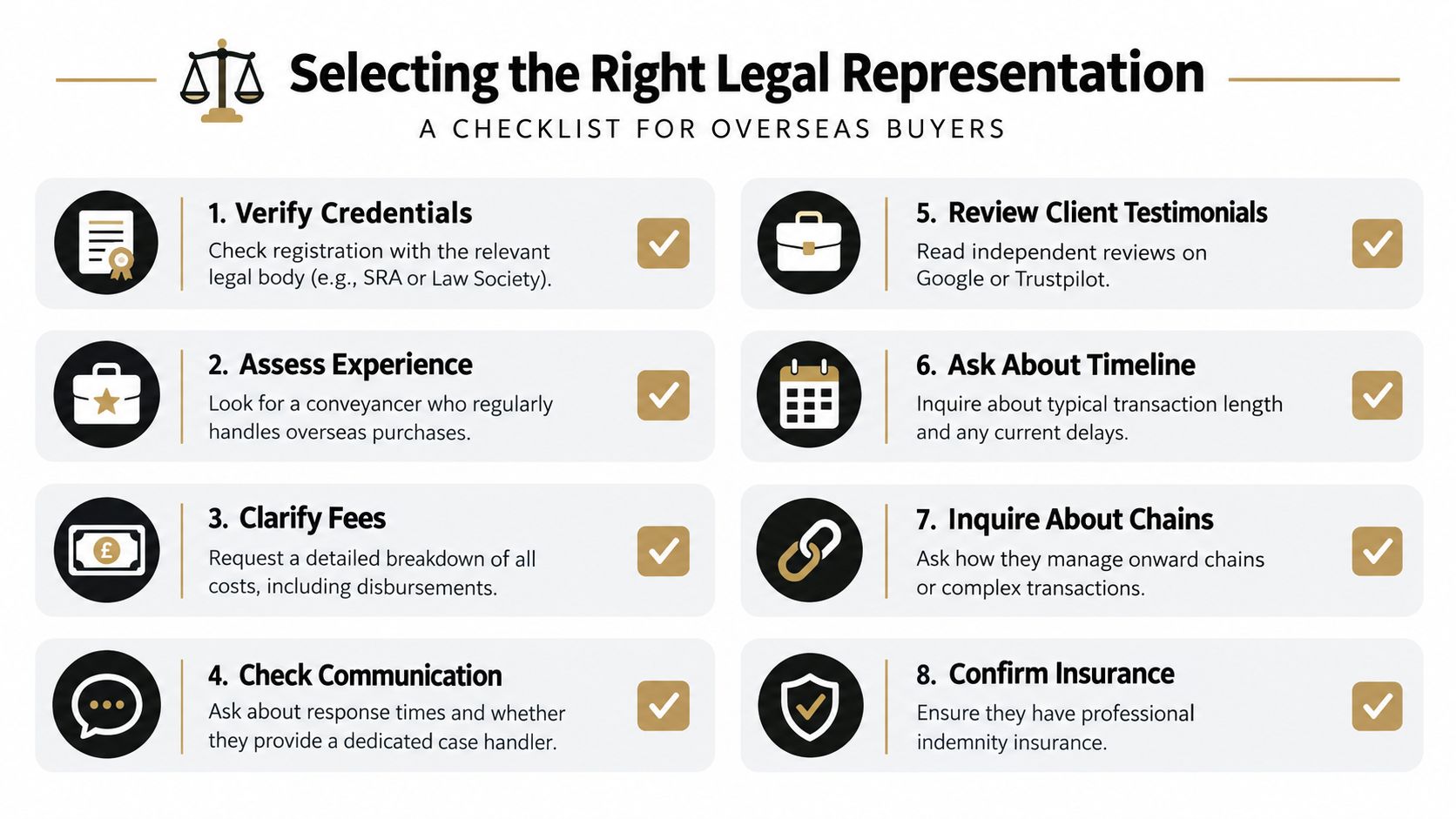
A cross-border purchase needs more than a conveyancer who can process a standard local sale. Your representative must be comfortable with international identity checks, foreign banking records, corporate structures, remote signing and communication across time zones.
Start with regulation and scope. In England and Wales, solicitors and licensed conveyancers operate under different regulatory arrangements, so verify the firm's status with the relevant professional body. Confirm that the person handling your file has experience with the property type, lender and ownership structure you're considering.
Questions to ask before instructing
Use the initial call to test capacity, not just courtesy. Ask:
- Who owns the file? Find out whether you'll have a named case handler and who covers absences.
- What does the quote include? Request professional fees, anticipated disbursements, lender work and possible extras in separate lines.
- How are overseas documents handled? Clarify certification, witnessing, translation and remote-signing requirements.
- How will updates work? Agree whether communication will be by email, portal or scheduled calls, and ask how urgent issues are escalated.
- What is happening in the current caseload? A firm should explain how it manages competing deadlines and whether it has capacity for a chain-sensitive purchase.
- Which risks need another adviser? Legal, tax, planning and building-condition advice aren't interchangeable.
A firm that promises a fixed completion date before seeing the contract pack is displaying poor judgement. The same applies to a quote that excludes obvious complexity or a representative who can't explain the difference between exchange and completion.
For a broader search framework, consult guidance on choosing an international real estate lawyer, then shortlist firms that can demonstrate relevant local experience rather than offering the fastest response.
A reliable legal representative tells you where the transaction is uncertain. They don't hide uncertainty behind an attractive headline fee.
Cross-Border Risks and Market-Specific Pitfalls
Property law isn't uniform across borders. A buyer accustomed to a centralised digital registry may assume another market offers the same title certainty, searchable records and enforcement standards. That assumption can expose an investor to defects that only become visible when refinancing, reselling or applying for permission to change the property's use.
In established systems, digital registration can reduce administrative friction, but it doesn't make the transaction automatic. HM Land Registry processed more than 46 million service requests in 2022-23, and 88% of applications were digital from December 2022 onwards. Its report also says urgent expedited cases were completed within 10 working days in 96% of cases, while post-completion applications averaged 16 working days. HM Land Registry's performance report shows why digital submission helps without removing requisitions, corrections or registration backlogs.
Risks that require local investigation
An overseas buyer should ask local counsel to test the risks most relevant to the market:
- Title and registration: Confirm that the seller's recorded interest matches the property being sold. Unregistered land, inconsistent plans or unresolved charges require specialist treatment.
- Planning and use: A home marketed as a holiday let may not have the permissions needed for short-term accommodation. Check planning, licensing, building compliance and any development restrictions before modelling rental income.
- Off-plan protection: For a new development, verify the developer's title, construction approvals, completion obligations, escrow or staged-payment protections and remedies if delivery changes.
- Foreign ownership: Some jurisdictions restrict ownership by nationality, entity type, location or property category. Don't rely on a sales brochure to interpret those rules.
- Fraud and identity: Verify bank instructions independently and use known contact details. A last-minute request to redirect completion funds is a serious warning sign.
- Tax and transaction charges: Legal completion doesn't answer every tax question. Obtain separate advice on acquisition taxes, annual ownership costs, rental income and disposal. A country-specific overview of stamp duty on overseas property can help frame the questions, but it isn't a substitute for local tax advice.
The main trade-off is speed versus verification. A rushed purchase may preserve a commercial opportunity, but it leaves less time to resolve missing documents and increases dependence on assumptions. Investors protecting capital should prefer a documented exception, with a clear remedy, over a verbal assurance that an issue is “normal” locally.
Investor Checklist and Frequently Asked Questions
Before instructing a lawyer, prepare the file as if the transaction has a deadline. Organised buyers don't eliminate market delays, but they remove avoidable pauses caused by missing information.
Pre-instruction checklist
- Identity: Prepare valid identification, proof of address and any required certified copies.
- Funds: Map the source and movement of every contribution, including loans, gifts, sales proceeds or company funds.
- Ownership: Decide whether you're buying personally, jointly or through a corporate vehicle, subject to legal and tax advice.
- Property use: State whether the asset will be a residence, holiday home, long-term rental or short-term let.
- Finance: Confirm lender requirements, valuation arrangements and the date by which funds can be released.
- Property documents: Request title, lease, planning, management and service-charge information as early as possible.
- Communication: Give the lawyer reliable email, telephone and time-zone details, plus an authorised contact if you can't sign locally.
- Risk budget: Reserve money for searches, certification, currency movement and professional advice beyond the headline legal fee.
Frequently asked questions
Can I sign remotely?
Often, remote signing can be arranged, but the exact method depends on the document, the jurisdiction and the lawyer's requirements. Some documents may need witnessing, certification, notarisation or legalisation. Ask for signing instructions before the contract reaches its deadline.
Does buying through a limited company simplify the process?
Not automatically. A company can introduce beneficial-ownership checks, constitutional documents, director identification, authority-to-sign evidence and additional tax considerations. Discuss the structure with a property lawyer and tax adviser before making the offer.
What happens if the transaction collapses?
Before exchange, either side can generally withdraw, although you may still lose money spent on searches, surveys, advice and administration. After exchange, the contract is binding and withdrawal can expose the defaulting party to serious financial consequences. HM Land Registry states that more than a quarter of property transactions in England and Wales don't complete, with an estimated financial loss of around £400 million for parties trying to sell. Its strategy for 2022 underlines why chain monitoring and early issue resolution matter.
How should I plan for the timeline?
Use the property type, chain position, financing and legal capacity of the selected firm to set expectations. Don't commit contractors, rental marketing or currency transfers to a narrow completion date until your conveyancer confirms that the legal and funding conditions are ready.
World Property Investor offers country and city guides, market analyses, rental-yield research and step-by-step buying guidance for international property buyers. Use its resources to compare jurisdictions and understand the legal and financial questions that should sit alongside your conveyancing plan, then visit World Property Investor before committing capital to your next overseas purchase.