
When an investor sells a property for more than its acquisition cost, the resulting profit is subject to Capital Gains Tax (CGT). This is a tax on the gain, not the total sale price. In essence, it is calculated on the difference between the sale price and the original cost, including certain allowable expenses. Understanding its mechanics is fundamental for any serious property investor.
Understanding Capital Gains Tax Fundamentals
For global property investors, a firm grasp of Capital Gains Tax is as critical as understanding rental yields or market fundamentals. It should be viewed not as a penalty, but as a standard business cost associated with a successful investment. A company pays tax on its profits; an investor pays CGT on the profit realised from selling an asset like property.
The tax is triggered by a 'chargeable event', which most commonly means the sale of a property. However, it can also include gifting a property or transferring it into a trust. CGT applies to a wide range of investment properties, including:
- Buy-to-let properties.
- Second homes or holiday homes.
- Inherited property that is sold (and was never the investor's primary residence).
- Plots of land sold for a profit.
Why Property Gains Are Often Taxed Differently
Many jurisdictions, including established markets like the UK, treat gains from residential property differently from gains on other assets, such as equities. UK policy is a clear example: gains from residential property are subject to higher CGT rates than other investments. This reflects a deliberate policy to tax the significant wealth often generated in real estate.
For a property investor, understanding the nuances of CGT is not just about compliance; it is about safeguarding your return on investment. A tax-efficient strategy can be the difference between a good return and a great one.
The rules demand meticulous attention. In the UK, for instance, the annual tax-free allowance for individuals is set at just £3,000 from April 2024, a significant reduction from £12,300 in the 2022-23 tax year. This policy change, based on official Gov.uk figures, brings far more property disposals into the tax net.
Once this allowance is exceeded, UK basic-rate taxpayers face an 18% CGT rate on residential property gains, while higher-rate taxpayers are charged 24%. These rates are considerably higher than the 10% and 20% rates applied to other assets.
This higher tax burden underscores why a solid grasp of CGT is essential from the outset. For those new to this area, building a strong foundation is key, and our beginner's guide to real estate investing is a valuable resource. Factoring potential CGT liability into financial forecasts is a cornerstone of protecting net profit.
How to Calculate Your Property Capital Gain
Calculating your capital gain is a methodical process designed to determine your taxable profit. The calculation hinges on a core formula: the final selling price, minus all allowable deductible costs.
The first step is to establish your ‘base cost’. This is not merely the purchase price; it includes other essential acquisition costs that tax authorities, such as HMRC in the UK, permit you to deduct.
Establishing Your Base Cost
To determine your true base cost, you must consolidate documentation for several key expenditures. It is the sum of:
- The original purchase price of the property.
- Associated buying costs, such as stamp duty land tax (or equivalent transfer taxes), legal fees, and surveyors' charges from the initial acquisition.
- Capital improvement costs. These are expenditures on major projects that demonstrably enhance the property's value, such as adding an extension or a significant structural renovation. Routine maintenance does not qualify.
Overlooking capital improvement costs is a frequent and costly error. An extension that cost £40,000 is a legitimate expense that can directly reduce your final tax liability.
Calculating Net Proceeds and Total Gain
Once the base cost is established, the next step is to calculate your ‘net proceeds’. This is the final sale price of the property, less any costs directly incurred during the sale, which typically include estate agent and legal fees.
With both figures, the calculation is straightforward:
Net Proceeds – Base Cost = Total Capital Gain
This total gain is the headline profit figure. The final step is to calculate the taxable portion. You must subtract any applicable tax-free allowance—known in the UK as the Annual Exempt Amount—from your total gain. The remaining amount is your ‘taxable gain’, to which the relevant CGT rate is applied.
This flowchart illustrates the capital gains tax process, from the property sale through to calculating the tax due.
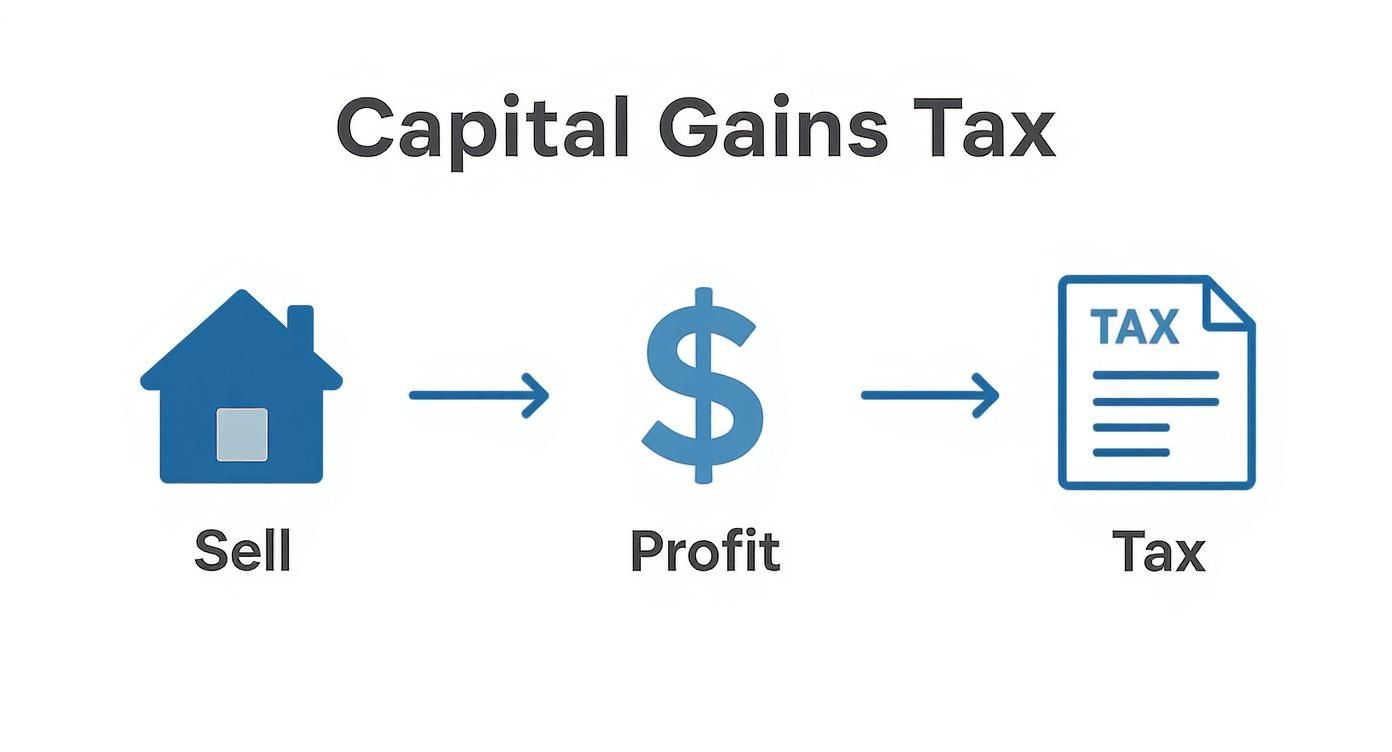
As shown, it is a linear process from the transaction to the taxable outcome, highlighting the core stages every investor must follow.
A Worked Example in the UK Market
Consider a real-world scenario. An investor purchased a buy-to-let flat in the UK for £250,000. Several years later, they invested £20,000 in a new kitchen and bathroom. Their total base cost is now £270,000.
They later sell the property for £400,000, incurring £10,000 in legal and agent fees. This makes their net proceeds £390,000.
- Total Gain: £390,000 (Net Proceeds) – £270,000 (Base Cost) = £120,000
Assuming the investor has their full tax-free allowance of £3,000 (for the 2024/25 tax year), their taxable gain becomes £117,000.
Accurate calculations are fundamental to professional property investment. You can learn more about how to calculate return on investment (ROI) for real estate in our detailed guide, as this knowledge is crucial for forecasting net returns accurately.
Key Tax Reliefs and Exemptions for Investors

Understanding what capital gains tax is represents only half the challenge. The other, more profitable, half involves learning how to mitigate it legally. This is where astute investors protect their returns.
Tax reliefs are not loopholes; they are established, government-designed rules for specific circumstances. For a global property investor, mastering the key reliefs available in each market is fundamental. They can substantially reduce, or even eliminate, a final tax bill, directly impacting portfolio profitability.
While the most generous reliefs often pertain to a primary residence, several others apply specifically to investment properties.
Private Residence Relief (PRR)
The most significant exemption in the UK tax system is Private Residence Relief (PRR). This powerful tool typically means you pay no Capital Gains Tax when you sell your main home.
To qualify, the property must have been your only or main residence throughout your period of ownership. However, the rules offer flexibility. For example, the final nine months of ownership are always exempt, regardless of whether you are living there. This provides a valuable buffer for homeowners moving to a new property before selling their old one.
Key Takeaway: PRR is the cornerstone of CGT planning for owner-occupiers. Ensuring a property is correctly designated as your main residence is a critical first step, especially if it may be rented out later.
Certain periods of absence can also be fully exempt under PRR, provided you occupied the property both before and after the absence. These include:
- Any period spent working abroad.
- Up to three years of absence for any reason.
- Up to four years of absence if required to work elsewhere in the UK.
Lettings Relief and Other Key Deductions
For investors who once lived in a property before letting it, Lettings Relief was formerly a major benefit. However, the rules have been tightened significantly; it now only applies in the rare case where you lived in shared occupancy with your tenant. This change highlights the importance of staying current with tax legislation. Understanding the full spectrum of property taxes is crucial for any investor, as regulations frequently change.
Another important mechanism is Business Asset Rollover Relief. This allows you to defer paying CGT when you sell certain business assets and reinvest the proceeds into new qualifying assets. While more common in commercial property, it can sometimes apply to furnished holiday lettings that meet the specific criteria to be treated as a business.
Practical Scenarios Comparing Reliefs
Let's examine two investor scenarios to see how these reliefs apply in practice.
Investor A: The "Accidental" Landlord
Sarah purchased a flat for £200,000 and lived in it as her main home for five years. She then took a job abroad for two years, letting the flat out. Upon her return to the UK, she lived elsewhere but retained the flat as a rental for another three years before selling it for £300,000. Her total ownership period was ten years, with a £100,000 gain.
- The five years she lived there are fully exempt under PRR.
- Her two years working abroad are also exempt.
- The final nine months of ownership are exempt.
- In total, 7.75 years out of 10 are covered by reliefs, making the vast majority of her gain tax-free.
Investor B: The Portfolio Landlord
Mark also purchases a property for £200,000 but never lives in it. It is a pure buy-to-let investment from day one. He sells it ten years later for £300,000, realising the same £100,000 gain as Sarah.
- As he never occupied the property as his main residence, Mark cannot claim PRR.
- His entire £100,000 gain (less his annual CGT allowance) is subject to Capital Gains Tax.
These examples demonstrate the transformative impact of tax reliefs. By understanding and applying these rules, investors can strategically plan acquisitions and disposals to retain a greater portion of their returns.
A Global Perspective on Property CGT Rates
For investors building a global portfolio, mastering international tax policy is non-negotiable. Capital Gains Tax on property is not a uniform concept; rates, rules, and reliefs vary dramatically between jurisdictions.
A strategy that is highly tax-efficient in the UK could prove costly in Germany or the US. These differences directly impact your net return on investment (ROI) and must be a core component of due diligence. A clear, comparative view enables smarter capital allocation decisions for long-term growth.
Established vs. Emerging Markets
Established property markets such as the UK, USA, and Canada typically have more complex tax systems, with distinct rules for residents and non-residents. While headline tax rates may appear high, they often provide a range of well-defined reliefs and allowances that a knowledgeable investor can utilise.
In contrast, some emerging markets and investment hubs use tax policy to attract foreign capital. Dubai is a prime example, with its 0% CGT rate on property, making it highly attractive for investors focused purely on capital appreciation. This bifurcation between high-tax, high-regulation environments and low-tax, pro-investment hubs is a critical strategic consideration.
Data from HMRC shows that in the 2022-23 UK tax year, £14.8 billion was paid in CGT on gains totalling £81.7 billion. A significant portion of this derived from property, illustrating the scale of tax revenue generated from this asset class in mature economies.
Key International CGT Approaches
Governments typically adopt one of a few distinct models for property CGT. Understanding these provides a framework for evaluating new markets.
- Tiered Rate Systems: Countries like the USA differentiate between short-term and long-term gains. A property held for less than a year is taxed at the owner's marginal income tax rate, which can be as high as 37%. Holding for longer than one year unlocks lower long-term CGT rates of 0%, 15%, or 20%, depending on income.
- Holding Period Exemptions: Germany offers a powerful incentive for long-term investors. If an investment property is sold after being held for more than 10 years, the entire capital gain is tax-free. This policy clearly encourages stable, long-term investment over speculative short-term trading.
- Flat Rate Systems: Some nations, like Spain, simplify the process by applying a flat rate to property gains for non-residents. For EU/EEA residents, this currently stands at 19%. This offers predictability but may lack the nuanced reliefs found in other systems.
Investor Takeaway: A country's tax policy offers a window into its economic priorities. A jurisdiction with zero CGT on property held for a decade signals a preference for stable, long-term investment. One with high short-term rates aims to deter property flipping.
This table provides a high-level comparison of the CGT landscape for non-resident investors in several key property markets. These are simplified figures; professional local tax advice is essential before any transaction.
International Property Capital Gains Tax Comparison
| Country | Typical CGT Rate on Property (Non-Resident) | Key Exemption or Rule for Investors |
|---|---|---|
| United Kingdom | 18% or 24% | Annual Exempt Amount (£3,000 for 2024/25) applies. |
| USA | 0%, 15%, or 20% (long-term) | Lower rates apply for assets held over one year. |
| Germany | 0% | Gain is entirely tax-free if property is held for over 10 years. |
| Spain | 19% (for EU residents) | Rates vary for non-EU residents. |
| Portugal | 28% (flat rate for non-residents) | Residents are taxed on 50% of the gain at marginal income tax rates. |
| Dubai (UAE) | 0% | No capital gains tax on property sales. |
The figures in this table have a tangible impact on final returns and should inform strategic decision-making.
Strategic Implications for Portfolio Diversification
The data confirms that geography is a primary determinant of an investor's final tax liability. An investor realising a €200,000 gain could pay €56,000 in tax in Portugal, but potentially nothing in Germany if the asset has been held long enough.
This has profound implications for portfolio construction. Diversifying investments across different tax jurisdictions can serve as a natural hedge. By blending assets from tax-free or low-tax locations with those in more traditional markets, an investor can optimise the portfolio’s overall tax efficiency. Our guide on the best countries to invest in property provides market-specific analysis that aligns with these tax considerations.
A global property investor must also be a global tax planner. The critical question is not just "What is the capital gains tax on property?" but "What is the capital gains tax on property in this specific market, and how does it fit within my broader investment strategy?"
Strategic Tax Planning for Property Investors
Proactive tax planning is a key differentiator for sophisticated property investors. This is not about tax evasion but the application of legitimate strategies to structure investments and legally retain more of the returns.
Optimal tax planning begins at acquisition, not disposal. Seemingly minor decisions regarding timing or ownership structure can have a significant impact on the final Capital Gains Tax (CGT) liability.
Timing Your Sale Strategically
Timing the disposal of an asset is one of the most effective methods of managing CGT liability. The objective is to realise the gain in a tax year when your other income is lower, potentially placing you in a more favourable tax bracket.
For example, selling a property during a period of lower income, such as retirement or a career break, can be advantageous. In the UK, this could result in the gain being taxed at the 18% rate instead of the 24% higher rate, delivering substantial savings.
Utilising the annual CGT allowance is another core tactic. Every individual in the UK has a tax-free amount each year (£3,000 for 2024/25). If a gain is marginal, deferring the sale until the start of a new tax year allows the use of a fresh allowance.
Optimising Ownership Structure
The legal structure of property ownership is as important as the timing of its sale. For married couples and civil partners, joint ownership is a powerful and straightforward tax-planning tool.
When a property is owned jointly, any capital gain is typically split equally between the owners. This allows the use of two individual CGT allowances, effectively doubling the tax-free portion of the gain.
- Sole Ownership: A £6,000 gain on a property owned by one person results in a £3,000 taxable gain after applying their single allowance.
- Joint Ownership: The same £6,000 gain, split between two people, creates a £3,000 gain for each. After both apply their allowance, the taxable gain is £0.
This simple structural decision can eliminate a small CGT liability entirely.
Investor Insight: Structuring ownership correctly from the outset is one of the most effective and low-cost tax planning strategies available. For couples, it allows the combination of tax-free allowances, significantly reducing the tax burden on any future sale.
Using Losses to Offset Gains
Not every investment yields a profit. While never the goal, a capital loss can be a valuable tool for tax management. If you sell an asset—such as shares or another property—for less than you paid, this loss can be registered with the tax authorities.
A registered loss can be carried forward and used to offset a capital gain made in the same or a future tax year. It directly reduces the amount of profit subject to CGT. For example, a £50,000 property gain combined with a registered capital loss of £10,000 from a previous investment means CGT is only payable on the net gain of £40,000.
Advanced Planning for Portfolio Investors
For investors with larger portfolios, more advanced strategies become viable. A common approach is to hold properties within a limited company structure. This moves the profit from the personal Capital Gains Tax regime into the Corporation Tax system.
Potential benefits include:
- Corporation Tax rates may be lower than higher-rate CGT.
- A broader range of expenses can often be offset against rental income.
- It can provide a more structured vehicle for inheritance tax planning.
This is a complex area requiring professional advice. The costs of company administration and the potential for double taxation upon extraction of funds must be carefully weighed. This is especially true when dealing with international assets, a topic explored in our guide on investing in overseas property.
Effective tax planning is rooted in being informed and proactive. By using these legitimate strategies, investors can ensure their portfolio operates with maximum efficiency, preserving hard-earned returns.
Common Questions About Capital Gains Tax on Property
Even with a strong grasp of the fundamentals, property tax presents numerous practical questions. This section addresses common queries from investors with clear, actionable answers.
Do I Pay CGT on Inherited Property?
Yes, but crucially, tax is not due upon inheritance. Capital Gains Tax is only triggered when you subsequently sell or otherwise 'dispose of' the property.
For tax purposes, the asset's 'base cost' is not the original purchase price but its market value at the date of the previous owner's death. This "uplift in basis" means you only pay tax on the capital appreciation from the date you inherited it, not on its entire historical growth.
How Quickly Must I Pay My CGT Bill in the UK?
The UK tax authorities enforce a strict deadline for residential property disposals. You must report the sale and pay any estimated CGT owed within 60 days of the completion date.
This is a much shorter timeframe than for other assets, where tax is typically settled via an annual self-assessment tax return. Missing the 60-day window can result in automatic penalties and interest charges.
Can Mortgage Interest Be Deducted from My Capital Gain?
No. This is one of the most common misconceptions in property tax. Mortgage interest payments are not deductible from a capital gain.
A mortgage is a financing tool used to acquire the asset. Tax authorities draw a clear distinction between the cost of an asset and the cost of financing it. Allowable deductions are generally restricted to the direct costs of acquisition, disposal, and capital improvements. Mortgage interest relief is a separate issue, claimable against rental income for income tax purposes.
Key Takeaway: It's a common trap to think financing costs can reduce a capital gain. The tax system strictly separates the cost of acquiring an asset from the cost of borrowing the money to do so.
What Should I Do If I Sell a Property at a Loss?
Selling a property for less than its base cost (including acquisition costs) results in a capital loss. While undesirable, a loss can be a useful tool for tax planning.
You must report the loss to the tax authorities (in the UK, via your self-assessment tax return). Once declared, the loss can be used to offset capital gains on other assets in the same tax year. If you have no other gains, the loss can be carried forward indefinitely to reduce CGT liability in future years.
At World Property Investor, we provide the data and analysis you need to make informed decisions in global real estate markets. From in-depth country guides to strategic investment advice, explore our resources to build your portfolio with confidence. Visit us at https://www.worldpropertyinvestor.com.