
Buying a house in Austria is a strategic move into one of Europe's most stable and high-quality property markets. The country offers a rare blend of economic resilience, consistent rental demand, and a well-earned reputation as a safe-haven asset for global investors. For those looking to diversify their portfolio, Austria presents a compelling long-term opportunity based on solid market fundamentals.
Why Invest in Austrian Property?
Austria's property market is founded on economic and political stability, making it highly attractive for investors seeking security and steady growth. Unlike more volatile markets, Austrian real estate is characterised by its resilience, underpinned by strong fundamentals rather than short-term speculative trends.
The nation’s robust economy, high standard of living, and central European location contribute to sustained housing demand. Cities like Vienna, consistently ranked among the world's most liveable, act as powerful magnets for professionals, students, and international organisations, ensuring a deep and reliable tenant pool.
Market Fundamentals and Key Drivers
Several core factors support the case for buying property in Austria. The Austrian National Bank (OeNB) has noted a market correction since the 2022 peak, with prices moderating while incomes have risen. This has improved affordability and created a more balanced environment, shifting from a seller’s market to one with greater opportunities for discerning buyers.
The key drivers are clear:
- Supply Constraints: In 2024, building permits in Austria fell to their lowest level since 2010, according to local housing authorities. This sharp decline in new construction indicates that future housing supply will be constrained, which will support property values in the long term.
- Strong Rental Demand: Population growth, fuelled by net migration, continues to drive demand for rental properties, particularly in urban hubs. With fewer new homes being built, the rental market is expected to remain tight, placing landlords in a favourable position.
- Economic Stability: Austria's reliable legal framework and transparent property register (the Grundbuch) provide a high degree of security for foreign investors. Contract enforcement is strong, minimising the risks associated with many cross-border property acquisitions.
For investors, the current climate in Austria is not about chasing rapid, speculative gains. It is an opportunity to acquire high-quality assets in a fundamentally sound market poised for steady, long-term capital appreciation and reliable rental income.
Established vs Emerging Austrian Markets
While Vienna, Salzburg, and Innsbruck are the established prime markets offering liquidity and prestige, emerging regional markets present untapped potential. Vienna remains a top choice, with gross rental yields typically ranging from 3% to 4%, according to Global Property Guide data. Its diverse economy and international appeal ensure consistent demand.
In contrast, cities like Graz and Linz offer more accessible entry points with potentially higher rental yields. These secondary cities are experiencing economic growth and urban development, attracting younger populations and creating fresh housing demand. For example, an investor might acquire a modern flat in Graz offering a yield closer to 4.5%, with strong prospects for capital growth as the city's profile rises.
For those exploring various European options, you may be interested in our guide on the best countries to invest in property. Strategically diversifying between established and emerging locations within Austria can balance a portfolio effectively.
Understanding Foreign Ownership Rules

For foreign investors looking to buy a house in Austria, it is crucial to understand its unique ownership regulations. This is not a market with a one-size-fits-all policy. Austria’s approach is decentralised, with rules varying significantly across its nine federal states, known as Bundesländer.
This regional variation is the single most important factor for any international buyer. The process is not uniform; a straightforward transaction in Vienna might be prohibited in Tyrol. The system dictates that your nationality and the property's location determine the specific approval process required.
The Permit Process for Non-EU and Non-EEA Citizens
For investors from outside the European Union (EU) or European Economic Area (EEA), the primary hurdle is obtaining a special permit, the Ausländergrunderwerbsgenehmigung. This is a formal approval from the local land transfer commission (Grundverkehrsbehörde) in the state where the property is located.
Securing this permit is not a mere formality. The authorities will scrutinise the application, seeking a clear, tangible benefit to their region.
You will typically need to demonstrate:
- Economic Interest: Your purchase must support the local economy. This could mean creating jobs, investing in a local business, or making the property your main residence and becoming a taxpayer.
- Social and Cultural Interest: Proving you will integrate into the local community or contribute to its cultural life can also be a factor in some cases.
- No Conflict with National Interests: The purchase cannot run counter to Austria's broader public or political interests.
Preparing the application requires meticulous preparation. You must submit a formal request with supporting documents, including personal details, property information, and a clear statement on your intended use of the property. Delays are common, and a vague or poorly justified application is likely to be rejected.
Regional Differences You Cannot Ignore
The application of these rules creates a vastly different investment landscape from one state to the next. Some regions are notoriously restrictive towards foreign buyers, while others are more welcoming.
For instance, popular holiday destinations like Tyrol and Salzburg have some of the tightest restrictions in the country. This is a deliberate policy to prevent their property markets from being dominated by foreign-owned second homes, which inflates prices for local residents and can leave villages feeling deserted for much of the year. Obtaining a permit for a holiday home in these areas as a non-EU citizen is exceptionally difficult.
Conversely, the city-state of Vienna is known for being more liberal and pragmatic. The authorities there are generally more open to foreign buyers, particularly if the property is intended as a primary residence. States like Styria and Upper Austria may also offer a smoother process, especially if the purchase is linked to commercial activity or long-term residency.
To see how these regional hurdles compare with other global markets, it is worth learning about the nuances of investing in overseas property.
A Smoother Path for EU and EEA Citizens
For citizens of EU and EEA member states, the process of buying a house in Austria is significantly simpler. Due to freedom of movement principles, EU/EEA nationals are treated in the same way as Austrian citizens.
This means you do not need to apply for the Ausländergrunderwerbsgenehmigung. While some states may still require a simple declaration confirming the property will not be used as a secondary or holiday home (unless it is in a designated tourist zone), the main regulatory barrier is removed.
The key takeaway is this: for EU/EEA citizens, the legal framework is accommodating. For all other investors, success depends on building a compelling case that aligns with the specific economic and social goals of the target state. Engaging an Austrian lawyer early in the process is not merely advisable; it is essential.
How to Finance Your Austrian Property
Obtaining a mortgage in Austria as a foreign investor is a well-established process that rewards a methodical approach. Austrian banks are generally open to lending to non-residents, provided you can demonstrate financial stability and present a solid investment case. Their primary concern is risk management, which shapes the terms offered.
The first figure to understand is the loan-to-value (LTV) ratio. For non-EU buyers, banks typically cap LTVs at between 60% and 80%. In practice, this means you must be prepared with a deposit of at least 20% to 40% of the property's price, plus sufficient funds to cover all transaction costs.
Preparing Your Mortgage Application
Austrian lenders require a detailed overview of your financial position. A well-prepared application not only improves your chances of approval but can also streamline the process. While specific requirements vary between banks, the core documentation is standard for anyone buying a house in Austria.
You will almost certainly need to provide the following:
- Proof of Income: Payslips from the last three to six months and your most recent annual tax return.
- Proof of Funds: Bank statements demonstrating you have the capital for the deposit and purchase costs.
- Credit History: A credit report from your home country (e.g., from Experian or Equifax in the UK).
- Property Details: The draft purchase agreement (Kaufvertragsentwurf) and an official extract from the Land Registry (Grundbuchauszug).
Presenting a clear and organised file demonstrates reliability and can expedite the process. For a broader look at this topic, you can learn about financing an investment property in our detailed guide.
Fixed vs Variable Rate Mortgages
Choosing between a fixed or variable interest rate is a critical decision, dependent on the current economic climate and your risk tolerance.
- Fixed-Rate Mortgages (Fixzinsdarlehen): These lock in your interest rate for a set period, often five, ten, or fifteen years. This provides certainty over monthly repayments and protects against rising interest rates—an important feature in a volatile market.
- Variable-Rate Mortgages (Variables Darlehen): The interest rate is tied to a benchmark like the 3-month EURIBOR, plus the bank's margin. They may appear cheaper when rates are low, but you are exposed to the risk of higher payments if the benchmark rate increases.
Given recent interest rate fluctuations across Europe, many investors are opting for the stability of a fixed-rate deal, at least for the initial years of the loan.
A Real-World Financing Scenario
To illustrate, consider a non-EU buyer financing a €400,000 flat in Vienna.
The bank approves a 70% LTV mortgage, resulting in a loan of €280,000. This requires the buyer to provide a €120,000 deposit. Additionally, they must cover purchase costs, which in Austria amount to approximately 10% of the price—another €40,000.
Total Upfront Capital Required:
€120,000 (Deposit) + €40,000 (Costs) = €160,000
The buyer opts for a 10-year fixed-rate mortgage for predictable outgoings. The bank’s approval process takes around four to six weeks, during which they verify all documents and conduct their own property valuation. This demonstrates the importance of having substantial liquid capital available before beginning the application process.
Working Out Your Real Purchase Costs
The advertised price of a property is only the starting point. When buying a home in Austria, you must account for a range of additional transaction costs, known locally as Nebenkosten. Overlooking these can lead to significant financial shortfalls at closing.
As a rule of thumb, budget for these extra expenses to add between 9% and 13% to the property's purchase price. Understanding this from the outset is crucial for accurate financial planning and ensuring your investment calculations are realistic. Let’s break down the specific costs involved.
The Big Two: Government Taxes and Fees
The largest portion of your additional costs will be government-levied taxes and fees. These are non-negotiable charges calculated directly from the gross purchase price.
There are two main charges:
- Property Transfer Tax (Grunderwerbsteuer): This is the single largest tax, set at a standard rate of 3.5% of the purchase price. On a €500,000 property, this amounts to €17,500.
- Land Registry Fee (Grundbucheintragungsgebühr): To officially register your ownership in the Land Register (Grundbuch), the state charges a fee of 1.1% of the purchase price. This step legally secures your ownership.
Together, these two fees alone add a fixed 4.6% to your total cost.
Investor Takeaway: When budgeting, always add a minimum of 10% to the purchase price for ancillary costs. For a €400,000 flat, this means having an additional €40,000 in cash ready, separate from your deposit. This conservative approach is the best way to avoid last-minute financial stress.
Paying the Professionals: Legal and Agency Fees
Beyond government charges, you will also need to pay for the professionals who facilitate the transaction securely and legally. These fees cover the essential work of the notary (or lawyer) and the estate agent.
Here is what to expect:
- Notary or Lawyer Fees (Notar- oder Anwaltskosten): Expect to pay between 1% and 3% of the purchase price, plus 20% VAT. The final figure depends on the complexity of the deal. This professional drafts the purchase contract and manages the secure escrow account (Treuhandkonto).
- Real Estate Agent Commission (Maklerprovision): If an agent sourced the property, their commission is typically 3% of the purchase price, plus 20% VAT, resulting in an effective rate of 3.6%. This is usually paid by the buyer, although it is sometimes split with the seller.
For a broader view on how property taxes function across different countries, our detailed guide can help you understand property taxes for investors.
A Real-World Example: Putting it all Together
Let's calculate the total cost for buying a flat in Graz for €350,000.
First, here is an overview of typical purchase costs.
Typical Property Purchase Costs in Austria
| Cost Item | Typical Percentage of Purchase Price | Description |
|---|---|---|
| Property Transfer Tax (Grunderwerbsteuer) | 3.5% | A mandatory government tax on all property transactions. |
| Land Registry Fee (Grundbucheintragungsgebühr) | 1.1% | A state fee to legally register your ownership title. |
| Notary/Lawyer Fees | 1.0% – 3.0% (+ 20% VAT) | Covers contract drafting and managing the escrow account. |
| Estate Agent Commission | 3.0% (+ 20% VAT) | Fee for the agent's services, usually paid by the buyer. |
| Total Estimated Ancillary Costs | ~9% – 13% | The total extra amount you should budget for. |
Now, let's apply these figures to our €350,000 Graz flat.
- Purchase Price: €350,000
- Property Transfer Tax (3.5%): €12,250
- Land Registry Fee (1.1%): €3,850
- Notary Fees (est. 2% + VAT): €8,400
- Estate Agent Commission (3% + VAT): €12,600
Adding it all up:
- Total Ancillary Costs: €37,100
- Your True Total Investment: €350,000 + €37,100 = €387,100
As shown, the extra costs amount to 10.6% of the purchase price. This calculation helps you move from the 'sticker price' to the actual capital required, forming a solid financial foundation for your investment.
The Legal Process From Offer to Ownership
Buying property in Austria is a formal, structured, and heavily regulated process designed to protect both buyer and seller. It is not a market for informal agreements; the journey from offer to ownership is a carefully managed legal procedure overseen by professionals.
Understanding this framework is key to investing with confidence. It clarifies roles, demystifies the steps, and ensures your funds are secure until the transaction is complete. The system is built around legal certainty, a significant advantage for any buyer.
The Role of the Notary or Lawyer
In Austria, you cannot buy property without engaging a notary (Notar) or a lawyer (Rechtsanwalt). This individual acts as a neutral third party responsible for the legal mechanics of the transaction, ensuring everything is conducted fairly and in accordance with the law.
Their responsibilities include:
- Drafting Contracts: Preparing the initial binding offer (Kaufanbot) and the final, detailed purchase contract (Kaufvertrag).
- Managing Funds: Establishing and controlling a secure escrow account (Treuhandkonto), where your funds are held until all sale conditions are met.
- Registering Ownership: Managing the final step of filing the paperwork to have your name officially recorded in the Land Registry (Grundbuch).
This structured approach practically eliminates the risk of fraud. For more on navigating international real estate safely, our comprehensive guide for property investors is an excellent resource.
From Binding Offer to Final Contract
The process begins once your offer is accepted. The first legally significant document you will sign is the Kaufanbot, or binding purchase offer. This is more than an expression of interest; once signed by both parties, it becomes a legally enforceable commitment to complete the purchase on the agreed terms.
With the Kaufanbot signed, your notary or lawyer drafts the main purchase contract, the Kaufvertrag. This master document details every aspect of the sale: price, payment dates, property specifics, and any conditions precedent. It is crucial to review this document thoroughly with your legal representative before signing.
Due Diligence and the Land Registry
Before any contracts are finalised, your lawyer or notary will perform comprehensive due diligence. The cornerstone of this is checking the Grundbuch, Austria’s public Land Registry. This register is the definitive source of information for property ownership and is known for its meticulous accuracy.
A check of the Grundbuch confirms several critical details:
- That the seller is the legitimate, registered owner.
- Whether there are any existing mortgages, liens, or other debts registered against the title.
- If any third-party rights exist, such as rights of way or residency rights, that could impact your ownership.
A clean extract from the Grundbuch is non-negotiable. It is the single most important piece of due diligence, providing absolute certainty that you will receive a clean and unencumbered title.
Secure Payments and Closing the Deal
A key feature of the Austrian system is the mandatory use of a secure escrow account, or Treuhandkonto, managed by the notary. You will transfer the full purchase price, plus all taxes and fees, into this account. The funds are held securely and are only released to the seller after your ownership is successfully registered in the Grundbuch.
This infographic illustrates the flow of funds when closing a deal, breaking down the major costs.
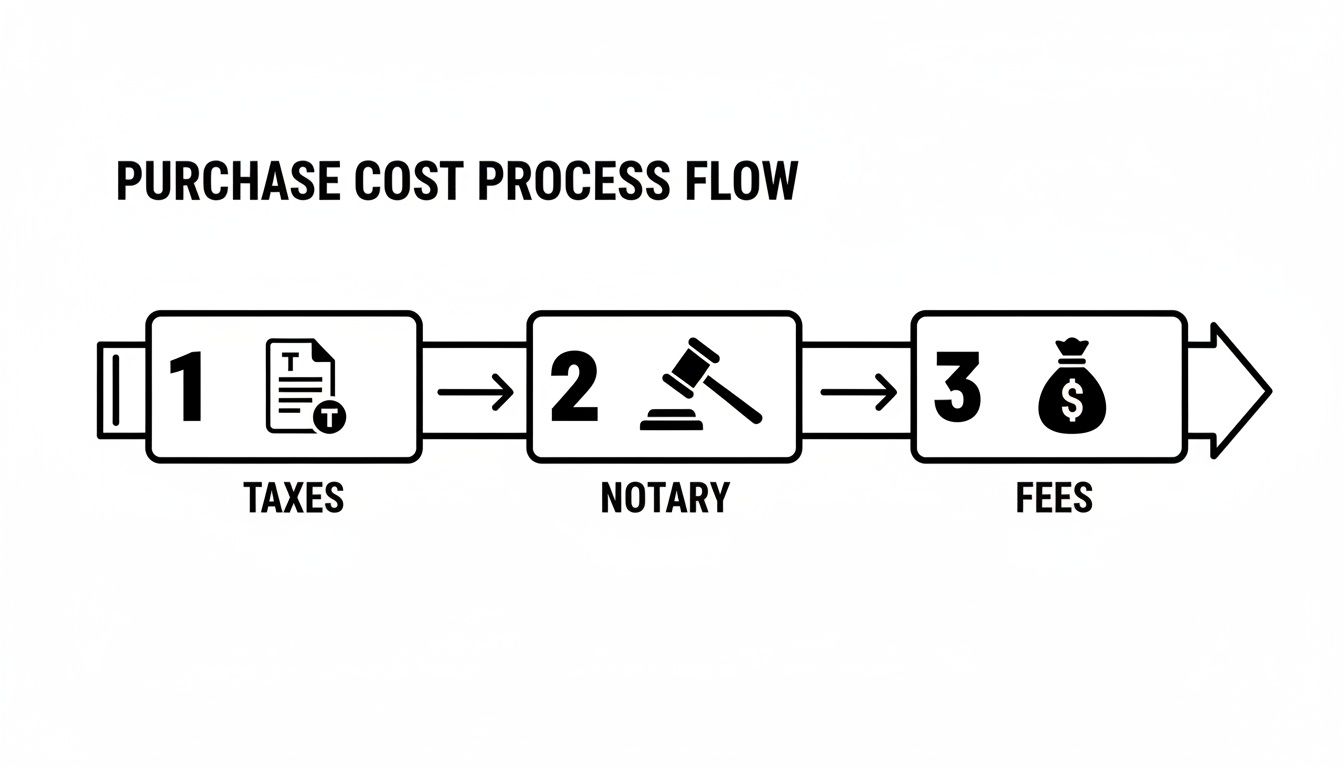
The total amount is split between taxes, notary services, and other fees, all handled through the secure escrow process.
The final steps involve the formal, notarised signing of the Kaufvertrag. Your notary then submits all required documents to the local court to pay the property transfer tax and register you as the new owner. Once the court confirms the registration is complete, the funds are released from escrow, and you can collect the keys to your new Austrian home.
Managing Your Austrian Property Investment

Acquiring the keys to your Austrian property is a significant milestone, but the work of turning it into a successful investment begins now. For overseas investors, the primary decision is whether to self-manage or hire a professional.
Unless you are based in Austria and fluent in German, engaging a local management company—a Hausverwaltung—is almost always the most practical choice. These firms act as your local presence, handling everything from finding tenants and collecting rent to dealing with maintenance and navigating Austria’s tenancy laws, thereby protecting your investment from a distance.
Professional Management And Typical Costs
A reputable Hausverwaltung provides comprehensive administrative, technical, and financial oversight to ensure your asset performs optimally without requiring your day-to-day involvement.
For this service, expect to pay a management fee of between 3% and 5% of the gross monthly rent, plus VAT. Considering the complexity of Austrian rental law and the challenges of coordinating repairs from abroad, this is a justifiable expense.
Their services typically include:
- Tenant Sourcing and Vetting: Finding and screening reliable tenants to maintain occupancy and consistent income.
- Rent Collection and Accounting: Managing payments and providing clear, regular financial statements.
- Maintenance and Repairs: Utilising a network of trusted local tradespeople to address issues promptly and professionally.
- Legal Compliance: Ensuring lease agreements are robust and fully compliant with Austrian regulations.
Rental Yields And Ongoing Expenses
Before calculating returns, it is vital to have a realistic understanding of potential income and ongoing costs. Gross rental yields in Austria's main cities are generally solid, though they vary by location.
Here is a general guide based on current market data:
- Vienna: Yields typically range between 3% and 4%. Demand is consistently high, as expected in a major European capital.
- Graz: Returns are often slightly better here, around 4% to 4.5%, making it popular with investors seeking value.
- Salzburg: Due to premium property prices, yields are tighter, usually between 2.5% and 3.5%.
Remember to factor in costs beyond the management fee when calculating your net return. These include the annual property tax (Grundsteuer), which is relatively modest, and contributions to the building’s maintenance reserve fund (Rücklage) if you own a flat.
The short-term holiday let market, particularly in tourist hotspots like Tyrol or the Salzkammergut, can offer significantly higher income potential. However, this sector is heavily regulated. Each region has specific rules on registration, tourist taxes, and rental frequency. Thorough research into local legislation is essential before pursuing this strategy.
Frequently Asked Questions About Buying in Austria
International investors often have several key questions when first exploring the Austrian property market. Clarifying these early can save considerable time and help you proceed with confidence.
A primary concern is whether it is possible to obtain a mortgage as a foreigner. The answer is yes; Austrian banks are generally open to lending to non-residents who can demonstrate a stable income and a good credit history. You can typically expect to secure a loan-to-value (LTV) ratio of between 60% and 80%.
What About Capital Gains Tax if I Decide to Sell?
This is a critical consideration for any investor. In Austria, the capital gains tax on property is called Immobilienertragsteuer, levied at a flat rate of 30% on any profit from a sale. This is a significant figure, but there is a crucial exemption.
If the property has served as your main residence (Hauptwohnsitz) for at least two consecutive years after purchase, or for five of the ten years prior to selling, you are generally exempt from the tax.
This rule heavily influences investment strategies in the country, making short-term "flipping" less attractive and favouring longer-term holding periods.
Investor Takeaway: The Austrian tax structure strongly incentivises a buy-and-hold strategy. If you are considering a quick resale, you must factor the 30% tax into your calculations from the outset. For most investors, holding the property long-term is far more tax-efficient.
How Does the Austrian Market Compare to Others?
Investors frequently want to compare Austria to more familiar markets, such as the UK. While Austria is renowned for its stability, other markets offer different types of opportunities and risk profiles.
The UK housing market, for instance, has demonstrated significant resilience. According to the Office for National Statistics (ONS), average UK house prices have shown consistent long-term growth despite short-term fluctuations. For example, data from the ONS for early 2024 indicated that while prices had seen a slight annual decrease, rental prices were increasing at their fastest rate on record. This combination of potential capital growth and strong rental demand, especially in key regions, makes the UK a solid option for portfolio diversification. You can explore the data with the UK property market trends and data from the ONS.
At World Property Investor, we provide the data and analysis required to make informed decisions in global property markets. Explore our in-depth guides to identify your next investment at https://www.worldpropertyinvestor.com.