
If you're a UK investor looking at overseas property, you're probably balancing two frustrations at once. Domestic buy-to-let still offers familiarity, but the margins feel tighter, tax is more intrusive, and sourcing a strong deal takes more work than it did a few years ago. At the same time, many overseas guides oversell opportunity and under-explain the legal reality.
Egypt sits in that gap. It attracts attention because it offers a different demand profile from the UK, with resort markets, expanding urban districts, and pricing that often feels more accessible to foreign-currency buyers than many mature markets. But buying property in Egypt isn't a plug-and-play version of buying in Manchester, Leeds, or Birmingham. The bureaucracy matters. The paperwork matters. The sequencing matters.
That's why disciplined investors do better here than impulsive ones. The upside comes from choosing the right location, using an independent lawyer, and planning for a government approval process that many glossy sales brochures barely mention. If you're comparing mature and emerging markets, broad international market context helps, and global property market comparisons are useful for framing where Egypt sits on the risk-reward spectrum.
An Introduction to the Egyptian Property Market
A UK buyer flies to Hurghada for a viewing trip, reserves an apartment by the sea, pays a deposit, and assumes the rest will work broadly like an overseas version of a UK purchase. That assumption is where problems start. In Egypt, the deal can look attractive on price and rental story, but the transaction only works if the legal route, title position, and security clearance process are checked early.
Egypt attracts investors for clear reasons. Prices can be more accessible than in many UK cities. Demand comes from more than one segment, including tourism, domestic movers, professionals in newer urban districts, and diaspora buyers. For investors comparing risk and return across borders, these international property market comparisons help put Egypt in the right context.
The market is not one single story.
Parts of Egypt behave like tourism property plays. Other areas are driven more by local housing demand, infrastructure expansion, and long-hold urban growth. That gives a UK investor several possible strategies, but it also means headline pricing tells you very little on its own. A low entry price is not the same as a good investment if resale demand is thin, the building is poorly managed, or the ownership paperwork cannot support a clean transfer.
Why Egypt gets serious investor attention
Three features usually bring Egypt into the shortlist:
- Lower capital entry in selected submarkets: Many buyers can access resort apartments or units in new developments with less capital than a comparable purchase in established UK markets.
- Different demand drivers: Short-stay tourism, professional lets, and owner-occupier demand do not all move for the same reasons.
- Diversification outside the UK system: Currency, regulation, tenant profile, and growth drivers differ from the domestic market.
That variety is useful, but it raises the standard for due diligence.
The main mistake I see is buyers spending too much time on brochure quality, payment plans, and projected returns before testing whether the transaction is executable. In Egypt, process risk is real. You need to know who owns the land, what form of title is being transferred, whether the contract structure is enforceable, and how long security clearance may hold up completion or registration for a foreign buyer.
What makes Egypt different from a UK purchase
UK investors are used to a system where the broad steps are familiar, even when the deal itself is not. In Egypt, the sequence matters more. A good unit in the wrong legal structure can become a slow, expensive problem.
Security clearance is one of the details generic guides often gloss over. It is not a side issue. It can affect timing, deal certainty, and your ability to move from reservation to a properly completed acquisition. For a UK investor, that means underwriting the purchase with realistic timeframes, not sales-office timelines.
A disciplined buyer treats Egypt as a market where legal verification comes before confidence. That approach protects capital, reduces avoidable delays, and gives you a better basis for judging whether the opportunity is attractive in reality or only looks that way on a viewing trip.
Where to Invest in Egypt Property Hotspots
Not every Egyptian market suits the same investor. Coastal resort areas and newer urban centres can both work, but they produce different holding patterns, tenant demand, and management headaches. If you're comparing options, property investment location guides help frame the strategic differences between lifestyle-driven and fundamentals-driven markets.
Coastal markets for holiday and short-stay demand
Hurghada and El Gouna are the names many foreign buyers encounter first. That's not surprising. They're easier to market internationally, easier for a UK buyer to visualise, and often more straightforward to position as holiday or seasonal rental plays.
These areas generally suit investors who want:
- Tourism-led occupancy
- A property they may also use personally
- A shorter-stay rental strategy
- An asset that is easier to market visually
That said, coastal buying works best when the building, management structure, and local letting model are already clear. Resort demand can support rental income, but poor block management, weak furnishing standards, and unrealistic occupancy assumptions can ruin an otherwise sensible purchase.
Urban markets for longer-hold strategy
New Cairo and the New Administrative Capital attract a different buyer profile. These aren't primarily about holiday demand. They're about urban growth, professional tenants, business activity, and the expansion of newer districts.
This kind of investment usually fits buyers who prefer:
- Longer holding periods
- Capital appreciation potential
- Professional or family tenants
- Less reliance on seasonal tourism flows
Urban units often make more sense for investors who think like landlords first and holiday-home owners second. They can also be easier to underwrite in practical terms because you're not relying on peak-season performance to make the numbers work.
Egypt Investment Hotspot Comparison 2026
Because precise local pricing and yield figures vary by project, build quality, and legal status, the smartest comparison is qualitative rather than speculative.
| Location | Investor Profile | Avg. Price/sq. m. (GBP) | Typical Gross Yield | Key Drivers |
|---|---|---|---|---|
| Hurghada | Holiday-let investor, lifestyle buyer | Varies by project and title quality | Market-dependent | Tourism demand, resort inventory, resale appeal |
| El Gouna | Premium leisure investor, second-home buyer | Varies by community and finish | Market-dependent | Master-planned environment, international appeal, managed communities |
| New Cairo | Long-term landlord, professional tenant focus | Varies by district and developer | Market-dependent | Urban expansion, professional demand, newer housing stock |
| New Administrative Capital | Growth-oriented investor, early-position buyer | Varies by phase and developer | Market-dependent | Government relocation, infrastructure rollout, new commercial nodes |
| Alexandria | Mixed-use investor, domestic demand focus | Varies by neighbourhood | Market-dependent | Established city demand, coastal identity, local occupancy base |
The best location isn't the one with the strongest sales pitch. It's the one whose tenant profile matches your management capacity and risk tolerance.
Matching location to strategy
A simple way to choose is to decide what problem the asset is meant to solve.
If you want flexibility, occasional personal use, and tourism-driven upside, a coastal asset may fit. If you want a more conventional landlord model with local end-user demand, urban districts deserve more attention.
What doesn't work is mixing both ideas without recognising the compromise. A unit bought for personal holidays is rarely the same unit that performs best as a disciplined rental investment.
Understanding Foreign Ownership Rules and Security Clearance
Foreign buyers usually focus on the sale contract first. In Egypt, the legal framework deserves attention before you negotiate anything substantial. If you want a broader comparison point, foreign ownership restrictions across countries show that Egypt is far from the only market where foreign buyers face extra procedural layers.
What UK buyers need to understand first
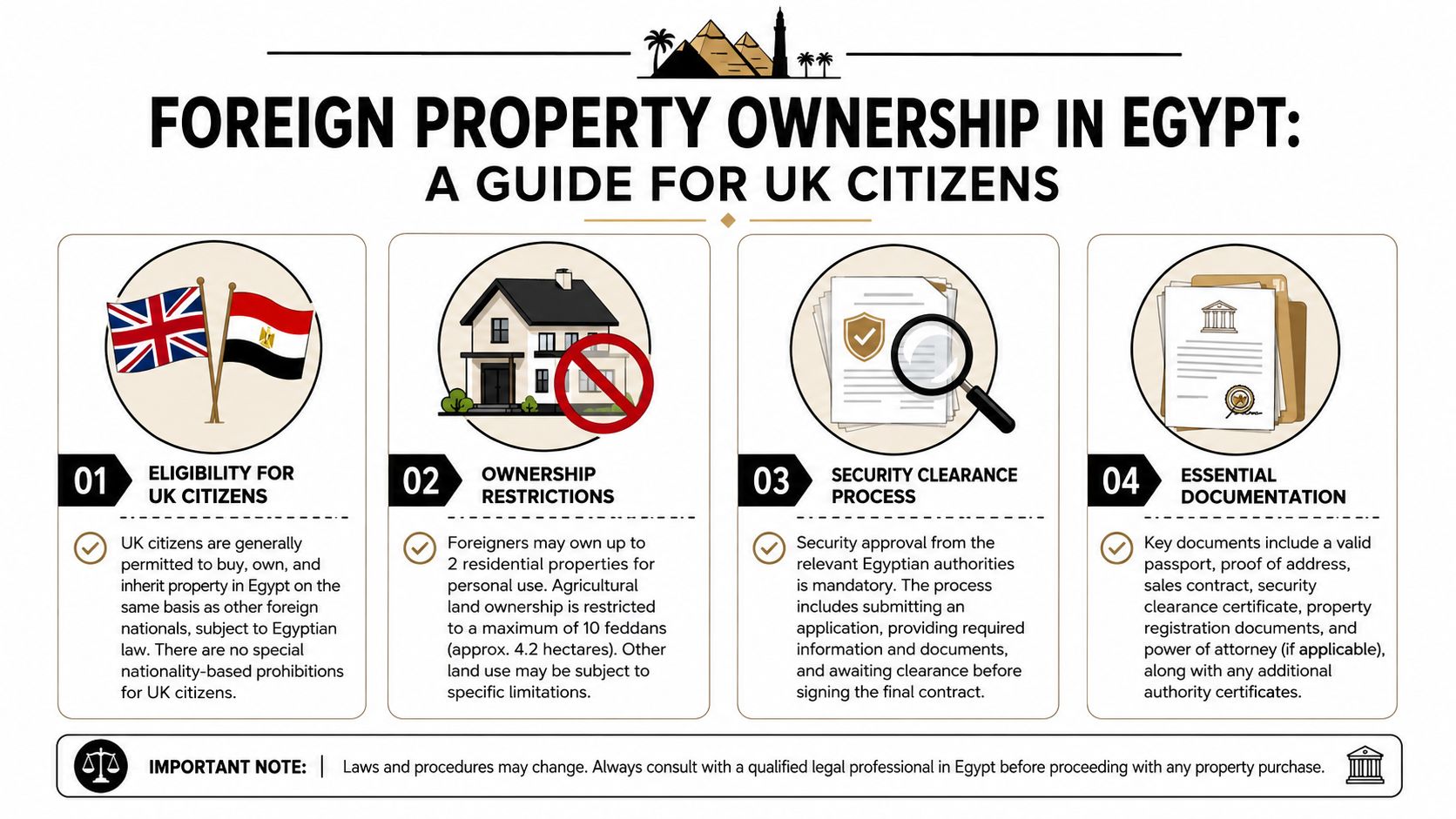
Foreign nationals can buy residential property in Egypt, but the legal route isn't informal. A major blind spot for UK buyers is the security clearance process. It requires Egyptian government vetting before the purchase can be finalised, and the waiting period often lasts 3 to 6 months, as noted in Imtilak's overview for UK citizens buying in Egypt.
That delay changes how you negotiate, how you transfer funds, and how you plan your timeline. It also changes what “ready to buy” means.
Why the clearance process matters
The security clearance stage is often treated as a formality by sales agents. That's a mistake. It's a state approval process, not a courtesy stamp.
UK buyers should plan for requests around identity verification, source of funds, and personal background documentation. In practice, that may include passport copies, proof of address, banking evidence, and supporting records that help establish who you are and where the purchase money comes from. For investors used to modern compliance checks, the logic is familiar. A useful comparison is India's Aadhaar-based eKYC compliance, where identity and transaction legitimacy are central to approval systems. Egypt's property vetting is different in law and process, but the principle is similar. Authorities want a traceable buyer, traceable funds, and a file that stands up to scrutiny.
How UK investors should approach it
Treat security clearance as a project in its own right:
- Assemble documents early. Don't wait until after negotiating price.
- Use translated and properly prepared paperwork where required. Incomplete files create avoidable delay.
- Budget for waiting time. If your plan depends on instant completion, it's the wrong plan.
- Keep funds traceable. Informal transfer arrangements are asking for trouble.
- Avoid pressure tactics from developers or brokers. If someone dismisses approval requirements, step back.
Buying property in Egypt without planning for clearance timing is like exchanging contracts while ignoring whether title can actually pass. The deal may look alive, but completion risk is already building.
The real practical issue
The problem isn't only whether a buyer can get clearance. The problem is that many buyers commit too early, pay too much too soon, or sign documents they don't fully understand before that approval risk is properly managed.
That's where independent legal advice earns its fee.
The Step by Step Property Purchase Process in Egypt
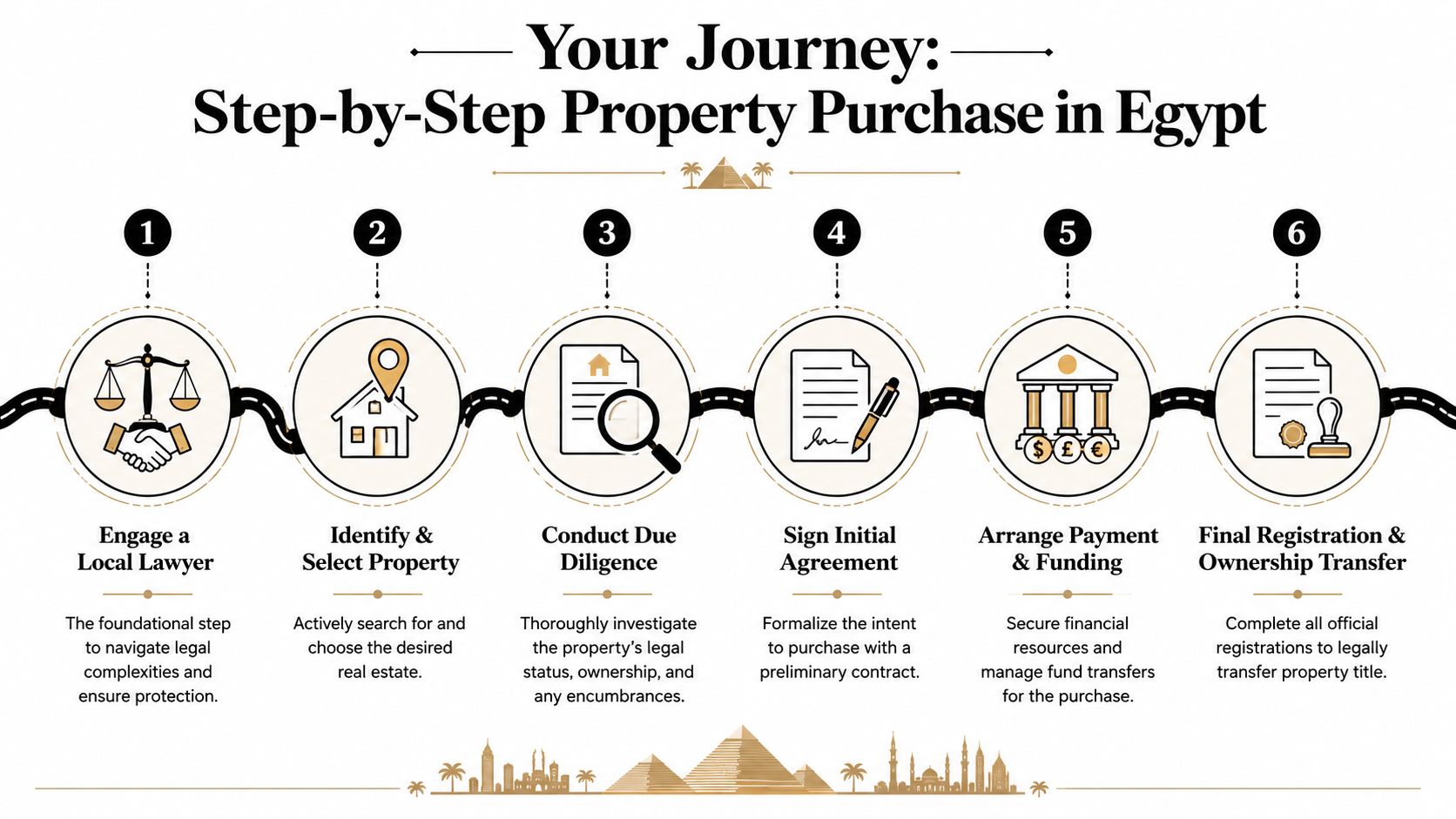
A sound purchase in Egypt follows an order. Skip that order and you increase the chance of delay, title problems, or a failed transfer. For legal support, buyers often benefit from reviewing how to choose an international real estate lawyer before engaging anyone locally.
A visual summary helps, especially if you're mapping responsibilities between yourself, your lawyer, and the seller.
Start with an independent solicitor
For UK buyers purchasing residential property in Egypt, the process should begin with appointing a solicitor to conduct a title search before any offer is made. The purchase then moves toward a registration package submitted to the Council of Ministers for government clearance, and the process typically incurs a registration tax of 2% to 3% of the property value at final registration, according to Wise's guide to buying property in Egypt.
That opening step is mandatory.
Your solicitor should be independent from the developer and independent from the selling agent. If the person “helping” you buy is paid by the seller, assume their priority is getting the deal over the line, not protecting your downside.
The practical purchase sequence
The workflow usually looks like this:
Choose the property carefully
Shortlist based on location, developer reputation, title quality, and realistic rental use. Ignore glossy projections that can't be independently verified.Instruct your lawyer
They should review ownership records, legal status, and any claims, debts, or registration problems attached to the property.Run due diligence before committing
This includes title review, seller identity checks, and confirming whether the property can be transferred to a foreign buyer without hidden issues.
Key check: If your lawyer can't clearly explain who owns the property now, how ownership is evidenced, and what must happen for title to pass to you, you are not ready to proceed.
Agree heads of terms or reservation terms carefully
Reservation agreements can be useful, but only if the wording protects you if legal issues emerge or approvals fail.Draft and review the sale contract
If you're not reading Arabic, insist on an accurate translation and legal explanation. Don't rely on verbal summaries.Prepare the government submission and final registration package
At this stage, procedural discipline is paramount. Missing documents and inconsistent names across paperwork can slow things down.
Don't rush the middle of the process
Many buyers think the risky part is finding the property. It isn't. The risky part is the middle, where money starts moving and legal assumptions start hardening.
This is also where remote buyers can get into trouble. If you're buying from the UK, insist on a document trail for every step. Copies of title records, signed agreements, passport details, proof of funds, utility documentation, and tax clearances should be organised and easy to retrieve.
The registration stage matters because final title transfer depends on state acceptance, not just a private agreement between buyer and seller. Wise notes that the buyer must pay the registration tax at final registration alongside utility receipts and tax clearances to prove there are no hidden liens.
Use the process, don't improvise it
This walkthrough is easier to understand when you can see how the pieces fit together in practice:
What works and what doesn't
What works:
- Independent legal representation
- Document-led due diligence
- Traceable payments
- Clear contractual exit clauses
- Patience during government clearance and registration
What doesn't work:
- Paying large sums before title review
- Trusting a developer's in-house legal reassurance
- Assuming a reservation form is harmless
- Treating translation as optional
- Believing that “everyone buys this way” is legal advice
Buying property in Egypt can be straightforward when the chain of ownership is clean and the paperwork is handled properly. It becomes messy when buyers let speed replace verification.
Analysing Costs Taxes and Potential Rental Yields
A UK buyer who agrees an Egyptian purchase price on Monday can still be revising the deal economics by Friday. Legal fees, furnishing, management, registration, vacancy periods, and currency transfer costs all affect the return. Security clearance can affect it too. If completion is delayed, your capital sits idle for longer, and that changes the annualised return even if the headline rent looks strong. If you need a clean framework for the maths, how to calculate rental yields is the right starting point.
The acquisition costs buyers often overlook
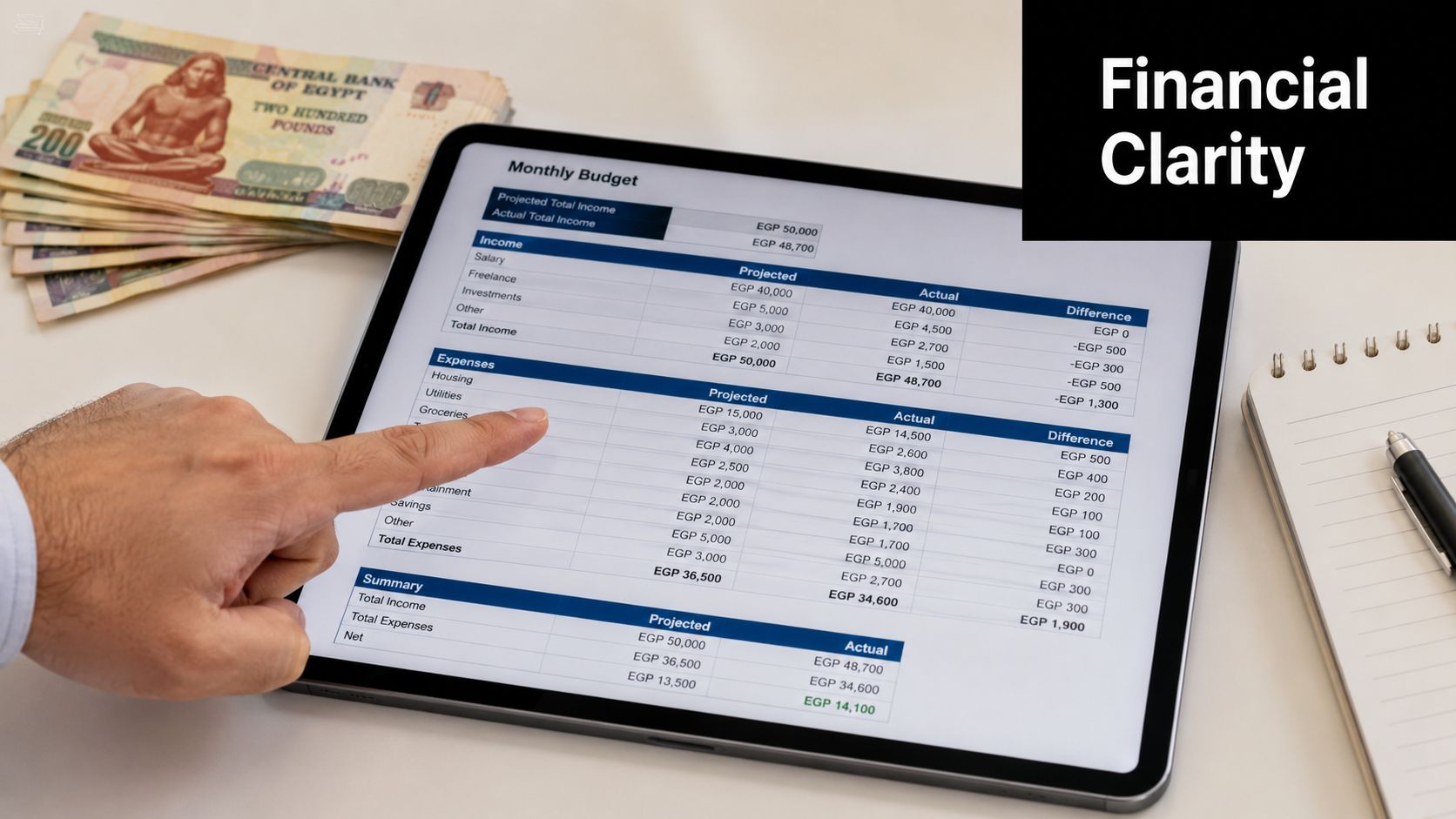
The purchase price is the easy number. The useful number is total cash in.
In Egypt, buyers should budget for legal fees, document preparation, agency fees where they apply, furnishing if the unit is aimed at short lets, and the registration tax already noted earlier. Add contingency for translation, certified copies, utility setup, and early maintenance. On smaller deals, those costs can materially change the expected yield.
UK investors should also compare the Egyptian deal against the home-market alternative. That comparison is sharper now because UK entry costs on additional properties have risen. In October 2024, the Stamp Duty Land Tax surcharge on additional properties increased from 3% to 5% above standard rates, applying to the entire purchase price on additional properties over £40,000, as outlined by Total Landlord Insurance's landlord tax summary. That does not make Egypt automatically better. It means the hurdle rate for a UK buy-to-let purchase is higher, so offshore opportunities get closer scrutiny.
One more practical point. If your Egyptian purchase cannot complete or register on the timetable first discussed because security clearance runs long, carrying costs rise and your first-year return falls. I treat that as part of underwriting, not an administrative footnote.
Understanding gross yield properly
Gross yield is only a first filter. It helps compare deals quickly, but it does not measure what you keep after costs, delays, and tax.
The basic formula is simple. Gross rental yield = (Annual rental income ÷ Property value) × 100. As noted earlier, UK investors often use local gross yield norms as a rough benchmark before looking abroad. That benchmark is useful only if the Egyptian number is built on real assumptions rather than sales copy.
Ask direct questions:
- Is the rent based on signed comparables or on a developer projection?
- Is occupancy supported by local demand, seasonality, and management capability?
- Are furnishing, service charges, repairs, cleaning, and letting fees included anywhere?
- Does the property type and building allow the rental strategy being marketed?
- If security clearance or registration takes longer than expected, how many months of lost rent or delayed use have been allowed for?
For a straightforward explanation of the mechanics, this guide to understanding rental property returns is useful because it separates simple yield maths from the harder question of net performance.
A lower quoted yield on a clean, rentable unit in a proven micro-location can outperform a higher quoted yield attached to weak occupancy assumptions or a messy ownership position.
UK tax context still matters
Egyptian rental income still sits inside a wider UK tax picture if you are UK resident for tax purposes. That is why I focus clients on net return after operating costs, transfer costs, and tax, rather than headline rent.
A proposed future change has also been discussed in the UK tax conversation. From April 2027, the UK government is planned to apply separate, higher income tax rates for property income only at 22%, 42%, and 47%, according to the cited LinkedIn post on the planned property tax update. Because that is a planned measure rather than a current rule, treat it as a scenario to model rather than a settled outcome.
There is also the exit side to consider. As of 6 April 2024, the higher UK Capital Gains Tax rate on residential property fell from 28% to 24%, while the basic rate remained 18% and the annual exemption dropped to £3,000 from £6,000 in the prior tax year, as summarised by St. James's Place on buy-to-let tax changes. For a UK investor buying in Egypt, that does not settle the investment case. It does mean disposal planning, ownership structure, and realistic net yield assumptions should be part of the decision from day one.
Common Pitfalls and Your Next Steps
The biggest mistakes in buying property in Egypt aren't dramatic. They're ordinary errors repeated by buyers who move too quickly.
The mistakes that cost investors most
- Using the seller's lawyer as if they were your adviser: That arrangement may keep the transaction moving, but it doesn't guarantee anyone is protecting your position.
- Underestimating the approval timeline: The security clearance process can stretch for months. Buyers who need speed often make poor decisions under pressure.
- Paying before due diligence is complete: Deposits and staged payments feel harmless until a title issue appears.
- Buying off-plan without verifying the developer and legal structure: Off-plan can work, but only when the developer, land rights, and contract terms are all strong.
- Confusing holiday appeal with investment quality: A good-looking unit isn't automatically a good-performing asset.
If a deal only works when every assumption is favourable, it isn't an investment case. It's a sales narrative.
What disciplined buyers do differently
They slow the process down at the front end. They ask for paperwork early. They test rental assumptions rather than repeating marketing language. They choose a location based on tenant demand, not just personal taste. Most of all, they accept that legal certainty matters more than launch discounts or “today only” incentives.
That mindset is what separates a workable emerging-market investment from an avoidable overseas problem.
Next steps
If you're serious about entering the Egyptian market, keep the next move simple:
Define your strategy first
Decide whether you want holiday-let exposure, long-term rental income, personal use with some income, or a growth-oriented hold.Narrow your target location
Compare resort markets with urban districts based on tenant type, management intensity, and resale logic.Start sourcing an independent local solicitor
Ask about title review, foreign buyer experience, translation support, and how they manage registration and clearance paperwork.Stress-test the numbers
Run gross yield, likely net yield, vacancy assumptions, and all acquisition costs before paying anything meaningful.Prepare your buyer file
Organise identification, proof of funds, and supporting documents early so you're not scrambling once the legal process starts.
Buying property in Egypt can make sense for a UK investor. But it only makes sense when the purchase is structured around due diligence, timing realism, and clean execution.
If you're comparing Egypt with other international markets, World Property Investor gives you country guides, rental yield breakdowns, tax overviews, and practical buying advice so you can assess deals with more confidence before committing capital.