
Albania's residential market has moved beyond the simple “cheap European property” story. The Fischer House Price Index rose 41.7% year on year, while Tirana recorded a 32.6% annual increase, according to market reporting cited in UK government guidance on living in Albania. For a UK buyer, that changes the central question from “Can I find a bargain?” to “Which property type still offers sensible value, and which purchase creates unnecessary legal complexity?”
Buying property in Albania remains accessible for standard residential assets. British nationals can generally buy apartments, houses, villas and commercial buildings without being resident in Albania, but agricultural land introduces a significant dividing line. A purchase of 1,000 square metres or more of agricultural land requires the buyer to establish an Albanian company or partner with a locally registered company, based on the Albanian property guidance provided for UK buyers.
That distinction matters for holiday-home buyers, developers and investors considering rural plots. An apartment in Tirana or a registered coastal unit may be relatively straightforward. A villa with agricultural land attached can demand a far more careful ownership structure, classification review and legal timetable.
Table of Contents
- Albania Property Market Overview and Recent Trends
- Foreign Ownership Rules for UK Buyers
- Where to Buy Property in Albania by Investment Goal
- The Legal and Notary Process Explained
- Taxes Fees and Transaction Costs
- Common Pitfalls and How to Avoid Them
- Practical Next Steps for Prospective Buyers
Albania Property Market Overview and Recent Trends
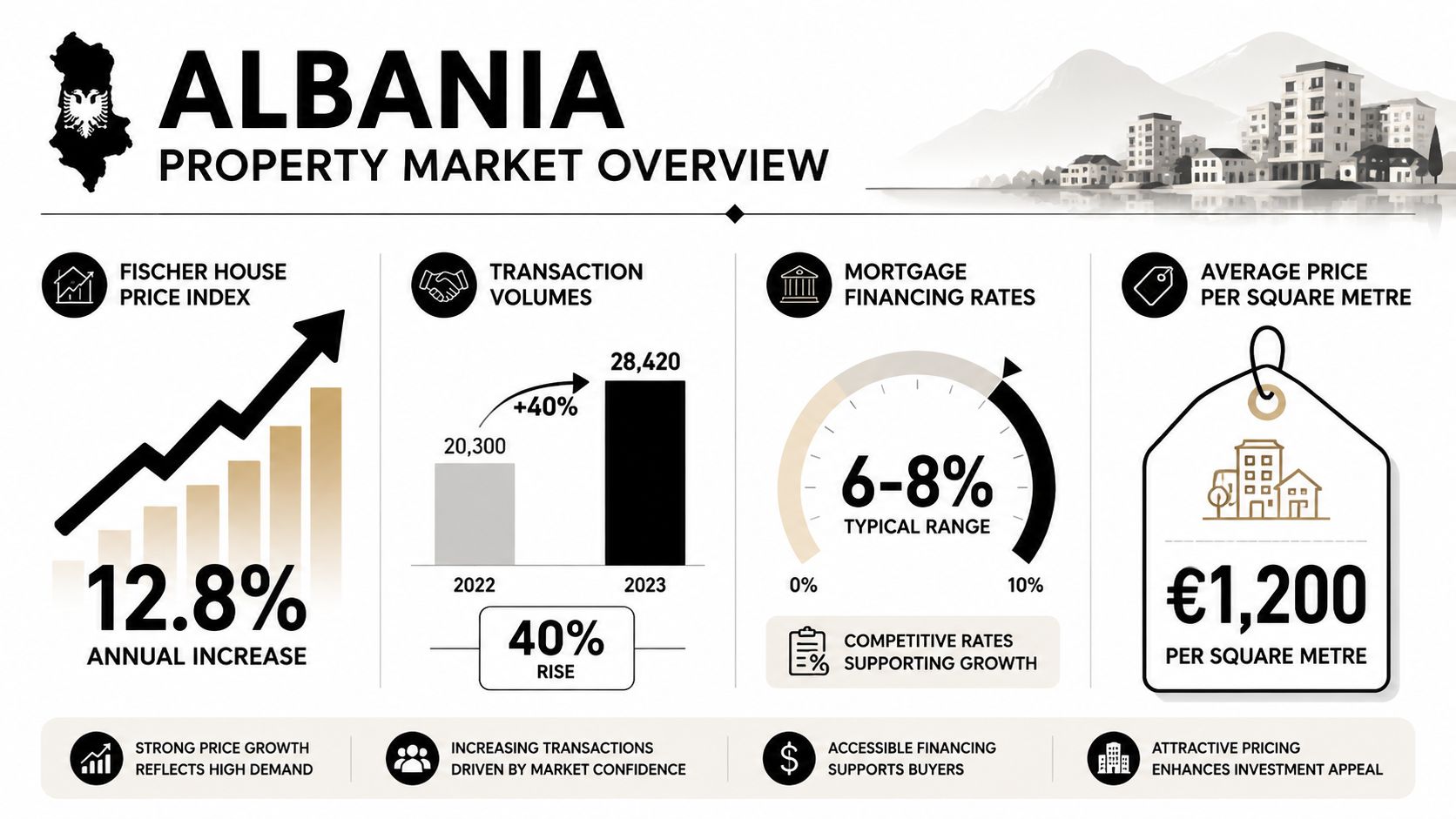
The 41.7% year-on-year rise in the national Fischer House Price Index has changed the value equation for UK buyers. Prices also increased 14.6% over six months, while Tirana recorded a 32.6% annual increase. The figures, summarised in earlier UK government guidance for Albania, show why Albania can no longer be assessed as a uniformly low-cost European market.
Transaction data supports the repricing. 1,959 properties changed hands in the first half of the year, compared with 863 in the previous six-month period, and 58% of transactions were mortgage-financed. Among those mortgage-backed purchases, 62% involved loans covering up to 60% of the property price. Rising prices therefore coincided with higher completed sales and active domestic borrowing, rather than relying only on advertised prices.
Why the market has re-rated
Foreign demand, tourism, infrastructure investment and urbanisation have concentrated buying interest in Tirana and coastal locations. A market summary drawing on Bank of Albania survey data reported that about 18% of apartments sold were bought by non-residents, with roughly 77% of those non-resident buyers coming from the EU, according to Albanian Times' 2025 housing-market coverage.
For UK buyers, the result is a divided market. Standard residential units can remain accessible, particularly where title, registration and year-round demand are clear. Coastal property and land-led projects are harder to price confidently after the surge, especially when asking prices depend on holiday demand or overseas buyers rather than local rental evidence.
A wider review of international property trends can provide context, but country-level comparisons are insufficient for Albania. Micro-location, title quality and property type now matter more than the country label.
What the price data means for a UK entrant
Waiting could mean paying more if demand persists. Rushing could mean overpaying for a poorly registered unit or a coastal property whose rental prospects have been overstated. Albania may still offer value, but value is no longer automatic.
The stronger opportunities are likely to be legally clean apartments, houses or villas in locations with identifiable year-round demand. Agricultural land, mixed-use schemes and unverified off-plan projects require a higher risk allowance, particularly because residency and ownership rules can complicate land-based purchases. For UK buyers, the recent price surge has not removed the market's potential. It has narrowed the margin for weak due diligence and shifted the focus from finding the cheapest asset to selecting the most defensible one.
Foreign Ownership Rules for UK Buyers
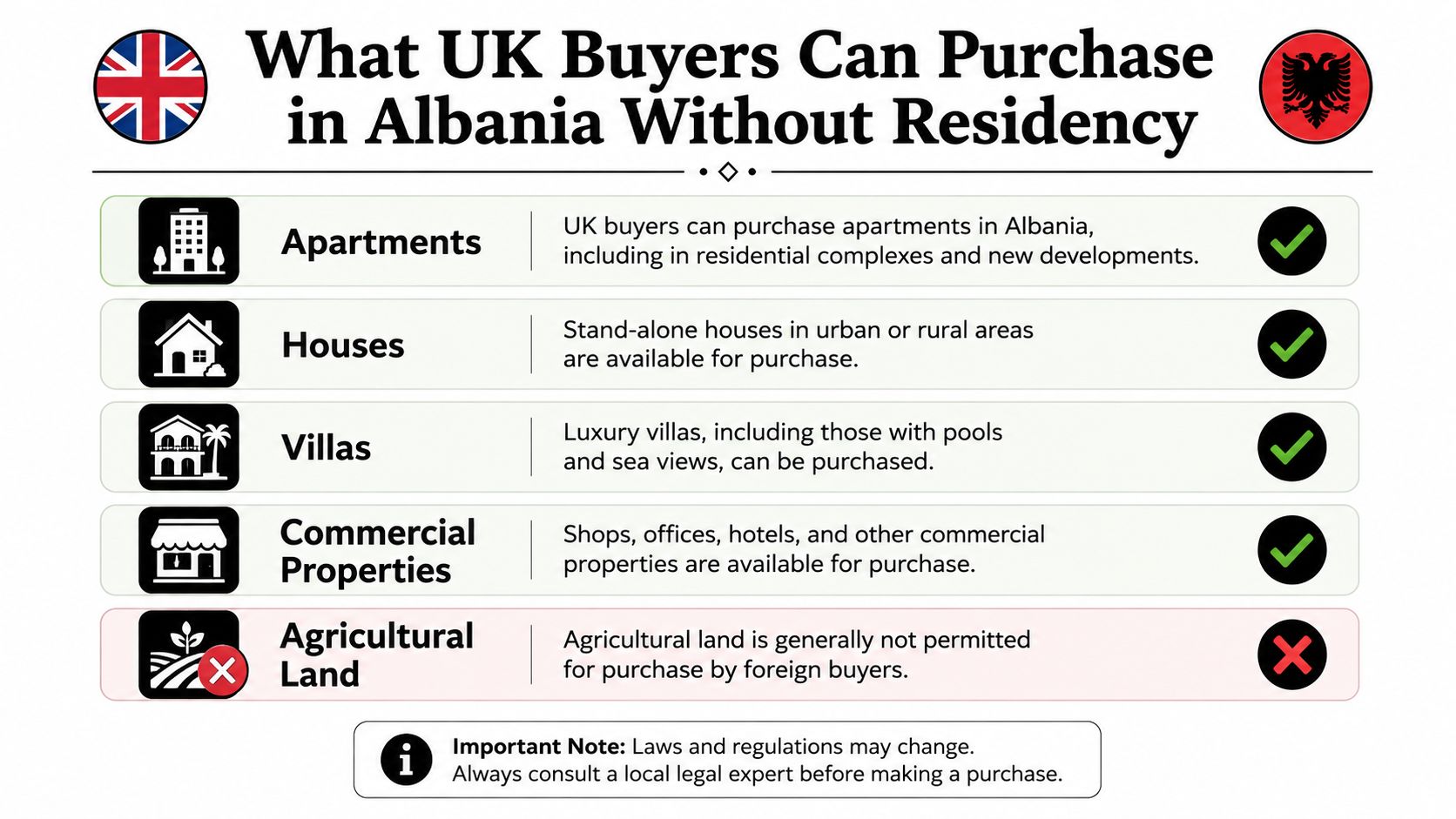
For most UK buyers, Albania's residential ownership rules are comparatively accessible. A British national can generally purchase an apartment, house, villa or commercial building in their own name, without needing Albanian residency or citizenship. Foreigners can also buy apartments and commercial units without a reciprocity requirement, according to the Albanian foreign-buyer tax and ownership overview.
That makes the first decision straightforward. If your target is a registered apartment in Tirana, Durrës, Vlora or Saranda, the main challenge is usually not permission to own it. The challenge is confirming that the seller has valid title, the building is lawful and the deed can be registered correctly.
The agricultural-land boundary
Agricultural land is the important exception. UK guidance says that non-residents can buy property or land, but where the agricultural-land purchase reaches 1,000 square metres or more, the buyer must either establish a company in Albania or partner with a locally registered company. This isn't a technical footnote. It can change the entire transaction structure, funding plan and exit route.
A villa purchase therefore needs more than a viewing and a title check. Your lawyer should confirm whether the land beneath or surrounding the building is classified as urban, buildable, agricultural, forest or another restricted category. The word “villa” describes the building, not necessarily the legal status of its plot.
Practical rule: Treat the land classification as a separate investment question from the quality of the house.
The rule also creates a clear contrast with how many UK buyers approach Spain or Portugal. Buyers familiar with those markets may assume that owning a rural home and its surrounding land is as simple as buying a city apartment. In Albania, that assumption can produce an unsuitable structure or a deposit on an asset you can't hold directly.
For an international comparison of these issues, see foreign ownership restrictions by country.
The safest initial shortlist for a first-time UK buyer is usually a fully registered residential unit. Land-heavy purchases should begin with legal classification and ownership structuring, not with the property brochure.
Where to Buy Property in Albania by Investment Goal
Location should follow the property's intended use. Tirana, the southern coast and secondary cities serve different demand pools, so a buyer seeking stable tenants should not assess a coastal holiday apartment by the same criteria as a city investment.
Tirana remains Albania's economic and administrative centre. It offers year-round demand from professionals, families and students, reducing reliance on a short summer season. Prices have risen sharply, however, and the 41.7% year-on-year increase has changed the value equation for UK buyers. Entry-level city units may remain accessible, but competition leaves less room for mistakes in valuation, renovation budgets or rental assumptions.
The southern coast, particularly Saranda and Vlora, suits a different strategy. International visibility and holiday demand can support short-term lets, while seasonal income, furnishing costs, guest management and remote maintenance reduce the simplicity of the model. Coastal apartments can work for buyers seeking personal use alongside rental income, provided the price reflects the exact neighbourhood, building quality and access to amenities rather than a broad “Albanian coast” premium.
Durrës and other secondary locations may offer more room for value-focused buyers. Their performance depends on local employment, transport links, access to services and tenant demand in the specific area. A lower purchase price is not enough if occupancy outside the holiday period is weak or resale liquidity is limited.
| Location | Avg Price per m² | Primary Demand | Best For |
|---|---|---|---|
| Tirana | Tirana's most economical areas are reported at €1,000 to €1,500 per m² | Long-term residential, professional and student demand | Buyers prioritising year-round occupancy |
| Saranda and Vlora | Coastal pricing is rising faster in premium areas, with value dependent on micro-location | Holiday lets, second homes and seasonal demand | Investors comfortable with seasonality |
| Durrës and secondary cities | Often considered more value-oriented than prime Tirana and coastal locations | Local residential demand with some holiday activity | Budget-conscious buyers seeking diversification |
The Tirana range comes from 2025 reporting on Albanian apartment prices. The broader price surge means that “affordable Albania” is now an incomplete investment thesis. UK buyers should compare net rental income, purchase costs, management requirements and likely resale demand, rather than relying on headline prices.
Value is more likely to remain in specific neighbourhoods, properly documented older stock and assets matched to reliable demand. Fully registered apartments may be easier to assess than land-heavy or structurally complex purchases, particularly where residency arrangements affect ownership choices. Use where to buy investment property as a comparison framework, then test each candidate against local tenant evidence, total costs and legal records.
The Legal and Notary Process Explained
A clean Albanian purchase can commonly complete in about two to six weeks once the documents are in order, according to Albanian property transaction guidance. That timeframe shouldn't encourage haste. It describes an efficient transaction after the difficult work has been completed, not a safe timetable from first viewing to ownership.
Start with the right professionals
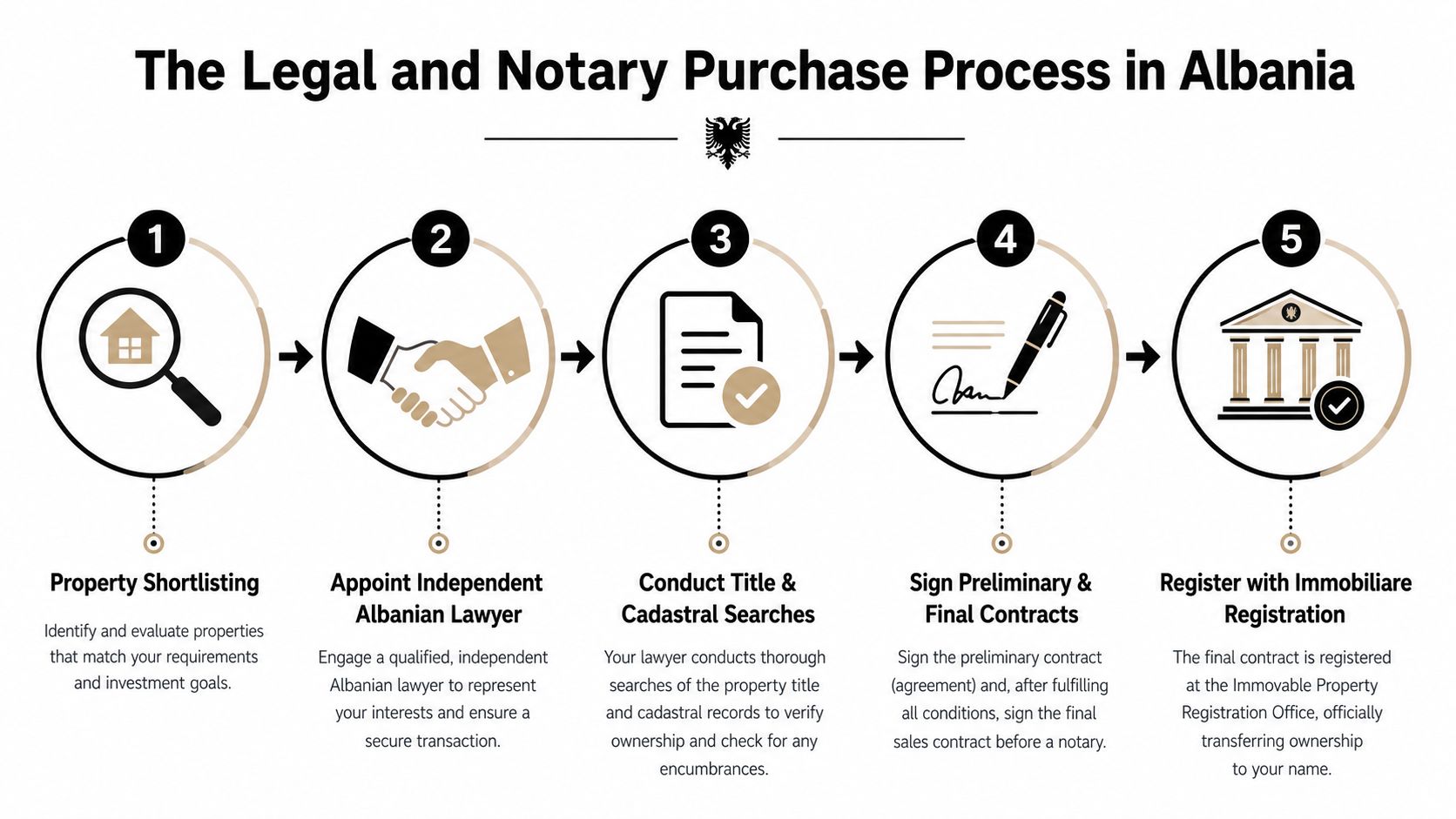
Shortlist the city and property first, then appoint an independent Albanian lawyer before signing a reservation or preliminary agreement. The lawyer shouldn't be selected solely by the agent or developer. A notary formalises the transaction, but your lawyer's role is to identify risks before you become committed.
The first review should establish who owns the property, whether the cadastral record matches the physical unit, and whether the seller has authority to transfer it. Your lawyer should also check zoning, construction permits, occupancy or legalisation status, registered debts, mortgages, seizures and other encumbrances.
Move from verification to registration
For an off-plan property, the preliminary contract should set out the unit, specifications, completion obligations, remedies and payment schedule. Practical Albanian buying guidance notes that these deals often involve a 30% to 40% deposit, which is why legal review must happen before reservation rather than after money has changed hands. See international real estate lawyer guidance for broader cross-border legal considerations.
Once due diligence is satisfactory, the parties sign the final notarised deed. The notary handles the formal completion process, while ownership still needs to be registered with the relevant property registration authority. Keep copies of the signed deed, cadastral documentation, payment records and translations.
The most common causes of delay or loss are predictable:
- Defective title: The seller's documents may not prove clean ownership.
- Missing permits: The building or an extension may not have the required authorisation.
- Unresolved mortgages or seizures: A property can appear attractive while carrying registered claims.
- Cadastral mismatch: The physical apartment, boundaries or floor area may differ from official records.
The sequence is simple. The controls are not optional.
Taxes Fees and Transaction Costs
A buyer's budget should distinguish between the purchase price and the costs required to complete safely. A buyer-facing Albanian tax overview states that residential purchases don't carry VAT or stamp duty, but a property transfer tax of 2% of the contract value applies instead. The parties can negotiate who ultimately bears that transfer tax.
Other costs can include notary charges, independent legal advice, translation and certification, registration, bank charges and an estate-agent commission where the buyer is responsible for some or all of it. These amounts vary by transaction and provider, so they should be confirmed in writing before signing.
A worked example
Assume a hypothetical apartment purchase price of €120,000. The transfer tax at 2% would be €2,400, calculated from the contract value. The remaining costs, such as the lawyer, notary, registration, translations and any agreed agency fee, can't be calculated responsibly without actual quotations and the agreed allocation between buyer and seller.
| Cost item | Treatment in this example |
|---|---|
| Apartment price | €120,000 |
| Property transfer tax at 2% | €2,400 |
| VAT on residential purchase | No VAT according to the cited overview |
| Stamp duty | No stamp duty according to the cited overview |
| Lawyer, notary, registration and other services | Obtain written quotations |
| Indicative minimum before variable services | €122,400 |
This isn't a complete closing-cost total. It's a transparent starting point that prevents buyers from treating the tax as though it were the only expense. Agent commission and professional fees should be agreed before the offer, not introduced at the notary's office.
UK buyers should also separate Albanian acquisition costs from their wider UK tax position. If you're reviewing disposing of UK property as a non, obtain advice on the UK consequences of selling or restructuring existing assets before committing capital abroad. For a broader explanation of legal cost planning, see property conveyancing costs.
Ongoing ownership expenses, including utilities, building maintenance and applicable property taxes, should be checked with a local adviser. They can materially affect a holiday-let strategy even when the purchase tax is clear.
Common Pitfalls and How to Avoid Them
The fastest way to turn an accessible residential purchase into a difficult investment is to trust the sales process more than the records. Foreign buyers often see a clean-looking apartment, hear that the documents are “in order” and assume the notary will identify every problem. The safer approach is to treat the agent's information as a starting point, not proof.
The risks that deserve the most attention
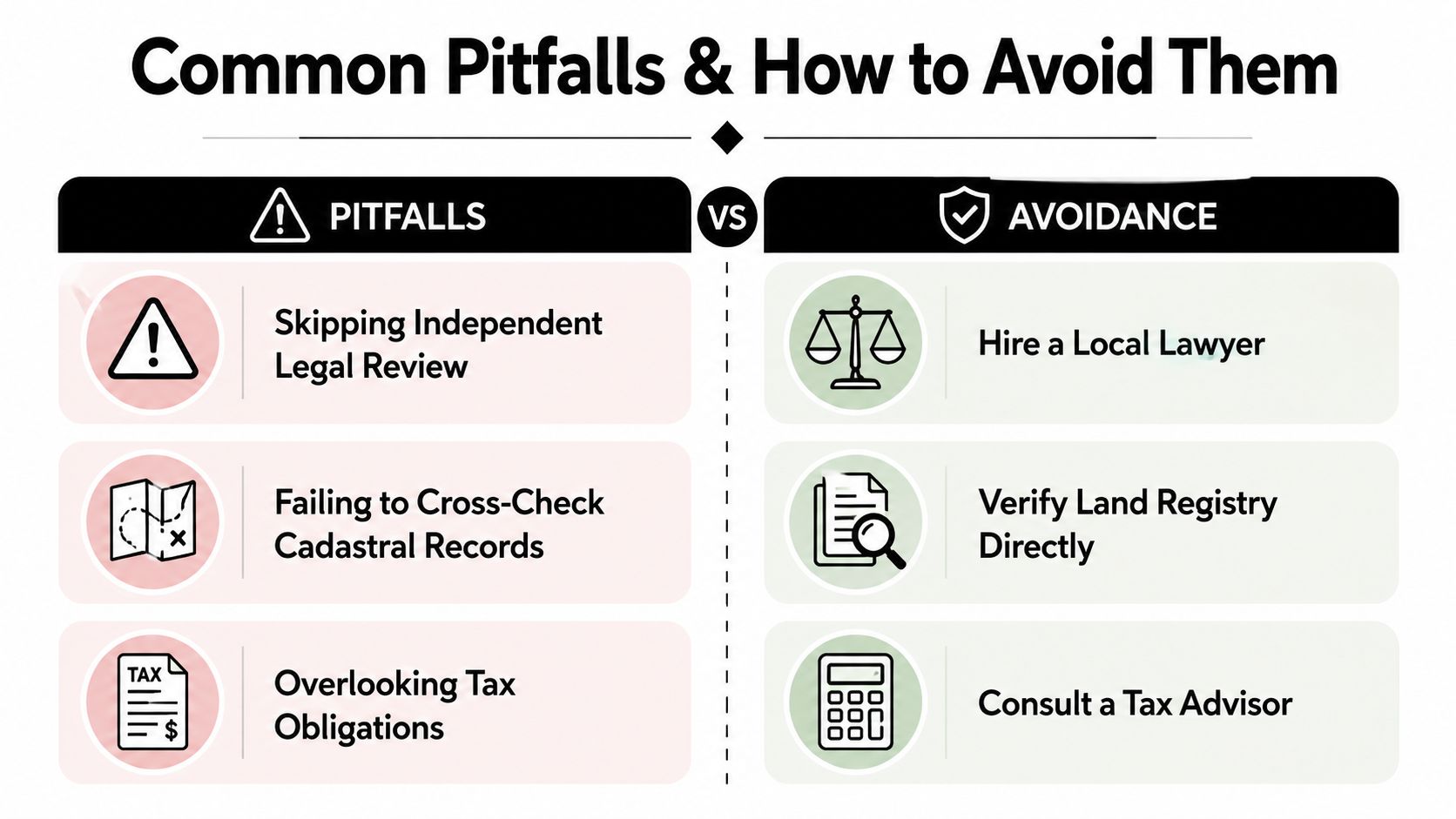
Skipping independent legal review creates the greatest avoidable exposure. A developer or agent may know the project well, but they're not acting as your independent risk adviser. Appoint your own Albanian lawyer and require a written review of title, encumbrances, permits and registration prospects.
Failing to cross-check the cadastre against the physical property can leave you buying a unit whose area, boundaries, floor, layout or ownership details don't match the official record. Visit the property with the documents in hand, and ask your lawyer or surveyor to reconcile what exists on site with what the records describe.
Paying an off-plan deposit before reviewing the contract can create lock-in. The deposit may be substantial, and the buyer may have limited protection if the developer misses obligations or the unit cannot be registered as promised. Legal review should precede the preliminary contract and payment.
Underestimating agricultural-land rules is especially dangerous for villa buyers. The building may be freely purchasable while the surrounding plot falls into a restricted category. Confirm the classification and the ownership structure before negotiating the price.
Relying on verbal assurances produces weak evidence when expectations change. Require the agreed price, specifications, completion terms, responsibility for debts and remedies to appear in the formal contract. Don't accept side arrangements, undeclared payments or documents you haven't independently verified.
A persuasive brochure can sell the property. Only verified records can establish what you're buying.
The pattern behind these mistakes is consistent. Buyers focus on the visible asset and underestimate the legal identity of the land, building and seller. In Albania's fast-moving market, patience is a form of due diligence.
Practical Next Steps for Prospective Buyers
Start with the asset class, not the listing portal. Decide whether you want a Tirana apartment for year-round residential demand, a coastal unit for personal use and holiday letting, or a land-linked villa that may require additional structuring. That decision determines which legal checks matter most.
Set a budget that includes the transfer tax, professional services, registration, financing costs and an appropriate contingency. Don't use the full amount for the purchase price. A property that looks affordable at the viewing stage can become unsuitable once the legal, banking and operating requirements are added.
What to organise before travelling
Prepare the administrative basics before arranging viewings:
- Identity documents: Have a valid passport and any documents your lawyer or notary needs to identify you.
- Funds evidence: Keep bank records and source-of-funds documents ready for compliance checks.
- Tax and banking arrangements: Ask your lawyer about the Albanian tax or identification steps and the local bank account typically needed for completion.
- Professional appointments: Interview an independent lawyer before you pay a reservation fee.
- Property brief: Define your preferred city, asset type, intended use and maximum all-in budget.
During the first visit, inspect the neighbourhood at different times of day, ask how the building is managed and request the documents needed for verification. Don't let a limited travel schedule turn into a reason to waive checks.
This week, choose your investment goal and shortlist locations. This month, appoint counsel, obtain financing clarity and compare properties using the same legal and operational criteria. Before signing, verify title, cadastral records, zoning, permits, debts, land classification and the exact registration route.
World Property Investor provides country and city research, ownership guidance, tax context and international investment analysis that can help you compare Albania with other overseas markets. Visit World Property Investor to evaluate locations and build a more disciplined buying strategy before committing funds.