
You've found the villa. The photographs show a broad Mediterranean view, the terrace looks made for long lunches, and the agent is already talking about holiday income. Yet the 2026 Kalkan buyer is entering a very different market from the one promoted in older sales brochures. Foreign demand across Türkiye has cooled, while Kalkan remains a tightly supplied, lifestyle-led resort with a smaller pool of potential resale buyers.
That combination creates opportunity, but not the easy, ever-rising investment story many buyers still expect. Buying property in Kalkan, Turkey, now requires two separate judgements: whether the property suits your life and whether you can hold it comfortably if a sale takes longer than planned.
Table of Contents
- Why Kalkan Appeals to UK Buyers in 2026
- Kalkan Market and Price Reality
- Who Can Buy and the Legal Entry Requirements
- The Step-by-Step Kalkan Buying Workflow
- Costs, Taxes and Ongoing Charges
- Liquidity, Yields and the 2026 Exit Question
- Buyer Checklist and Common Questions
Why Kalkan Appeals to UK Buyers in 2026
A couple arriving from Dalaman might spend their first afternoon comparing two hillside villas, one in Kışla and another in Kalamar. Both offer the familiar Kalkan proposition, sea views, terraces, pools and a strong connection with the British holiday market. The important difference is less visible. They're not choosing between two attractive homes. They're choosing between scarce coastal stock and a resale market where buyers have more time to negotiate.
Kalkan has retained its appeal because the town isn't a standard mass-market resort. Its bay, steep topography and planning environment limit the amount of new accommodation that can be added in the most desirable locations. Established international demand, particularly from British owners and holidaymakers, has helped support a mature ecosystem of English-speaking agents, solicitors, villa managers and rental operators.
One widely cited set of Turkish land-registry figures recorded 35,249 UK nationals owning 24,848 properties in Türkiye, while another dataset recorded 25,177 Turkish properties owned by British citizens, representing roughly 22.2% of 113,687 foreign-owned properties at that point. These figures are national rather than Kalkan-specific, but they show why British demand has mattered so much to Turkish coastal property markets, as reported by The Ege Eye's coverage of British ownership in Türkiye.
Scarcity matters more than national optimism
Kalkan's value proposition rests on a limited supply of well-positioned homes, not on a huge local employment base or deep year-round corporate rental demand. That distinction matters. A villa with a walkable position, strong views, good access and credible rental management may remain desirable, while a poorly built hillside property can struggle even when the wider town sounds positive.
The town also benefits from its lifestyle setting. Restaurants, beach clubs, boat trips, nearby historical sites and access to the Lycian coast support holiday appeal. British buyers can also compare ownership expenses with everyday costs using this practical guide to the cost of living in Turkey, but lower living costs don't automatically make an overpriced villa a sound investment.
My view: Kalkan is now a scarcity market inside a cooling national market. Buy the right asset at the right price, and hold it for lifestyle and income. Don't buy on the assumption that every sea-view villa will provide a quick exit.
Kalkan Market and Price Reality
Kalkan asking prices vary sharply by position, build quality, view, access and rental usability. A resale villa in Kışla, Kalamar or Komşuluk should be assessed differently from an off-plan or village property in Bezirgan or İslamlar. The same bedroom count can conceal a major difference in walkability, terrace usability and the quality of the surrounding stock.
Historical market commentary has placed Kalkan entry prices at about £75,000 at the lower end, with larger waterfront villas reaching six-figure prices, while land-price comparisons in several neighbourhoods showed gains of around 60% to 80% over a five-year period, as discussed by Kalkan Real Estate. Those figures describe historical pricing patterns, not a guaranteed 2026 return.
A practical pricing framework
The following ranges are useful as an underwriting framework rather than as promises about every listing. Gross yield means rental income before management, cleaning, maintenance, tax, utilities, insurance, financing and vacancy costs.
| Area | Typical asking price (GBP) | Property type | Gross rental yield |
|---|---|---|---|
| Kışla | £260,000–£420,000 | Two-bedroom resale villa | 5–7% gross |
| Kalamar | £260,000–£420,000 | Two-bedroom resale villa | 5–7% gross |
| Komşuluk | £260,000–£420,000 | Two-bedroom resale villa | 5–7% gross |
| Kalkan prime sea-view areas | £450,000–£900,000 | Three- to four-bedroom resale villa | 5–7% gross |
| İslamlar | £250,000–£380,000 | Village house or villa | 5–7% gross |
| Bezirgan | Varies by specification | Off-plan or rural product | Case-by-case |
Treat those ranges cautiously. A property advertised at a target yield may achieve it only with strong photographs, reliable maintenance, realistic seasonal pricing and professional guest handling. A cheaper inland villa can have a higher theoretical yield but weaker resale liquidity than a more expensive home near the bay.
For broader context on regional real estate shifts in 2026, compare national and regional movement rather than relying on one agent's listings. Kalkan shouldn't be treated as interchangeable with Bodrum or Fethiye. Bodrum has a different luxury and domestic buyer profile, while Fethiye offers a broader residential market. Kalkan's international recognition helps demand, but its smaller scale can make the exit pool thinner.
Before making an offer, use a structured assessment of property investment in Turkey and then test the individual villa against actual costs. The asking price is only the starting point.
Who Can Buy and the Legal Entry Requirements
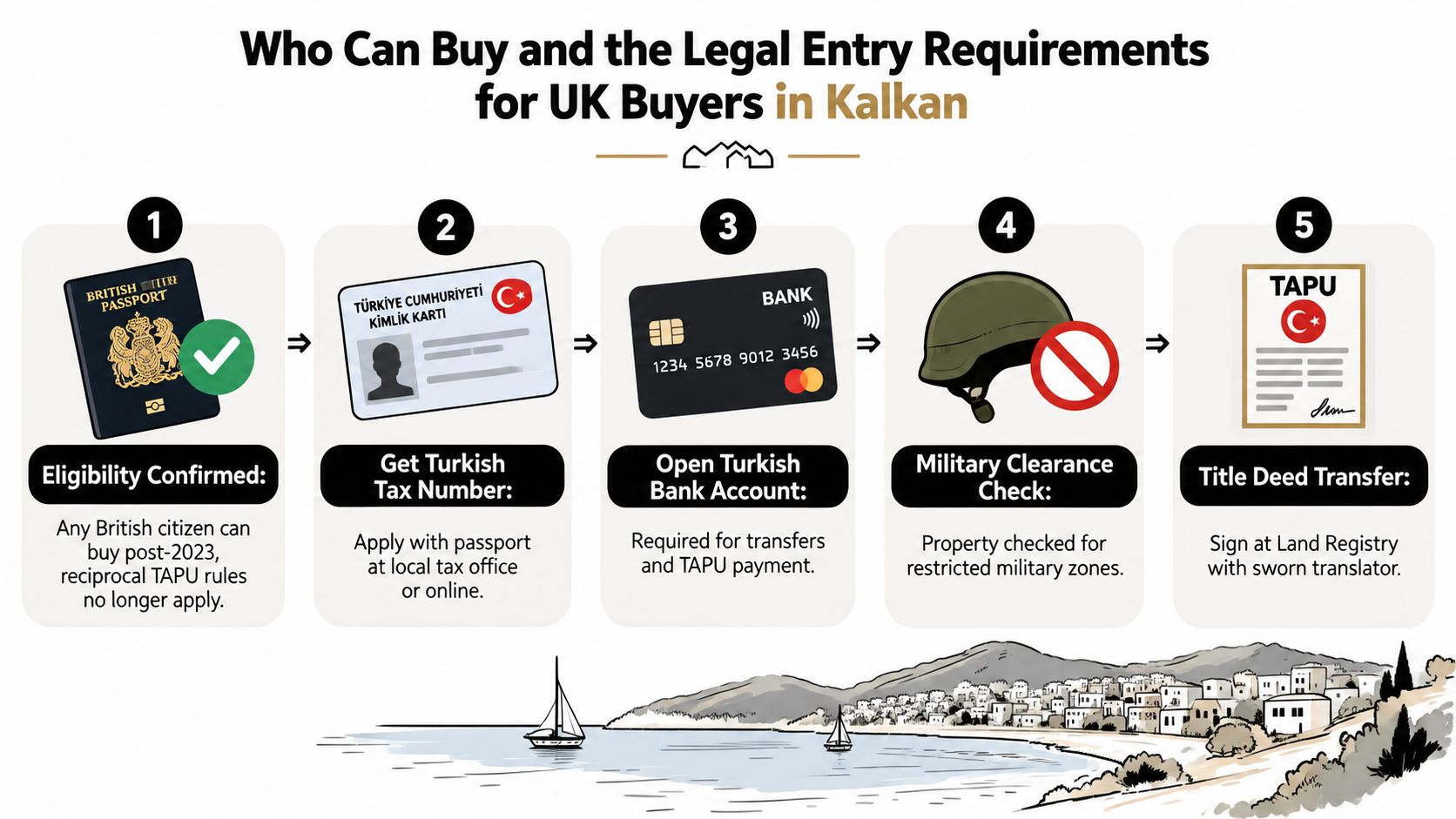
British citizens can purchase Turkish property, subject to the property passing the applicable legal checks and location restrictions. The nationality question is only the first filter. A buyer still needs to confirm that the title is transferable, the property has the necessary permissions and the location doesn't create an ownership problem.
Set up the essentials before committing funds
Start with a Turkish tax number, known locally as a vergi numarası. You'll need it for banking and the property transaction. Then open a Turkish bank account so funds can move through a documented banking route and payments connected with the title transfer can be handled properly.
A Turkish mobile number is practical for bank messages, utility accounts and local administration. Access to e-Devlet can also make post-purchase administration easier, although your solicitor should explain exactly which services you need and how access will be arranged.
Use a bank with a clear process for foreign customers, such as Ziraat, İş Bankası or Yapı Kredi, but choose based on documentation, transfer support and service rather than brand familiarity alone. Your bank may require proof of address, passport details, tax information and evidence explaining the source of funds.
Never confuse eligibility with approval
The property may still need a military or restricted-zone check. In Kalkan, this is a routine part of the legal workflow, but routine doesn't mean optional. Your lawyer should confirm the property's status early rather than allowing the seller to present clearance as an afterthought.
At the Land Registry, a sworn translator is required so you understand the official documents and declarations. Don't rely on a bilingual agent to interpret legal commitments. A useful companion for broader international property buyer tips is helpful, but it can't replace a Turkish solicitor who checks the actual title.
Research on foreign ownership restrictions by country can provide wider comparison, but your Kalkan lawyer must verify this particular property. Ask for written confirmation of ownership, liens, mortgages, seizure notices, planning status and any restrictions before paying a meaningful deposit.
The Step-by-Step Kalkan Buying Workflow
A safe purchase has a clear order. The agent may want speed because the villa has other interest, but pressure is not a substitute for due diligence. Your job is to keep the transaction moving without allowing anyone to remove the safeguards.
Build a shortlist that reflects how you'll use the property
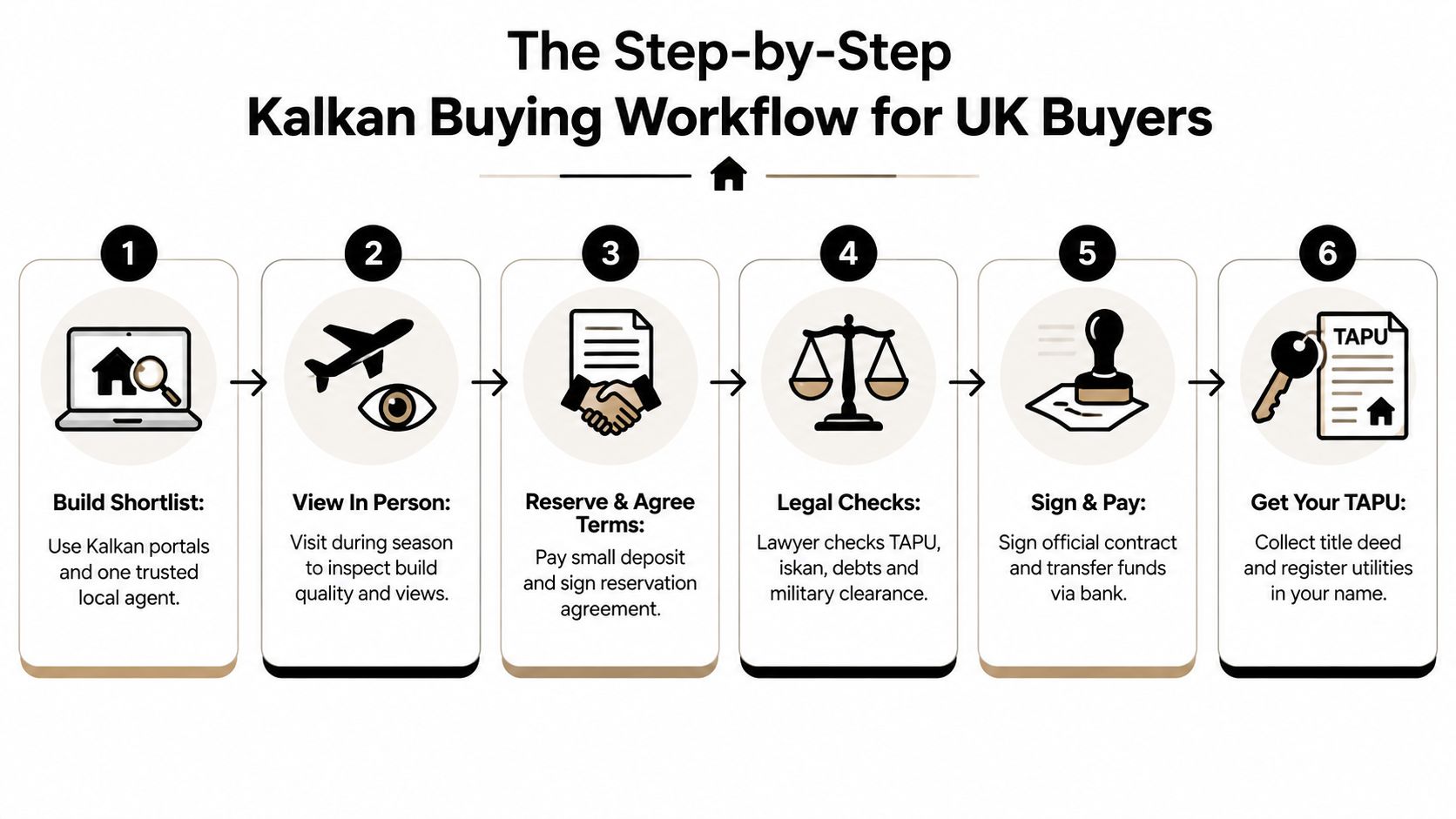
Start with Kalkan-specific portals and one trusted local agent. Don't ask several competing agents to send every available villa. That creates duplicated listings, inconsistent prices and confusion over who represents whom.
View in person, preferably outside the peak summer rush. You'll see noise, road access, neighbouring construction, sun exposure, damp, pool equipment and the practical effort required to reach the property. A perfect photograph can't show whether the route from the town is comfortable or whether the terrace remains usable at the times guests want to sit outside.
Confirm the military or restricted-zone position early. Obtain your tax number and open the Turkish bank account before the transaction reaches the payment stage. Agree the price in Turkish lira, with the exchange-rate treatment recorded clearly in writing.
Reserve only with written protection
A reservation payment should be made through a Turkish bank transfer, not handed informally to an individual. The agreement should state the property, price, refund conditions, completion timetable and what happens if title or valuation problems appear.
The exact deposit should be negotiated rather than accepted blindly. If a contract uses a 10% reservation deposit, make sure the document explains when it's refundable and whether the seller must compensate you if they withdraw or cannot transfer clear title.
Instruct an independent Turkish lawyer. The agent's recommended solicitor may be competent, but independence matters because the lawyer must protect your position rather than close the sale. The lawyer should review the Tapu, iskan, debts, mortgages, annotations, planning records and military clearance.
Sign a bilingual tapu taahhüt satış vaadi where appropriate, with clear penalty clauses. The official title transfer then takes place at the tapu dairesi, with the sworn translator present. The transaction should include the required independent valuation before the transfer where applicable, and UK government guidance on buying property in Turkey supports independent legal advice and title verification.
Finish the job after the keys arrive
Arrange DASK earthquake insurance, complete the title transfer and retain every payment record. Then register utilities, update tax records, check meter readings and agree a management handover if the villa will be let.
For a wider process overview, use this guide to how to buy property in Turkey, but keep the Kalkan-specific legal checks with your own adviser.
Costs, Taxes and Ongoing Charges
The headline purchase price understates the cash required. The largest transaction cost is the tapu transfer fee, charged at 4% of the declared transfer value. Legally, the fee is split between buyer and seller at 2% each, although contracts often make the buyer pay the full amount, so settle that point before signing.
The final bill can also include professional fees, valuation, translation, banking and insurance charges. Don't let an agent reduce the negotiation to the villa price while leaving these items vague.
| Cost item | Typical amount (2026) | Who pays | When due |
|---|---|---|---|
| Tapu transfer fee | 4% of declared transfer value | Legally 2% buyer and 2% seller, often varied by contract | At title transfer |
| Döner sermaye surcharge | TRY 20,868 per property or unit for foreign buyers, according to a 2026 guide | Buyer, unless agreed otherwise | During Land Registry process |
| Independent valuation | Varies by provider | Usually buyer | Before transfer where required |
| Lawyer and translator fees | Agreed professional fee | Buyer | During legal work and signing |
| DASK earthquake insurance | Varies by property | Buyer or owner | Before completion and renewal |
| Agency fee and applicable VAT | Depends on agreement and property | As contract specifies | Purchase completion |
| Annual emlak tax | Residential rates typically 0.1% in smaller towns and 0.2% in metropolitan municipalities | Owner | Annually |
| Rental tax and compliance | Depends on taxable rental income and filing position | Rental owner | During annual tax reporting |
The TRY 20,868 foreign-buyer döner sermaye surcharge is identified in a 2026 property-cost guide, so the 4% transfer fee isn't the only registry cost to budget for. See the published breakdown of Turkish property purchase costs before setting your cash reserve.
Separate one-off costs from ownership costs
Kalkan sits in Antalya Province, and annual municipal property tax, emlak vergisi, applies to ownership rather than purchase. Residential rates are typically 0.1% in smaller towns and 0.2% in metropolitan municipalities, with Antalya relevant to the higher municipal category, as explained in this 2026 guide to Turkish property taxes.
You may also face communal maintenance charges, utility deposits, repairs, pool servicing, garden care, insurance and management fees. Holiday letting brings a separate rental-tax and compliance regime. Recent guidance notes that rental income is taxed separately from ownership taxes, while any VAT exemption for qualifying first-sale new-builds depends on strict conditions, including foreign-currency payment and a minimum one-year holding period, as outlined in this 2026 tax guide for foreign property buyers.
Model costs in sterling and Turkish lira. Currency conversion spreads and transfer charges can materially change the amount that leaves your UK account, even when the agreed property price stays fixed.
Liquidity, Yields and the 2026 Exit Question
Kalkan's strongest selling point, limited supply, can also make it difficult to exit. A scarce asset isn't automatically liquid. If the buyer pool narrows, a seller may wait longer or accept a sharper discount to complete.
Foreign home purchases in Türkiye fell to 21,534 in 2025, the weakest level in nine years and 1.3% of total sales, while Muğla recorded a residential price level of TRY 79,077 per square metre and 9.72% annual price growth in the latest regional dataset, according to recent coverage of Türkiye's housing market. Kalkan sits in Antalya Province, so don't treat the Muğla data as a direct Kalkan valuation. It's useful as a regional signal, not a substitute for local comparable evidence.
Coverage also shows the foreign-buying share falling from 4.5% at the 2022 peak to 1.3% in 2025, with the share at 1.6% of all sales in the first half of 2026, as reported in this analysis of foreign property demand. The practical message is simple. Don't base an exit plan on a constant stream of overseas buyers.
Gross yield isn't spendable income
A well-run villa may achieve a gross rental yield in the 5–7% range on suitable stock, but gross income isn't your return. Management, cleaning, maintenance, utilities, insurance, tax, repairs, vacancy and booking-platform costs reduce the amount available to you. Review the difference between gross yield and net yield before comparing Kalkan with Bodrum or Fethiye.
Kalkan's best-positioned homes, including desirable Komşuluk and Kışla stock, can attract stronger buyer attention than inland or difficult-access hillside properties. That doesn't guarantee a quick sale. Keep a cash reserve, avoid excessive borrowing and buy only if you can tolerate a patient exit.
Resale rule: Price for the market you'll sell into, not the market you remember from the brochure.
Buyer Checklist and Common Questions
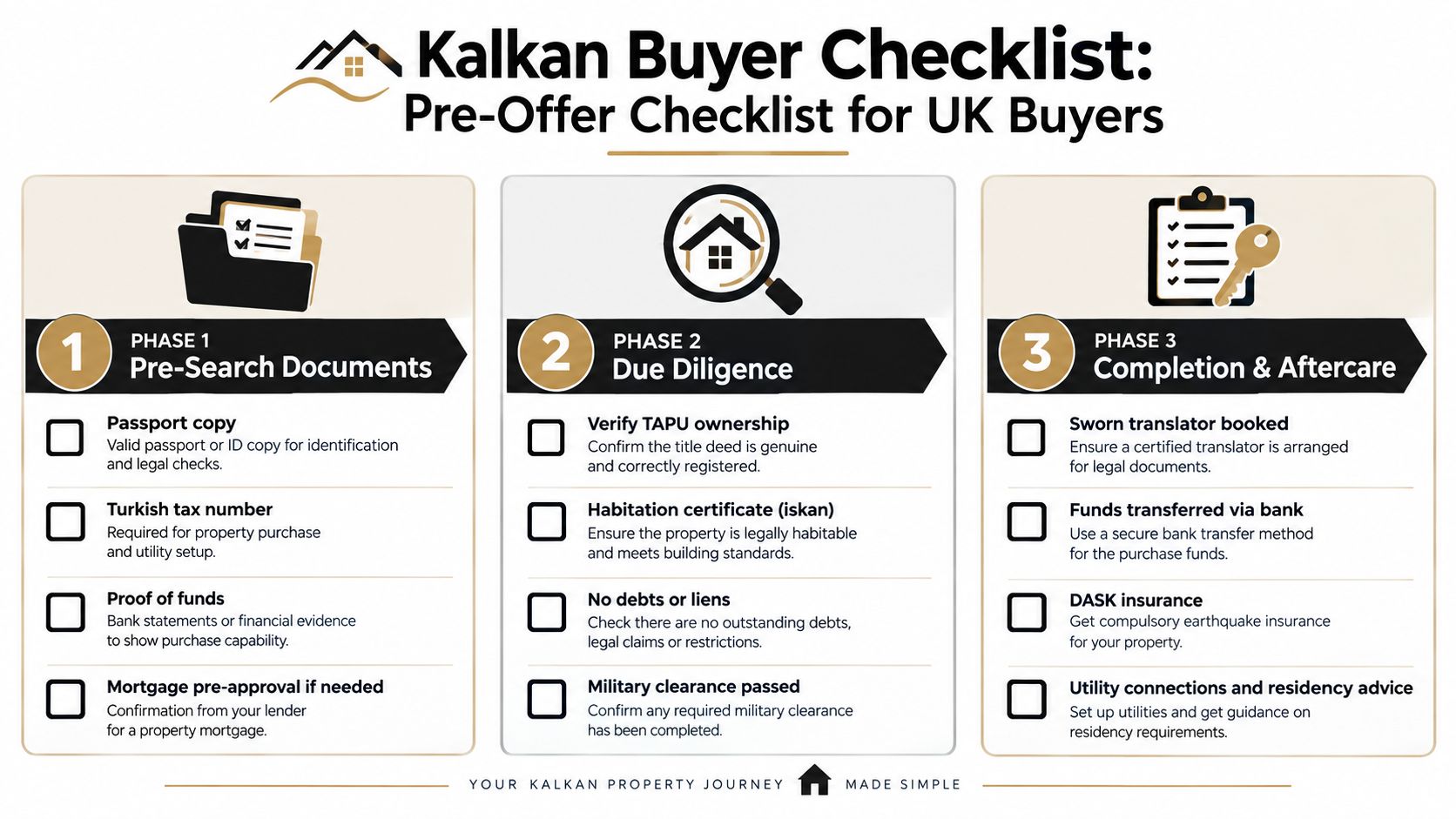
A sensible Kalkan purchase becomes much easier when the checks are completed in phases. Print this list and use it before paying a reservation deposit.
Before searching
- Documents: Prepare your passport copy, proof of funds and any mortgage information.
- Tax and banking: Obtain a Turkish tax number and open the account you'll use for documented transfers.
- Language: Arrange an independent solicitor and sworn translator before signing anything.
- Use case: Decide whether the villa is primarily for personal use, holiday letting or a mixture.
Before making an offer
- Title: Confirm the seller owns the property and request an up-to-date Tapu search.
- Habitation: Check the iskan, which confirms the relevant habitation or occupancy status.
- Encumbrances: Search for mortgages, debts, seizure notices and other annotations.
- Location: Obtain confirmation of military or restricted-zone clearance.
- Physical condition: Inspect structure, pool, roof, plumbing, electrics, access and neighbouring development.
At completion and afterwards
- Contract: Make the deposit route, refund terms, penalties and completion conditions explicit.
- Payment: Transfer funds through the bank and retain receipts.
- Registry: Complete the title transfer at the Land Registry with a sworn translator.
- Insurance: Arrange DASK before completion where required.
- Aftercare: Register utilities, confirm tax records and organise rental compliance if the property is let.
Frequently asked questions
What's the difference between Tapu and iskan?
The Tapu is the title deed showing ownership and property details. The iskan is the habitation or occupancy document connected with the building's authorised use. Your solicitor should check both, because ownership alone doesn't prove that the building has the permissions you expect.
Is buying through a power of attorney advisable from the UK?
It can be practical when a trusted representative handles completion, but it carries authority and fraud risks. Use a narrowly drafted power of attorney prepared and reviewed by an independent Turkish solicitor. Don't give an agent broad control over the price, bank transfers and legal decisions.
What happens if military clearance is denied?
Don't complete the purchase. Your contract should state what happens to the deposit if the property fails the relevant clearance or location check. Your lawyer should investigate alternatives and recover funds according to the signed agreement.
What resale timeframe should I expect?
There's no reliable fixed timeframe in a softer foreign-buyer market. Assume a sale may require patience, realistic pricing and negotiation, particularly for properties with difficult access, dated interiors or weak rental records. Buy with enough financial headroom that you won't become a forced seller.
World Property Investor provides Turkey guides, market analysis, rental-yield breakdowns and step-by-step advice for international buyers comparing locations such as Kalkan. Visit World Property Investor to research the legal, tax and investment questions before you commit funds.