
Emigrating is no longer just a lifestyle move. For many British investors, it’s a capital allocation decision with tax, residency, financing, and portfolio consequences that can either compound wealth or lock it up in the wrong jurisdiction.
That framing matters because the usual advice on how to emigrate from UK ignores the investor’s real questions. Should you keep the UK rentals? Which visa route aligns with property ownership? Where do yields still justify execution risk? How do you leave cleanly enough that HMRC, your pension provider, and your lenders don’t become the hidden drag on the move?
The Growing Trend to Emigrate From The UK
In the year ending June 2025, net emigration of British citizens from the UK reached an estimated 109,000, according to Office for National Statistics data analysed by the Migration Observatory, meaning more British citizens left long term than returned. The same source notes this fits a longstanding pattern rather than a one-off break with history, although recent estimates use updated methodology and should be read with that caveat in mind through the Migration Observatory briefing on long-term international migration flows.

For property investors, that number matters less as a headline and more as a signal. When British households leave, housing demand, landlord strategy, and cross-border capital flows all shift. Some sellers release UK stock into the market. Others become overseas landlords. Many redirect equity into jurisdictions where residency, tax treatment, and rental income look more favourable than they do at home.
Why investors need a different emigration plan
A retiree moving for sunshine and an investor moving with borrowed capital, tenants, and future acquisitions are not solving the same problem. The second person has to think in layers:
- Residency layer. Where can you legally live, and on what visa basis?
- Tax layer. When do you cease UK tax residence, and what remains taxable in Britain?
- Portfolio layer. Do your UK assets still earn their place in the portfolio?
- Deployment layer. Where will released capital work harder?
That’s why generic “best countries to move to” lists are only a starting point. Lifestyle matters, but the better question is whether the destination supports your income structure, financing needs, and holding period. If you’re still comparing broad relocation options, this overview of best EU countries to live in is useful as an initial screen before you do the investment analysis.
Practical rule: Don’t choose the country first and force the numbers to fit later. Choose the residency and property strategy together.
Choosing Your Destination and Visa Pathway
Spain, the United States, and Australia are among the most common destinations for British movers, according to this Statista summary of UK migration trends. Popularity helps with familiarity, English-speaking advisers, and established expat networks. It does not answer the investor’s harder question: where will your residence rights and your capital both hold up over time?
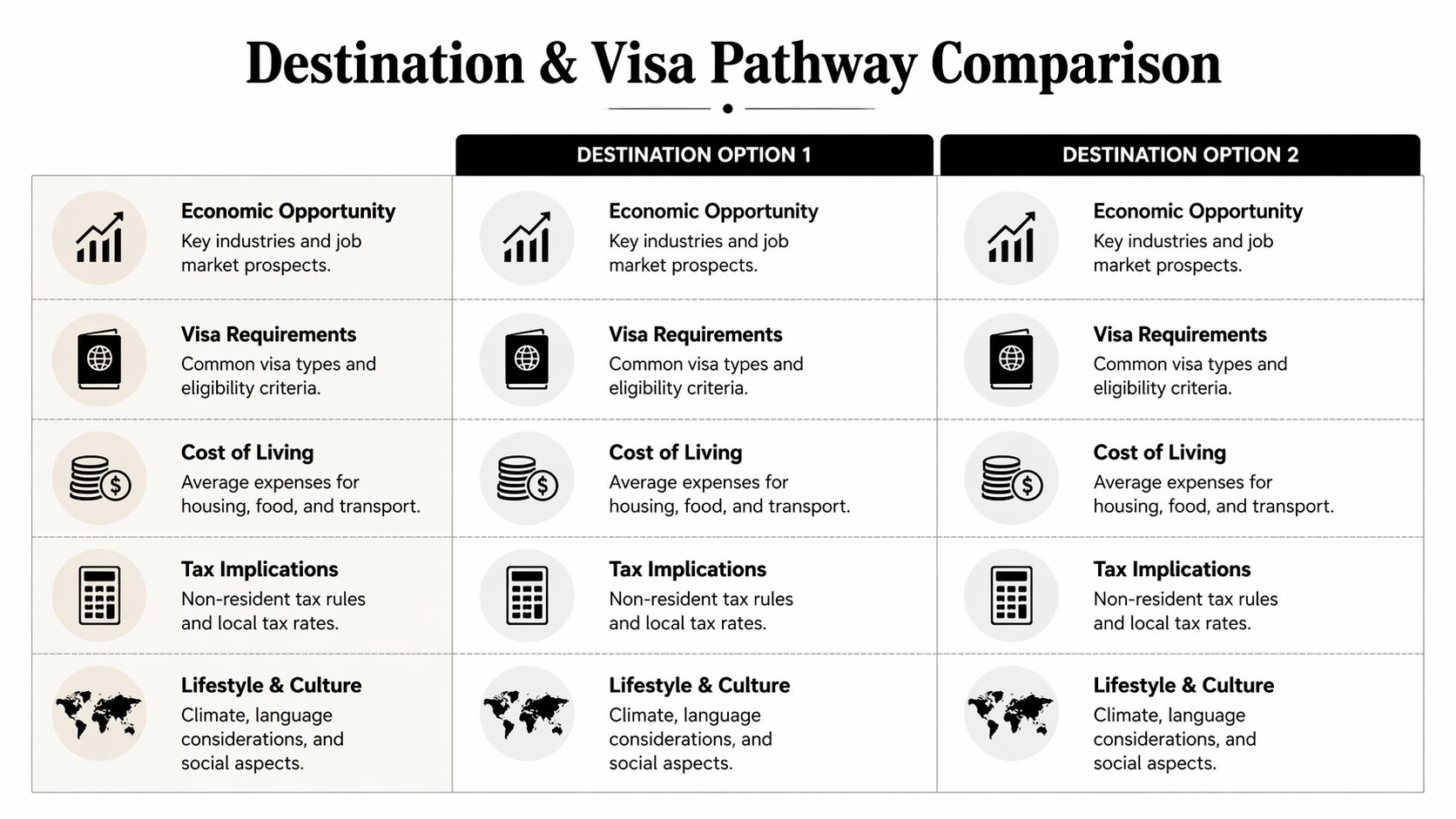
A destination choice is stronger when three parts line up. You can live there on terms that suit your income source. You can own and finance property there without avoidable friction. You can justify the move on net return, not just lifestyle appeal.
Established markets versus emerging investor hubs
Established markets usually offer clearer regulation, deeper resale demand, and easier access to banks, lawyers, and managing agents. Emerging investor hubs can offer better income, lighter tax drag, or residency incentives tied to capital deployment. The trade-off is execution risk. Title systems, lender appetite, and exit routes often require more scrutiny.
That difference matters more than headline popularity.
| Country | Avg. Gross Rental Yield (City Centre) | Investor Visa Option | Typical Property Tax | Market Outlook |
|---|---|---|---|---|
| Spain | Moderate by major-city standards | Non-Lucrative Visa | Varies by region and ownership structure | Mature market with strong expat demand and established resale depth |
| Portugal | Moderate, with local variation | D7 visa | Local purchase and holding costs need careful modelling | Attractive for lifestyle investors, but tax treatment needs closer scrutiny for new arrivals |
| Dubai | Higher than many mature European markets | Golden Visa linked to qualifying property ownership | Zero income tax and zero capital gains tax noted in the source material | Higher income potential, stronger yield case, different legal and market conventions |
| Australia | Lower-yielding in many prime markets | Skilled and investor-linked pathways vary by applicant profile | State-based taxes and foreign buyer rules can materially affect returns | Stable, transparent, but often more defensive than high-yield plays |
| United States | Varies sharply by city and state | Employment, family, or investment-related pathways | Highly jurisdiction-specific | Deep market, broad opportunity set, more fragmented execution |
For broad market context, Global Property Guide rental yield data remains a more useful benchmark than relocation roundups because it lets you compare income potential across jurisdictions on a like-for-like basis. I treat those figures as a starting point only. Gross yield can look attractive on paper and still disappoint once you account for vacancy, service charges, financing costs, and local taxes.
What works for investors
A practical shortlist starts with four filters.
Can you live there on terms that match your income source
If your income comes mainly from rents, dividends, or company distributions, passive-income visas and residency-by-investment routes usually fit better than employment visas. If the move depends on salaried work, labour market access and sponsorship rules matter far more than any property plan.
I see this mistake regularly. Buyers choose a market first, then try to force a visa route around the purchase. That sequence creates pressure to buy before the tax position, banking access, and holding structure are settled.
Does the local market reward your style of investing
A long-let strategy needs durable tenant demand, efficient management, and a clear path to refinance or exit. A short-let strategy needs regulatory headroom, resilient occupancy, and realistic numbers after platform fees, local licensing, and higher operating costs.
Some destinations sell very well and cash flow poorly.
Spain often suits buyers who want a familiar European market, solid resale depth, and broad British tenant or buyer demand. Portugal can suit investors with a mixed objective of residency, personal use, and moderate income. Dubai tends to attract buyers who put yield and tax efficiency ahead of European legal familiarity.
Are foreign ownership and borrowing rules workable
Foreign ownership is rarely as simple as the marketing suggests. Registration rules, title checks, local entity requirements, lender criteria, and asset-level restrictions can all change the numbers.
That point becomes sharper if debt is part of the plan. A lender that is comfortable while you are UK resident may reduce loan options or change pricing once you become non-resident. That affects both what you can buy and whether retaining UK property for yield makes more sense than selling and redeploying the equity abroad.
Can the visa route support the holding period you want
A five-to-ten-year property thesis sits badly under a short or uncertain residency route. If your right to remain is fragile, your investment plan is fragile too.
For many buyers, the better fit is straightforward. Use flexible rental strategies where your residence status may change. Use longer-duration assets where you have a stable residency basis or a clear path to renewal. If you are comparing structures in more detail, this guide to an investor visa for overseas buyers is a useful reference.
A sensible way to shortlist countries
Use this sequence before booking viewings or paying application fees:
- Start with residency certainty. Remove countries where your legal route is weak, temporary, or too conditional for your intended holding period.
- Model tax before returns. Compare how local rules treat rental income, gains, remittances, and any continuing UK income.
- Compare net yield across borders. A lower-tax market with slightly higher management costs can still outperform a familiar market with weaker after-tax income.
- Test liquidity and financing. Check resale depth, mortgage access for non-residents, and how easily capital can be moved out later.
- Decide what happens to the UK assets. Retaining a well-let UK property may preserve income and optionality. Selling may release capital into a market with stronger yields or a visa-linked investment threshold.
- Use lifestyle as the final filter. The move still needs to work day to day, but lifestyle should confirm the decision, not carry it.
The Pre-Move Immigration and Legal Checklist
Execution is where otherwise sensible emigration plans start to unravel. Most failed or delayed applications don’t collapse because the applicant chose the wrong country. They collapse because the paperwork was incomplete, inconsistent, or badly timed.

For work-related visas, simple errors still do a lot of damage. The verified data notes that failing to provide complete financial proof, including £1,270 in maintenance funds for a UK Skilled Worker visa, is a common reason for rejection, and incomplete TB test results can lead to rejection in 15-20% of applicable cases according to the guide cited here in this step-by-step emigration article.
Build the file before you file the application
A strong visa application behaves like a good credit file. It’s coherent, evidenced, and easy for a caseworker to follow.
Start by pulling together the core documents well before any online submission:
- Identity documents. Passport validity sounds basic, but it’s still one of the easiest issues to overlook when timing a move.
- Status documents. Sponsorship letters, employer confirmations, or residency-qualifying evidence need to match the application exactly.
- Financial proof. Bank statements must show the required funds clearly and for the relevant period.
- Medical evidence. If your route requires testing, incomplete results can derail the file.
- Property and family records. These matter where dependants, address history, or source-of-funds checks come into play.
The point isn’t paperwork for its own sake. It’s risk control. A missing document can delay a move long enough to affect school enrolments, tenancy start dates, completion schedules, or mortgage offers.
The phases that matter most
Investors often treat immigration as a single task. It’s better handled as a sequence of gates.
First gate: legal eligibility
You confirm whether the route suits your circumstances at all. Sponsored work visas depend on the employer and role. Passive-income routes depend on the source and nature of income. Investor routes depend on the asset threshold or qualifying investment.
Don’t assume a property purchase alone grants a practical right to live in the country. In some places it may support residency. In others it only means you own property there.
Second gate: evidence quality
This is the stage where avoidable failures happen. Dates have to align. Names have to match. Income sources have to be traceable. If a file requires translation, apostille, or certified copies, sort that out before you book travel around the expected approval date.
Checklist discipline beats optimism. Most application problems are boring, administrative, and preventable.
A useful visual primer sits below if you want a broad overview of the moving parts before building your own file.
Third gate: timing and sequence
Biometrics, interviews, and approvals don’t always line up neatly with property completions or school terms. That matters if you’re trying to relocate while exchanging on a purchase, winding down a UK business, or switching tax residence.
A practical timeline usually works better in this order:
- Secure visa pathway
- Assemble evidence pack
- Submit and complete biometrics
- Wait for approval
- Only then lock in irreversible commitments
What doesn’t work
Three recurring mistakes show up in investor files.
- Buying first, legalising later. Ownership and residency aren’t the same thing.
- Using rough proof of funds. Lenders and immigration authorities both dislike vague money trails.
- Underestimating admin lead time. Certified records, police checks, and bank documentation all take longer than people expect.
The cleaner your legal entry, the easier every next step becomes, from opening bank accounts to proving address history and arranging finance in your new country.
Managing Your UK Property Portfolio From Abroad
The hardest portfolio question for many emigrants isn’t where to buy next. It’s whether the UK assets you already own still deserve a place in the strategy.

There are only two real paths. Retain and manage as a non-resident landlord, or liquidate and redeploy capital elsewhere. Both can be right. The better choice depends on income quality, tax drag, gearing, and whether the property still has a clear role in the portfolio.
When retaining UK property makes sense
Keeping the asset can work well if the rental stream is dependable, financing is already in place, and the property sits in a location you’d struggle to replace at the same basis cost.
That approach tends to suit investors who want:
- Sterling income exposure while living overseas
- Existing debt terms they don’t want to disturb
- A re-entry option if they may return to the UK
- A proven asset rather than a rushed sale before departure
The weak point is management. Distance magnifies small operational failures. A slow repair response, poor tenant communication, or rent arrears issue can become much more expensive when you’re in another time zone. If you plan to hold, study how experienced landlords manage rental property remotely before you leave. The operational side matters almost as much as the tax side.
When selling is the stronger move
Selling usually makes more sense when the UK property has become capital-heavy and income-light, or when your new market offers a clearer return profile after tax and costs.
A sale can also simplify your exit. Fewer moving parts. Fewer reporting obligations. More cash available for one deliberate reallocation rather than a piecemeal portfolio half in Britain and half abroad.
Keep a UK property because it performs a job in the portfolio, not because it feels familiar.
A practical retain versus liquidate test
Use a simple qualitative test before deciding:
| Question | Retain if the answer is yes | Consider selling if the answer is no |
|---|---|---|
| Is the rent resilient and easy to collect? | The property still produces reliable cash flow | Income is patchy or management-heavy |
| Is the financing still competitive? | Existing debt remains useful | The mortgage no longer helps returns |
| Can an agent run it properly? | You can delegate confidently | Oversight risk is too high from abroad |
| Does it still fit your new strategy? | It diversifies the portfolio | It traps capital needed elsewhere |
The mistake I see most often is the half-decision. Owners keep the UK asset, but they don’t appoint a proper managing agent, don’t reorganise reporting, and don’t decide whether the property is an income asset, a future home, or a sentimental hold. That ambiguity costs money.
If your move leaves you with rental income still flowing from Britain, it helps to understand the broader treatment of overseas rental income and reporting obligations before the first tax year closes.
Navigating Tax, Pensions, and Cross-Border Finance
A relocation only becomes real when the paperwork changes your tax position, your pension structure, and the way your money moves. Until then, you’re often just physically absent while still financially tied to the UK in all the wrong ways.
The first administrative priority is HMRC. The verified data is clear that to manage your exit correctly, you must notify HMRC, and that claiming split-year treatment via form SA109 is critical where relevant. The same data states that to qualify for non-residency you must meet criteria such as spending fewer than 16 days in the UK, and that an estimated 40% of DIY pension transfers fail because people choose an ineligible non-UK scheme, which can trigger a 25% tax charge, based on the cited government source here in this HMRC and ONS-linked report.
Get tax residence right first
If you only do one thing properly before departure, do this. Tax residence determines how much of your financial life remains exposed to UK rules.
In practice, that means:
- Confirming your departure date carefully
- Recording your UK day count
- Assessing whether split-year treatment applies
- Making sure your filings support the story your move tells
This isn’t academic. Property sales, dividend receipts, pension decisions, and remittances can all land differently depending on whether your residence position is clear.
Pensions are where DIY confidence becomes expensive
A pension transfer sounds straightforward until the receiving scheme turns out not to qualify. At that point, a move that was meant to create flexibility can produce an avoidable tax event.
If you’re considering moving a pension, the sequence matters:
- Identify what you hold. Defined contribution and defined benefit arrangements need different handling.
- Check the receiving scheme’s status. Don’t rely on assumptions or adviser shorthand.
- Understand the local use case. Some investors transfer because they think they should, not because the destination improves planning.
- Model access, tax, and currency exposure together. A pension is not just an account transfer. It becomes part of your retirement jurisdiction strategy.
For many emigrants, leaving the pension where it is remains the better option. The wrong transfer can be worse than no transfer.
A clean emigration plan isn’t the one with the most moving parts. It’s the one with the fewest avoidable tax events.
Banking, currency, and deployment discipline
Cross-border finance usually breaks down in the mundane places. Bank accounts opened too late. Foreign exchange handled ad hoc. Completion funds sitting in the wrong currency while lawyers and lenders wait.
A good setup normally includes:
- A multi-currency banking arrangement before departure
- A documented source-of-funds trail for future property purchases
- A transfer plan for large balances rather than spot conversions done under time pressure
- A lender conversation early if you’ll need borrowing as a non-resident
This is also where specialist advisers add value. General accountants often understand domestic filing but not the overlap between residence tests, rental income, and international acquisitions. If you need a simple visual prompt before speaking to a professional, this external tax guidance for emigrants summarises the kind of issues that should be on your checklist.
Property gains need a cross-border view
Investors often think of tax by country. The better approach is by asset, event, and timing. A UK sale before departure can produce a different outcome from a sale after non-residency begins. Likewise, a new overseas acquisition may create future gain exposure in more than one jurisdiction depending on treaty treatment and local rules.
That’s why any sale or purchase around the move date should be reviewed as part of one integrated plan, not as separate transactions. If foreign disposals are part of your next phase, understanding capital gains tax on foreign property is essential before you exchange.
Post-Move Investment Strategies and Opportunities
Seven out of ten poor overseas property purchases I review have the same cause. The buyer treated the first post-move acquisition as proof the relocation was working, rather than as a capital allocation decision.
That first deal matters because it usually sets your operating model. It determines where your liquidity sits, how much management friction you accept, what currency your income arrives in, and whether you are building for yield, personal use, or long-term appreciation. Strategic investors are usually choosing between three clear paths: a pure income asset in the new country, a home that can also perform as a disciplined rental, or a diversification purchase in a market that does not track the UK cycle closely.
Compare markets by net return and operating friction
Headline yield is only the starting point. What matters is what survives after local taxes, service charges, vacancy, financing costs, and management quality. A market with lower gross yield can still outperform if title is straightforward, tenant demand is stable, and exit liquidity is deeper. The reverse is also common. High quoted yields often come attached to weaker resale depth, inconsistent management, or legal processes that are harder to control from abroad.
That is the primary trade-off between markets such as Spain, Portugal, and Dubai. Spain often suits buyers who want a usable asset in a familiar European setting and can accept more moderate income. Portugal can still make sense where lifestyle and residency features carry significant weight, but the numbers need to stand on their own. Dubai tends to attract income-focused investors who are comfortable with a faster transaction pace, different ownership conventions, and a market that rewards close monitoring.
For UK emigrants with retained property at home, the better question is not "Which country is best?" It is whether the next pound should remain in UK yield stock, be recycled into a higher-income overseas market, or sit partly in cash until residency and banking arrangements have settled. That decision should be made on expected net return and control, not sentiment.
Execution decides whether the thesis holds up
A market can look attractive in a spreadsheet and still disappoint in practice. Non-resident mortgage terms may be weaker than expected. Property managers may be fine at tenant find and poor at arrears control. Local legal advisers may be competent on conveyancing but weak on investor reporting.
That is why the first post-move purchase should usually be simple. Buy where title is clean, demand is conventional, maintenance exposure is limited, and local management can be replaced without drama. Complexity is easier to add later than remove.
Buy the asset you can run properly from your new base, with numbers that still work after costs.
Research also needs to get more granular once you are living outside the UK. National property commentary is useful for screening, but neighbourhood-level evidence is what protects returns. Tools such as Investorpulse Reports can help investors assess local ownership trends and comparable activity before they spend serious time and money on viewings.
If you are weighing several jurisdictions at once, start with a serious shortlist of the best countries for property investment. Then test each one against four filters: net yield after local costs, financing access as a non-resident, operational control from abroad, and how the purchase fits with the UK assets you kept or sold. That is the point where emigration stops being a lifestyle change and starts working as an investment strategy.
Conclusion Your Emigration as a Strategic Investment
To emigrate from UK successfully as a property investor, you need to think like an operator, not just a mover. The move has to work legally, financially, and practically. A good destination with the wrong visa, weak tax planning, or badly handled UK assets can still produce a poor outcome.
The investors who do this well usually get three things right. They choose the destination through the lens of residency and returns, not sentiment alone. They handle immigration and tax paperwork early, before property transactions force rushed decisions. And they decide with discipline whether UK assets still belong in the portfolio once they’re living abroad.
There’s also a broader mindset shift. Emigration is not merely leaving one country and arriving in another. It’s a reorganisation of cash flow, legal residence, asset location, and future optionality. When treated that way, the move can create a more resilient portfolio rather than a more complicated life.
The right result isn’t just a house in the sun or a visa stamp. It’s a structure that lets you live where you want, hold property where the numbers justify it, and move capital with far less friction than most emigrants ever achieve.
If you’re comparing markets, yields, tax exposure, and residency routes, World Property Investor is a strong place to continue your research. Its country and city guides help you move from broad relocation ideas to concrete property decisions with far more clarity.