
If you're considering a move to Malta, you're probably balancing three questions at once. Can it work as a residence base after Brexit, can the property stack up as an investment, and can day-to-day life support the decision once the novelty wears off?
That’s the right way to approach it. Malta isn’t just a lifestyle relocation. For many UK buyers, it’s a capital allocation decision tied to residency planning, tax position, rental income, and long-term portfolio flexibility inside Europe.
The strongest moves to Malta are made by investors who treat the island as both a place to live and an operating environment. That means looking beyond sea views and residency marketing. You need to assess demand drivers, acquisition costs, programme fit, tenant appeal, and the practical frictions that affect returns.
The Strategic Case for Malta in 2026
Malta has evolved from a familiar British expat destination into a more complex international market. The UK connection still matters. In 2011, UK nationals were the largest migrant group in Malta, with 6,652 individuals, and by December 2024 Malta’s foreign-born population had reached 173,781, nearly one-third of the total population. Over the same period, the foreign population rose by 755%, while net migration remained positive at 6,591 in 2023 according to Malta immigration data.
That matters for investors because sustained inward migration supports underlying housing demand. It doesn’t guarantee easy gains, but it does provide a stronger demand base than you see in many purely seasonal Mediterranean markets.

Why Malta still stands out
For a UK national, the move to Malta remains commercially attractive for a simple reason. It combines an English-speaking environment, EU access through residency routes, and a property market that is active enough to support both owner-occupation and rental strategies.
The demand story is broader than retirees. Buyers now include remote earners, internationally mobile families, tax-led relocators, and investors using Malta as a European base. That widens the occupier pool and supports multiple asset strategies, from long lets in established urban districts to more selective short-stay and mixed-use plays.
A second advantage is that Malta is small enough to understand quickly. A disciplined investor can tour the core markets, meet agents, inspect stock, and compare micro-locations in a short visit. That’s much harder in larger jurisdictions where distance and fragmented local conditions increase execution risk.
Practical rule: Malta works best when you buy for two exits, your own use case and a resale or rental use case. If only one of those works, the investment case is weaker.
What supports the long-term case
The strategic appeal isn’t based on one factor. It sits on a stack of mutually reinforcing fundamentals:
- Migration-led demand: The size and growth of the foreign-born population support recurring housing demand from new entrants and mobile professionals.
- Post-Brexit relevance: UK nationals often want a workable European base without relying on ad hoc travel arrangements.
- Language and administration: English lowers friction in legal work, banking, property management, and tenant communication.
- Market familiarity: British buyers usually adapt faster in Malta than in less familiar civil-law jurisdictions because the environment feels more straightforward.
Malta also benefits from being easy to compare. Against larger Mediterranean relocation markets, it offers simplicity and legal accessibility. Against more mature European hubs, it can offer a lower capital threshold for entry into a residency-linked strategy, depending on programme and location.
The trade-off investors need to accept
The move to Malta isn’t frictionless. Limited land, dense development, localised liquidity, and infrastructure pressure all affect how property performs in practice. You’re not buying into a spacious secondary-home market. You’re buying into a compact island economy where location mistakes are magnified.
That’s why broad enthusiasm isn’t enough. Neighbourhood selection, building quality, and transport practicality matter more in Malta than many overseas buyers expect.
For a lifestyle cost comparison that helps frame the relocation side of the decision, see this guide to living costs in Malta.
Choosing Your Residency Pathway An Investor's Analysis
The right residency route depends on what the property is supposed to do for you. Some buyers want permanent rights and family security. Others want tax efficiency. Others want flexibility first and will delay a larger acquisition until they understand the market properly.
Those are different investor profiles. They shouldn’t be pushed into the same programme.

Which route fits which investor
A simple way to assess Malta is to match the residency route to the role property plays in your wider plan.
| Investor profile | Best-fit route | Why it fits |
|---|---|---|
| Long-term family base buyer | MPRP | Best suited to buyers who want durable residency status tied to a property-backed commitment |
| Tax-focused HNWI | GRP | Better aligned with remittance-based planning and broader wealth structuring |
| Remote earner testing the market | Nomad Residence Permit | Gives flexibility before making a larger capital commitment |
| Employer-backed relocation | Single Permit | More relevant where the move is linked to Maltese employment rather than investment |
The mistake I see most often is choosing the visa first and the investment logic second. That reverses the proper order. Start with your end state. Are you buying a home, building a let portfolio, reducing travel friction, or restructuring residence and tax exposure? The correct programme usually becomes obvious once that answer is clear.
MPRP for investors who want permanence
For many UK nationals, the Malta Permanent Residence Programme is the most strategic route because it aligns with long-term control. It’s useful for buyers who want a credible European base, don’t want to rely on temporary permissions, and are comfortable making a property-linked commitment.
The process is structured, but it isn’t casual. The MPRP application has a success rate exceeding 99% when preliminary due diligence is done correctly, and the full 10-stage process takes 6 to 8 months. It includes an online application, biometrics in Malta, and meeting the qualifying investment requirement, including a property purchase in the €300,000 to €350,000 range depending on location according to this overview of the MPRP process for Malta applicants.
What matters more than the headline success rate is execution quality. The same source notes that 20% to 30% of cases are delayed by incomplete financial proof or un-apostilled UK documents. In practice, those aren’t minor admin issues. They slow the entire relocation timetable and can disrupt banking, completion planning, and family moves.
Buy the programme only if you're prepared to run it like a transaction. Residency applications fail in practice when applicants treat document preparation as an afterthought.
GRP for tax-led relocation
The Global Residence Programme suits a different buyer. This is usually the internationally exposed investor who already has income streams, understands remittance-based taxation, and wants residence status that complements a broader tax plan.
For this buyer, property is part of the structure, but not the entire point. The core attraction is often the tax treatment of foreign income remitted to Malta. The right use case is someone who wants a controlled, compliant setup and is prepared to work closely with cross-border advisers from the beginning.
GRP is not a substitute for proper tax planning. It’s a framework. If the buyer doesn’t understand what is remitted, where income arises, and how UK obligations continue to apply, the perceived benefit can be overstated.
Nomad route for market testing
The Nomad Residence Permit is useful for the buyer who wants to move to Malta first, learn the island, and acquire later. That can be a sound approach. It reduces the risk of buying in the wrong district because you were making a property decision from a hotel terrace instead of from lived experience.
This route often suits remote professionals with portable income who don’t need immediate permanence. The property strategy here is usually phased. Rent first, test commute patterns, check building quality, observe occupancy trends, then decide whether to buy.
For readers comparing options at a higher level, this guide to the Malta golden visa and residency landscape is a useful starting point.
What works and what doesn’t
What works:
- Match programme to holding period: Long-term buyers usually do better with permanent frameworks.
- Prepare documents early: Apostilles, proof of funds, and insurance paperwork should be handled before property selection gets serious.
- Use property as part of the strategy: Not as a rushed compliance purchase.
What doesn’t work:
- Buying first and understanding rules later
- Assuming all approved developments are equally suitable for residency and rental
- Using a temporary route when your real objective is permanent family relocation
Malta Property Market Analysis for Investors
Most foreign buyers start with the obvious districts. Sliema, St Julian’s, and Valletta dominate search behaviour because they are visible, liquid, and familiar to international tenants. That’s sensible, but not sufficient.
In Malta, the market is compact enough that micro-location matters more than broad area branding. Two buildings in the same district can perform very differently because of parking, road noise, pedestrian access, neighbouring construction, or building management quality.
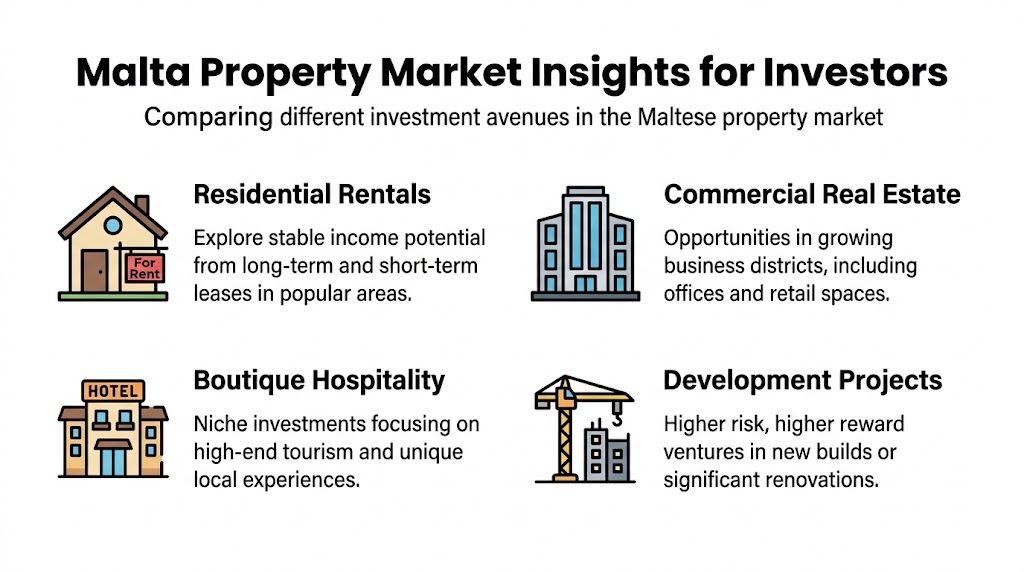
Prime districts versus emerging areas
The established urban strip still offers the strongest demand visibility. These areas tend to attract professionals, affluent renters, and buyers who want convenience over space. For investors, that usually means better reletting prospects and easier resale discussions.
The trade-off is pricing discipline. Prime Malta often attracts buyers who overpay for view, branding, or brochure-led finishes without thinking enough about tenant durability. A flashy apartment can underperform a better-positioned but less glamorous unit if the latter is easier to access and manage.
Emerging areas can make sense for buyers pursuing lower entry costs or a specific residency threshold. Gozo can appeal to slower-living relocators and selective tenants, while parts of southern Malta may look attractive on paper where programme thresholds are relevant. But you need to be stricter on exit liquidity and occupier profile.
The issue many brochures ignore
Infrastructure pressure is a property factor in Malta, not just a lifestyle irritation. Malta has a population density of over 1,600 people per square kilometre and more than 450,000 vehicles. In 2025, average commute times rose 15% year on year, and UK expats report 20 to 30 minutes searching for parking in areas such as St Julian’s according to this review of daily life and congestion in Malta.
That changes how I assess rental stock. If a tenant can’t park, can’t reach the arterial roads easily, and feels trapped in seasonal congestion, the property becomes harder to hold at premium rent. Accessibility is part of tenant retention.
A sea view can win the viewing. Practical access often decides whether the tenant renews.
How to read neighbourhood quality properly
When clients assess an area for a move to Malta, I tell them to test it at three times of day. Morning, afternoon, and late evening. A street that feels calm in a mid-morning inspection can be noisy, blocked, or parking-starved when residents are present.
Use this checklist during viewings:
- Access before aesthetics: Check parking reality, not agent assurances.
- Walk the last 300 metres: Delivery access, pavement quality, and street condition matter.
- Inspect the building, not just the flat: Common parts, lifts, façade maintenance, and neighbouring works affect tenant perception.
- Test the route to daily anchors: Supermarket, pharmacy, waterfront, school run, ferry, or office district.
- Look for nuisance risk: Bars, heavy traffic, construction sites, and awkward junctions reduce long-term appeal.
Buy or rent first
For some investors, renting first is the smarter move. That’s especially true if the move to Malta is linked to a residency application but the investor hasn’t yet developed strong conviction on district choice.
A short decision framework helps:
| Approach | Best for | Main advantage | Main risk |
|---|---|---|---|
| Buy immediately | Experienced buyers with clear area knowledge | Locks in the asset and residency alignment early | Wrong location choice is expensive |
| Rent first, buy later | First-time Malta relocators | Better neighbourhood intelligence | Delayed deployment of capital |
| Buy for compliance, rent personally | Structured investors | Separates personal flexibility from investment logic | More moving parts to manage |
For wider context on where Malta may sit against other destinations, this property market forecast for 2025 is useful as a comparative benchmark.
The Property Buying Process from A to Z
Buying in Malta is straightforward when you treat it as a managed legal process rather than a casual overseas purchase. Problems usually start when buyers rely too heavily on sales guidance and don’t build an independent team around the transaction.
The core principle is simple. Your notary, architect, tax adviser, and residency adviser should each be solving a distinct problem. When one person tries to cover everything, gaps appear.

Step one to step three
Start with budgeting before viewings. That sounds obvious, but many buyers budget only for the property price and ignore programme-linked costs, legal fees, and transaction friction.
For UK investors using residency routes, the gap between headline property spend and total commitment can be large. Under the Global Residence Programme, the application fee is €6,000 and applicants must show capital assets of at least €650,000. Under the MPRP, a property purchase of €300,000+ is paired with a €58,000 government contribution and a €45,000 administrative fee, which pushes the total upfront capital requirement well beyond the purchase price according to this summary of Malta residency costs and tax considerations.
Once your budget is real, not aspirational, the sequence usually looks like this:
Define the purchase brief
Separate residence needs from investment needs. If one property must do both jobs, be strict about compromise points.Build your advisory team
Use an independent notary and a tax adviser who understands both Malta and the UK position.View stock with building quality in mind
Focus on title, common parts, structural condition, parking, and local nuisance factors.
For a broader framework on cross-border acquisitions, this practical guide on how to buy property overseas is worth reviewing before you start signing anything.
The middle of the transaction
Once you’ve selected the asset, the process becomes document-heavy. At this point, discipline matters.
The preliminary agreement stage is where buyers often relax too soon. They’ve found the property, terms are taking shape, and everyone wants to move quickly. That’s precisely when legal checks, title review, planning questions, and building condition need close attention.
The biggest mistake isn’t paying too much. It’s committing to the wrong asset because the early paperwork felt routine.
A local architect’s input can be useful, especially on older stock or heavily altered properties. The issue isn’t whether the apartment looks polished. The issue is whether what exists matches what is legally and structurally expected.
This short explainer gives a useful visual overview of the buying journey:
Final checks before completion
Before final deed, confirm the operational points that affect post-completion performance:
- Ownership and title: Your notary should verify clean title and any encumbrances.
- Building administration: Ask who manages the block and how maintenance is handled.
- Utility setup: Clarify transfer practicalities early, especially if there’s a tenancy or renovation plan.
- Residency alignment: If the property supports an application, make sure the purchase structure and timing fit the programme requirements.
- Exit logic: Check whether the unit will be easy to let or resell if your own plans change.
For a wider primer on acquisition sequencing and due diligence, see this guide on how to buy property abroad.
Managing Your Maltese Property for Optimal Yield
Owning in Malta isn’t passive. It can become passive only after you’ve made a series of active decisions well. The market punishes buyers who assume a good postcode automatically produces good performance.
That’s especially true now that the easy narrative around holiday lets and prime-area yields has become less reliable. A move to Malta tied to property should be managed as an operating asset, not as a postcard with rent attached.
What the yield story looks like now
Promotional material often relies on older peak numbers or broad gross yield claims that ignore market drift and operating costs. The more useful view is what happens after tenant churn, maintenance, compliance, and tax administration.
The current warning signs are clear. Rental price growth in Malta slowed to 2.1% year on year in Q1 2025, and gross yields in Valletta fell to 3.8% from 5.2% according to this analysis of Malta relocation and investment risks. That doesn’t mean Malta has stopped working. It means underwriting needs to be tighter.
A prime asset can still make sense, but not if the purchase price assumes yesterday’s market and tomorrow’s perfect occupancy.
Gross yield is not your return
Investors relocating from the UK sometimes overestimate what a Maltese rental will produce because they stop at gross income. Net return depends on what survives after the practical deductions.
Typical pressure points include:
- Management drag: Especially where the owner is overseas or semi-absent.
- Maintenance cycles: Common parts, lifts, air conditioning, and wear from short stays all matter.
- Void risk: Tenant turnover is rarely cost-free in a compact market.
- Furnishing and refresh costs: Presentation standards in competitive areas move quickly.
If the property only works before those costs, it doesn’t work.
Net income is what you can keep after the boring bills. Most overseas buyers spend too much time discussing demand and too little time discussing leak repairs, common parts, and tax filings.
The UK tax point that catches people out
Many otherwise capable investors often get sloppy. They assume that residency in Malta or a Maltese property company somehow removes their UK reporting exposure. It doesn’t work like that.
The same source notes that HMRC data from 2025 shows 12% of expat investors face audits on undeclared Maltese rentals. That should focus attention quickly. Cross-border rental income needs correct reporting and correct structuring from the outset.
The practical approach is straightforward:
- take Maltese tax advice before first rent is received
- take UK advice before changing residence assumptions
- keep documentation clean from day one
- avoid improvised structures built around hearsay from agents or other expats
For investors building an income strategy across jurisdictions, this overview of overseas rental income is a useful reference point.
What tends to work best
The most resilient Malta holdings tend to have four characteristics. They are easy to access, easy to explain to a tenant, easy to maintain, and easy to resell.
That often points towards well-located apartments in established districts with strong everyday usability. Not necessarily the most glamorous stock. Usually the stock with the fewest operational surprises.
What tends not to work is buying a story. That includes over-designed units in awkward buildings, properties dependent on one narrow tenant niche, or purchases justified mainly by residency marketing rather than by asset fundamentals.
Your Malta Relocation and Investment Checklist
A successful move to Malta usually takes shape over months, not weeks. The buyers who execute well break the process into phases and keep legal, tax, residency, banking, and property work moving in parallel.
Treat the move like a twelve-month project. That lowers the chance of rushed purchases, incomplete filings, and avoidable delays.
Months one to three
Start with decision clarity. Define whether Malta is primarily a residence base, a tax residence strategy, a buy-to-let market, or a mixed objective.
Then line up the foundations:
- Clarify your objective: Know whether the priority is permanent relocation, tax structuring, or asset diversification.
- Stress-test the budget: Include acquisition costs, programme costs, advisory fees, and working capital.
- Choose advisers early: You’ll want legal, tax, and residency input before making offers.
- Review document readiness: Passports, proof of funds, source of wealth evidence, insurance documents, and certified records should be prepared in advance.
If your paperwork includes foreign-origin records, it helps to understand the mechanics of legal recognition. This explainer on understanding how US documents are recognized internationally is useful background because document authentication issues often delay residency and property matters alike.
Months four to six
This is the research and application phase. Visit multiple districts, not just the ones agents push first. Inspect buildings at realistic times of day and compare owner-occupier areas with investor-heavy zones.
At the same time:
Open the residency file
Start the chosen application route and confirm the required property parameters.Shortlist neighbourhoods
Focus on tenant appeal, access, and resale logic, not just views and brochure finishes.Engage banking and payment planning
International transfers, source-of-funds checks, and timing can all affect completion.
Good relocation planning is mostly sequencing. The wrong task at the wrong time creates avoidable friction.
Months seven to nine
This is usually where buyers commit. Offers are made, due diligence intensifies, and advisory work becomes more technical.
Use this period to complete:
- Property due diligence
- Preliminary agreement review
- Tax structuring confirmation
- Insurance setup
- Operational planning for letting or occupation
If the asset will become a rental, prepare management decisions before completion. Don’t wait until after key handover to decide who handles tenanting, furnishing, check-ins, and maintenance.
Months ten to twelve
Finalise the move operationally. Completion, utility setup, local registrations, residency milestones, and move logistics all need tracking.
Your closing checklist should include:
- Completion readiness: Funds, legal sign-off, title confirmation.
- Residency follow-through: Biometrics, final supporting papers, compliance steps.
- Income setup: Rental marketing plan, lease strategy, or occupancy plan.
- UK reporting discipline: Make sure your ongoing tax and disclosure obligations are understood.
- Post-move review: Reassess whether the first purchase has performed as intended before considering a second.
A move to Malta works best when the first asset is boring in the right way. Easy to own, easy to let, easy to justify. Once you have that base, expansion becomes much easier.
If you're researching where to buy next, World Property Investor offers practical country guides, market comparisons, and step-by-step advice for international buyers who want to invest with more clarity and less guesswork.