
You're probably looking at two very different pictures at once.
One is aspirational: a flat in Lisbon, a villa in Spain, an apartment in Dubai, or a rental unit in a growth city you visit twice a year. The other is practical: exchange rates, financing, tax filings, legal title, local letting rules, and the question that matters most, will this still look like a good investment after all the friction is counted?
That's where most international property buying goes wrong. Buyers focus on listings, not underwriting. They compare asking prices, not net income. They assume a sunny market equals a sound market. It doesn't.
A good cross-border purchase is usually quite boring on paper. The legal structure is clear. The financing works even if rates stay firm. The rental case still holds after management, maintenance, voids, and tax. If there's a lifestyle upside or a residency angle, that's a bonus, not the reason the deal survives scrutiny.
Why Consider International Property in 2026
For a UK-based investor, buying abroad isn't just about escape. It can be a way to diversify exposure by geography, currency, tenant base, and market cycle. But diversification only helps if you know what you're diversifying into.
The domestic benchmark matters. The Office for National Statistics reports that average UK house prices increased from £250,000 in January 2020 to £268,000 in January 2024, a rise of about 7.2% over four years (ONS benchmark for UK house price growth). That tells you something important. UK property has still delivered structural resilience through a difficult rate environment.
That resilience cuts both ways. It supports the case for staying local if you value familiarity and legal clarity. It also gives you a reference point when you assess overseas property. If a foreign deal offers more operational risk, more tax complexity, and more currency exposure, it should compensate you with either stronger income, better strategic optionality, or access to a market you can't replicate at home.
What buyers usually get wrong
A lot of “international real estate for sale” content is built for browsers, not investors. It highlights beaches, amenities, and price-per-square-metre comparisons, then stops before the hard questions start.
Those hard questions are simple:
- Can you own the asset cleanly? Some countries welcome foreign buyers. Others restrict land ownership, title forms, or short-let use.
- Can you finance it sensibly? A deal that only works as an all-cash purchase can look very different once borrowing costs are tested.
- Can you exit it? Liquidity matters. You don't want to discover that resale demand is thin when you need to sell.
- Can you defend the return? Headline yield means very little if tax, vacancy, and local fees absorb the margin.
Practical rule: If a property abroad looks attractive only before tax, before currency conversion, and before financing, it isn't attractive.
Why 2026 buyers need a stricter framework
The post-2025 investor is dealing with tighter affordability, more scrutiny on short-term rentals in many markets, and a bigger compliance burden for UK residents with overseas assets. That doesn't make international buying a bad idea. It just means a purchase abroad should be treated like a business decision first.
The most sensible approach is to screen markets in layers. Start with macro stability. Then review ownership rules and tax. Then test financing. Only then should you spend serious time on individual stock.
A useful starting point is tracking broader international property trends for cross-border investors. But trends only help if they feed into a disciplined deal model.
Choosing the Right International Property Market
The first market you should eliminate is the one you only like because you've had a good holiday there.
That sounds blunt, but it's necessary. Lifestyle familiarity can help with local knowledge, yet it often blinds buyers to weak rental demand, awkward ownership structures, or poor resale depth. A strong market choice starts with function, not emotion.
International capital has concentrated in stable, recognisable property markets for a reason. HM Land Registry data for 2024 shows foreign-owned titles account for approximately 188,000 properties in England and Wales, with a heavy concentration in London (HM Land Registry context on foreign ownership). Cross-border money usually prefers places where title is clear, demand is deep, and exits are credible.
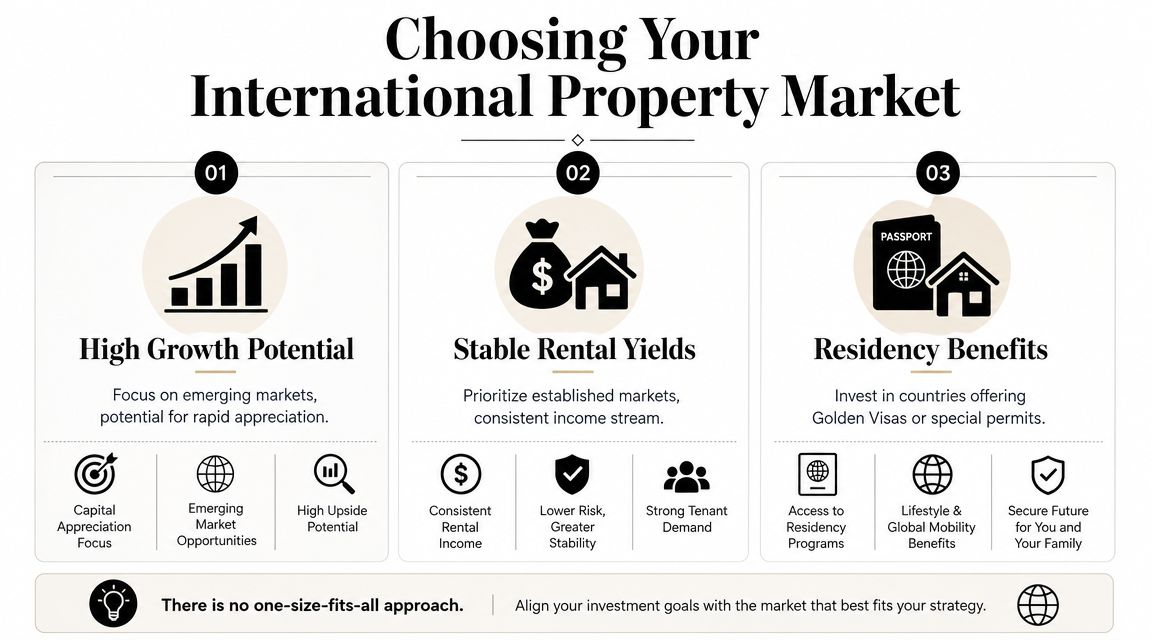
Established markets versus emerging markets
This isn't a simple good-versus-bad choice. It's a trade-off between predictability and upside.
| Market type | What usually works | What often disappoints |
|---|---|---|
| Established markets | Better legal clarity, stronger lending infrastructure, deeper resale pools, more reliable professional services | Lower headline upside, tighter yields in prime areas, more competition |
| Emerging markets | Lower entry pricing in some locations, potential for stronger appreciation, less crowded buyer pools | Greater political risk, thinner financing options, more opaque processes, higher execution risk |
Established markets such as France, Spain, or the USA often suit buyers who want income stability, recognisable legal processes, and easier management from abroad. Emerging markets can work for buyers who can tolerate uncertainty and who understand that faster growth narratives often come with weaker investor protections or less predictable liquidity.
A practical shortlist test
Before viewing a single property, run each country through four filters.
- Legal access: Can a UK buyer purchase directly, or is a company structure, local partner, or specific permit needed?
- Income usability: Are long lets, holiday lets, or mixed-use rental strategies permitted in the target location?
- Currency exposure: Will your income and exit value sit in a currency you're comfortable holding?
- Exit depth: Who buys from you later. Local owner-occupiers, expats, institutional buyers, or mostly other overseas investors?
If the answer to the last question is “mostly other overseas investors”, be careful. That can create fragile resale demand if sentiment shifts.
Matching the market to the objective
Different buyers should want different countries.
If your priority is steady income, favour places with transparent tenancy rules, durable local demand, and manageable operating costs.
If your priority is capital preservation, look for liquid cities, established legal systems, and a clear buyer pool on resale.
If your priority is residency optionality, you'll need to assess immigration routes separately from the property itself. Some buyers overpay for real estate because they're really buying flexibility of movement. That may still be rational, but only if you admit that's what you're doing.
Stable markets don't always produce the highest returns. They often produce the most defendable ones.
For readers comparing destinations, a broader where to buy property abroad guide is useful. But market selection should still come down to one point: choose the country whose risks you can underwrite, not just the one whose listings look attractive.
Analysing Rental Yields and Capital Growth
Most sellers talk about rent. Serious investors talk about rent relative to price, costs, and risk.
That distinction matters because a property can produce healthy gross rent on paper and still be a poor investment once local taxes, management, maintenance, and vacancy are included. The number that carries the most weight isn't the brochure yield. It's the income left after reality.
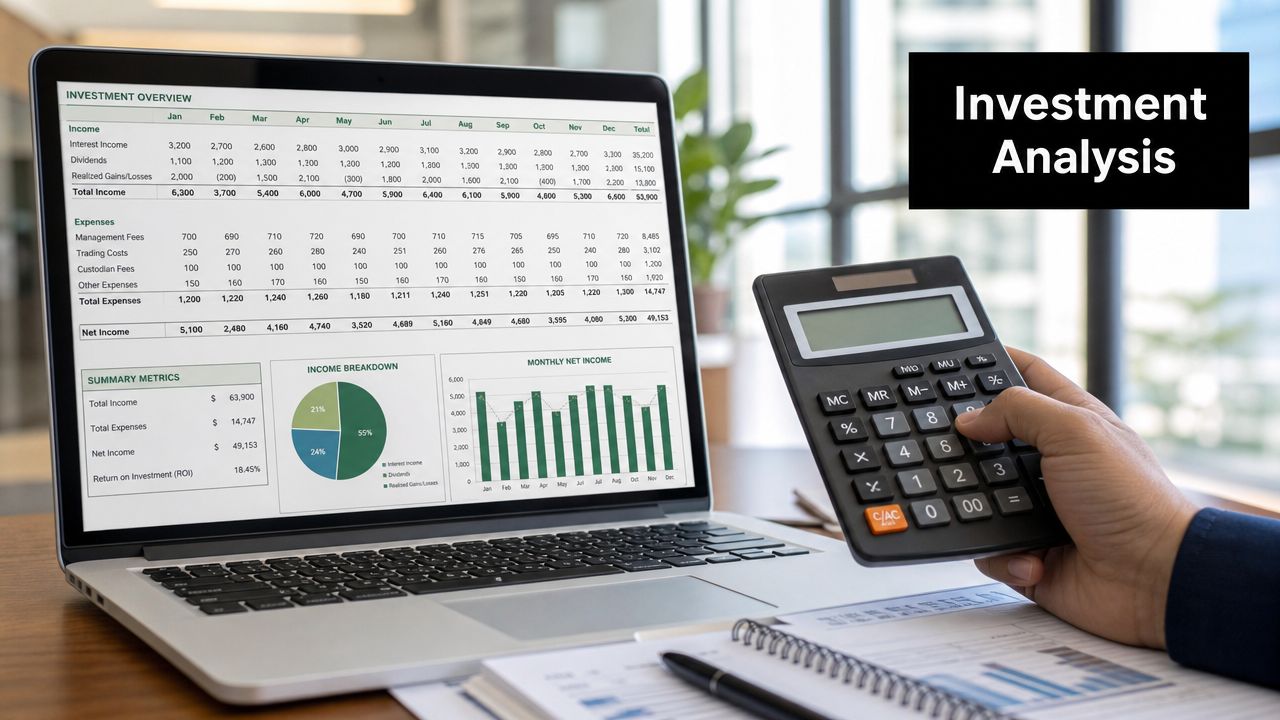
Official UK data from ONS consistently shows a regional yield spread, where prime London offers lower gross yields but stronger capital preservation, while many regional cities provide higher yields (ONS-linked explanation of regional yield spread). That principle applies internationally too. Expensive gateway cities often trade on liquidity and prestige. Secondary cities often trade on income.
Gross yield is only the starting point
Start with a simple formula:
Gross yield = annual rent ÷ purchase price
That's useful for a quick screen. It isn't enough for a buy decision.
A more serious model asks:
- What rent is realistically achievable, not just advertised?
- How often is the property likely to sit empty?
- Who pays for repairs, service charges, insurance, and compliance?
- What tax applies locally?
- What does the income look like once translated back into sterling?
Net yield and true return
A better working formula is:
Net yield = annual rent minus annual operating costs, divided by total acquisition cost
“Total acquisition cost” matters. It should include more than the agreed purchase price. In many countries, transfer taxes, legal fees, notary fees, furnishing, licensing, and early remedial works all change the effective basis of your investment.
Use a separate line for financing. Debt doesn't belong inside property operating performance if you're trying to compare deals cleanly. First judge the asset on its own merits, without considering debt. Then decide whether using debt improves or weakens the case.
Underwriting habit: Model the property three ways. Base case, weak-rent case, and delayed-exit case. If the deal only works in one version, the margin is too thin.
A detailed rental yield explained guide for property investors can help when you build a deal screen, but the logic is straightforward. Income has to survive friction.
Capital growth needs context
Buyers often make the opposite mistake with capital growth. They assume a market that has risen strongly will continue to do so, or they buy a prime address on the belief that prestige alone protects value.
Capital growth should be assessed through drivers, not stories:
- Supply pressure: Is new stock easy to build, or restricted?
- Local demand: Are there end-users, not just investors?
- Employment base: Does the city attract stable income earners?
- Transport and infrastructure: Does accessibility improve occupier demand?
- Liquidity: Can owners resell without a very narrow buyer pool?
This walkthrough is a useful primer before you compare markets in more depth.
A simple decision lens
If two properties look similar, ask one practical question. Are you buying an income asset or a capital storage asset?
| If the property is mainly for… | Prioritise |
|---|---|
| Income | Rent-to-price ratio, tenant demand, operating costs, local management quality |
| Capital storage | Liquidity, legal security, resale demand, location quality |
| Mixed return | Balance of net income, market depth, and constrained supply |
A lot of international real estate for sale sits in the awkward middle. It's marketed as both high-yield and high-growth. That combination exists, but it's rarer than sales material suggests.
Understanding Foreign Ownership Rules and Taxes
This is the stage where enthusiasm usually meets paperwork.
A market can look compelling right up until you discover that foreign buyers face title limitations, that short lets need a specific licence, or that your expected net return weakens once local taxes and UK reporting are layered on top. Buyers who treat legal and tax work as an afterthought usually end up paying for that mistake later.
For UK residents buying in Europe post-Brexit, understanding tax compliance is critical. Beyond local purchase taxes, investors must consider how foreign rental income and capital gains are treated under UK law and any applicable double-taxation treaties. The true after-tax yield can vary significantly from headline figures (post-Brexit tax compliance for UK residents).
The three tax layers you need to map
Most overseas property purchases involve three separate tax questions.
- At purchase: Transfer taxes, stamp duties, registration charges, legal fees, and notary costs.
- During ownership: Annual property taxes, local municipal charges, and tax on rental income.
- At exit: Capital gains tax in the property's jurisdiction, plus any UK reporting implications.
Some investors focus almost entirely on the first layer because it's the most visible. That's a mistake. The ownership phase often determines whether the investment performs.
Ownership rules can change the investment case
Two apartments in the same city can produce very different outcomes if one sits in a building with restrictive lease terms, owner limitations, or short-let bans.
Review these points before you agree terms:
| Legal issue | Why it matters |
|---|---|
| Title form | Freehold, leasehold, strata, and concession structures don't carry the same rights |
| Foreign buyer eligibility | Some countries or zones restrict non-resident ownership |
| Rental permissions | Holiday lets, serviced lets, and long lets may be treated differently |
| Building compliance | Licensing, planning, and community rules can limit income strategy |
| Inheritance and succession | Local succession law can affect how the asset passes on |
A lot of trouble comes from buyers assuming UK concepts travel neatly across borders. They often don't. Even familiar terms can work differently in another legal system.
If your lawyer can't explain the title structure in plain English, slow the deal down.
Post-Brexit use rights matter too
For many UK buyers, especially in Europe, the property isn't just an investment. It's also a lifestyle asset. That introduces a second layer of complexity. You need to separate ownership rights from usage rights.
Owning a property doesn't automatically mean unrestricted personal use, long stays, or a straightforward path to residency. Immigration status, visa limits, and local letting rules can all affect how useful the asset is in practice. Buyers often conflate these issues and only realise the distinction once they've completed.
Build an after-tax model before you negotiate
Don't wait until legal review to estimate tax drag. Ask your solicitor and tax adviser to help you create a simple after-tax cash flow model before you commit.
Include:
- Local rental tax treatment
- Allowable deductions
- Whether a treaty gives relief from double taxation
- Likely tax treatment on disposal
- UK reporting obligations to HMRC
For UK readers assessing future sale exposure, this overview of capital gains tax on foreign property is a sensible starting reference. The key point is operational. If you don't underwrite tax early, you're not underwriting the deal at all.
Financing and Completing Your Purchase Abroad
Funding is where many otherwise sensible deals stop making sense.
For UK-based buyers, financing an overseas purchase is rarely frictionless. With the Bank of England base rate at 5.25% for much of the recent period, the opportunity cost of cash and the price of borrowing are high (Bank of England rate context for overseas buyers). That doesn't mean you shouldn't buy abroad. It means your property return has to justify what your capital is giving up, plus the cost and complexity of cross-border borrowing.

Which funding route usually works best
Most buyers use one of three routes.
| Funding route | Strength | Weakness |
|---|---|---|
| Local mortgage | Can match debt to local asset and income | Harder for non-residents, slower process, local underwriting quirks |
| UK-based specialist finance | Familiar lender relationship and English-language process | Can be more selective, and product range may be narrow |
| Cash purchase | Stronger negotiating position and cleaner completion | Ties up capital and increases concentration risk |
A local mortgage can be useful when income and debt sit in the same currency. That creates cleaner cash flow alignment. But many foreign buyers underestimate the document burden, local banking timelines, and how differently affordability can be assessed outside the UK.
Cash sounds simple, but it carries its own cost. If that capital could earn a solid return elsewhere, your overseas property needs to outperform that alternative after all costs and risk.
The due diligence sequence that protects you
Completion abroad isn't just about transferring funds and signing papers. The transaction has to be de-risked in the right order.
Verify the seller's legal right to sell
Your lawyer should confirm title, boundaries, and whether the property matches official records.Check debts, charges, and usage restrictions
Service charge arrears, planning breaches, occupancy restrictions, or community rules can attach to the asset.Review the building, not just the unit
Structural issues, major works exposure, or poor building governance can damage returns quickly.Confirm rental legality
If the investment case depends on letting, make sure the intended strategy is permitted.Plan the money movement early
International transfers can create timing and currency risk if left too late.
Completion discipline: Never rely on the seller's lawyer, agent, or developer to define your risk for you. Use independent counsel and independent technical checks.
Currency handling is part of due diligence
A lot of buyers treat FX as an admin task. It isn't. If sterling moves between reservation and completion, your real acquisition cost moves with it. The same applies later when rent or sale proceeds come back into the UK.
This doesn't require a complicated trading strategy. It does require planning. Decide in advance how much currency exposure you're willing to carry, when funds need to move, and whether your lender or payment provider introduces avoidable friction.
For buyers considering securing a loan, this guide to an overseas property mortgage process is a practical reference. The bigger issue remains simple: finance should support the deal, not rescue a weak one.
Maximising Your Investment and Exploring Residency
Completion isn't the finish line. It's the point where the actual work starts.
An overseas property only performs if it's managed properly. That means rent collection, maintenance, local compliance, insurance, tenant communication, tax paperwork, and regular review of whether the original strategy still makes sense. Passive ownership at a distance tends to work only when the asset, building, and local team are all unusually straightforward.

Remote ownership needs a local operating system
The decision is rarely “self-manage or don't”. It's about choosing the right level of control.
- Self-management: Better if you know the market well, speak the language, and can respond quickly.
- Full-service management: Better for buyers who prioritise time, distance, and compliance over maximum margin.
- Hybrid model: Often the most sensible. Local manager for operations, owner retains strategic control on pricing, tenancy type, and capex.
The wrong management setup can destroy a decent asset. Weak tenant screening, delayed repairs, poor reporting, or missed compliance deadlines have a direct effect on income and resale value.
Hold the asset to a business standard
Review the property at least as critically as you did when you bought it.
Ask:
- Is the tenant profile still right for the location?
- Are local rules changing in a way that affects rental strategy?
- Is the asset still competitive against newer stock?
- Would you buy it again today at current pricing?
If the answer to that last question is no, don't ignore it. Long-term ownership should be a deliberate choice, not inertia.
Good international investors don't just buy well. They review well.
Residency can be useful, but it shouldn't distort the purchase
Some buyers want more than income or capital growth. They want optionality. That may mean easier travel, a second base, retirement planning, or a route to residency.
That's legitimate. But property-linked residency should be assessed as a separate objective. A mediocre asset doesn't become a strong investment merely because it supports a wider lifestyle plan. If the residency benefit matters, price that benefit accurately and avoid pretending it's pure return.
The strongest international real estate for sale opportunities usually sit where three things overlap. The legal structure is clean, the economics hold after tax and costs, and the ownership fits the buyer's wider plan. Miss one of those, and the deal weakens fast.
World Property Investor helps buyers cut through brochure language and compare overseas markets on the metrics that matter: yields, taxes, financing, ownership rules, and exit potential. If you're assessing your next move, explore the research and market guides at World Property Investor to compare countries, stress-test deals, and make better international property decisions.