
You've found a property that looks right on paper. The rental demand is there, the area has liquidity, and the price still fits your financial strategy. Then your solicitor sends the estimated completion statement, and one line changes the deal more than any cosmetic issue or minor negotiation ever could: stamp duty.
For investors, stamp duty on investment property isn't a background cost. It affects your day-one cash requirement, your effective yield, and in some cases whether the acquisition still meets your return threshold at all. That's true whether you're buying a buy-to-let flat in Manchester, a second home in Wales, or adding a UK asset to an international portfolio while living overseas.
Most buyers only focus on the purchase price. Experienced investors focus on the all-in acquisition cost. That includes tax, legal fees, financing friction, and how each of those costs changes the holding period needed to hit the target return. If you want a broader primer before getting into the detail, this investment property tax guide gives useful context on the wider tax picture around property ownership.
A sensible purchase process starts before the offer goes in. It starts with the numbers, the ownership structure, and the local tax treatment. That's especially important if you're comparing multiple jurisdictions or weighing the UK against another market. For a wider buying framework, see this guide to purchasing an investment property.
Understanding Stamp Duty in Property Investment
Stamp duty matters because it's paid upfront and can't be ignored in your entry price. Investors often underestimate that point. They negotiate hard on the property price, then treat the tax bill as an administrative afterthought. In practice, it's part of the acquisition price and should be modelled that way from the start.
That changes the way disciplined investors assess ROI. If two properties produce similar rent, but one attracts a heavier transaction tax burden, the cheaper-looking deal can become the weaker investment once the full capital outlay is included. Consequently, many first-time landlords make poor comparisons between owner-occupied purchases and investment purchases.
Why investors treat stamp duty differently
An owner-occupier may think about affordability and monthly mortgage cost first. An investor has to think about net yield, cash deployment, and exit planning. Stamp duty on investment property sits at the centre of that analysis because it reduces available capital immediately.
Practical rule: Never assess a property on purchase price alone. Assess it on total cash in.
The same property can produce a perfectly acceptable gross yield and still fail an investor's hurdle rate once tax is layered in. That's why serious buyers build stamp duty into their underwriting before they instruct surveys, lawyers, or financing.
The strategic question behind the tax bill
The useful question isn't just, “What do I owe?” It's, “What does this tax do to my return profile?”
Use that lens when comparing:
- Established markets: Mature legal systems and predictable tax administration can support lower execution risk, even where entry costs are higher.
- Emerging markets: Entry pricing may look attractive, but local transfer taxes, legal process, enforcement standards, and resale friction can change the actual situation.
- Domestic versus overseas ownership: Residency status, existing property ownership, and local purchase rules can alter the tax treatment quickly.
Investors who do this well don't merely calculate the tax. They use it to decide whether the deal still deserves capital.
How Stamp Duty Works for Investors vs Homeowners
The key distinction is simple. Tax authorities don't usually treat an investment purchase the same way they treat the purchase of a main home. In England and Northern Ireland, that difference is driven by the additional property surcharge.
If you already own a main residence and buy another residential property, the new purchase is generally treated as an additional property. That remains the case even if your main home is outside the UK. So a global investor who owns a residence abroad but acquires a UK buy-to-let can still fall into the higher-rate regime for additional properties.
What counts as an additional property
The practical test is ownership, not your personal label for the asset. If completion leaves you owning more than one property, you need to check whether the additional property rules apply.
That catches several common investor situations:
- Buy-to-let acquisitions: You keep your home and buy a rental property.
- Second homes: You buy a holiday or occasional-use property while retaining your main residence.
- International ownership: You live overseas, own property there, and buy in England or Northern Ireland.
The reason this matters is cost. In England and Northern Ireland, the SDLT surcharge for investment properties is +5% on top of standard rates, effective from 1 April 2025. That raises the rate for properties up to £125,000 from 3% to 5%, and to 7% for the £125,001 to £250,000 band. It also means the effective SDLT rate for the £250,001 to £925,000 band becomes 10%, compared with 5% for main residences. For properties above £1.5 million, the combined rate reaches 17% (Price Bailey's SDLT surcharge guide).
Why the surcharge changes investor maths
That surcharge doesn't just increase the tax bill. It lowers your initial return because it increases the amount of equity tied up on day one. For buyers utilizing substantial loans, it can also reduce flexibility by pushing more cash into transaction costs rather than deposit, works, or reserve capital.
Here's the practical difference:
| Buyer type | Tax treatment |
|---|---|
| Main residence buyer | Standard residential SDLT bands apply |
| Investor or second-home buyer | Standard bands plus the additional property surcharge apply |
That's why a homeowner moving house and an investor buying the same priced property can face very different economics.
If you want to test scenarios before making an offer, a dedicated stamp duty on BTL calculator is useful for checking whether a deal still clears your target yield once the surcharge is included.
Investors don't lose money on stamp duty because they forgot the rule. They lose money because they underwrote the property before applying it.
A Global Look at Stamp Duty Surcharges
Not every market taxes property acquisition the same way. Some use a clear stamp duty framework. Others apply transfer taxes under different names. For investors, the lesson is the same. Don't compare countries on purchase price and rental demand alone. Compare them on tax-adjusted entry cost.
Within the UK, even crossing an internal border changes the numbers. That's a useful reminder for international buyers who assume one country means one system.

England and Wales don't produce the same result
Wales applies Land Transaction Tax (LTT) rather than SDLT, and the rates for additional properties differ. For an additional property purchase in Wales, the rates are 5% on the first £180,000, 8.5% on the next £70,000, and 10% on the portion from £250,001 to £400,000. On that basis, a £400,000 additional property buyer pays £26,500 in Wales versus £31,250 in England, excluding any non-resident surcharge in England (BBC reporting on Welsh additional property tax rates).
That gap matters. If two locations offer similar rental prospects and tenant demand, the lower entry tax can improve the starting position of the Welsh asset. It doesn't automatically make Wales the better market. Liquidity, local supply, rent regulation, and exit conditions still matter. But it does improve the all-in acquisition cost.
Established markets versus emerging markets
In established markets, transaction taxes are often easier to forecast because the legal and filing systems are clearer. That predictability has value. Investors can model cash requirements with more confidence, which improves underwriting discipline and reduces execution risk.
Emerging markets sometimes look cheaper at first glance because headline property prices are lower. But investors still need to examine transfer taxes, title process, local filing requirements, and resale mechanics carefully. A lower entry price doesn't help much if the transaction process is opaque or if ownership rules create costly surprises.
A practical comparison framework looks like this:
- Tax clarity: Can you calculate the liability before exchange or reservation?
- Administrative certainty: Will your lawyer or notary handle filing efficiently?
- Market liquidity: Can you exit without relying on a narrow buyer pool?
- Ownership restrictions: Do residency, entity ownership, or foreign buyer rules change the economics?
For anyone buying across borders, this guide to foreign ownership restrictions by country is a useful due diligence checkpoint before you move from market research to legal instruction.
A low-tax purchase in the wrong legal environment can be riskier than a higher-tax purchase in a stable one.
What works in practice
The best investors compare markets on a net basis. They ask which location offers the strongest combination of predictable taxation, durable demand, and manageable holding costs.
That usually means separating two questions. First, how expensive is entry? Second, what quality of asset and income stream do you get after paying that cost? Those aren't the same question, and treating them as if they are leads to weak portfolio decisions.
Calculating Stamp Duty on Your Investment Property
A deal can look attractive at the offer stage and still miss your return target once stamp duty is priced properly. I see this often with investors who model rent, finance, and refurbishment carefully, but leave transaction taxes as a rough estimate until late in the process. That is a mistake because stamp duty changes your true entry cost, your cash-on-cash return, and in some cases the timing of any later capital gains planning.
SDLT in England and Northern Ireland is charged on a slice basis. Different portions of the purchase price are taxed at different rates, and investors usually face the additional property surcharge across those bands. The practical point is simple. You are not calculating one flat percentage on the whole price. You are building the tax liability band by band, then folding it into the acquisition model.
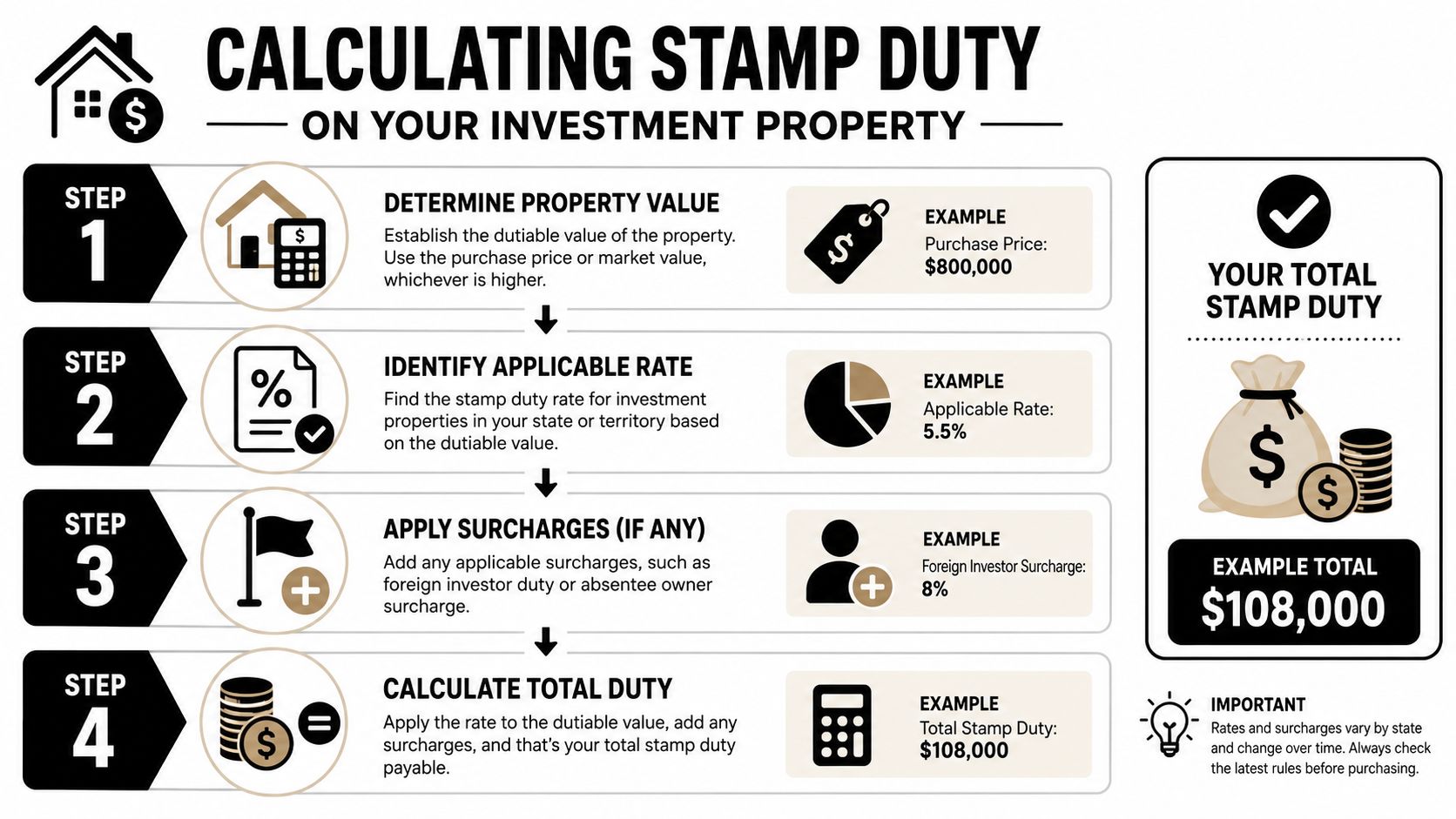
This infographic is a useful way to frame the process before running the numbers.
Worked example for a UK resident investor
Gov.uk's residential SDLT guidance shows the mechanics clearly. On a standard residential purchase of £500,000, SDLT is 0% on the first £125,000, 2% on the next £125,000, and 5% on the remaining £250,000, producing total SDLT of £16,250. For an additional property, a 5% surcharge applies to each band, increasing the total to £41,250 (Gov.uk residential SDLT rates).
For underwriting, the calculation works in this order:
- Start with the agreed purchase price. In this example, £500,000.
- Apply the standard SDLT bands incrementally. That gives £16,250.
- Apply the additional property surcharge across the same bands. That takes the total to £41,250.
- Add the tax to total acquisition cost. Your capital outlay is higher than the headline purchase price.
That fourth step carries the investment logic. A property that clears your target return before stamp duty may fall short once the tax is included. On tighter-yielding assets, that difference can be the line between a disciplined purchase and an underperforming one.
Worked example for a non-UK resident investor
For overseas buyers, the same property can carry a meaningfully higher entry cost. Non-UK residents buying an investment property in England may face the standard residential rates, the 5% additional property surcharge, and a further 2% non-resident surcharge. In practical terms, that means two investors can buy similar assets at similar prices and still end up with very different net returns because their tax profile is different.
The safest approach is to check three points before you submit an offer:
- Residency position: confirm it early, not after legal work is under way
- Whether the purchase counts as an additional property: overseas holdings can still matter
- The full tax stack: standard SDLT, investment property surcharge, and any non-resident surcharge
If you want to screen deals quickly, use this stamp duty calculator on property investments alongside your own spreadsheet rather than treating the tax as a later adjustment.
A short explainer can also help if you prefer to see the logic visually before checking the numbers in your own spreadsheet.
The underwriting mistake to avoid
Many investors still calculate yield against purchase price alone. That overstates performance. Your real entry basis includes stamp duty, legal fees, financing costs, and any setup expenditure needed to get the asset income-producing.
Use two return calculations. First, measure yield against headline price so you can compare listings quickly. Then measure it again against total acquisition cost, because that is the figure your capital has to recover. For cross-border investors comparing markets, this is also the only sensible way to judge whether a low-tax jurisdiction offers a better entry point, or a different mix of costs that will reappear later through compliance, holding structure, or disposal taxes.
Underwriting rule: Calculate yield twice. First on purchase price, then on total acquisition cost. Make decisions on the second number.
Navigating Payment Filing and Deadlines
Completion week is a bad time to discover your SDLT filing has been built on the wrong residency status or an incomplete ownership history. By then, the tax is not a theoretical cost in your model. It is a cash requirement tied to a legal deadline, and mistakes can delay registration, create penalties, or leave you paying more than expected and reclaiming later.
In the UK, the legal filing is often handled by your solicitor or conveyancer. Investors still carry the risk if the facts supplied are wrong. I see the same problem repeatedly in cross-border purchases. The buyer assumes the adviser will identify every surcharge issue from the file, but surcharge exposure usually turns on details only the investor can confirm, such as days spent in the UK, interests in overseas property, or whether the purchase sits inside a company.
What your solicitor needs from you
Give instructions early and in one clear package. At minimum, your legal team needs:
- Your residency position: This affects whether non-resident rules apply.
- Your full property ownership history: UK and overseas holdings can change surcharge treatment.
- The purchasing vehicle: An individual, couple, company, or trust can produce different outcomes.
- The intended use of the property: A main residence, second home, and rental asset are taxed differently.
- Any linked transactions or unusual funding: These can alter the filing analysis and the amount due.
The practical point is simple. Filing accuracy depends on fact accuracy.
That matters for returns. A filing error is not just an admin problem. It can change your true acquisition cost, disrupt completion cash flow, and distort the numbers you use to compare one market with another. Investors tracking post-tax yield should keep the SDLT submission, completion statement, and proof of payment with the same discipline used for rental statements and financing records. Those records also sit alongside wider portfolio reporting, including rental income tax rates for property investors.
Filing discipline that protects the deal
The process works best when the tax position is agreed before exchange or, at the latest, well before completion funds are requested.
- Ask for the SDLT analysis in writing: This exposes assumptions while there is still time to correct them.
- Disclose edge cases early: Inherited interests, minority shares in overseas homes, and prior main residence claims often matter.
- Confirm who is filing and paying: Responsibility should be explicit, especially where overseas buyers use UK agents or local finance brokers.
- Retain the submitted return and payment receipt: You may need them for future compliance, refinancing, or exit calculations.
Investors financing negatively geared property should be just as disciplined with transaction taxes as with interest deductibility. Baron Accounting's investor insights are a useful reminder that weak documentation at acquisition tends to create larger tax problems later.
A clean filing process does two jobs. It keeps the purchase on track today, and it preserves the records you will need when you review portfolio performance or calculate taxable gain on exit.
Strategic Tax Planning for Property Investors
Most investors think about stamp duty only at the point of purchase. That's too narrow. Paid correctly, it remains a sunk acquisition cost. Recorded correctly, it becomes part of your long-term tax planning.
The important distinction is this. Stamp duty usually isn't something you reclaim because you've held the property well or generated rent. But it can still matter later, especially when you sell.

Using stamp duty in capital gains planning
A useful planning point, often missed in mainstream property content, is that stamp duty costs can be factored into acquisition cost calculations for long-term capital gains tax planning. The same source notes that SDLT raised £11.6bn for the UK government in 2023-24, down from £15.4bn in 2022-23. It also makes the key practical point that while stamp duty cannot be reclaimed, integrating it into capital gains calculations can reduce net taxable profit when the property is eventually sold (video discussion of SDLT and CGT planning).
That matters because many investors mentally file stamp duty under “dead money” and stop there. From a cash flow perspective, that's understandable. From a tax planning perspective, it's incomplete.
What disciplined investors keep on file
If you want that cost treated properly later, keep a clean acquisition record now. At minimum, retain:
- Completion statements
- SDLT filing confirmation
- Proof of payment
- Legal invoices tied to acquisition
- Ownership records for the buying entity
This is routine portfolio housekeeping, but it has real value. When investors sell after a long hold, missing paperwork creates friction with accountants and can weaken the accuracy of the gain calculation.
A broader tax discussion around property cash flow and investor structure can be useful alongside this point. For example, Baron Accounting's investor insights offer perspective on how investors think about tax settings and property strategy over the life of an asset.
What works and what doesn't
What works is treating stamp duty as both an entry cost and a future record-keeping item. What doesn't work is paying it, forgetting it, and trying to reconstruct the file years later during a disposal.
If you're building a portfolio, stamp duty should sit inside a wider tax file that also tracks rental performance, deductible ownership costs where relevant, and eventual exit assumptions. A good reference point for that broader picture is this guide to rental income tax rates.
Good investors think about tax at purchase. Better investors think about tax at purchase, during ownership, and at exit.
Investor Checklist for Managing Stamp Duty
By the time you're ready to make an offer, most of the hard work should already be done. The investors who stay in control are the ones who use a checklist before they commit capital, not after they've paid a reservation fee or exchanged contracts.
Treat the list below as part of your acquisition discipline. It won't make a bad deal good, but it will stop avoidable mistakes from damaging a sound one.
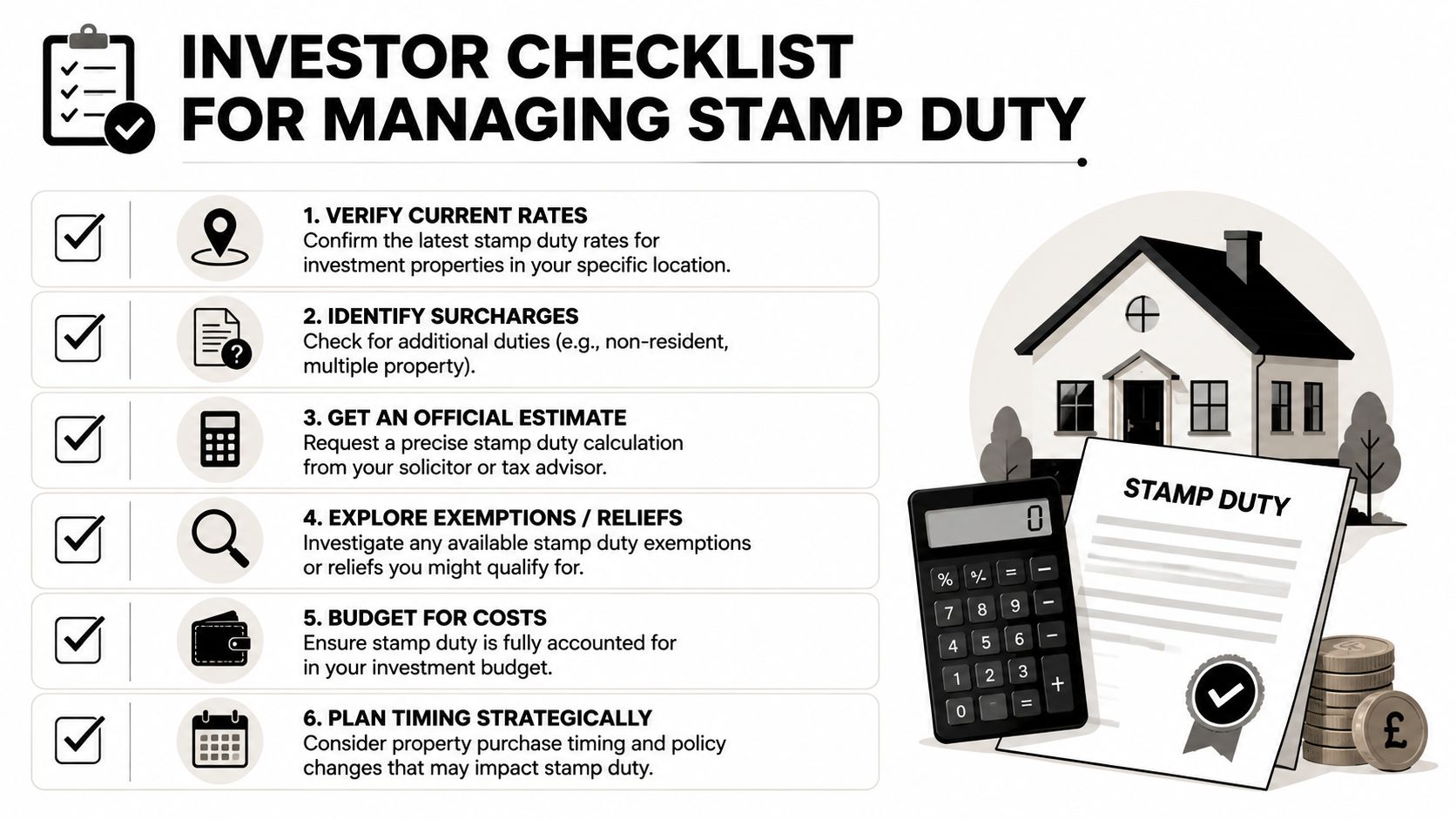
Pre-offer checklist
Confirm buyer status: Check whether you're buying as an individual or through a company, and make sure your adviser models the right tax treatment from the start.
Verify residency position: If you live overseas or split time between countries, ask your solicitor to confirm whether non-resident rules affect the purchase.
Identify all property ownership: List every property you already own, including homes outside the UK. That's often where surcharge assumptions go wrong.
Calculate the all-in acquisition cost: Include stamp duty, legal costs, financing fees, and any immediate works. Judge the deal on total cash required, not just headline price.
Underwrite yield on the true cost base: A property that looks fine on gross yield can weaken quickly once transaction taxes are included.
Keep a complete acquisition file: Store the completion statement, tax filing record, and proof of payment in a format your accountant can use years later.
The decision standard that protects capital
The right question before exchange is not whether you can afford the stamp duty. It's whether the investment still performs after paying it.
That's the standard serious investors use because it forces honesty into the numbers. It also improves market comparisons. A property in an established market with a higher entry tax may still be the better portfolio addition if the legal process is clearer, the tenant base is deeper, and the exit is more reliable.
If the numbers only work before stamp duty, they don't work.
World Property Investor helps you compare global markets with practical, data-led research on taxes, yields, regulations, and buying process. If you're assessing where to buy next, visit World Property Investor for country guides, market comparisons, and step-by-step advice for international buyers.