
Portugal's housing story looks very different when you follow the capital, not the postcards. In 2025, real estate absorbed 45.9% of all foreign direct investment entering Portugal, totalling €3.905 billion, even as total FDI into the country fell by 34.9% according to BP&A Property's review of foreign investment in Portuguese real estate. That divergence matters. It suggests overseas capital isn't treating Portuguese property as a lifestyle side bet. It's treating it as a defensive allocation with income potential.
For global investors, that changes the framing of property investment in Portugal in 2026. The key question isn't whether the country is attractive. The data already answers that. The real question is where returns still make sense after strong price growth, how the new non-resident tax rules alter acquisition maths, and which submarkets still justify fresh capital.
A disciplined investor should read Portugal as a market of contrasts. Prime Lisbon offers liquidity and pricing power. Porto often sits in a more balanced position between entry cost and income. The Algarve remains the main international capital magnet, but one where execution risk, licensing, and seasonal income assumptions need closer scrutiny than many glossy guides admit.
Portugal's Property Market in 2026 A Data-Driven Overview
Portugal recorded 169,812 residential transactions in 2025 and €41.2 billion in sales value, while annual price growth reached 17.6%, as noted earlier from BP&A Property's 2025 market summary. For an investor assessing 2026, the important point is not only that prices rose sharply. Turnover also remained high, which reduces the argument that recent appreciation was driven by thin, illiquid trading.

Several indicators point in the same direction. Eurostat data showed Portugal among the stronger house price performers in the euro area through 2025, while Banco de Portugal's financial stability work has continued to highlight housing supply constraints and affordability pressure as structural features rather than short-term distortions. That combination matters. A market can cool after a strong run, but persistent undersupply tends to put a floor under values in well-located submarkets.
The broader macro setting is less straightforward. The European Central Bank has eased from peak tightening, but financing costs remain above the ultra-cheap money period that fuelled earlier repricing across southern Europe. That shifts the investment case. In 2026, Portugal works less as a momentum trade and more as a yield-and-hold market where tax friction, debt structure, and exit liquidity have more influence on net returns.
Two practical conclusions follow.
First, investors should judge Portugal against international alternatives, not against its own pre-2020 pricing. Lisbon no longer screens as inexpensive beside Athens or parts of Spain, but selected Portuguese assets still compare reasonably against prime western European cities where entry pricing is higher and gross yields are often tighter. For a buyer using moderate financing, that relative spread remains relevant.
Second, the new tax framework changes acquisition maths immediately. For non-residents, the flat 7.5% IMT materially alters all-in entry costs, especially in higher-value transactions where the old progressive structure could be more punitive or less predictable across price bands. In plain terms, gross yield comparisons now need to be run on a post-tax basis. A 5% gross yield in Porto can look more compelling than a lower-yielding Paris or Milan asset if purchase tax, financing, and expected vacancy are modelled correctly.
Long-run pricing context still matters. Reviewing historical Portugal housing prices is more useful than relying on current asking prices or agent guidance alone. It helps separate cyclical acceleration from the underlying trend, which is particularly important after two years of outsized nominal growth.
The main risk is straightforward. Portugal's market is still supported by real demand and limited supply, but that does not mean every region offers the same margin of safety. In 2026, performance will depend less on buying "Portugal" as a theme and more on buying the right micro-market at a tax-adjusted basis that still leaves room for acceptable net income and a realistic exit.
Investment Hotspots Compared Lisbon vs Porto vs The Algarve
For a foreign buyer assessing Portugal in 2026, the regional decision has a larger effect on return than small differences in financing terms. Lisbon, Porto, and the Algarve sit in the same national market, but they behave like different asset classes once you account for entry pricing, tenant profile, resale depth, and the new non-resident tax position.
A useful screen is simple. Lisbon suits investors buying liquidity and capital preservation. Porto suits buyers who want a cleaner balance between income and urban demand. The Algarve suits buyers prepared to underwrite seasonality, operating intensity, and policy risk around short-term rentals.
| Region | Pricing Position | Income Profile | What tends to drive returns |
|---|---|---|---|
| Lisbon | Highest entry cost among the three | Lower gross yield relative to Porto | Scarcity in prime districts, international buyer demand, stronger resale depth |
| Porto | Mid-priced urban market | Typically stronger long-term yield than Lisbon | Student demand, local employment base, urban regeneration, lower basis |
| Algarve | Wide pricing dispersion by micro-market | Can screen well on gross yield, especially in holiday-led stock | International second-home demand, tourism flows, seasonality, licensing conditions |
| Silver Coast | Lower entry point than the main three hotspots | Highly asset-specific | Value entry, thinner liquidity, more uneven tenant depth |
The right comparison is not headline yield. It is post-tax yield on a realistic occupancy assumption. Investors who still benchmark Portugal only against domestic alternatives miss the point. The more relevant question is whether a Porto apartment or Algarve villa offers a better risk-adjusted return than comparable stock in Spain, southern France, or Italy after purchase tax, management costs, and vacancy are applied.
Lisbon for liquidity and exit depth
Lisbon remains the most institutionally recognisable Portuguese market. That matters because exit liquidity has value of its own, particularly for buyers allocating seven figures and above. In practical terms, prime Lisbon can justify a lower running yield if the investor wants a market with deeper international bid support and a broader resale audience.
That does not make Lisbon cheap. It makes it easier to explain.
The trade-off is straightforward. Rental income usually plays a supporting role rather than the core investment case, especially in prime neighbourhoods where acquisition prices are already high. For buyers assessing street-by-street differences in supply, transport links, and resale appeal, this guide to buying a house in Lisbon is more useful than national averages.
Lisbon also compares differently against overseas benchmarks than many investors assume. Against central Paris or prime inner Madrid, the entry ticket can still look moderate. Against higher-yielding secondary Spanish cities or parts of Athens, Lisbon often looks expensive on income alone. That is why the city works best for investors who want wealth storage first and cash flow second.
Porto for a better income-to-entry-price balance
Porto is usually the stronger option for investors who want an urban asset with less compression in yield. The city benefits from a more manageable acquisition basis than Lisbon and a tenant mix that is not dependent on one demand source. University demand, local employment, and tourism all matter, but none needs to carry the whole underwriting model on its own.
This usually produces a cleaner investment case.
Porto often screens better for buyers using the property cap rate formula, because the relationship between rent and purchase price is less stretched than in prime Lisbon. That does not guarantee a superior investment. It does mean the margin for underwriting error is often wider.
For a non-resident buyer paying the new flat 7.5% IMT, Porto can also compare well internationally. If gross yield is modestly higher than Lisbon and entry tax is now easier to model, the city may produce a more attractive first-year cash-on-cash return than a similar budget deployed into lower-yielding western European core markets.
The Algarve for globally mobile demand, with more operating risk
The Algarve is less a single market than a chain of micro-markets tied together by international leisure demand. Quinta do Lago, Vilamoura, Lagos, and Albufeira do not offer the same risk profile, tenant base, or resale audience. Investors who treat the region as one homogeneous market often overpay for weak locations and underwrite short-term income too aggressively.
The upside is clear. International demand is persistent, the lifestyle proposition is widely understood, and the buyer pool is not limited to domestic households. For some assets, especially well-located villas and resort-linked apartments, that creates stronger pricing support than local wage levels alone would justify.
The downside is operational. Seasonality affects occupancy. Management costs are higher. Short-term rental regulation can alter returns quickly. In the Algarve, a headline gross yield that looks superior to Lisbon can still translate into a weaker net return once cleaning, maintenance, marketing, platform fees, and vacancy are included. Investors comparing the region with Marbella, the Balearics, or southern Italy should run those costs before making any judgment on relative value.
The Silver Coast as a lower-basis alternative
The Silver Coast remains relevant for buyers priced out of Lisbon and selective parts of the Algarve. The attraction is not prestige. It is basis. A lower entry price can create more room for acceptable returns, especially for buyers who do not need immediate liquidity.
That discount exists for a reason. Tenant depth is thinner, resale velocity is slower, and performance can vary sharply between towns. For patient investors, those constraints may be acceptable if the purchase price leaves enough margin of safety. For buyers who may need to exit on a fixed timetable, Lisbon, Porto, and established Algarve submarkets usually offer a more reliable market.
Analysing Price Trends and Rental Yields
National prices have continued to rise at a pace that can hide weak underwriting.
As noted earlier, Portugal recorded another year of strong house price growth into 2026. That matters, but less than many overseas buyers assume. For a non-resident facing higher entry friction under the new tax regime, appreciation is no longer enough to rescue a thin-income deal. The asset now has to carry more of its return through actual cash flow, especially in the first five to seven years.
Price growth and yield are solving different problems
Price growth supports equity creation. Yield pays for ownership.
That distinction is central in Portugal because the country often screens well on scarcity, international demand, and long-term livability, yet only moderately on income. In practical terms, Lisbon and prime Algarve stock can still produce respectable total returns, but the running yield is often too slim to absorb financing costs, vacancy, maintenance, and agency fees without discipline on purchase price. Porto usually sits in a more balanced position. Secondary coastal and interior markets can look better on gross yield, but that advantage is often offset by weaker tenant depth and a slower resale market.
A good Portuguese acquisition in 2026 needs both income resilience and a credible exit market.
What a reasonable yield looks like
As noted earlier, market benchmarks place Portugal broadly in the mid-single-digit gross yield range, with net yields materially lower once operating costs are included. That positions Portugal below many higher-yield UK regional markets and well below specialist UK formats such as HMOs, but still within the range many global investors accept for euro exposure, legal stability, and limited land supply in established submarkets.
The more useful comparison is not whether Portugal beats every alternative on yield. It usually does not. The real question is whether a Portuguese asset can deliver an acceptable risk-adjusted return after tax, debt costs, and operating friction, while preserving capital in a market that remains internationally liquid by southern European standards.
Gross yield is a screen. Net yield is the investment case.
Gross yield is simple: annual rent divided by purchase price. It is useful for ranking deals quickly, and insufficient for making a decision.
Net yield is where Portugal separates disciplined buyers from optimistic ones. Owners commonly underestimate four costs. The first is acquisition friction, which now matters more for non-residents because a larger share of upfront capital is absorbed before the asset generates any income. The second is management, particularly for buyers living abroad or using short-stay strategies. The third is maintenance, which can be uneven in older buildings and in coastal locations exposed to salt air and heavier wear. The fourth is vacancy risk, which remains highly market-specific even inside the same city.
For a tighter underwriting framework, the property cap rate formula helps isolate operating income from optimistic resale assumptions. It pairs well with a practical guide on how to calculate rental yields if you are comparing Portugal with other international markets on a like-for-like basis.
Portugal against international yield benchmarks
The UK offers a useful reference point because it is familiar to many cross-border investors and generally provides stronger headline income. Recent UK market studies show average gross yields around the high-5% range nationally, with materially higher figures in selected regional cities and specialist formats such as shared housing. Portugal usually falls short on pure income.
That does not automatically weaken the Portuguese case. It changes the reason for owning it. Portugal is usually a lower-yield, quality-biased allocation where the return thesis depends on a combination of moderate rental income, euro-denominated assets, constrained supply in prime locations, and continued cross-border demand. For investors underwriting in 2026, that means setting a higher bar on entry price and being honest about net income. If the deal only works with full occupancy, low maintenance, and another strong year of price inflation, the margin of safety is too thin.
Navigating Tax and Residency Rules for Foreigners
For a foreign buyer, transaction taxes can shift the first-year return by several percentage points before the property produces any income. In a lower-yield market such as Portugal, that matters more than many international investors first assume.

The IMT proposal that could reset entry pricing
For 2026 underwriting, the main tax variable is the proposed change to IMT for non-resident buyers. If the current proposal takes effect, non-residents would face a flat 7.5% IMT from 1 September 2026, replacing the previous progressive structure. The practical implication is straightforward. Portugal would become more expensive to enter at the exact point when many investors are already accepting lower headline yields than they could get in parts of the UK, the US Sun Belt, or selected Gulf markets.
That changes the return profile. A higher acquisition tax lengthens the hold period needed to recover entry costs and reduces flexibility if you need to sell earlier than planned. For a client targeting moderate rental income and capital preservation, the difference between a workable deal and a weak one often comes down to basis, not rent growth assumptions.
Debt magnifies the tax drag
This matters even more for non-residents using finance. Foreign buyers are commonly offered lower loan-to-value ratios and less attractive pricing than domestic borrowers, so the equity cheque is already larger before transfer taxes, stamp duty, legal fees, and registration costs are added. A purchase that appears acceptable on a gross-yield screen can look materially weaker once those costs are capitalised into the true entry basis.
The discipline here is simple. Underwrite Portugal on net cash flow after acquisition costs, not on brochure yields.
The rules that deserve attention before signing
Foreign buyers do not need to memorise the entire tax code. They do need to isolate the items that change net return, compliance exposure, or residency planning.
- IMT transfer tax: This is the largest immediate cost issue for many non-resident buyers, especially if the proposed flat-rate regime is implemented.
- Stamp duty and annual holding taxes: These are smaller than IMT but still affect net yield and should sit inside the same cash-flow model.
- Rental income treatment: The tax outcome can differ depending on whether the asset is held for long-term residential letting or short-term accommodation, so the intended operating model should be set early.
- Residency status: Property ownership and residency planning are now separate decisions. Buying real estate does not, by itself, create a simple residency route.
For investors comparing a personal relocation plan with a pure investment purchase, this guide to the Portugal Golden Visa rules after property route changes is useful because it clarifies what ownership no longer achieves.
Residency is no longer the investment thesis
That separation is healthy for serious buyers. It removes part of the demand that was driven primarily by immigration incentives rather than property fundamentals. The result is a market where underwriting discipline matters more.
For global investors, the conclusion is non-obvious but important. Portugal can still work well as a euro-denominated wealth preservation asset with selective rental income, but the margin for error is narrower than in higher-yield markets. If new tax rules raise entry costs for non-residents, the case for buying becomes stronger in supply-constrained micro-locations and weaker in generic stock where rental growth is doing too much of the work.
The Portuguese Property Buying Process Step by Step
The legal process in Portugal is manageable if you sequence it correctly. Most foreign buyers run into trouble when they rush from property search to contract without getting their paperwork and representation in order first.
The core purchase path
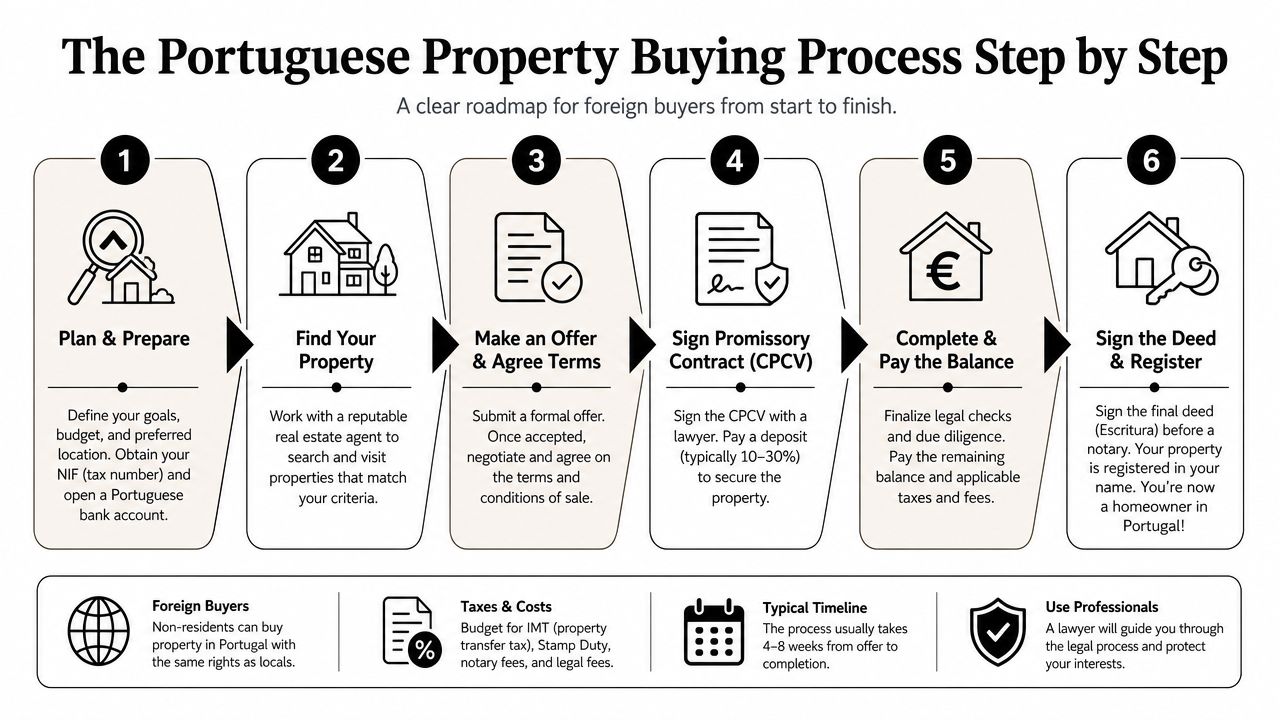
The normal route follows a recognisable pattern:
Get a NIF
Your Portuguese tax number is essential for property transactions and other fiscal activity. If you're overseas, a lawyer or authorised representative can usually help organise it.Open a Portuguese bank account
This isn't always legally mandatory in the broadest sense, but it makes deposits, taxes, utility setup, and ongoing ownership much easier to manage.Instruct an independent lawyer
At this stage, the process becomes safer. Your lawyer should review ownership, debts, permissions, and contract terms before you commit.Make an offer and agree terms
Once the commercial terms are clear, the parties move toward the promissory stage rather than jumping straight to final completion.
The two contract stages foreign buyers must understand
The CPCV is the promissory contract. It records the agreed terms and commits both parties before final closing. For foreign investors, this is often the point at which legal due diligence needs to be substantially complete. If you discover major issues after signing, your negotiating position is weaker.
The Escritura is the final deed. This is the formal transfer of ownership, usually completed before a notary or equivalent authorised process. At that stage, title passes and the transaction is registered.
The safest buyer is the one who treats the CPCV as a legally meaningful commitment, not as a casual reservation document.
A concise explainer can help if the terminology is unfamiliar, but don't substitute online reading for legal advice. Portuguese documents can look straightforward while still carrying material implications on deposits, deadlines, and completion conditions.
What the process looks like in practice
Many overseas buyers also benefit from a visual walkthrough before they start speaking to agents or lawyers. This short guide gives a useful overview of the sequence and terminology involved:
The operational lesson is simple. Prepare identity, banking, and legal representation first. Search second. Contract third. Buyers who reverse that order often end up negotiating from a position of urgency, and urgency is expensive.
Financing Risks and Due Diligence
A small underwriting error matters more in Portugal in 2026 because the tax drag is now easier to quantify. With the new flat 7.5% IMT treatment for non-residents already affecting entry costs, buyers have less room to absorb mistakes in pricing, licensing, financing, or currency execution. In lower-yield markets, that margin disappears quickly.
The practical implication is simple. Due diligence is no longer an administrative step near closing. It is part of return analysis.
Why underwriting discipline matters more in 2026
As noted earlier, international buyers in Portugal often deploy large ticket sizes, particularly in resort and prime urban segments. That raises the cost of being wrong about legal status, achievable rent, or resale liquidity. It also changes the comparison set. A buyer accepting a 3% to 5% gross yield in Lisbon or parts of the Algarve is competing, in capital allocation terms, with other global markets where yields may be higher or transaction costs lower.
That does not make Portugal unattractive. It means Portugal needs to be bought selectively.
The strongest cases are usually assets with one of three characteristics. A discount to local comparables that survives legal review. A rental profile supported by year-round demand rather than seasonal optimism. A resale position with scarcity value that is still defensible if financing conditions tighten.
What due diligence should test before you commit capital
A lawyer should verify ownership, registration consistency, and any charges over the asset. That includes liens, inheritance issues, condominium arrears, and discrepancies between the land registry, tax records, and actual physical configuration.
Planning review matters just as much. Older homes, renovated apartments, and villas with extensions often carry execution risk if prior works were not regularised. For an income strategy, licensing status also needs to be checked directly, especially where the business case depends on short-term letting rather than long-stay tenants.
Financial due diligence should be equally conservative:
- Rent assumptions: Stress-test projected income against lower occupancy, slower lease-up, and realistic operating costs.
- Exit liquidity: Assess who the next buyer is likely to be if market conditions weaken. A narrow buyer pool increases resale risk.
- Building-level exposure: Review service charges, sinking fund adequacy, and any announced capital works that could affect net yield.
- Tax-adjusted returns: Model acquisition taxes, annual holding costs, and sale frictions before comparing Portugal with alternative markets.
- Financing terms: Check whether your mortgage margin, fixed-period structure, and repayment profile still work under weaker rent or higher vacancy.
For high-end stock, comparables often mislead because headline price per square metre misses the variables that drive actual buyer behaviour. Floor height, outdoor area, privacy, view protection, and building quality can move value materially. A guide to 2026 penthouse valuation strategies is useful if you are assessing premium units where standard apartment comps are weak.
Financing risk extends beyond interest rates
Mortgage availability is only one part of the equation. International investors also face basis risk between euro-denominated assets and income or capital held in sterling, dollars, dirhams, or other currencies. A 5% to 10% foreign exchange move can alter your effective entry price more than weeks of negotiation with the seller.
This deserves the same discipline as legal review. Buyers transferring capital in stages should set an exchange plan before signing, not after completion dates are fixed. A practical note on how to hedge currency risk can help frame that decision.
The broader lesson is that financing risk in Portugal is layered. Rate risk affects debt service. Currency risk affects entry cost. Tax policy affects net return. Legal defects affect both income and exit value.
Investors who treat those risks as one underwriting exercise usually preserve more capital than buyers who focus only on location and headline price.
Your Next Steps to Investing in Portugal
Portugal still deserves attention from global buyers, but the easy version of the story is over. Prices have risen sharply, foreign capital remains active, and selected regions still offer credible rental income. At the same time, the new non-resident tax treatment means poor underwriting will show up faster.
Start by defining your objective with precision. If you want prime-city wealth preservation, Lisbon may justify lower yields. If you want a more balanced urban income profile, Porto often deserves closer study. If you want internationally driven demand and holiday-led upside, the Algarve can work, but only with stricter licensing and seasonality checks.
Then build the right local team. You need a bilingual independent lawyer first. After that, add a mortgage broker if financing with a loan is part of the plan, and a buyer's agent if you're purchasing remotely or entering a micro-market you don't know well. Keep each adviser independent enough to challenge the others.
One practical research option is World Property Investor, which publishes country and city guides, rental yield comparisons, tax explainers, and market overviews for international buyers. Used properly, that sort of resource helps investors compare Portugal with alternative markets before they commit capital.
The final step is to model one real transaction. Not ten browser tabs. One actual property. Underwrite the purchase price, acquisition costs, financing terms, realistic rent, management, maintenance, and exit assumptions. If the deal still works after that, you're not chasing a narrative. You're making an investment.
If you're comparing regions, yields, taxes, and buying rules before committing capital, World Property Investor offers practical research on Portugal and other international markets to help you assess opportunities with a clearer ROI lens.