
For a resale property in France, typical upfront acquisition costs are about 7% to 8% of the purchase price, while new-builds usually fall around 2% to 4%. The deeper question for a UK buyer is how much cash must be available at completion once mortgage charges, insurance, registration costs and currency conversion are included.
You may be comparing a €350,000 Provençal stone house with a similarly priced new-build apartment on the Côte d'Azur. On paper, the prices look close. In practice, the resale property carries a much heavier completion charge, while the new-build may reduce the initial capital drag but introduce different delivery, location and resale considerations.
That distinction matters for an investor assessing rental income, a family buying a holiday home, or an international buyer arranging a euro mortgage. A single “frais de notaire” percentage doesn't describe the full transaction. You need to separate acquisition costs, financing add-ons and recurring ownership expenses before deciding whether the deal works.
Table of Contents
- The Real Cost of Buying Property in France in 2026
- How Notaire Fees and Transfer Taxes Are Calculated
- New-Build Versus Resale Cost Structures
- Mortgage Fees and the Hidden Add-Ons That Push Costs Higher
- Worked Cost Examples Across Price Bands and Regions
- Ongoing Ownership Costs Every Investor Should Budget For
- Cash-Flow and Timing Strategies to Lower the All-In Cost
- Cost Summary and Investor FAQs
The Real Cost of Buying Property in France in 2026
The Provençal house looks familiar. It may have exposed stone, a swimming pool and a location that feels immediately lettable. The Côte d'Azur apartment, by contrast, may be sold off-plan, with a staged payment schedule and a price that already includes VAT. Treating both as €350,000 purchases would conceal the most important difference in the opening cash requirement.
For older French properties, UK-facing guidance places upfront purchase costs at about 7% to 9% of the purchase price. New-build homes typically fall to around 2% to 4%, because the VAT structure replaces much of the heavier resale transfer-tax burden. These ranges are set out in UK-focused guidance on buying property in France.
At €350,000, the broad acquisition-cost difference is material:
- Resale house: roughly €24,500 to €31,500 in acquisition costs.
- New-build apartment: roughly €7,000 to €14,000 in acquisition costs.
Those figures describe the property purchase itself, not every cost attached to a financed transaction. A mortgage can add bank charges, valuation costs, borrower insurance and mortgage registration expenses. UK buyers also need to consider the exchange rate used when euros are transferred, because the sterling amount can change between the offer, deposit and completion.
Practical rule: Treat the advertised price as the first line of the budget, not the budget itself.
The analysis therefore has three layers. First, calculate the acquisition charge at completion. Second, add financing costs that arise because you're borrowing. Third, model annual ownership costs, including local property taxes, insurance, building charges and management. The worked examples later in this guide show how the same percentage produces very different cash requirements across price bands and property types.
How Notaire Fees and Transfer Taxes Are Calculated
The phrase frais de notaire creates a common analytical error. Buyers often assume the entire charge represents the notaire's professional fee. In reality, the headline amount also includes transfer duties, formalities and disbursements collected during the legal completion process.
The regulated notaire fee itself follows a statutory degressive scale. The applicable bands are 3.945% up to €6,500, 1.627% from €6,500 to €17,000, 1.085% from €17,000 to €60,000, and 0.814% above €60,000, before VAT and related charges are added, as detailed in this explanation of the French notaire fee scale.
That structure explains why the notaire's own regulated remuneration is generally only about 0.8% to 1% of a higher-value property, even though the total resale acquisition charge is much larger. The rest is principally made up of state transfer duties, land-registration items, formalities and disbursements.
Rebuilding the headline figure
A buyer can test an estimate by separating the total into three questions:
- What is paid to the state? Transfer duties form the largest part of the resale charge. Departmental and communal components can affect the effective total.
- What is the notaire paid? The professional fee follows the degressive statutory scale rather than a single percentage applied to the whole price.
- What administrative work is required? Formalities, registrations and disbursements complete the calculation.
The result is a resale cost commonly presented as about 7% to 8%, with UK-facing guidance sometimes using the wider 7% to 9% range. A useful comparison of how these charges differ from other conveyancing systems is available in this guide to property conveyancing costs.
The key judgement is not whether a quote says “notaire fees”. It's whether the quote identifies the underlying duties and expenses clearly enough for you to compare it with the official purchase price and the financing plan.
New-Build Versus Resale Cost Structures
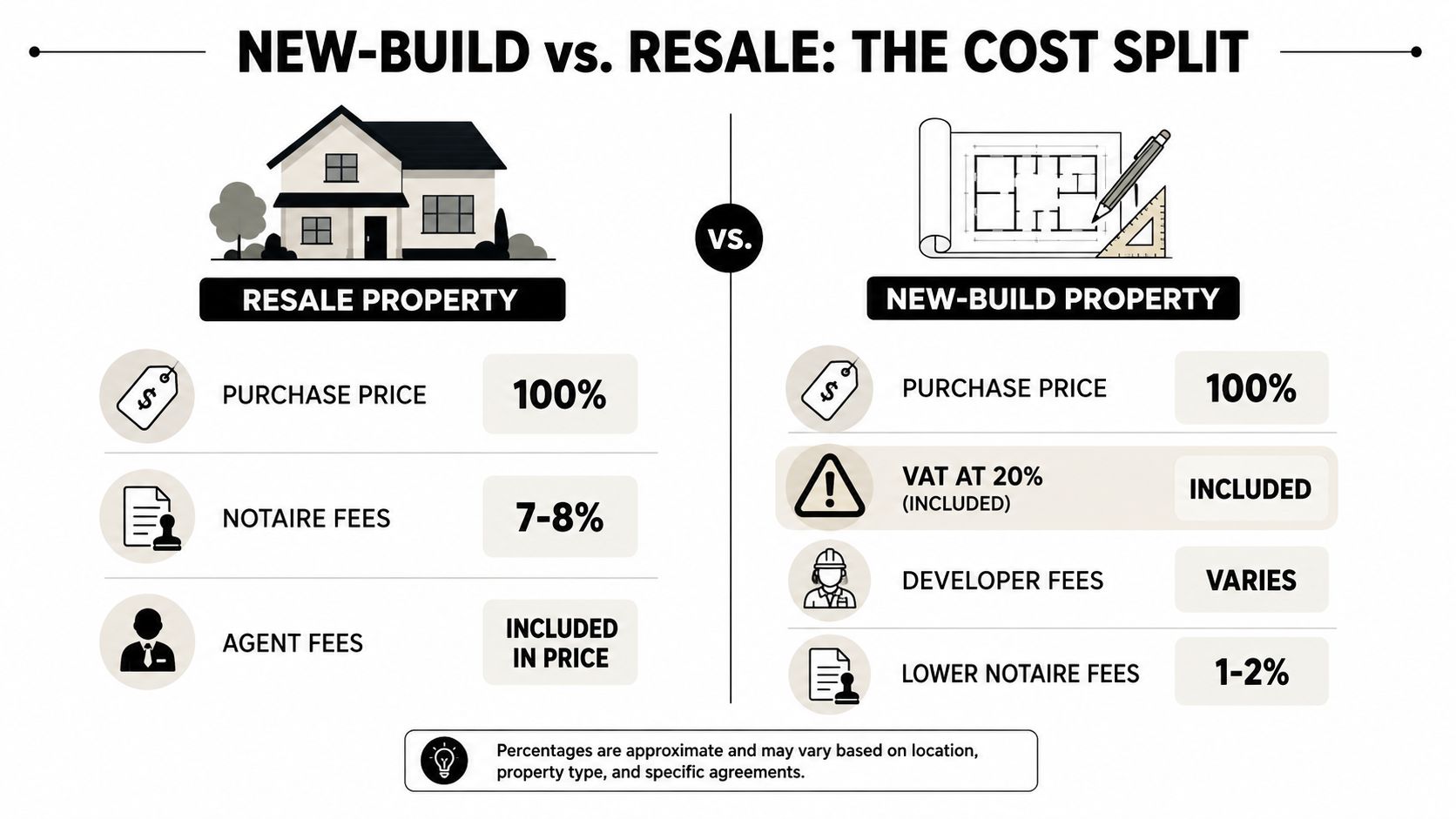
A buyer choosing between a new-build and a resale property is comparing two different cost structures. Resale purchases generally carry the heavier transfer-duty burden. A new-build price usually includes VAT at 20%, while the acquisition-cost calculation benefits from the new-property regime.
The practical difference is material at completion. New-build closing costs are commonly around 2% to 4%, compared with the higher resale structure, because VAT replaces much of the resale transfer-tax burden. The distinction is explained in this guide to French property buying costs.
For an off-plan purchase, the notaire charge is generally calculated against the relevant tax base rather than by applying the resale method to the headline price. Buyers considering what an off-plan property involves should also check how the contract defines that base. Where TVA applies, guidance identifies a reduced duty rate of about 0.715%, helping explain the lower upfront charge. VAT is normally embedded in the developer's pricing, so it should not be added again without checking the contract.
The investor trade-off
Lower completion costs improve the initial cash position. Capital that would otherwise be committed to duties and acquisition charges can remain available as a reserve, fund furnishing, or support the first rental period. For a UK buyer using financing, that distinction affects the sterling cash required at completion and can improve the apparent first-year cash-on-cash result.
The saving comes with a different risk profile. An off-plan property carries delivery and specification risk, whereas a completed resale property provides direct evidence of condition, neighbourhood character and existing rental demand. New-build supply may also be concentrated in developments where comparable units compete for tenants or future buyers.
A lower acquisition charge improves entry mathematics, but it does not remove the need to test location, tenant demand and exit liquidity.
Rather than asking which category is cheaper, compare whether the lower upfront drag of a new-build compensates for the specific asset's development risk, completion timing and resale characteristics.
Mortgage Fees and the Hidden Add-Ons That Push Costs Higher
A financed purchase has a second cost layer that the headline resale percentage doesn't capture. The bank's arrangement process can create charges linked to the loan rather than the property price, while the security registered against the property creates its own expenses.
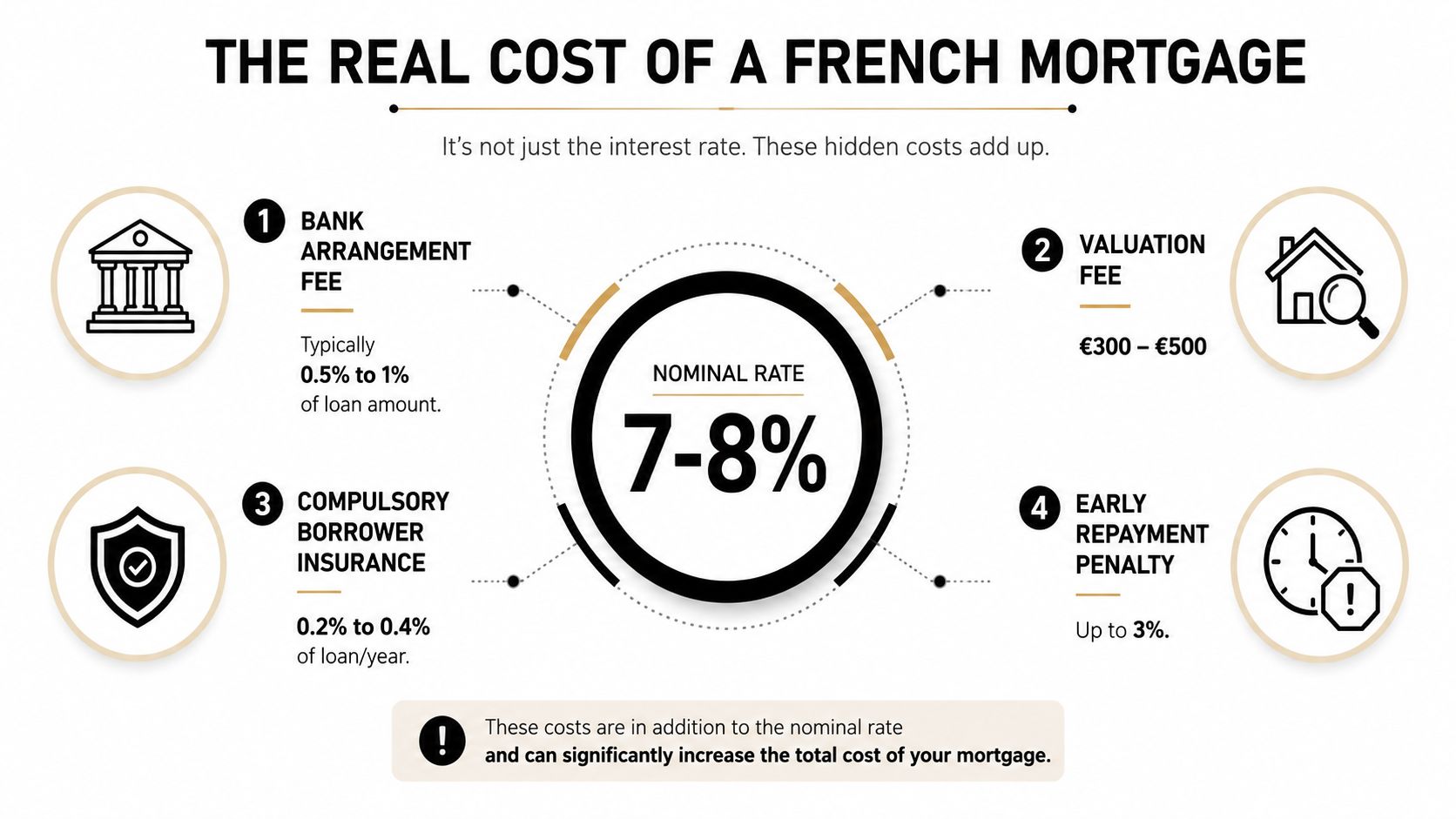
Mortgage-related costs commonly include €500 to €1,500 in bank fees, €300 to €600 for valuation, annual borrower insurance of 0.2% to 0.6%, and mortgage registration duty of about 0.715%. These figures are set out in this guide to buying property in France.
The items behave differently, which matters when you model the deal:
- Bank fees are usually a transaction charge and can vary by lender and application.
- Valuation costs pay for the lender's assessment of the security.
- Borrower insurance recurs annually and is tied to the loan and cover required by the lender.
- Mortgage registration duty is connected to registering the lender's security over the property.
Why the total can reach 10% to 15%
The frequently quoted 10% to 15% all-in range for a financed purchase reflects the combination of acquisition and mortgage-related expenses, rather than a new tax applied to every buyer. The upper end becomes more plausible when a resale property carries the standard acquisition burden and the buyer adds several financing charges, insurance and registration expenses.
This is why a UK investor should build two separate schedules. The first should show the property price, resale or new-build acquisition rate and any clearly disclosed transaction charges. The second should show lender costs, valuation, insurance and registration. Combining them only at the end prevents financing costs from disappearing inside a vague contingency.
A useful framework is:
Completion cash = purchase price contribution + acquisition costs + financing costs + immediate reserve.
The final reserve is a planning decision rather than a quoted statutory charge. It protects the buyer from treating every euro as available for the purchase and leaving no liquidity for furnishing, initial repairs or delayed rental income. Anyone comparing cross-border borrowing can also use this guide to mortgages for buying property abroad to structure the financing questions before applying.
Worked Cost Examples Across Price Bands and Regions
Worked examples make the percentage ranges easier to interpret. The following scenarios use the verified acquisition-cost bands only. They exclude financing charges, agency-fee surprises and currency movements, so the figures should be read as property acquisition estimates, not guaranteed completion statements.
| Price band | Property type | Acquisition fees % | Estimated upfront cash |
|---|---|---|---|
| €250,000 | Resale apartment in a mid-sized city | 7% to 8% | €17,500 to €20,000 |
| €500,000 | Resale family home in a coastal region | 7% to 8% | €35,000 to €40,000 |
| €750,000 | New-build in a prime market | 2% to 4% | €15,000 to €30,000 |
The €250,000 city apartment produces a relatively modest euro charge, but the percentage still matters if the buyer is relying on a tight deposit budget. The €500,000 coastal home demonstrates the effect of scale: the same resale percentage creates €35,000 to €40,000 of acquisition costs before financing, as reflected in French property buying guidance for UK buyers.
The €750,000 new-build has the highest purchase price in the table, yet its estimated acquisition charge can be lower than that of the €500,000 resale home. That's the central capital-allocation insight. A higher-priced new-build can require less cash for acquisition expenses than a cheaper resale property, although the buyer still commits more to the asset itself.
Sterling planning for UK buyers
There is no single honest sterling figure without an agreed exchange rate. The relevant rate is the one available when the buyer converts funds for the deposit and completion, not a rate remembered from the first viewing or offer. A buyer should therefore request a euro completion statement and obtain a live sterling quote before transferring money.
Keep the euro budget separate from the sterling budget. That makes it easier to identify whether a change comes from the property transaction or from currency conversion. For investors assessing the effect on returns, the property investment return calculator guidance provides a useful framework for separating acquisition costs from operating performance.
Ongoing Ownership Costs Every Investor Should Budget For
Completion is the point at which ownership costs begin, not the point at which the financial analysis ends. A French property can generate recurring charges even when it's empty, and those charges affect the difference between a promising gross rent and a defensible net return.
UK government guidance confirms that buyers should expect to pay both taxe d'habitation and taxe foncière after purchase, alongside other recurring ownership charges. The exact liability depends on the property's use and local circumstances, so an investor should obtain the latest bills and ask the notaire or local adviser how they're allocated.
The annual cost model
A practical budget should include:
- Taxe foncière: The owner pays this local property tax, with the amount determined by the property and local authority framework.
- Taxe d'habitation: This remains relevant to second homes and other qualifying uses, rather than being treated as a universal primary-residence charge.
- Copropriété charges: Apartment owners contribute towards shared maintenance, communal systems and building administration.
- Insurance: Buildings and contents cover protect the asset, with the required level depending on property type and risk.
- Management and accounting: Non-resident owners may need local support for guest access, maintenance, tax administration and rental records.
The operating model should distinguish fixed charges from usage-sensitive expenses. A coastal apartment with shared facilities may have a different cost profile from a rural house, while a holiday let may require more frequent cleaning, inspections and guest support.
For owners coordinating turnovers remotely, a property management platform for cleaning can help organise cleaning workflows and property operations. That doesn't replace local tax or legal advice, but it can make recurring service costs more visible in the monthly model.
A property's gross yield isn't the decision metric. Subtract taxes, insurance, management, building charges, maintenance and periods without income before comparing it with another market. Further background on local liabilities is available in this guide to property taxes in France.
Cash-Flow and Timing Strategies to Lower the All-In Cost
The lowest percentage isn't always the lowest total cost. A buyer can reduce avoidable friction by controlling the order and timing of each payment rather than treating the deposit, mortgage and completion transfer as separate events.
Start with a written euro cash schedule. It should show the offer, deposit, staged payments where relevant, mortgage drawdown and final completion balance. A UK buyer who converts money in several unplanned batches may pay conversion costs repeatedly and expose each transfer to a different exchange rate.
Sequence the transaction
Use the property contract and lender timetable to identify when euros are required. If the completion date is known, the buyer can discuss a currency strategy with a specialist provider and decide whether to convert in stages or protect a future payment. The objective isn't to predict the market. It's to avoid discovering that a sterling budget no longer covers a fixed euro obligation.
Agency fees also need early clarification. French listings may present fees within the advertised price or separately, so ask the agent to state the structure in writing. If the seller or agent is willing to adjust the commercial terms, preserving working capital may be more valuable than focusing only on a small change to the headline price.
Cash-flow discipline: Fix the euro obligations first, then decide how and when sterling will be converted.
Entity planning deserves specialist advice. Some international buyers consider an SCI or nominee arrangement, but the correct structure depends on tax residence, financing, inheritance objectives and the intended use of the property. It shouldn't be selected just because another investor used it.

Before making an offer, confirm the following:
- Euro requirement: Obtain a full completion estimate.
- Fee structure: Check whether agency costs are included or additional.
- Finance timing: Match the mortgage timetable to the notaire's schedule.
- Currency exposure: Decide how the deposit and completion balance will be funded.
- Operating reserve: Keep cash available after completion for ownership and letting costs.
Cost Summary and Investor FAQs
The cleanest way to assess buying property in France costs is to create a three-part deal sheet:
- Acquisition: Use about 7% to 8% for a resale property or 2% to 4% for a new-build, then verify the specific estimate.
- Finance: Add bank fees, valuation, borrower insurance and mortgage registration expenses if borrowing.
- Ownership: Model local taxes, insurance, building charges, management, maintenance and letting operations.
That framework is more useful than applying one percentage to every French property. It also separates costs that arise once from those that continue annually.
What happens if the buyer withdraws?
A buyer who withdraws may face financial consequences under the contract and applicable transaction rules. The exact outcome depends on the stage reached, contractual protections and the reason for withdrawal. Before signing, ask the notaire to explain the withdrawal provisions and the treatment of any deposit.
Are notaire costs divided between buyer and seller?
The buyer generally carries the acquisition costs associated with completing the purchase, while the seller's obligations are dealt with separately in the contract. The parties can negotiate commercial terms, but the buyer shouldn't assume that calling a charge an agency fee changes its legal or tax treatment. The written completion statement is decisive.
Do the same percentages apply to commercial property?
No single residential rule should be applied automatically to commercial property. The asset type, transaction structure, VAT treatment and financing can change the calculation. A commercial buyer needs a property-specific quote from the notaire and tax adviser.
How does a non-resident euro mortgage change the budget?
It adds lender-specific costs and recurring borrower insurance to the property acquisition schedule. The buyer should ask for a European Standardised Information Sheet or equivalent loan breakdown, then combine it with the notaire's estimate rather than relying on the mortgage rate alone.
The strongest investment decision is therefore based on cash required, annual operating burden and realistic exit assumptions, not the asking price in isolation.
World Property Investor offers country and city guides, market analyses and practical buying advice for international investors comparing French property with other overseas markets. Visit World Property Investor to research locations, assess deal costs and build a more disciplined cross-border investment shortlist.