
For any global property investor, understanding the on-the-ground cost of living is the foundational step towards building a successful buy-to-let strategy. The monthly expenses tenants face in Manchester directly shape rental demand, affordability, and ultimately, an investor's return on investment.
According to data compiled from sources like the Office for National Statistics (ONS) and major cost-of-living aggregators, a single person in Manchester can expect monthly outgoings of approximately £2,663. For a family of four, this figure rises to around £4,579 to maintain a comfortable standard of living. These numbers provide a clear, data-driven snapshot of the city's financial landscape.
A Strategic Overview of Manchester Living Expenses
Manchester’s primary appeal for property investors lies in a powerful economic fundamental: it offers the career opportunities and infrastructure of a premier UK city without the prohibitive living costs associated with London. This affordability gap is the engine driving a consistent inflow of skilled professionals, graduates, and corporations, all seeking superior value and a higher quality of life.
This sustained migration fuels the city’s robust and sustainable rental demand.
For an investor, this equilibrium represents a significant opportunity. Manchester’s manageable living costs attract a deep pool of high-calibre tenants, while the city's strong growth trajectory indicates significant potential for both rental income and capital appreciation. Analysing these expenses is not an academic exercise; it is the basis of a sound, long-term investment plan.
The Key Pillars of Living Costs
To build a profitable portfolio, an investor must dissect a typical tenant's budget. This is shaped by four core components:
- Housing and Rent: The largest single expenditure, varying significantly by neighbourhood and property specification.
- Utilities and Council Tax: Non-negotiable monthly liabilities that directly impact a tenant's disposable income.
- Transport: The cost of commuting, which can significantly enhance or detract from a property's desirability.
- Lifestyle and Discretionary Spending: Encompassing groceries, entertainment, and leisure, this category defines the city's quality of life and its appeal to target demographics.
By analysing these core expenses, an investor can accurately assess tenant affordability, forecast realistic rental yields, and identify properties that offer the best long-term value. This data-driven approach moves beyond speculation, grounding decisions in the financial reality of the target market.
This framework allows for the identification of tangible opportunities. For instance, a property with a high energy efficiency rating or one located near a key Metrolink tram stop can be marketed as a cost-saving asset. This is a compelling value proposition for discerning tenants, who may be willing to pay a rental premium for such benefits.
This strategic thinking is crucial, whether comparing Manchester to other UK cities or against international markets. For a different perspective, our guide to the cost of living in Malta offers a useful comparison.
We will now explore each of these elements in greater detail, providing the actionable intelligence required to invest with confidence.
Analysing Manchester Housing and Rental Costs
For any property investor evaluating Manchester, housing costs are the paramount variable. This is the largest outgoing for tenants and, consequently, the most direct influence on rental yields and portfolio performance. A granular, real-world understanding of the city’s rental market is essential for making astute investment decisions.
The market's growth is not speculative; it is built on solid economic fundamentals. The establishment of major operations like the BBC in MediaCityUK and significant government investment in infrastructure act as a powerful magnet for skilled professionals and graduates. This constant influx of a high-earning tenant pool maintains fierce competition for quality housing, driving rental values consistently upwards.
This chart provides a quick snapshot of the total monthly expenses for both single residents and families in Manchester.
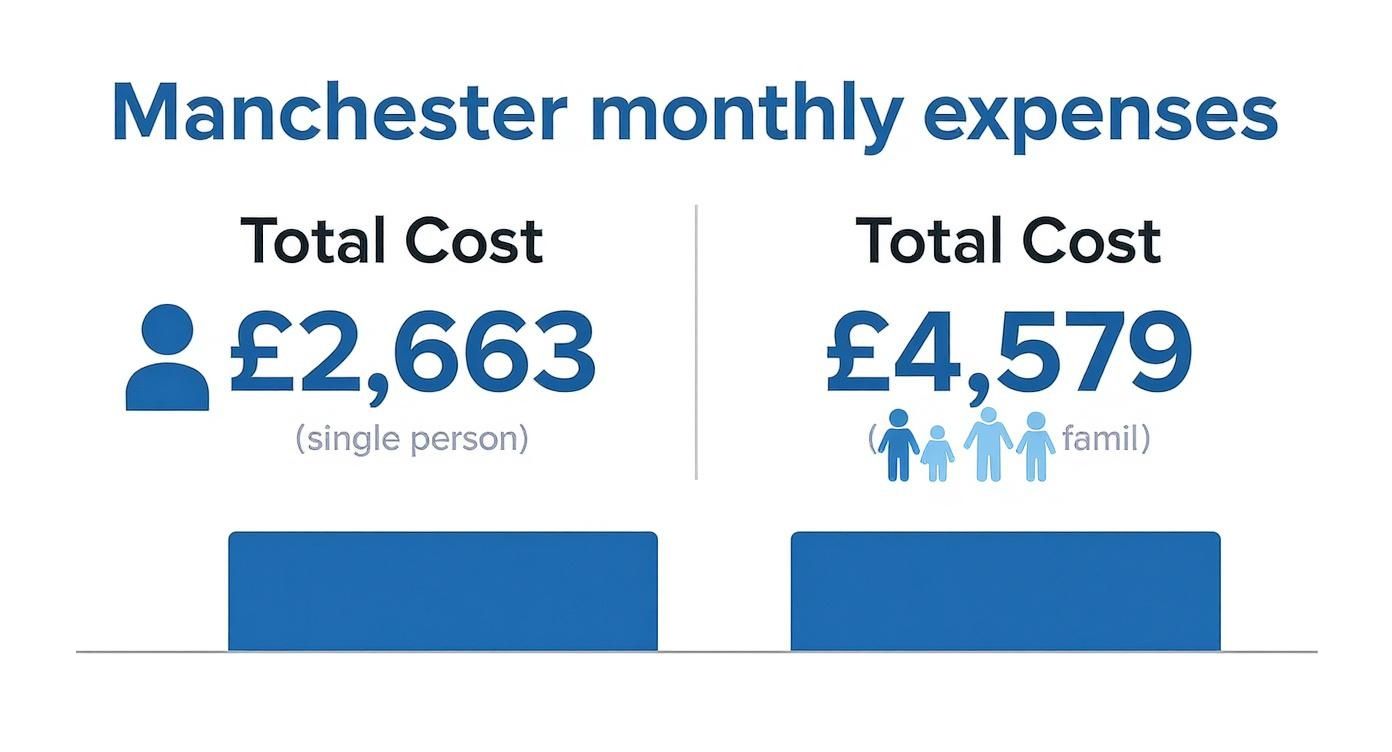
As the data illustrates, the financial commitment is significant, reinforcing why accommodation is the primary financial concern for anyone renting in the city.
Prime Versus Potential: A Tale of Two Markets
Manchester presents a diverse property landscape, from the premium residential towers of the city centre to high-potential, emerging neighbourhoods. This creates a spectrum of investment opportunities, each with a distinct risk and reward profile. An investor's strategy will determine whether to target the stability of established postcodes or the growth potential of emerging markets.
- Established Prime Markets: Areas like Spinningfields and Deansgate represent the pinnacle of city living, attracting corporate professionals and high-net-worth individuals who pay a premium for convenience and amenities. Rents here are the highest in the city, offering stable—though often lower-percentage—yields due to high capital entry costs.
- Emerging High-Growth Markets: Locations such as Salford Quays and Ancoats have transformed from industrial heartlands into vibrant, desirable communities. They offer a more accessible entry point for investors and attract a younger demographic of professionals and creatives. While purchase prices are lower, the potential for both rental growth and capital appreciation can be significantly higher.
For the discerning investor, the key is to align the choice of location with specific portfolio goals. A strategy focused on immediate, stable cash flow might favour a prime postcode, whereas one targeting long-term capital growth could find better value in an emerging neighbourhood with strong fundamentals and ongoing regeneration.
A Data-Driven Look at Rental Prices
Let's examine the hard numbers that define the market. As established, housing costs dominate living expenses. According to local housing data, the average three-bedroom apartment in Manchester's city centre commands a rent of approximately £1,741 per month. Outside the city centre, rental prices decrease to more manageable levels.
For single residents, a one-bedroom flat in the city centre costs around £1,610 monthly. The same property outside the core averages a more affordable £1,401. You can explore more UK cost of living data from Global Citizen Solutions.
This price differential between the city core and its surrounding districts is a critical insight. It enables investors to target different tenant segments—from the single professional requiring a central postcode to a young family prioritising space and affordability further out.
The Impact on Investment Yields
Translating rental figures into potential returns is the next critical step. Gross rental yield is calculated as: (Annual Rental Income / Property Purchase Price) x 100. A higher rent relative to the property's cost results in a better yield.
In Manchester, a one-bedroom flat in a prime area like Castlefield might yield around 4-5%, offering stability and prestige. In contrast, a similar property in an emerging area like Salford Quays, with its lower purchase price but still strong rental demand, could achieve yields closer to 6-7%, representing a more aggressive growth opportunity. These figures are also influenced by property-specific factors, including the type of ownership. For a deeper analysis of UK ownership structures, our guide comparing leasehold vs freehold property is a valuable resource.
Ultimately, a successful investment hinges on matching the property type and location to a clearly defined tenant profile. By analysing the granular data behind Manchester's living costs, an investor can move beyond speculation and build a robust, evidence-based strategy.
Breaking Down Everyday Tenant Expenses

While rent is the headline figure, the combination of essential costs shapes a tenant's budget. For any investor, particularly one based overseas, understanding these non-negotiable manchester living expenses is fundamental. These liabilities directly impact a tenant's disposable income and their ability to consistently meet rental obligations.
This analysis moves beyond a simple yield calculation to a more sophisticated assessment of genuine tenant affordability. A property with high running costs is less competitive, whereas one with lower outgoings provides a powerful marketing advantage. This operational knowledge is key to accurate net return forecasting.
Utilities and Council Tax
These fixed monthly costs constitute a significant portion of any household budget. While energy bills fluctuate with usage and market prices, official data from sources like Gov.uk provides a solid baseline for estimation.
For a typical two-bedroom flat, tenants should budget between £150 and £220 per month for combined gas, electricity, and water. This figure is heavily influenced by a property’s energy efficiency. An asset with a strong Energy Performance Certificate (EPC) rating (C or above) is not just a regulatory requirement; it represents a tangible financial saving for tenants, often justifying a higher rent.
Council Tax, set by the local authority based on a property's valuation band (A to H), is another non-negotiable expense. Properties typical of a buy-to-let portfolio in Manchester often fall into Band B or C. This equates to an annual charge of approximately £1,600 to £1,800, which must be factored into any affordability assessment.
A property with a higher EPC rating is a more attractive long-term asset. It directly reduces a tenant's outgoings, making your property more desirable in a competitive market and contributing to lower tenant turnover. This focus on operational efficiency is a hallmark of a sound investment strategy.
Understanding these fundamentals is crucial, whether investing in the UK or abroad. Tax and utility structures vary dramatically, as explored in our breakdown of the cost of living in Turkey for property investors.
The Cost of Getting Around
Manchester's public transport network, particularly the Metrolink tram system, is a vital component of the city's infrastructure. For tenants, the daily commute is a major consideration when choosing a property.
A monthly pass for unlimited travel across key zones costs approximately £80 to £100. This makes properties with excellent transport links highly desirable. A flat within a short walk of a tram stop or major bus route is a premium asset.
In contrast, running a car in the city is a considerably more expensive proposition. A breakdown for a typical vehicle owner includes:
- Insurance: Averages over £700 annually, according to industry bodies.
- Fuel: Dependent on mileage, but can easily exceed £150 a month.
- Parking: City centre parking can add another £100 to £200 monthly.
This comparison makes the investment case for properties in well-connected, walkable neighbourhoods clear. Proximity to transport hubs can be marketed as a direct cost-saving benefit, attracting tenants who prioritise convenience and lower financial outlays over car ownership.
The Real Value of Lifestyle and Discretionary Spending

Beyond essential costs lies the core of a city's appeal, a key driver of property demand in Manchester. Investors who grasp this are not merely providing accommodation; they are offering access to a desirable lifestyle.
Manchester's global reputation is built on its vibrant culture, music, and sporting heritage. This cultural capital attracts a continuous flow of young professionals and skilled workers who prioritise quality of life. They seek not just a place to live, but a community to be part of, and they budget accordingly. This creates a direct correlation between a neighbourhood's amenities and the rental premium it can command.
Putting a Number on Culture and Leisure
While discretionary spending varies, a typical young professional in Manchester allocates between £250 and £450 per month for socialising and leisure. This budget covers activities that define modern city living and underpin Manchester's appeal.
- Dining and Socialising: A meal for two at a mid-range restaurant in a popular area like the Northern Quarter costs £50 to £70. The city's pub culture is a social cornerstone, with a pint averaging £4.50 to £5.50.
- Entertainment and Events: As a global hub, a ticket for a concert at the AO Arena or a Premier League match can range from £60 to over £100, forming a significant part of a resident's manchester living expenses.
- Fitness and Wellbeing: A monthly gym membership in the city centre typically costs between £30 and £50, another regular item in a tenant's outgoings.
For an investor, this data is invaluable. It demonstrates that proximity to lifestyle amenities is a core asset. A flat within walking distance of popular restaurants, music venues, or green spaces like Heaton Park offers tangible value that tenants are willing to pay a premium for.
For the modern tenant, lifestyle isn't an afterthought; it's a key part of the rental equation. Investing in a property in a vibrant, well-connected neighbourhood is a direct investment in the very things that drive demand, slash void periods, and support long-term capital growth.
How Lifestyle Appeal Translates into Investment Returns
The connection between tenant lifestyle and investment return is direct. Properties in amenity-rich neighbourhoods consistently attract a higher calibre of tenant, who often have more disposable income and greater stability, thereby de-risking the investment.
Consider the contrast between an established market like Didsbury, known for its independent cafés and bars, and a purely residential suburb with limited amenities. The initial purchase price in Didsbury may be higher, but its strong lifestyle appeal enables it to command a rental premium, attract quality tenants more quickly, and maintain higher occupancy rates over the long term.
This insight allows an investor to look beyond simple yield calculations. By analysing a neighbourhood’s cultural assets, one gains a clearer understanding of its future demand and resilience. A location with a growing number of independent businesses and cultural hubs is a strong indicator of a market on an upward trajectory.
How Manchester Stacks Up, UK and Worldwide
A prudent investment decision is never made in isolation. While Manchester’s local market fundamentals are strong, its true strength becomes apparent when compared to other major cities, both in the UK and globally. This comparative analysis is essential for identifying a market that balances growth, affordability, and sustainable demand.
For investors in UK property, London is the primary benchmark. The capital's high cost of living is the main driver of the "north-shoring" trend, where corporations and skilled professionals relocate to Manchester for superior value and quality of life. A one-bedroom flat in central London costs 40-60% more to rent than a comparable property in Manchester’s city centre. This significant affordability gap is the bedrock of Manchester's appeal.
Manchester Versus Other UK Hubs
Manchester also holds a competitive advantage against other key regional cities. While markets like Birmingham and Leeds offer opportunities, Manchester often leads in economic momentum and global brand recognition.
- Birmingham: Often viewed as Manchester’s closest rival, Birmingham has a slightly lower cost of living but is arguably at an earlier stage in its regeneration cycle. Manchester’s more mature creative and technology sectors provide a stronger draw for the high-earning young professionals sought by landlords.
- Leeds: As a robust financial centre, Leeds is a strong contender but operates on a smaller scale. Manchester’s larger population, more developed transport infrastructure, and world-renowned cultural scene create a deeper, more diverse tenant pool.
This places Manchester in a strategic sweet spot: a mature, dynamic market with substantial room for continued growth, particularly when contrasted with the overheated South East.
A Global Perspective on Affordability
On the world stage, Manchester’s position is equally compelling. Data from major economic bodies places Manchester at 74th on a global cost of living index, with a score of 67.4. This indicates its day-to-day expenses are comparable to major US cities like Tampa, Florida, but significantly more affordable than European counterparts like Dublin. For deeper analysis of city rankings, you can discover more insights on Numbeo.com.
For the international investor, these numbers are gold. They show Manchester isn't a low-cost, low-demand city. Instead, it occupies a perfect middle ground: affordable enough to pull in talent from ridiculously expensive global hubs, yet prestigious enough to command strong, rising rents.
This balance is the core of Manchester's investment case. The city offers a more accessible entry point than many world-class cities, yet possesses the economic fundamentals and infrastructure to support long-term capital growth. This presents a rare opportunity to enter a market with a global reputation without the prohibitive capital requirements of London, Paris, or New York. For a broader perspective on international markets, our guide to the best countries to invest in property is a valuable resource.
To provide further context, the following table compares Manchester's living costs against key UK and international cities.
Cost of Living Manchester vs Key Cities
| City | Average Monthly Rent (1-Bed City Centre) | Cost of Living Index (Excl. Rent) | Average Monthly Net Salary |
|---|---|---|---|
| Manchester, UK | £1,270 | 67.4 | £2,650 |
| London, UK | £2,250 | 85.3 | £3,600 |
| Birmingham, UK | £980 | 62.1 | £2,400 |
| Dublin, Ireland | £2,050 | 80.5 | £3,400 |
| Paris, France | £1,500 | 89.2 | £3,000 |
| New York, USA | £3,500 | 100.0 | £5,500 |
Data sourced from Numbeo, mid-2025 estimates. Figures are approximate and subject to change.
The table clearly illustrates Manchester's powerful combination of affordable living and strong earning potential, creating a sustainable ecosystem where businesses, tenants, and investors can thrive.
Translating Living Costs Into Investment Returns
A detailed breakdown of Manchester’s living expenses is the fundamental tool for forecasting real-world returns. Each data point, from a tenant’s utility bill to their transport costs, directly impacts net operating income and the long-term performance of an asset.
This level of analysis allows an investor to move beyond surface-level metrics and de-risk decisions. By understanding the financial pressures on tenants, one can set sustainable rents, minimise void periods, and attract a higher calibre of resident. A deep knowledge of Manchester living expenses is what distinguishes a speculative purchase from a calculated, profitable strategy.
Connecting Expenses to Asset Performance
The link between living costs and investment returns is direct. Rising energy costs, for example, have made properties with high Energy Performance Certificate (EPC) ratings highly desirable. Tenants actively seek homes that are cheaper to run, creating an opportunity for investors to command premium rents for energy-efficient properties.
The same principle applies to transport. The high cost of car ownership in the city centre makes properties near Metrolink tram stops prime real estate. By investing in a well-connected location, an investor offers tenants a tangible monthly saving, which in turn supports stronger rental demand and drives asset value.
Yields, Operational Costs and Appreciation
A comprehensive grasp of living costs directly informs the three pillars of any successful property investment: rental yield, operational costs, and capital appreciation. Understanding local salary levels versus expenses is essential. For further guidance on this key metric, you can learn more about what is a good rental yield in our detailed guide.
This translates into practice as follows:
- Forecasting Rental Yields: By knowing what tenants can realistically afford after essential bills are paid, an investor can set a competitive market rent that maximises income without deterring suitable applicants.
- Managing Operational Costs: Understanding typical utility bills and council tax enables accurate forecasting of holding costs during void periods, leading to more precise net return calculations.
- Predicting Capital Appreciation: Neighbourhoods with a favourable balance of lifestyle amenities and manageable living costs are magnets for skilled professionals. Investing in these areas positions an asset to benefit from sustained demand and long-term price growth.
The core investment case for Manchester rests on its unique balance of world-class career opportunities and a quality of life that remains accessible. As an investor, your strategy should aim to acquire assets that directly align with this value proposition, offering tenants a cost-effective and desirable living experience.
By consolidating all the data points covered—from housing and utilities to lifestyle and transport—an investor builds a complete, holistic view of the market. This data-driven approach transforms analysis from a simple property search into a sophisticated financial strategy, tailored to one of the UK’s most dynamic and promising property markets.
Frequently Asked Questions
For global investors evaluating the UK property market, understanding the real-world cost of living in Manchester is critical. Here are our answers to the most common questions.
What Is a Realistic Monthly Budget for a Tenant in Manchester?
A single professional renting a one-bedroom flat should budget for approximately £2,000 to £2,700 per month. This covers rent in a central or well-connected area, council tax (typically Band B or C), utilities, transport, and a reasonable allowance for groceries and lifestyle spending.
For a family of four, the required budget would be closer to £4,000 to £4,800. The final figure is heavily dependent on property size and, most significantly, schooling choices.
How Do Living Costs Impact Rental Yields?
Higher living costs, particularly for essentials like council tax and energy, directly reduce a tenant’s disposable income. This places a natural ceiling on what they can afford in rent, which in turn influences potential gross yield.
However, this presents an opportunity for astute investors. Properties with high energy efficiency (a strong EPC rating) or those located adjacent to a tram stop can be marketed as cost-saving homes. Tenants are often willing to pay a rental premium for a property that lowers their overall monthly outgoings, which helps protect and even enhance an investor's net return.
Which Neighbourhoods Offer the Best Balance of Affordability and Demand?
While prime city centre postcodes like Spinningfields will always command the highest rents, the most compelling investment opportunities are often found in emerging markets just outside the core.
- Salford Quays: As the home of MediaCityUK, this area benefits from a constant pipeline of media and tech professionals seeking quality rental accommodation. Its modern apartments and superb transport links strike an excellent balance between strong demand and more accessible purchase prices.
- Ancoats: Voted one of the world's most desirable neighbourhoods, its blend of converted historic mills and new-build developments is a magnet for young professionals and creatives. The area’s vibrant social scene supports firm rental values.
Are Manchester's Living Expenses Still a Good Value Compared to London?
Yes, unequivocally. This value proposition is the cornerstone of Manchester's investment case.
A tenant's total monthly expenditure in Manchester is typically 30-40% lower than for a comparable lifestyle in London. This significant affordability gap is a primary driver for corporate and professional relocation to the city. For an investor, this migration underpins a deep and sustainable pool of high-quality tenants, supporting both rental demand and long-term capital growth potential.
At World Property Investor, we provide the in-depth analysis global investors need to make confident decisions. Explore our comprehensive city guides and investment strategies to build your international portfolio. Visit us at https://www.worldpropertyinvestor.com.