
Nationwide house prices in Latvia rose 6.74% year-on-year in Q2 2025, according to the Central Statistical Bureau data cited by Global Property Guide. That’s the number that changes the conversation.
Many overseas buyers still think of Latvia as a low-liquidity Baltic outlier. That view is dated. Latvia now sits in a more interesting position for international investors: eurozone market, relatively accessible entry points, moderate yields, and a buying process that can be efficient if you respect the legal mechanics.
The catch is that buying a house in Latvia isn’t forgiving if you bring UK assumptions into a civil law system that places more burden on the buyer. The market can work well for disciplined investors. It can also punish lazy due diligence, especially around title, land status, and unregistered alterations.
The Latvian Property Market in 2026 An Investor's Overview
A 6.74% year-on-year rise in nationwide house prices by Q2 2025 puts Latvia in a different category from the distressed, low-attention market some foreign buyers still expect. The current phase looks more like measured expansion than speculative overheating. As noted earlier, price growth has been accompanied by a sharp increase in new dwelling approvals, which is usually a healthier signal than price growth on its own.
For investors, that combination points to a market where demand is present, but supply is not completely frozen. That reduces the risk of buying into pure scarcity pricing. It does not reduce legal risk, which is where Latvia still catches out overseas buyers.

Riga is the core market
Riga remains the first market to assess because it concentrates liquidity, tenant demand, professional services, and the deepest resale pool. Pricing is still low enough, by eurozone capital standards, to attract yield-focused investors, but its main advantage is market depth. If an overseas buyer needs to exit, refinance, or replace a manager, Riga gives more room to do it.
Yield is only part of the case. In Latvia, the better question is whether the asset is legally clean and operationally straightforward enough to preserve that yield after purchase. A house or apartment with undocumented alterations, unclear use status, or shared land complications can turn a decent-looking return into a slow legal and administrative drain.
For a broader comparison with other investable markets, review this 2025 global property market outlook.
Price bands show where the real risk sits
Riga is not one pricing story. New-build schemes, renovated central units, old town apartments, Soviet-era stock, and edge-of-city locations each behave differently on maintenance, tenant profile, financing, and resale.
The mistake I see most often is treating low entry price as a margin of safety. In Latvia, lower-priced stock often carries higher document risk. That is especially true where prior owners enclosed terraces, moved internal walls, expanded utility areas, converted outbuildings, or changed actual use without fully updating the Land Book, cadastral records, or building file. Buyers from the UK or US often expect these issues to be disclosed clearly by the seller or surfaced early by the transaction process. Latvia puts more of that burden on the buyer.
A practical read of the market looks like this:
- Prime and old town stock offers stronger prestige and better appeal to international tenants or future lifestyle buyers, but yields are usually tighter and building-level restrictions can complicate works.
- New-build units are often easier to finance, easier to let, and less exposed to surprise capex in the first years, though developers still need vetting on permits, specification delivery, and common-area governance.
- Older secondary stock can price well on paper, but unauthorized reconstructions, weak reserve funds, and inherited maintenance issues can erase the discount fast.
- House-and-land assets outside the core city need closer review of land classification, access rights, utility connections, and whether all structures are properly registered.
Practical rule: In Latvia, your actual cost basis is purchase price, legal remediation, deferred building works, and exit friction. The advertised price is only the first line of that calculation.
Where investors get caught out
The headline opportunity in Latvia is straightforward. Entry pricing remains accessible, rental income can still make sense, and Riga gives more liquidity than many foreign buyers assume.
The less obvious part is that Civil Law mechanics shape investment performance here. A property can look attractive in photos, produce acceptable headline yield, and still be a poor acquisition if part of the building is not properly registered or if the land use position limits what you thought you were buying. That is why disciplined buyers do well in Latvia and casual buyers regularly overestimate how clean a cheap deal really is.
The market can reward precision. It also penalizes assumptions.
Foreign Ownership Rules and Investment Pathways
The first filter isn’t price. It’s eligibility.
Foreign buyers can acquire Latvian property, but the practical answer depends on what you’re buying. Apartments in urban areas are generally simpler than land-heavy assets, houses with agricultural land, or plots in sensitive zones. That distinction matters more than most overseas buyers expect.
Residency route and property strategy
For investors who want a residency angle, Latvia’s €250,000 property investment threshold for residency has a 95% grant rate for compliant applications, according to Latvia Sotheby’s Realty’s purchase procedure overview. That can make Latvia more than a yield or diversification play. It can also be a mobility strategy.
Still, don’t let the residency threshold dictate a poor asset choice. A residency-compliant purchase isn’t automatically a good investment purchase. Some buyers overpay for larger units or awkward properties because they want to cross the threshold quickly.
If residency is part of your plan, review wider European pathways as well through this guide to the EU golden visa landscape.
The land issue is where buyers slip
The most common misunderstanding is assuming that if you can buy an apartment, you can buy any house with attached land on similar terms. That’s where deals become messy.
About 8% of foreign land deals are rejected due to restrictions in border zones or on agricultural land, based on the same Latvia Sotheby’s Realty source. That’s not a marginal detail. It’s a direct warning that land classification and location restrictions must be checked before emotional commitment, not after.
Use a simple decision screen early:
- Urban apartment or city house on clean urban land is usually the most straightforward path.
- Agricultural or forest-linked property requires much closer legal scrutiny.
- Border-zone property needs extra caution from the outset.
- Residency-motivated purchases should still pass normal investment tests on rentability, resale, and legal clarity.
Most international buyers do best in Latvia when they start with straightforward urban assets and only move into land-heavy deals once they understand the local rules.
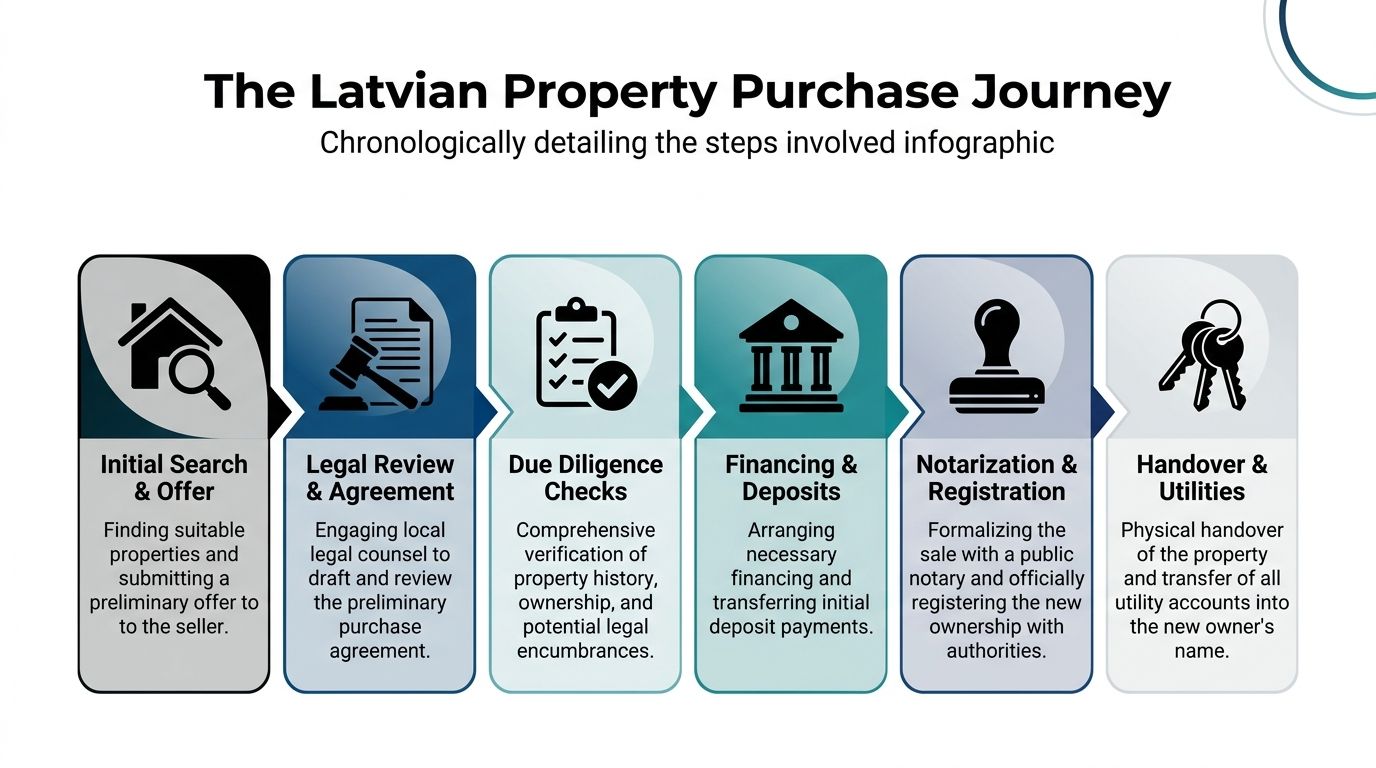
The Latvian Property Purchase Process Deconstructed
A large share of failed Latvian property deals do not collapse on price. They fail on documents, registration gaps, and legal facts the buyer assumed would have been disclosed earlier. In Latvia’s Civil Law system, that assumption is expensive.
The centre of the process is the Land Register, or Zemesgrāmata. According to LexFinance’s guide to buying property in Latvia, proper title verification sharply reduces dispute risk and materially improves completion outcomes for foreign buyers. That matters, but international investors should understand the limit of the register as well. The register confirms the legal record. It does not guarantee that the physical property matches that record in every practical sense.
Start legal review before price negotiation gets serious
Buyers from the UK or US often expect seller disclosures to do more of the work. Latvia places more weight on the buyer’s side to verify what is being bought. I advise clients to open the file early and test three things before arguing over furniture, closing dates, or a small discount.
First, confirm the seller has the right to sell. Second, confirm the cadastral and Land Register records describe the same asset being shown on site. Third, confirm what is attached to the title, including debts, easements, lease rights, management issues, or usage restrictions.
That second point catches people out. A renovated attic, enclosed terrace, shifted internal layout, added heating system, or rebuilt outbuilding may exist physically and still create legal trouble if it was never properly approved or registered. In Latvia, unregistered reconstruction is not a cosmetic issue. It can affect mortgageability, insurance, future resale, and in some cases the legal usability of part of the property.
A preliminary agreement only works if the fallback terms are written properly
Once the first document checks are passed, parties usually move to a preliminary agreement and a reservation or escrow-style deposit. Market practice often falls in the 5% to 10% range, as noted earlier from the LexFinance process guide.
The deposit stage is where foreign buyers take unnecessary risk. The agreement should state exactly what happens if the seller cannot produce missing title documents, if municipal records do not match the current building configuration, or if land-use classification creates a problem that was not obvious during viewing. A weak preliminary agreement leaves the buyer fighting over recovery rather than walking away cleanly.
For non-residents signing from abroad, paperwork quality matters just as much as deal terms. If you are using powers of attorney or foreign-issued corporate and identity documents, specialist apostille support services can help you prepare them correctly before they reach the Latvian notary or Land Register.
The notary formalises the deal, but does not replace due diligence
Foreign buyers sometimes overestimate the notary’s role. The Latvian notary is central to formal execution, identity checks, signatures, and legal form. The notary is not your substitute for investment-grade due diligence.
That distinction matters in Latvia because hidden defects are often legal rather than structural. I have seen otherwise attractive houses delayed or repriced because a garage was never regularised, shared access rights were poorly documented, or the land under the building had a classification issue that limited intended use. None of that is fixed by having a meeting at the notary.
Spousal consent and marital property status also need attention. If the seller’s authority is incomplete, registration can stall after commercial terms are agreed and funds are already committed.
Registration is the real closing point
In Latvia, ownership is functionally secure when the transfer is registered, not when the contract is signed. Treat signed documents as one stage in the chain, not the finish line.
A sound process usually runs in this order:
- Title and encumbrance review through the Land Register, cadastral records, and supporting municipal or building documents.
- Physical-to-legal matching to confirm the property on site is the same property described in the records.
- Preliminary agreement and deposit terms drafted to cover title defects, missing approvals, access issues, and default scenarios.
- Funds transfer through a documented route that satisfies bank compliance, source-of-funds review, and registration requirements.
- Notarial execution and final filing with all consents, translations, and identity documents in order.
- Registration of ownership before the buyer treats the asset as fully acquired.
That sequence sounds procedural. In practice, it is your risk filter. Latvia can be a straightforward market to transact in, but only if the legal object, the built reality, and the intended use all line up. Buyers who want a broader framework for structuring overseas acquisitions should also review this guide on how to buy property abroad.
Financing Your Latvian Property Purchase
Financing in Latvia is possible for foreign buyers, but banks lend against clarity, not optimism. If the property, income trail, or document package is weak, you should assume a slower process and tighter credit appetite.
The practical borrowing environment has improved compared with the peak-rate period. Mortgage rates had eased to around 4% by early 2026 in the market context outlined earlier, which helps affordability and can improve buy-to-let maths if the asset is priced sensibly. That doesn’t mean every non-resident borrower will get local-bank debt on smooth terms. Banks still want a clean story.
What lenders usually care about
A Latvian lender is typically trying to answer three questions.
First, is the property legally straightforward and readily mortgageable? Second, is the borrower’s income transparent and documentable? Third, does the deal still make sense if valuation, rent, or timing comes in less favourably than expected?
Expect the bank to focus on:
- Proof of income from employment, business, or investments.
- Bank statements and source-of-funds evidence that can survive compliance review.
- Credit profile from your home jurisdiction.
- Property documents that match registry records and valuation assumptions.
- Translation and certification quality if your documentation originates abroad.
Foreign buyers should underwrite conservatively
The mistake I see most often is assuming debt will solve a weak acquisition. It won’t. If the property has title issues, informal reconstructions, or awkward land status, financing may become slower, more expensive, or unavailable altogether.
That’s why the financing decision should follow legal due diligence, not race ahead of it. If you need lender certainty before committing, build that into your offer terms and timeline.
For a general benchmark on documentation and lender expectations across cross-border purchases, this overview of second home mortgage requirements is a useful starting point.
Borrowing works best in Latvia when the asset is easy to explain. Clean apartment, clean title, clean income file. Every extra complication weakens your leverage with the bank.
Navigating Taxes Fees and Associated Costs
Latvia is attractive partly because transaction costs are not as punishing as in some mature markets. But buyers still need a full acquisition budget before they make an offer. I’ve seen investors calculate yield off the purchase price alone and then realise too late that fees, registration, and setup costs materially alter the entry basis.
The key figures available from the verified data are enough to build a sensible estimate. Buyer transaction costs are generally described as 5% to 8% of property value in one market summary, and another source notes a 2% average state fee in the standard transaction context. Annual real estate tax is noted in the market material as 0.2% to 3%, varying by municipality. Because fee structures can differ by asset, municipality, and service provider, treat any budget as a pre-lawyer estimate, not a final invoice.
A practical budget view
Here is a simple working table for a mid-market purchase.
| Cost Item | Typical Rate | Estimated Cost (€) |
|---|---|---|
| State duty and registration-related charges | Varies by transaction structure and applicable rate | Varies |
| Notary fees | Professional fee, transaction-specific | Varies |
| Agent commission if payable by buyer | Market and contract dependent | Varies |
| Legal review and due diligence | Scope dependent | Varies |
| Total buyer costs | 5% to 8% of property value | €7,500 to €12,000 on a €150,000 property |
That range is consistent with the verified market guidance on overall buyer costs. If you’re comparing Latvia with the UK, the broad point is simple. The friction cost is often lower, but the burden of checking what you are buying is higher.
Ongoing ownership costs matter more than buyers think
Annual holding costs aren’t usually the reason a deal fails, but they do affect net yield. Municipal real estate tax varies, so your lawyer or accountant should confirm the local treatment for the specific asset rather than relying on a generic national assumption.
If you’re planning furnished letting or holiday-style use, your tax treatment becomes even more sensitive to structure, deductible expenses, and record-keeping. For a practical primer on expense planning, this guide to short term rental tax deductions is worth reading before you model post-tax returns.
Budget for the exit while you buy
A disciplined investor doesn’t stop at acquisition fees. You should also think about disposal treatment, future tax exposure, and whether your ownership structure is suitable for your intended hold period.
This broader guide to capital gains tax on foreign property is useful for framing those questions before you commit capital.
Critical Due Diligence Beyond the Standard Checks
Most guides on buying a house in Latvia stop at “hire a lawyer and check title”. That’s necessary, but it’s not sufficient.
The issue is legal culture. Under Latvia’s Civil Law (Civillikums), sellers don’t carry the same broad disclosure burden many UK buyers expect. According to Global Citizen Solutions’ Latvia buying guide, 15% of 2025 urban sales involved pre-emption rights disputes. The same source warns that, without mandatory building surveys, fixing structural issues in Soviet-era properties can cost an average of €20,000 to €50,000.

Buyer beware means exactly that
In the UK, many purchasers are used to a stronger culture of seller replies, disclosure, and survey-driven negotiation. Latvia puts more of the investigative burden on the buyer and the buyer’s advisers.
That changes how you should behave. You should assume that if something matters, your side must verify it independently. Don’t rely on brochure language, seller assurances, or an agent’s informal explanation of what was “renovated”.
Unregistered reconstructions are a serious trap
This is the hidden risk I’d flag first for foreign buyers. A flat can look upgraded and highly rentable, but the legal records may not reflect the physical layout. Walls may have been moved. Wet areas may have been reconfigured. Balconies may have been enclosed. Storage or utility areas may have been absorbed into living space without proper registration.
If the physical unit and official records don’t match, several problems can follow:
- Mortgage friction because the lender doesn’t want to finance an irregular asset.
- Resale friction because your future buyer’s lawyer will spot the same issue.
- Regulatory exposure if the works breached building or planning rules.
- Insurance disputes if a future claim relates to altered elements not properly recorded.
Hard lesson: A beautiful renovation with incomplete paperwork is not an upgraded asset. It is a legal problem with new flooring.
Land classification can wreck an otherwise sensible deal
The second trap is land status. This matters most with houses, country properties, and mixed-use plots. Foreign buyers often focus on the building and ignore the legal nature of the land underneath it.
If the plot is agricultural, forest-related, or otherwise restricted, the transaction may require approvals or trigger rights that delay or derail the purchase. Even in urban contexts, pre-emption rights can surface where buyers least expect them.
Before you move to completion, make sure your lawyer confirms:
- Land classification and permitted use.
- Whether any pre-emption rights apply.
- Whether co-ownership or shared land arrangements exist.
- Whether all structures on site are properly registered.
- Whether municipal planning creates practical constraints on renovation or use.
A useful visual explainer is below, but treat it as orientation, not as a substitute for legal review.
Soviet-era stock needs a different mindset
Older apartments can still work as investments. Some produce strong relative yields because entry pricing is lower. The mistake is assuming lower purchase price means lower risk.
In Latvia, older stock can carry structural, ownership, and documentation issues all at once. If you’re buying that segment, insist on a much stricter evidence trail. Otherwise, the discount you think you’re getting may be deferred capex.
Finding and Vetting Local Professionals
A foreign buyer’s outcome in Latvia usually reflects the quality of the local team more than the quality of the listing portal. You need three people to be good at their job: the lawyer, the notary, and the agent. If even one is weak, the process becomes slower, riskier, and more expensive.
Who to hire first
Hire the lawyer before you become emotionally attached to a specific property. A strong Latvian property lawyer should be comfortable with foreign buyers, bilingual paperwork, title checks, and municipal follow-up where needed.
The notary is essential, but not your substitute for legal representation. The agent may find the deal, but the lawyer decides whether the deal is safe to own.
Questions that separate professionals from salespeople
Use short, direct questions. Good advisers answer them clearly.
- Experience with non-resident buyers. Ask how often they handle overseas purchases and what usually goes wrong.
- Scope of review. Confirm whether they check title only, or also cadastral match, land status, co-ownership issues, and municipal restrictions.
- Fee structure. Ask what is fixed, what is hourly, and what falls outside the quote.
- Communication style. If they can’t explain a problem in plain English before instruction, they won’t become clearer once the transaction starts.
- Conflict management. Ask how they respond if the registry data doesn’t match the physical property or seller representations.
The right professional in Latvia doesn’t just tell you how to complete. They tell you when to walk away.
Your Investment Verdict on Latvia
Latvia is a credible market for international property investors who want eurozone exposure without paying prime Western European entry pricing. The case is strongest in urban assets with clear title, straightforward land status, and realistic rental demand.
The opportunity is real. So is the legal asymmetry. That’s the whole investment thesis in one line.
If you want frictionless buying based on seller disclosure norms you already understand, Latvia may feel uncomfortable. If you’re prepared to treat legal verification as part of the asset selection process, it can be a sensible diversification market with balanced yields and manageable acquisition costs.
My view is simple. Buy clean, not cheap. In Latvia, that one decision improves almost everything else: financing, registration, lettability, resale, and stress.
Frequently Asked Questions
Can UK citizens still buy property in Latvia after Brexit
Yes. UK citizens can still buy property in Latvia. The practical difference is that they should plan as non-EU buyers and check land rights early, especially if the purchase includes agricultural land, forest land, or a house sitting on a separately classified plot.
What do Riga apartments cost now
Prices vary too much by district, building era, and legal condition for a single FAQ number to be useful. As noted earlier in the article, broad market averages only provide a starting point. In Riga, a renovated apartment in a building with clean documentation can trade very differently from a similar-looking unit with undocumented layout changes or unresolved shared property issues.
Are Latvian rental properties still worth considering
They can be, but the headline yield is rarely the deciding factor. The better question is whether the property is legally lettable, easy to finance, and likely to resell without a discount. In Latvia, those points often depend on details foreign buyers miss at first pass, such as unregistered reconstructions, heating system alterations, or land use classification that does not match the intended use.
What documents do I need for a straightforward purchase
For a standard purchase, buyers usually need identification, the signed purchase agreement, proof of payment, and the documents required for Land Register filing. The risk sits less in the paperwork count and more in whether the seller’s documents reflect the property as it is on site. I regularly advise buyers to compare cadastral data, inventory files, and the current physical condition before signing, especially for older apartments and houses.
Can I buy remotely
Yes, part or even most of the transaction can be handled remotely through a properly drafted power of attorney and certified documents. Remote buying makes sense for newer, well-documented assets. It is a weaker approach for houses, rural property, or any asset where extensions, rebuilt interiors, or utility changes may not be fully registered under Latvia’s Civil Law system.
If you're comparing Latvia with other European markets, World Property Investor can help you assess yields, legal complexity, entry costs, and market fundamentals side by side before you commit capital.