
For UK-based remote workers, freelancers, and property investors, Portugal’s Digital Nomad Visa (officially the D8) has become the primary legal pathway to living and working in the country post-Brexit. It provides a structured mechanism for establishing a base in Portugal while earning income from non-Portuguese sources.
The visa is structured with two distinct options, allowing applicants to choose between a short-term exploratory stay and a long-term relocation with a path to permanent residency.
A Strategic Gateway to Living and Investing in Portugal
For British property investors, this visa represents more than a residency permit; it is a strategic tool. In the post-Brexit landscape, it effectively reopens access to long-term European residency, which had become significantly more complex for UK citizens. This is not merely about lifestyle; it is about integrating into one of Europe’s most dynamic economies and property markets.
Before examining the application process, it is crucial to understand the two available routes.
Portugal Digital Nomad Visa At a Glance
The decision between a Temporary Stay Visa and a Residency Visa depends entirely on your long-term objectives. The former is designed for experiencing Portugal, while the latter is for permanent relocation. This table outlines the core differences for UK applicants.
| Feature | Temporary Stay Visa (Up to 1 year) | Residency Visa (Long-term) |
|---|---|---|
| Duration | Up to 1 year, non-renewable. | 2-year initial residency permit, renewable for 3 years. |
| Best For | Experiencing Portugal without a long-term commitment. | A clear path to permanent residency and citizenship. |
| Residency Path | No direct path to long-term residency. | Leads to permanent residency after 5 years. |
| Main Requirement | Proof of accommodation and sufficient funds for one year. | Requires a longer-term rental contract and higher income proof. |
| End Goal | Short-term lifestyle experience. | Long-term relocation and potential citizenship. |
Selecting the correct option from the outset is critical, as converting a temporary stay visa into a residency track is not a straightforward procedure. An investor must carefully consider whether their plan involves a one-year trial or laying the foundations for long-term residency and investment.
A Strategic Driver for the Property Market
Launched in late 2022, the visa's impact has been immediate. According to official immigration data, British remote workers are now the third largest nationality to secure it, following applicants from the USA and Brazil. The data reveals a clear geographic pattern: a significant 60% of nomad visas are concentrated in the established economic hubs of Lisbon and Porto.
This influx of financially stable, location-independent professionals is creating tangible effects in the property market. The demand for high-quality rental accommodation is increasing, particularly in prime urban centres. For a property investor, this is a clear indicator of a robust and growing rental market.
From an investment perspective, the visa functions as a demand catalyst. It funnels a consistent stream of financially stable, long-term tenants into key rental markets, which underpins property values and supports rental yields. This makes it a foundational element of a contemporary Portuguese property investment strategy.
Understanding the broader context of what makes cities attractive to remote professionals is valuable; reviewing global trends for the best cities for digital nomads provides useful insights. A successful relocation, however, depends on more than a visa. Our in-depth analysis of what it is truly like to live in Portugal offers practical details on daily life.
This guide provides a comprehensive overview of the entire process, from application requirements to building a sound investment strategy aligned with your move to Portugal.
Meeting the Eligibility and Financial Thresholds
Before commencing the document-gathering process, it is essential to verify eligibility for Portugal's digital nomad visa. The regulations are designed to ensure applicants are self-sufficient and will not compete in the local job market—a fundamental principle for most remote work visas globally.
The primary requirements relate to nationality, income source, and financial stability. As a UK citizen, you are a non-EU/EEA national, satisfying the first criterion. The next critical point is that your income must be derived from sources outside Portugal. This can be a salary from a UK-based company permitting remote work or freelance income from international clients.
Proving Your Financial Standing
The most significant hurdle for many applicants is the minimum income threshold. The Portuguese authorities require proof of a monthly income equivalent to at least four times the national minimum wage. As of 2026, this translates to a minimum monthly income of €3,480 (based on four times the current minimum wage of €870). For a UK-based professional, this is approximately £2,950 per month, a figure achievable for many in mid-to-senior level roles. Further details regarding Portugal's visa income rules on imin-portugal.com are available for review.
Substantiating this income requires robust evidence, with specifics varying by employment type.
- For Salaried Employees: You will need your employment contract (which must clearly state your remote status), your last three to six months of payslips, and corresponding bank statements showing these salary payments. A letter from your employer confirming your role and remote work arrangement provides additional weight.
- For Self-Employed Professionals: Consistency is key. You must provide recent client contracts, invoices, and bank statements demonstrating regular income. A summary document outlining your business activities and calculating your average monthly income is also advisable.
Key Takeaway: Demonstrating at least six months of consistent income is non-negotiable. The consulate requires evidence of a stable financial track record to mitigate any perceived risk. A single high-earning month will not suffice.
Essential Administrative Steps
Beyond income verification, several administrative tasks are required. It is useful to understand the wider context of global digital nomad visa requirements to appreciate how Portugal’s approach compares.
First, you must obtain a Portuguese tax number, the Número de Identificação Fiscal (NIF). This can be acquired from the UK via a legal representative or a specialised online service. The NIF is fundamental for nearly all financial transactions in Portugal, from opening a bank account to signing a property lease.
Next, you must open a Portuguese bank account. Some banks permit this remotely once a NIF is secured, while others may require an in-person visit. This account is where you should deposit initial funds and, ideally, direct some of your income to establish a local financial history.
Finally, you must secure proof of accommodation. For the long-stay residency visa, a short-term holiday letting is insufficient. A formal rental agreement (lease) with a minimum 12-month term is required to demonstrate a genuine intention to reside in the country.
While the D8 visa is an excellent option for remote workers, investors with more substantial capital may also wish to investigate other routes. Our guide on the distinctions between the D8 and the Portugal Golden Visa provides a useful comparison.
Navigating the Two-Stage Application Process
Securing Portugal’s digital nomad visa is a two-stage process. It begins in the UK with a consular application and concludes in Portugal with an appointment to finalise your residency. This structure is advantageous, as it provides pre-approval before you relocate, streamlining the final steps on the ground.
First, you apply for a temporary four-month national visa from a Portuguese consulate in the UK. This serves as your legal entry permit for the specific purpose of obtaining your residency permit. With this visa in your passport, you travel to Portugal for a pre-booked, in-person meeting with AIMA (the Agency for Integration, Migration and Asylum), which issues the permit.
This is a highly document-driven process. Success hinges on meticulous preparation. A common cause for delay or rejection is a missing form or an incorrectly certified document. It is prudent to approach this with the same diligence as a property transaction.
Assembling Your Definitive Document Checklist
Having your paperwork in perfect order is the single most critical factor for a smooth application. Portuguese consulates are known for their strict adherence to requirements, with little room for error. Before booking an appointment, ensure you have gathered, organised, and verified every item on this list.
- Completed National Visa Application Form: The official form, filled out accurately and signed.
- Valid Passport: Must have at least six months' validity beyond your intended stay and a minimum of two blank pages.
- Two Passport-Sized Photographs: Recent and compliant with Portuguese photo guidelines.
- Proof of Remote Work: An employment contract or a signed declaration from your employer confirming your remote status and salary. For freelancers, this includes client contracts and business registration documents.
- Proof of Income: Bank statements from the last six months showing a consistent income meeting the threshold—currently four times the Portuguese minimum wage.
- Proof of Accommodation in Portugal: A rental agreement with a minimum 12-month term is mandatory for the long-stay residency visa.
- Criminal Record Certificate: An ACRO Criminal Records Office certificate from the UK, legalised with an apostille, as per government guidelines.
- Compliant Travel & Health Insurance: The policy must provide at least €30,000 in coverage and explicitly include medical repatriation.
- Personal Statement (Cover Letter): A letter explaining your motivations for moving to Portugal, detailing your professional work, and confirming you will not seek local employment.
This flowchart illustrates the essential eligibility checks you must clear before compiling these documents.
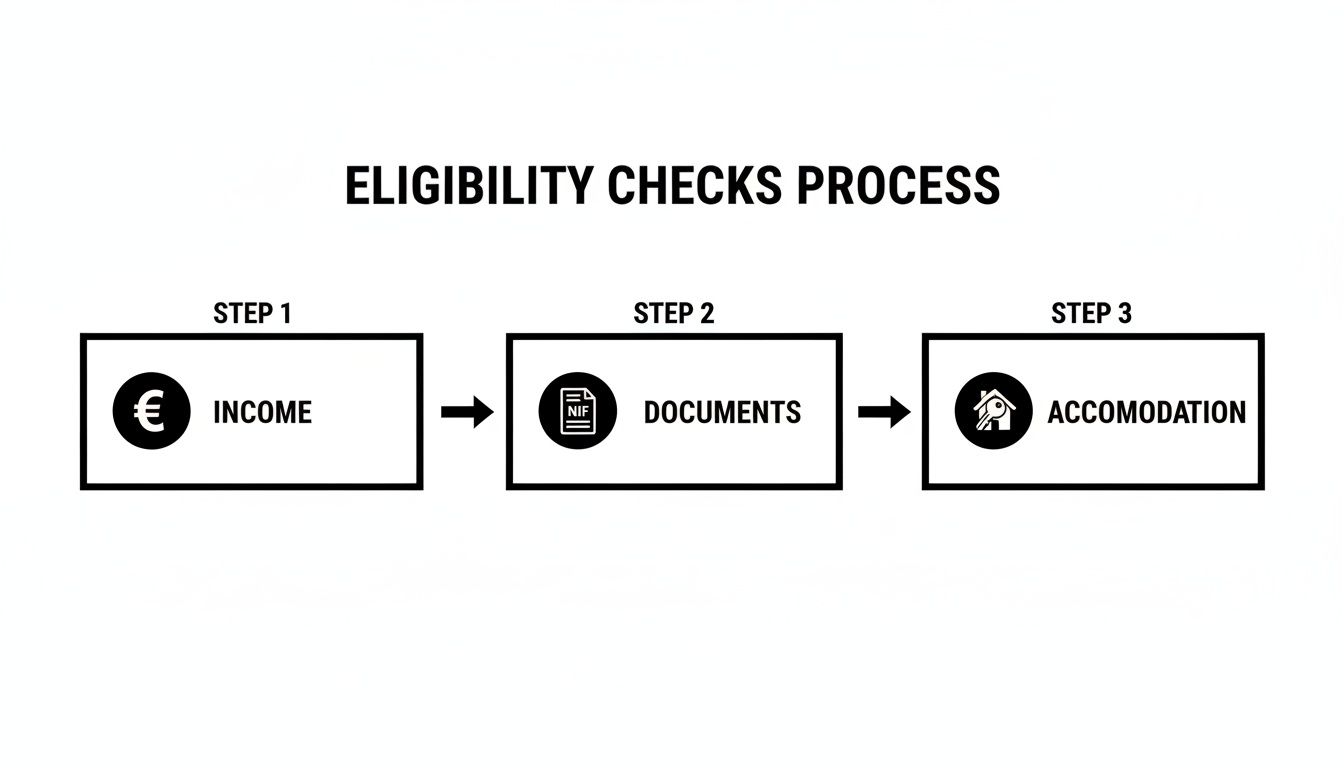
As shown, a successful application depends on three pillars: demonstrating stable income, providing all correct documentation (including your NIF), and securing long-term accommodation.
Actionable Insights to Avoid Common Pitfalls
Navigating the bureaucracy can be challenging, but certain insights can improve the outcome. Book your consular appointment well in advance, as slots are limited and processing times can take 8-12 weeks. A fundamental rule is to never book non-refundable travel or make irreversible financial commitments until the visa is physically in your passport.
Investor Risk: A frequent and costly error is underestimating document legalisation requirements. The UK criminal record check must be apostilled to be valid. Failure to do so will result in an automatic rejection, forcing you to restart the entire process.
Furthermore, ensure your proof of income is irrefutable. If you are a freelancer with fluctuating earnings, provide a summary sheet that averages your income over the last six to twelve months to clearly demonstrate you are consistently above the required threshold. The objective is to present a clear, low-risk profile to the consular officer.
While this visa is an excellent option for remote workers, investors seeking a more direct route to residency through capital deployment might also want to learn more about the Golden Visa for Europe as a potential alternative.
Understanding Tax Residency and Long-Term Status
Obtaining Portugal’s digital nomad visa is the first step towards becoming a Portuguese resident. For any UK investor considering this move, understanding the tax and residency implications is non-negotiable. Your financial planning must account for how Portugal will treat your worldwide income.
The primary rule is straightforward: if you spend 183 days or more in Portugal within any 12-month period, you are generally considered a tax resident. This is a critical threshold, as it means your worldwide income—not just earnings from your remote work—could become subject to the Portuguese tax system.
This transition requires careful management, particularly following recent changes to the country’s fiscal landscape. The popular Non-Habitual Resident (NHR) regime, which offered significant tax advantages to new residents, was closed to new applicants in 2024. This means UK nomads must now navigate standard Portuguese tax residency rules, using the UK-Portugal Double Taxation Agreement as a key instrument to manage their liabilities. You can discover more about Portugal's current tax rules for nomads on imin-portugal.com.
The Post-NHR Tax Reality
Without the NHR scheme, new residents are subject to Portugal's standard progressive income tax rates (IRS), which can reach 48% on earnings over approximately €78,834. This makes proactive tax planning essential. Once you become a tax resident, your UK-sourced salary or freelance income will be assessed under this system.
This does not mean you will be taxed twice. The UK-Portugal Double Taxation Agreement (DTA) is a crucial treaty designed to prevent this. The DTA clarifies which country has the primary right to tax different income types and allows you to claim a credit for taxes paid in one country against your liability in the other.
Key Takeaway: The DTA is your most important tool for tax efficiency. It ensures that income taxed in Portugal is not fully taxed again in the UK. Understanding its articles on employment income and business profits is essential for any remote worker.
For investors, the treaty also covers other income streams, such as rental income from a UK property. Structuring your finances in accordance with this treaty is a necessity, not merely advice. It is also beneficial to check out our guide on capital gains tax on foreign property for a broader context.
Your Path to Long-Term Residency and Citizenship
The digital nomad visa is a direct route to permanent status in the EU. This long-term perspective is vital for investors considering Portugal as a permanent base for their personal and professional activities.
The timeline is clear and predictable:
- Initial Permit: Upon arrival and completion of formalities in Portugal, you receive an initial residency permit, valid for two years.
- Renewal: This permit is renewable for a further three-year period.
- Permanent Residency or Citizenship: After five years of continuous legal residency, you are eligible to apply for either permanent residency or full Portuguese citizenship.
This five-year pathway offers a stable and predictable horizon for an investment strategy. Gaining permanent residency or a Portuguese passport grants you the indefinite right to live and work across the entire EU, cementing your position and providing ultimate long-term security.
How to Build a Property Strategy Around Portugal’s Nomad Boom

Portugal’s digital nomad visa is more than a residency route—it is an investment signal. The influx of financially stable, internationally mobile professionals is reshaping rental demand, creating distinct opportunities for property investors.
This trend presents two primary investment strategies, each with a unique risk profile, management intensity, and potential return. The optimal choice depends on an investor's individual objectives.
Short-Term Rentals Versus Long-Term Lets
The short-term rental market, known locally as Alojamento Local (AL), directly targets nomads staying for shorter periods. This strategy offers the potential for higher gross yields compared to a standard lease, with nightly and weekly rates proving lucrative in peak seasons.
However, this higher return is accompanied by greater operational demands. AL properties require constant management, including marketing on platforms like Airbnb, coordinating cleaning, and managing guest relations. Critically, the regulatory environment is tightening. To address housing shortages, municipalities in high-demand areas are restricting or halting new AL licences, introducing significant regulatory risk for new investors.
Conversely, a traditional long-term buy-to-let strategy offers stability. Digital nomads applying for the D8 residency permit require proof of accommodation, often a 12-month lease, creating a steady demand for high-quality, long-term housing.
While monthly rents are lower than a fully occupied AL property, the income stream is far more predictable. Void periods are less frequent, operational complexities are minimal, and the tenant has already undergone income verification by the government as part of their visa application.
For a risk-averse investor, a long-term let to a D8 visa holder is an almost perfect fit. It provides a reliable tenant with proven income, reduces management workload, and allows the investor to benefit from long-term capital appreciation in a rising market.
Identifying High-Growth Nomad Hotspots
While Lisbon and Porto remain the primary hubs for remote workers, their property markets reflect this popularity with higher prices and increased competition. Astute investors are now looking beyond the capitals to emerging hotspots that offer a lower cost of entry and greater potential for capital growth.
These secondary cities possess the lifestyle amenities and infrastructure that nomads seek, but with more attractive property prices and less market saturation.
- Braga: A dynamic university city in the north with a growing technology sector and excellent transport links. It offers a high quality of life at a fraction of Lisbon’s cost.
- Coimbra: Located centrally between Lisbon and Porto, this historic university city is experiencing a rise in co-working spaces and international residents, positioning it for strong future growth.
- The Algarve: Evolving beyond a seasonal holiday destination, towns like Lagos, Faro, and Loulé now host year-round nomad communities drawn by the lifestyle, climate, and improving remote work infrastructure.
The following table provides a snapshot comparison of property metrics in these key locations.
Investment Snapshot: Key Portuguese Cities for Nomads
| City | Avg. 2-Bed Apartment Price | Avg. Monthly Rent (Long-Term) | Typical Rental Yield |
|---|---|---|---|
| Lisbon (Central) | €400,000 – €600,000+ | €1,800 – €2,500+ | 3.5% – 5.0% |
| Porto | €280,000 – €450,000 | €1,200 – €1,800 | 4.5% – 6.0% |
| Braga | €180,000 – €280,000 | €800 – €1,200 | 5.0% – 6.5% |
| Coimbra | €150,000 – €250,000 | €750 – €1,100 | 5.5% – 7.0% |
| Faro (Algarve) | €250,000 – €400,000 | €1,000 – €1,600 | 4.0% – 5.5% |
These figures demonstrate that looking beyond primary markets can significantly enhance rental yield. While Lisbon offers prestige, emerging hubs like Braga and Coimbra deliver stronger returns on a lower initial capital outlay.
This demand is already yielding tangible results. For example, investors are achieving annual short-term rental yields of 5-7% in prime Lisbon districts, while a typical two-bedroom apartment in Porto can command €1,200-€1,800 per month on a long-term lease. For more detailed analysis, our guide on how to buy a house in Lisbon, Portugal offers a deeper dive into neighbourhood specifics.
Ultimately, a successful strategy aligns an investment thesis—high-yield and hands-on, or stable and lower-maintenance—with the right location. This approach enables investors to capitalise effectively on the opportunities created by Portugal's new wave of remote professionals.
Frequently Asked Questions from UK Investors
Portugal’s digital nomad visa process is relatively straightforward, yet for UK citizens navigating the post-Brexit environment, several key questions consistently arise. Clarifying these points from the outset can prevent common application pitfalls.
Can I Apply for the Visa While Already in Portugal?
This is a critical point of frequent confusion. The answer is unequivocally no.
You must submit your initial application for the long-stay residency visa from your official country of residence. For UK residents, this means applying through a designated Portuguese Consulate in the United Kingdom.
Attempting to convert from a tourist status while already in Portugal is almost certain to result in rejection. The process is structured for you to obtain a four-month national visa in the UK first. Only then can you travel to Portugal to complete the final residency permit steps with the immigration agency, AIMA.
Is Private Health Insurance Mandatory?
Yes, this is a non-negotiable requirement for the initial visa application. You must provide proof of a comprehensive private health insurance policy with a minimum of €30,000 in medical coverage, which must also include repatriation. This is to ensure you do not place a burden on Portugal's state healthcare system upon your initial arrival.
Once you become a legal resident and begin contributing to social security (Segurança Social), you will be entitled to use the public SNS healthcare system. Nevertheless, many British expatriates opt to maintain private cover for faster access to specialists and a wider range of treatment options.
A key trend we're observing is the sharp rise in British citizens choosing Portugal. UK government outbound migration statistics suggest a 25% increase in Brits relocating to Portugal between 2022 and 2025, a period that aligns with the D8 visa's introduction. Many are drawn by the significantly lower cost of living—around 40% cheaper than London—while earning their UK-level income. Read more about the drivers behind this trend at imin-portugal.com.
How Does This Visa Affect My UK Tax Status?
Spending more than 183 days a year in Portugal will almost certainly make you a tax resident there. Consequently, you will likely become non-resident for tax purposes in the UK.
The final determination is made based on the UK's Statutory Residence Test (SRT), a complex framework that assesses your ties to the UK, such as property, family, and the number of days you spend in the country.
Given the intricacy of the rules and the significant financial implications, seeking professional tax advice is essential. You should consult a specialist who understands the UK-Portugal Double Taxation Agreement to ensure your finances are structured correctly and you remain fully compliant in both jurisdictions.
Can My Family Join Me on This Visa?
Yes. The D8 visa includes provisions for family reunification, a significant advantage for those planning a long-term relocation. You can bring your spouse or long-term partner, dependent children, and in some cases, dependent parents.
You must, however, demonstrate a higher income to support them. The standard requirement is an additional 50% of the main applicant’s minimum income for a spouse, plus an extra 30% for each dependent child. This serves as proof that you can support your entire family without recourse to public funds.
At World Property Investor, we provide the data-driven analysis and on-the-ground insights you need to invest with confidence. From detailed city guides to breakdowns of rental yields and tax laws, our resources are designed to help you navigate the global property market. Explore our in-depth guides at https://www.worldpropertyinvestor.com.